
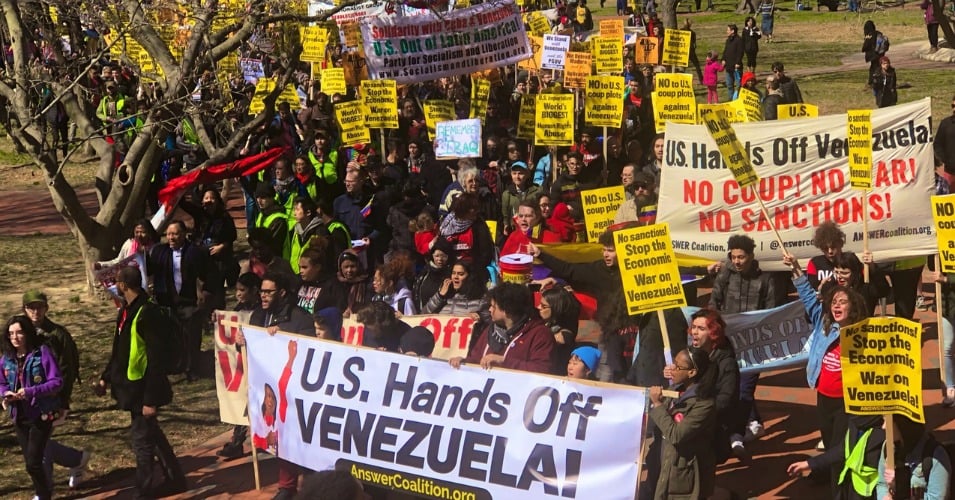
The world must end Washington’s illegal economic war

By Kevin Zeese and Margaret Flowers

February 10, 2020

The US is currently attacking one-third of the planet’s population with 8,000 economic sanctions, ongoing acts of war against 39 nations.

“Their intent is to shrink the economy and cause chronic shortages and hyperinflation while ensuring a lack of access to finance to pay for essentials.”

Originally posted in the Black Agenda Report, January 15, 2020

The United States is relying more heavily on illegal unilateral coercive measures (also known as economic sanctions) in place of war or as part of its build-up to war. In fact, economic sanctions are an act of war that kills tens of thousands of people each year through financial strangulation. An economic blockade places a country under siege.

A recent example is the increase in economic measures being imposed against Iran, which many viewed as more acceptable than a military attack. In response to Iran retaliating for the assassination of General Qassem Soleimani and seven other people, Iran used ballistic missiles to strike two bases in Iraq that house US troops. President Trump responded by saying he would impose more sanctions on Iran. Then he ended his comments by urging peace negotiations with Iran.

The United States needs to understand there will be no negotiations with Iran until the US lifts sanctions that seek to destroy the Iranian economy and turn the people against their government.

The sanctions on Iran have been in place since the 1979 Iranian Revolution, which made that country independent of the United States. Iran is not the only country being sanctioned by the United States. Samuel Moncada, the Venezuelan ambassador to the United Nations, speaking to the summit of the Non-Aligned Movement of 120 nations on October 26, 2019, denounced the imposition of sanctions by the US, as “economic terrorism which affects a third of humanity with more than 8,000 measures in 39 countries.”

It is time to end US economic warfare and repeal these unilateral coercive measures, which violate international law.

Sanctions are a weapon of war

The United States uses sanctions against countries that resist the US’ agenda. US sanctions are designed to kill by destroying an economy through denial of access to finance, causing hyperinflation and shortages and blocking basic necessities such as food and medicine. For example, sanctions are expected to cause the death of tens of thousands of Iranians by creating a severe shortage of critical medicines and medical equipment everywhere in Iran.

Muhammad Sahimi writes that in a “letter published by The Lancet, the prestigious medical journal, three doctors working in Tehran’s MAHAK Pediatric Cancer Treatment and Research Center warned that, ‘Re-establishment of sanctions, scarcity of drugs due to the reluctance of pharmaceutical companies to deal with Iran, and a tremendous increase in oncology drug prices [due to the plummeting value of the Iranian rial by 50–70%], will inevitably lead to a decrease in survival of children with cancer.’”

Diabetes, multiple sclerosis, HIV/AIDS, Parkinson’s, Alzheimer’s, and asthma affect over ten million Iranians who will find essential medicines impossible to get or available only at high prices. The US claims that food and medicines are excluded from sanctions but in practice, they are not because pharmaceutical companies fear sanctions being applied to them over some technical violation and Iran cannot pay for essentials when banks can’t do business with it. European nations failed to persuade the Trump administration to ensure that essential medicine and food were available to Iranians.

“Iran cannot pay for essentials when banks can’t do business with it.”

In Venezuela, due to the sanctions, 180,000 medical operations have been cancelled and 823,000 chronically ill patients are awaiting medicines. The Center for Economic and Policy Research found sanctions have deprived Venezuela of “billions of dollars of foreign exchange needed to pay for essential and life-saving imports,” contributing to 40,000 total deaths in 2017 and 2018. More than 300,000 Venezuelans are at risk due to a lack of access to medicine or treatment.

Economists warn US sanctions could cause famine in Venezuela. Sanctions also cause shortages of parts and equipment needed for electricity generation, water systems, and transportation as well as preventing participation in the global financial market. Sanctions, which are illegal under the UN, OAS and US law, have caused mass protests in Venezuela against the US. 

Sanctions against Iran and Venezuela could be a prelude to military attack, i.e. the US weakening a nation economically before attacking it. This is what happened in Iraq. Under pressure from the United States, on Aug. 2, 1990, the UN Security Council passed sanctions that required countries to stop trading or carrying out financial transactions with Iraq. President George H.W. Bush said the UN sanctions would not be lifted “as long as Saddam Hussein is in power.” The US continued to pressure the increasingly skeptical Security Council members into compliance even though hundreds of thousands of children were dying. In 1996, then-U.S. Ambassador to the UN Madeleine Albright was asked about the death of as many as 500,000 children due to lack of medicine and malnutrition exacerbated by the sanctions, and she brutally replied, “[The] price is worth it.” Sanctions were also used against Libya and Syria before the US attacked them.

“More than 300,000 Venezuelans are at risk due to a lack of access to medicine or treatment.”

This is consistent with the US ‘way of war’ described by Roxanne Dunbar-Ortiz in “An Indigenous Peoples’ History of the United States,” which describes frontier counterinsurgency premised on annihilation including the destruction of food, housing, and resources as well as ruthless militarism. The US has waged a long-term economic war against Cuba (sanctions in place since 1960), North Korea (first sanctions in the 1950s, tightened in the 1980s), Zimbabwe (2003) and Iran (1979) 

Sanctions hurt civilians, especially the most vulnerable – babies, children, the elderly and chronically ill – not governments. Their intent is to shrink the economy and cause chronic shortages and hyperinflation while ensuring a lack of access to finance to pay for essentials. The US then blames the targeted government claiming that corruption or socialism is the problem in an effort to turn the people against their government. This often backfires as people instead rally around the government, quiet their calls for democracy and work to develop a resistance economy.

The Movement to end sanctions

In recent years, a movement has been building to end the use of illegal economic coercive measures. The movement includes governments coming together in forums like the Non-Aligned Movement, made up of countries that represent 55 per cent of the global population, as well as UN member-states calling for international law and the UN Charter to be upheld and social movements organizing to educate about the impact of sanctions and demand an end to their use. This June, the Non-Aligned Movement called for the end of sanctions against Venezuela.

Popular Resistance is working with groups around the world on the Global Appeal for Peace, an initiative to create a worldwide network of people and organizations that will work together to oppose the lawless actions of the United States, and any country that acts similarly. A high priority is opposing the imposition of unilateral coercive economic measures that violate the charter of the United Nations.

The UN and its International Court of Justice have been ineffective in holding the US accountable for its actions. No one country or one movement has the power alone to hold the United States accountable, but together we can make a difference. Join this campaign here.

“The UN and its International Court of Justice have been ineffective in holding the US accountable for its actions.”

With 39 countries targeted with sanctions, and other countries impacted because they cannot trade with those countries, nations are challenging the US’ dollar domination. Countries are seeking to conduct trade without the dollar and are no longer treating the US dollar as the world’s reserve currency while also avoiding Wall Street. The de-dollarization of the global economy is a boomerang effect that is hastening due to the abuse of sanctions and will seriously weaken the US economy.

Foreign Minister Zarif, who describes sanctions as “economic terrorism,” warned that “the excessive use of economic power by the United States, and the excessive use of the dollar as a weapon in US economic terrorism against other countries, will backfire.”  As the blowback continues to grow, the negative impact on the US economy may force the US to stop using sanctions. The end of dollar domination will add to the demise of the failing US empire.

Time to end the use of illegal economic sanctions

The combination of countries acting against US sanctions, and people’s movements pressuring the US government has the potential to end the abuse of sanctions. The EU has moved to blunt the impact of the sanctions against Iran by creating an alternative to the US-controlled SWIFT system for trade. This is spurring the end of the dollar as the reserve currency. Some officials in the EU have called for retaliatory sanctions against the US.

Trump left a small opening for potential diplomacy with Iran that could lead to the end of sanctions against that country. Trump bragged about the US being the number one oil and gas producer, taking credit for an Obama climate crime, and therefore no longer needing to spend hundreds of millions a year to have troops in the Middle East. He concluded with a message to the “people and leaders of Iran” that the US was “ready to have peace with all those who seek it.” He said the US wanted Iran to have a “great and prosperous future with other countries of the world.”

That future is only possible if the US moves to end the sanctions against Iran. Iranians have learned the US cannot be trusted. Iran lived up to the requirements of the Iran nuclear deal, the Joint Comprehensive Plan of Action, but Trump did not when he withdrew from it and re-instated draconian sanctions lifted by Obama. Trump added even move sanctions. This also angered European allies who had negotiated the agreement and were put in the position of being subservient to the US or going against it. To regain Iran’s trust, the US needs to make a good-faith gesture of ending punitive economic measures.

“Iranians have learned the US cannot be trusted.”

North Korea, which has been sanctioned by the US longer than any other country, had a similar experience after they reached an agreement with the United States in 1994 under the Clinton administration.  The George W. Bush administration wanted to put in place a national missile defence system but the agreement with North Korea blocked that. John Bolton and Dick Cheney falsely accused North Korea of violating the agreement, increased sanctions against it and claimed it was part of the Axis of Evil, along with Iran, and Iraq.

North Korea, like Iran, learned they cannot trust the United States. Sanctions are causing thousands of deaths in North Korea. Now, China and Russia are allied with North Korea and are urging relief from the US sanctions. Russia and China have also ignored US sanctions against Venezuela and continue to do business with it.

On December 17, the Senate passed a Sanctions Bill that put in place sanctions against corporations working with Russia to develop gas pipelines to Europe. The action is naked US imperialism seeking to prevent Russia from being the main natural gas exporter to the EU market and to replace it with more expensive US-produced gas, a move to save the financially-underwater US fracking industry. Russia, Germany, and others have defiantly told Washington its weaponizing of economic sanctions will not halt the gas pipeline construction. 

The indiscriminate, illegal and immoral use of sanctions is an act of war. Unless they are authorized by the United Nations, unilateral coercive measures are illegal. A critical objective of the peace and justice movement in the United States, working with allies around the world, must be to end this terrorist economic warfare. The US economy currently depends on financial hegemony and war. The slow, steady collapse of the dollarized economy means the 2020s will be the decade US domination comes to an end. The US must learn to be a cooperative member of the global community or risk this isolation and retaliation.

If you appreciated this article…

Kevin Zeese is an American political activist who has been a leader in the drug policy reform and peace movements and in efforts to ensure a voter- verified paper audit trail. Margaret Flowers, M.D., is a Maryland paediatrician seeking the Green Party nomination for the US Senate. She is co-director of PopularResistance.org and a board adviser to Physicians for a National Health Program and is on the Leadership Council of the Maryland Health Care Is a Human Right campaign.

Recommended reading

Report: US sanctions have cost 40 000 Venezuelan lives

US sanctions against Russia: What you need to know

US sanctions on Russia

From sanctions to war: An analysis of America’s relationship with Iran

One Response

  1. The only way to fight against these oppressive, illegal sanctions which are acts of war and result in the deaths of millions of innocent people is to break the monopoly of US dollar as a global currency. It’s essential to create a truly independent global currency that serves all states and deals with them in a fair and equitable way.

Related Posts

The agreement is catastrophic both because of what it says and what it doesn’t mention. It reduces further the major asset of security policies: Freedom of action. Jan Oberg TFF director September 25, 2026 A couple of hours before the agreement was signed on September 22, 2026, I published the following 13 hypotheses about what it would most likely contain on TFF Substack (in English). I was wrong on only the first point. Contrary to what Trump had written on his Truth Social platform, it does not appear to come into force immediately. In fact, it turned out to be worse than even I had anticipated. After these hypotheses now come a number of reflections in light of what the agreement actually contains, and does not contain, as well as the way in which it has generally been presented by major media outlets and by the public-service broadcaster DR. My...
Jan Oberg May 15, 2026 Go to this Fox News page and scroll the whole way down: President Donald Trump tells the world that his meeting with President Xi Jinping yielded a lot of very concrete political and economic results – of course, only where the Chinese side, according to him, agreed with him. He does not mention the Taiwan issue, but Secretary of State, Marco Rubio, says that it did not feature prominently in their talks and that the US policy on Taiwan has not changed. Then go to China Daily – or Global Times – and you will see that for the Chinese it is framework, principles, structure of cooperation etc. that matters – all embedded in the overall idea of “constructive bilateral relationship of strategic stability.” Nowhere is any concrete agreement or deal – all that Trump refers to – mentioned. At the general level, this gives you insights into the very different social...
Jan Oberg, TFF director April 9, 2026 I was recently invited to have a good, long talk about the world – and, of course, about peace too – with Boris Malagurski on his Weight of Chains Channel on YouTube. It was a real joy and seems to have been greatly appreciated by the viewers too. Mr Malagurski and I shall of course be grateful if you share this conversation in your circles – of course, only if you like what you see and hear 😉☮️ And remember that this one – like hundreds of others with TFF Associates – can be enjoyed at our TFF Video Collection.

Recent Articles

Below are TFF-related media mentions, comments, videos and social media posts published elsewhere but not on this homepage. We happen to catch and list only a fraction. Regarding video comments and debates, we recommend that you go to the TFF Video Channel on Substack where many of them are reproduced. Jan Oberg is a contributor to China Daily – 52 million daily clicks – and Global Times, CGTN and CCTV (the national television), China Investment, Xinhua News Agency and several others. Articles and videos on these media very often multiply into countless Chinese (and Western media) that re-post them from these main media. Thanks to The China Academy, his analyses, interviews and comments are frequently posted on YouTube channels such as Thinkers Forum and Wave Media. These videos are often re-posted on Bilibili (China’s YouTube), the China Content Center on TikTok, and on the Chinese edition of TikTok, Douyin.com. This means reaching hundreds of millions of viewers worldwide over a year. While there are too many to catch on all these...
Jan Oberg TFF director October 13, 2026 According to Alfred Nobel’s will, the Nobel Peace Prize shall be awarded: ”to the person who has done the most or best to advance fellowship among nations, the abolition or reduction of standing armies, and the establishment and promotion of peace congresses.” Further down, he also expresses how the prize for the “champions of peace” shall be decided: “that for champions of peace by a committee of five persons to be selected by the Norwegian Storting. Alfred Nobel’s will is remarkably short and clear. But few seem to have read it. Nobel did not say that the committee itself should consist of members of parliament. He entrusted the Storting with appointing five persons. In principle, it could have selected diplomats, mediators, peace researchers, conflict-resolution specialists, or other individuals with recognised expertise in matters of peace from around the world. Instead, the Storting gradually...
The Quest for Humane Survival Richard Falk Professor emeritus, Princeton UniversityTFF Associate since 1986October 12, 2026 After decades of teaching and writing about international law in academic frameworks that were not institutionally situated within law school environments—at Princeton and the University of California, Santa Barbara—I found myself most receptive to the TWAIL outlook. It has been especially illuminating in clarifying the extent to which international law evolved as a dialogical critique of Europe’s efforts to legitimize its colonial undertakings. In particular, TWAIL has exposed how international law has functioned to legalize the subjugation of Third World peoples, securing conditions for exploitative investment and trade relations, the coercive enforcement of public debts, and an ideology of cultural superiority. TWAIL’s exposure of these economic legacies of colonialism has influenced my understanding of the history and development of international law, broadly conceived, as an ideological project of the Western sub-system of the world...

TFF on Substack

Discover and subscribe to more peace materials on TFF Substack

Most Popular

Below are TFF-related media mentions, comments, videos and social media posts published elsewhere but not on this homepage. We happen to catch and list only a fraction. Regarding video comments and debates, we recommend that you go to the TFF Video Channel on Substack where many of them are reproduced. Jan Oberg is a contributor to China Daily – 52 million daily clicks – and Global Times, CGTN and CCTV (the national television), China Investment, Xinhua News Agency and several others. Articles and videos on these media very often multiply into countless Chinese (and Western media) that re-post them from these main media. Thanks to The China Academy, his analyses, interviews and comments are frequently posted on YouTube channels such as Thinkers Forum and Wave Media. These videos are often re-posted on Bilibili (China’s YouTube), the China Content Center on TikTok, and on the Chinese edition of TikTok, Douyin.com. This means reaching hundreds of millions of viewers worldwide over a year. While there are too many to catch on all these...
Jan Oberg TFF director October 13, 2026 According to Alfred Nobel’s will, the Nobel Peace Prize shall be awarded: ”to the person who has done the most or best to advance fellowship among nations, the abolition or reduction of standing armies, and the establishment and promotion of peace congresses.” Further down, he also expresses how the prize for the “champions of peace” shall be decided: “that for champions of peace by a committee of five persons to be selected by the Norwegian Storting. Alfred Nobel’s will is remarkably short and clear. But few seem to have read it. Nobel did not say that the committee itself should consist of members of parliament. He entrusted the Storting with appointing five persons. In principle, it could have selected diplomats, mediators, peace researchers, conflict-resolution specialists, or other individuals with recognised expertise in matters of peace from around the world. Instead, the Storting gradually...
The Quest for Humane Survival Richard Falk Professor emeritus, Princeton UniversityTFF Associate since 1986October 12, 2026 After decades of teaching and writing about international law in academic frameworks that were not institutionally situated within law school environments—at Princeton and the University of California, Santa Barbara—I found myself most receptive to the TWAIL outlook. It has been especially illuminating in clarifying the extent to which international law evolved as a dialogical critique of Europe’s efforts to legitimize its colonial undertakings. In particular, TWAIL has exposed how international law has functioned to legalize the subjugation of Third World peoples, securing conditions for exploitative investment and trade relations, the coercive enforcement of public debts, and an ideology of cultural superiority. TWAIL’s exposure of these economic legacies of colonialism has influenced my understanding of the history and development of international law, broadly conceived, as an ideological project of the Western sub-system of the world...
Read More
girl-5894831_1280
Below are TFF-related media mentions, comments, videos and social media posts published elsewhere but not on this homepage. We happen to catch and list only a fraction. Regarding video comments and debates, we recommend that you go to the TFF Video Channel on Substack where many of them are reproduced. Jan Oberg is a contributor to China Daily – 52 million daily clicks – and Global Times, CGTN and CCTV (the national television), China Investment, Xinhua News Agency and several others. Articles and videos on these media very often multiply into countless Chinese (and Western media) that re-post them from these main media. Thanks to The China Academy, his analyses, interviews and comments are frequently posted on YouTube channels such as Thinkers Forum and Wave Media. These videos are often re-posted on Bilibili (China’s YouTube), the China Content Center on TikTok, and on the Chinese edition of TikTok, Douyin.com. This means reaching hundreds of millions of viewers worldwide over a year. While there are too many to catch on all these...
Nobel-Prize-Plaque
Jan Oberg TFF director October 13, 2026 According to Alfred Nobel’s will, the Nobel Peace Prize shall be awarded: ”to the person who has done the most or best to advance fellowship among nations, the abolition or reduction of standing armies, and the establishment and promotion of peace congresses.” Further down, he also expresses how the prize for the “champions of peace” shall be decided: “that for champions of peace by a committee of five persons to be selected by the Norwegian Storting. Alfred Nobel’s will is remarkably short and clear. But few seem to have read it. Nobel did not say that the committee itself should consist of members of parliament. He entrusted the Storting with appointing five persons. In principle, it could have selected diplomats, mediators, peace researchers, conflict-resolution specialists, or other individuals with recognised expertise in matters of peace from around the world. Instead, the Storting gradually...
law-419057_1280
The Quest for Humane Survival Richard Falk Professor emeritus, Princeton UniversityTFF Associate since 1986October 12, 2026 After decades of teaching and writing about international law in academic frameworks that were not institutionally situated within law school environments—at Princeton and the University of California, Santa Barbara—I found myself most receptive to the TWAIL outlook. It has been especially illuminating in clarifying the extent to which international law evolved as a dialogical critique of Europe’s efforts to legitimize its colonial undertakings. In particular, TWAIL has exposed how international law has functioned to legalize the subjugation of Third World peoples, securing conditions for exploitative investment and trade relations, the coercive enforcement of public debts, and an ideology of cultural superiority. TWAIL’s exposure of these economic legacies of colonialism has influenced my understanding of the history and development of international law, broadly conceived, as an ideological project of the Western sub-system of the world...
images-2
Advocates of nuclear disarmament are regularly dismissed by the champions of nuclear deterrence as naïve and unrealistic, utopian or even irresponsible. Yet this ‘doctrine’ of deterrence, regarded by France as the ‘cornerstone’ of its national security, is based on quasi-religious beliefs, a theory that cannot be proven, risky gambles and fragile assumptions. So much so that one might legitimately ask which side the ‘Care Bears’ are on. Marc FinaudVice-President of Initiatives for Nuclear Disarmament (IDN) October 9, 2026 This article was originally published on Pressenza When it comes to these things being treated as religious concepts, look here. Idealists and realists It was Hubert Védrine, François Mitterrand’s former Foreign Minister, who repeatedly coined the phrase: ‘Europeans are a sort of Care Bears who don’t realise they’re living in Jurassic Park’. He applies this reference to the cartoon for well-behaved children not only to what he regards as weakness or idealism...
8824b09f-33a5-43f9-9fd0-550f28cda24d_1536x1024
What the West Borrowed from Asia and What It Left Behind Jan Krikke October 8, 2026 The article was originally published here In the late 1960s, the musical Hair announced that the Age of Aquarius was dawning. Its opening anthem promised a transformation of human consciousness: an era of peace, harmony and understanding. Half a century later, a familiar echo of that promise is a meditation app offered by your employer. You can find it in the same list of benefits as the pension plan and the gym discount. How did a spiritual revolution become an employee benefit? The answer lies in the history of the movement known as New Age: where it came from, what it borrowed from Asia, and why the meaning of what it borrowed changed in the process. Two definitions will help. New Age is a loose label for a wide range of spiritual practices and...
Screenshot 2026-10-04 210142
Small and different + among the 10% most active + 9,000 texts + 150 Associates + 60 000 a day — and a stubborn belief that peace is smarter and must be secured by peaceful means. In 2026, the Transnational Foundation for Peace and Future Research (TFF) turns 40. On Monday, October 5, 2026, a new TFF homepage will go live — a new gateway to more than 9,000 articles, analyses, research papers and other contributions produced over four decades of independent peace research. But this is not simply a new website. For four decades, TFF has worked from a simple conviction: peace is smarter than militarism and can be brought about by peaceful means. This is not merely an aspiration. It is the principle expressed in the UN Charter and the Gandhian tradition that has guided our work from the beginning. TFF is a research-based, independent and people-financed foundation....




