

The US general in Europe is dishonest and beyond the rational

And a few words about Western mainstream media unwillingness to deal with NATO criticism
By Jan Oberg

It’s as amazing as it is frightening how the West – a group of countries allegedly fighting for truth against propaganda and fake news by others – leads exactly that game itself.

And so is the degree to which Western allegedly free media – meaning free also of political powers that be – continue to ask no questions and do no research. We are obviously living in the post-intellectual age, knowledge having been replaced by marketed and more or less invented, elite self-serving narratives. For instance…

Take a close look at what Gen. Curtis M. Scaparrotti, commander of U.S. European Command, says when testifying before the US House Armed Service Committee. He is also SACEUR – Supreme Allied Commander Europe, the man whose views and actions will decide the fate of 500+ Europeans should there be a major war in this region of the world.

What is says is plain irresponsible. It’s beyond the rational. While it may not be fake news, it’s an example of ignored, omitted news.


He blows up beyond recognition the so-called Russian threat. There is no single evidence of it in his statement – why it would happen, how, where, with what motives the Moscow would have and – in particular – how likely it is to become reality. He merely asserts it – based upon a wildly exaggerated estimate of his own authority: It’s enough to just state it, state how much more arms I would like to have – or, it would be wonderful to have – and, simultaneously, ignore the need for explaining or offering even the slightest evidence.

Well, not quite true – there is the wonderful Russian annexation of Crimea. NATO’s armament is the – presumed innocent – response to what “the always bad guys over there” do to us. We are just responding, we are the ones for peace and we never provoke the other side. “They” must be out of their right minds if they feel threatened by our peaceful moves.

Military superiority coupled with intellectual disarmament for decades may one day turn out to be an extremely dangerous mix. Self-poisoning too.

But back to the beloved Crimea Annexation.

It was a violation of international law. But where is the context?

It is tiny event in world history compared with what the countries in his alliance, his own US in particular, have done for years around the world since, say, the bombings of Yugoslavia.

It is used ad absurdum as a mantra and pretext for re-arming, expanding and well, appropriating even more money out of deliberately scared taxpayers pockets.

And the annexation was endorsed by a later referendum result – not an instrument used by NATO countries where they have intervened.

General Scaparotti states these things in spite of the fact – that he must know but deliberately ignores – that NATO is an alliance with 28 members, 10 of which are former Warsaw Pact members, that spends 12 times more on the military than Russia and has military base facilities and special troops in over 130 countries (and around Russia). It represents a vastly larger economic and technological power (and more sophisticated advance technologies) than Russia and operates on a set a values that are much more shared around the world than was that of the Soviet Union and Russia today.

The use of Russia’s essentially responsive annexation of Crimea as cause of NATO’s rampant armament should be considered a fake argument if not put in context of the world system, the regional European setting, in a historical perspective – including NATO’s expansion after 1989 that Western leaders at the time promised Gorbachev would not happen with as much as an inch but Bill Clinton just broke from 1994.

Like it takes two to tango, it takes at least two to conflict, General!

Sandbox thinking isn’t what we need in the age of nuclear weapons where people like you have fingers on the buttom!

NATO’s ongoing, provocative armament that is not in the interest of us Europeans happens mainly due to two – real – factors:

1) The MIMAC – the Military-Industrial-Media-Academic Complex – a monolithic but small system of vested interests outside democratic control and in support of more and more arms production, sales and thus war – irrespective of what the world really looks like. Even when the Soviet Union and the Warsaw Pact fell apart, MIMAC quickly found new actors – such as Milosevic, Manuel Noriega or Mohamed Fahrah Aideed – to legitimize their ongoing militarism with based on installing fear in the citizenry, i.e. getting taxpayers to cough up more and more and accept wars, particularly in the Middle East, as necessary for our own security and world peace.

Additionally, this MIMAC also runs the global war on terror which must be the most stupid war in modern, if not all of, history in that 80 times more people are killed today in terror attacks than was the case in 2001.

But it is a wonderful perpetuum mobile for MIMAC: this global counterproductive war that never asks why people become terrorists produces more of what it is supposed to fight and thus per automaticity promotes even more militarism and war.

The price? In the process the very freedom, privacy and democracy we used to be proud of thrown out the window.

That is exactly what the SACEUR general contributes to – but thanks to the group think he is part of, he probably is quite unaware.

And the – good old type – media freedom is diminishing. Neither his type of statement nor the media that refuse to discuss it deserves attention or trust.

2) Because of the urgent need to cover up for one of the largest foreign policy blunders US foreign policy (and the EU’s too but in a different manner) has made in recent years: the attempt to get Ukraine into the Western camp, eventually a member of NATO.

And to achieve that purpose, it meddled systematically in domestic affairs and contributed to the violent regime change in Kiev that also led to the ouster of a corrupt but legally elected leader of the country and – surprise, surprise – replace him with a new President who is “one of ours” (although now giving us a lot of problems because he is rather much of an amateur politician).

Regime change for the umptieth time – and it wasn’t the last.

Last year I wrote a 10-article series on the new Cold War – different from the First of course, but it’s still a New Cold War. It’s an explainer to what I say above here.

The Russian Sputnik Radio network kindly asked me to comment* on these things, point of departure being the General’s statement. It gave me an opportunity to say a bit about the wider context where media tend to focus on one spot or event, narrow in time and space.

Based upon the interview the editors wrote up an article and embedded my words on Soundcloud “Western Europeans must recognize that they live under occupation”.

And Sputnik International posted it on its frontpage (see above). It’s always encouraging to be appreciate for what one does, isn’t it.

In it I argue that:

• It’s high time Europe comes together and says “No” to remain occupied mentally and politically by the United States. And bullied too about paying this or that ever more for what is essentially America’s defence.

• NATO should be heavily reformed or close down – which it ought to have been already when the Warsaw Pact, its only raison d’etre, collapsed 28 years ago. NATO as it is today is little but a grumpy old organisation – of the past and in search of a mission, thus rather: North Atlantic Treaty Obsolescence!

• Europe needs to develop an entirely different way of thinking and new policies for stability, peace and co-operation backed up by alternative defence civil and military means of defence and security. That is, peace first.

• If we lack trust, we should dialogue about it. More weapons will never reduce mistrust. They will, no matter the intentions, always do the opposite. More confrontation, more superiority, more lack of trust are problems that cannot be solved by more of the weapons that have caused them.

*)
I comment according to a clearly defined media relation policy. I work with any media that is interested in peace and alternative thinking and not only geo-political, politically correct mainstream views. I say the same no matter the audience – and, in contrast to Western media, I’ve never been the object of censorship in Sputnik, Russia Today or Iran’s PressTV.

It’s a pity, if not shameful, that the leading free media of the free world are not – grosso modo – the slightest interested in qualified criticism and open debate about its own policies too. Even about such an important issue as war or peace in Europe.
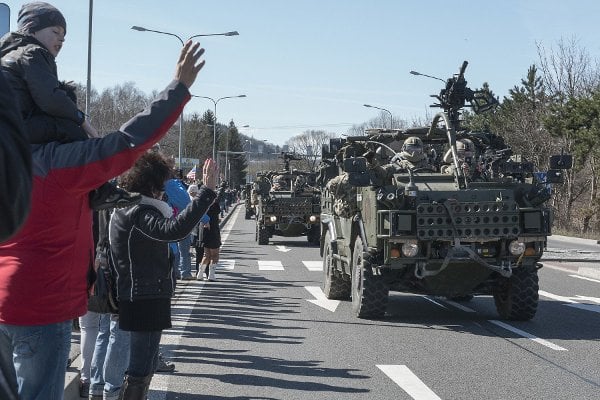
Citizens greet Battle Group Poland as a tactical vehicle convoy crosses into Poland March 26, 2017. U.S. Army 2nd Squadron, 2nd Cavalry Regiment, and other nations are deployed as part of NATO’s Enhanced Forward Presence. Sgt. 1st Class Patricia Deal/Army


Peace & future researcher + ‌Art Photographer

Related Posts

Below are TFF-related media mentions, comments, videos and social media posts published elsewhere but not on this homepage. We happen to catch and list only a fraction. Regarding video comments and debates, we recommend that you go to the TFF Video Channel on Substack where many of them are reproduced. Jan Oberg is a contributor to China Daily – 52 million daily clicks – and Global Times, CGTN and CCTV (the national television), China Investment, Xinhua News Agency and several others. Articles and videos on these media very often multiply into countless Chinese (and Western media) that re-post them from these main media. Thanks to The China Academy, his analyses, interviews and comments are frequently posted on YouTube channels such as Thinkers Forum and Wave Media. These videos are often re-posted on Bilibili (China’s YouTube), the China Content Center on TikTok, and on the Chinese edition of TikTok, Douyin.com. This means reaching hundreds of millions of viewers worldwide over a year. While there are too many to catch on all these...
Jan Oberg TFF director October 13, 2026 According to Alfred Nobel’s will, the Nobel Peace Prize shall be awarded: ”to the person who has done the most or best to advance fellowship among nations, the abolition or reduction of standing armies, and the establishment and promotion of peace congresses.” Further down, he also expresses how the prize for the “champions of peace” shall be decided: “that for champions of peace by a committee of five persons to be selected by the Norwegian Storting. Alfred Nobel’s will is remarkably short and clear. But few seem to have read it. Nobel did not say that the committee itself should consist of members of parliament. He entrusted the Storting with appointing five persons. In principle, it could have selected diplomats, mediators, peace researchers, conflict-resolution specialists, or other individuals with recognised expertise in matters of peace from around the world. Instead, the Storting gradually...
The Quest for Humane Survival Richard Falk Professor emeritus, Princeton UniversityTFF Associate since 1986October 12, 2026 After decades of teaching and writing about international law in academic frameworks that were not institutionally situated within law school environments—at Princeton and the University of California, Santa Barbara—I found myself most receptive to the TWAIL outlook. It has been especially illuminating in clarifying the extent to which international law evolved as a dialogical critique of Europe’s efforts to legitimize its colonial undertakings. In particular, TWAIL has exposed how international law has functioned to legalize the subjugation of Third World peoples, securing conditions for exploitative investment and trade relations, the coercive enforcement of public debts, and an ideology of cultural superiority. TWAIL’s exposure of these economic legacies of colonialism has influenced my understanding of the history and development of international law, broadly conceived, as an ideological project of the Western sub-system of the world...

Recent Articles

Below are TFF-related media mentions, comments, videos and social media posts published elsewhere but not on this homepage. We happen to catch and list only a fraction. Regarding video comments and debates, we recommend that you go to the TFF Video Channel on Substack where many of them are reproduced. Jan Oberg is a contributor to China Daily – 52 million daily clicks – and Global Times, CGTN and CCTV (the national television), China Investment, Xinhua News Agency and several others. Articles and videos on these media very often multiply into countless Chinese (and Western media) that re-post them from these main media. Thanks to The China Academy, his analyses, interviews and comments are frequently posted on YouTube channels such as Thinkers Forum and Wave Media. These videos are often re-posted on Bilibili (China’s YouTube), the China Content Center on TikTok, and on the Chinese edition of TikTok, Douyin.com. This means reaching hundreds of millions of viewers worldwide over a year. While there are too many to catch on all these...
Jan Oberg TFF director October 13, 2026 According to Alfred Nobel’s will, the Nobel Peace Prize shall be awarded: ”to the person who has done the most or best to advance fellowship among nations, the abolition or reduction of standing armies, and the establishment and promotion of peace congresses.” Further down, he also expresses how the prize for the “champions of peace” shall be decided: “that for champions of peace by a committee of five persons to be selected by the Norwegian Storting. Alfred Nobel’s will is remarkably short and clear. But few seem to have read it. Nobel did not say that the committee itself should consist of members of parliament. He entrusted the Storting with appointing five persons. In principle, it could have selected diplomats, mediators, peace researchers, conflict-resolution specialists, or other individuals with recognised expertise in matters of peace from around the world. Instead, the Storting gradually...
The Quest for Humane Survival Richard Falk Professor emeritus, Princeton UniversityTFF Associate since 1986October 12, 2026 After decades of teaching and writing about international law in academic frameworks that were not institutionally situated within law school environments—at Princeton and the University of California, Santa Barbara—I found myself most receptive to the TWAIL outlook. It has been especially illuminating in clarifying the extent to which international law evolved as a dialogical critique of Europe’s efforts to legitimize its colonial undertakings. In particular, TWAIL has exposed how international law has functioned to legalize the subjugation of Third World peoples, securing conditions for exploitative investment and trade relations, the coercive enforcement of public debts, and an ideology of cultural superiority. TWAIL’s exposure of these economic legacies of colonialism has influenced my understanding of the history and development of international law, broadly conceived, as an ideological project of the Western sub-system of the world...

TFF on Substack

Discover and subscribe to more peace materials on TFF Substack

Most Popular

Below are TFF-related media mentions, comments, videos and social media posts published elsewhere but not on this homepage. We happen to catch and list only a fraction. Regarding video comments and debates, we recommend that you go to the TFF Video Channel on Substack where many of them are reproduced. Jan Oberg is a contributor to China Daily – 52 million daily clicks – and Global Times, CGTN and CCTV (the national television), China Investment, Xinhua News Agency and several others. Articles and videos on these media very often multiply into countless Chinese (and Western media) that re-post them from these main media. Thanks to The China Academy, his analyses, interviews and comments are frequently posted on YouTube channels such as Thinkers Forum and Wave Media. These videos are often re-posted on Bilibili (China’s YouTube), the China Content Center on TikTok, and on the Chinese edition of TikTok, Douyin.com. This means reaching hundreds of millions of viewers worldwide over a year. While there are too many to catch on all these...
Jan Oberg TFF director October 13, 2026 According to Alfred Nobel’s will, the Nobel Peace Prize shall be awarded: ”to the person who has done the most or best to advance fellowship among nations, the abolition or reduction of standing armies, and the establishment and promotion of peace congresses.” Further down, he also expresses how the prize for the “champions of peace” shall be decided: “that for champions of peace by a committee of five persons to be selected by the Norwegian Storting. Alfred Nobel’s will is remarkably short and clear. But few seem to have read it. Nobel did not say that the committee itself should consist of members of parliament. He entrusted the Storting with appointing five persons. In principle, it could have selected diplomats, mediators, peace researchers, conflict-resolution specialists, or other individuals with recognised expertise in matters of peace from around the world. Instead, the Storting gradually...
The Quest for Humane Survival Richard Falk Professor emeritus, Princeton UniversityTFF Associate since 1986October 12, 2026 After decades of teaching and writing about international law in academic frameworks that were not institutionally situated within law school environments—at Princeton and the University of California, Santa Barbara—I found myself most receptive to the TWAIL outlook. It has been especially illuminating in clarifying the extent to which international law evolved as a dialogical critique of Europe’s efforts to legitimize its colonial undertakings. In particular, TWAIL has exposed how international law has functioned to legalize the subjugation of Third World peoples, securing conditions for exploitative investment and trade relations, the coercive enforcement of public debts, and an ideology of cultural superiority. TWAIL’s exposure of these economic legacies of colonialism has influenced my understanding of the history and development of international law, broadly conceived, as an ideological project of the Western sub-system of the world...
Read More
girl-5894831_1280
Below are TFF-related media mentions, comments, videos and social media posts published elsewhere but not on this homepage. We happen to catch and list only a fraction. Regarding video comments and debates, we recommend that you go to the TFF Video Channel on Substack where many of them are reproduced. Jan Oberg is a contributor to China Daily – 52 million daily clicks – and Global Times, CGTN and CCTV (the national television), China Investment, Xinhua News Agency and several others. Articles and videos on these media very often multiply into countless Chinese (and Western media) that re-post them from these main media. Thanks to The China Academy, his analyses, interviews and comments are frequently posted on YouTube channels such as Thinkers Forum and Wave Media. These videos are often re-posted on Bilibili (China’s YouTube), the China Content Center on TikTok, and on the Chinese edition of TikTok, Douyin.com. This means reaching hundreds of millions of viewers worldwide over a year. While there are too many to catch on all these...
Nobel-Prize-Plaque
Jan Oberg TFF director October 13, 2026 According to Alfred Nobel’s will, the Nobel Peace Prize shall be awarded: ”to the person who has done the most or best to advance fellowship among nations, the abolition or reduction of standing armies, and the establishment and promotion of peace congresses.” Further down, he also expresses how the prize for the “champions of peace” shall be decided: “that for champions of peace by a committee of five persons to be selected by the Norwegian Storting. Alfred Nobel’s will is remarkably short and clear. But few seem to have read it. Nobel did not say that the committee itself should consist of members of parliament. He entrusted the Storting with appointing five persons. In principle, it could have selected diplomats, mediators, peace researchers, conflict-resolution specialists, or other individuals with recognised expertise in matters of peace from around the world. Instead, the Storting gradually...
law-419057_1280
The Quest for Humane Survival Richard Falk Professor emeritus, Princeton UniversityTFF Associate since 1986October 12, 2026 After decades of teaching and writing about international law in academic frameworks that were not institutionally situated within law school environments—at Princeton and the University of California, Santa Barbara—I found myself most receptive to the TWAIL outlook. It has been especially illuminating in clarifying the extent to which international law evolved as a dialogical critique of Europe’s efforts to legitimize its colonial undertakings. In particular, TWAIL has exposed how international law has functioned to legalize the subjugation of Third World peoples, securing conditions for exploitative investment and trade relations, the coercive enforcement of public debts, and an ideology of cultural superiority. TWAIL’s exposure of these economic legacies of colonialism has influenced my understanding of the history and development of international law, broadly conceived, as an ideological project of the Western sub-system of the world...
images-2
Advocates of nuclear disarmament are regularly dismissed by the champions of nuclear deterrence as naïve and unrealistic, utopian or even irresponsible. Yet this ‘doctrine’ of deterrence, regarded by France as the ‘cornerstone’ of its national security, is based on quasi-religious beliefs, a theory that cannot be proven, risky gambles and fragile assumptions. So much so that one might legitimately ask which side the ‘Care Bears’ are on. Marc FinaudVice-President of Initiatives for Nuclear Disarmament (IDN) October 9, 2026 This article was originally published on Pressenza When it comes to these things being treated as religious concepts, look here. Idealists and realists It was Hubert Védrine, François Mitterrand’s former Foreign Minister, who repeatedly coined the phrase: ‘Europeans are a sort of Care Bears who don’t realise they’re living in Jurassic Park’. He applies this reference to the cartoon for well-behaved children not only to what he regards as weakness or idealism...
8824b09f-33a5-43f9-9fd0-550f28cda24d_1536x1024
What the West Borrowed from Asia and What It Left Behind Jan Krikke October 8, 2026 The article was originally published here In the late 1960s, the musical Hair announced that the Age of Aquarius was dawning. Its opening anthem promised a transformation of human consciousness: an era of peace, harmony and understanding. Half a century later, a familiar echo of that promise is a meditation app offered by your employer. You can find it in the same list of benefits as the pension plan and the gym discount. How did a spiritual revolution become an employee benefit? The answer lies in the history of the movement known as New Age: where it came from, what it borrowed from Asia, and why the meaning of what it borrowed changed in the process. Two definitions will help. New Age is a loose label for a wide range of spiritual practices and...
Screenshot 2026-10-04 210142
Small and different + among the 10% most active + 9,000 texts + 150 Associates + 60 000 a day — and a stubborn belief that peace is smarter and must be secured by peaceful means. In 2026, the Transnational Foundation for Peace and Future Research (TFF) turns 40. On Monday, October 5, 2026, a new TFF homepage will go live — a new gateway to more than 9,000 articles, analyses, research papers and other contributions produced over four decades of independent peace research. But this is not simply a new website. For four decades, TFF has worked from a simple conviction: peace is smarter than militarism and can be brought about by peaceful means. This is not merely an aspiration. It is the principle expressed in the UN Charter and the Gandhian tradition that has guided our work from the beginning. TFF is a research-based, independent and people-financed foundation....




