
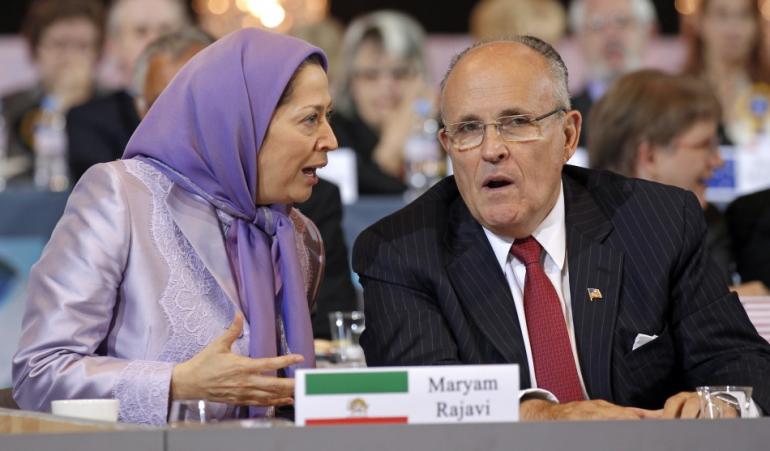
The MEK’s Maryam Rajavi with Trump lawyer Rudy Giuliani


By Paul R. Pillar

President Trump’s belligerent, all-caps tweet about Iran this past weekend is hardly a natural response to anything the Iranians have been saying or doing lately. Iranian President Hassan Rouhani did make a speech on Sunday in which he stated, “America should know that peace with Iran is the mother of all peace, and war with Iran is the mother of all wars,” while advising Trump that “to play with the lion’s tail” would become a source of “regret.”

So, Rouhani was saying that he wants peace with America and that moving toward war would be a bad idea. Hardly the stuff that ordinarily would provoke a flaming riposte.

To the extent Iranian leaders might be sounding a little testy these days, no one should be surprised. In response to Iran’s internationally certified compliance with an agreement in which the country willingly subjected itself to some of the most severe restrictions and intrusive monitoring in the history of nuclear arms control, the Trump administration has reneged on U.S. obligations under the same agreement, sworn hostility toward Iran, waged economic warfare against it, and blatantly attempted to destabilize it.

Originally published by LobeLog on July 23, 2018 here

Trump’s now-familiar methods give rise to some possible motivations for his blast on Twitter. The president is, of course, a master of commanding and diverting the attention of the media and the public. This stoking of the fire aimed at Iran helped to steal headlines from a miserable, Russia-centered week that included the embarrassment at Helsinki. The week continued with a release of documents that knock down a scenario that Trump and his partisan defenders have tried to spin about allegedly ignoble motives underlying the investigation into Russia’s election interference.

Trump’s threat in his tweet of “consequences the likes of which few throughout history have ever suffered before” brings to mind his earlier threat against North Korea of “fire and fury like the world has never seen.” This comparison in turn evokes another of Trump’s now-familiar tactics, which he tried to use with the North Korean issue, which is to create a crisis as part of his contention that his predecessors left him a mess and then, after holding a meeting or signing something, claiming that he has achieved a wonderful success.

The current tension with Iran, featuring the U.S. reneging on the nuclear agreement, certainly is a creation of the Trump administration. But there any similarity with the North Korean case ends. There is no U.S.-Iranian summit meeting, or even normal, working-level diplomacy, in the offing. The administration is too committed to permanent hostility toward the Islamic Republic of Iran to move in that direction.

A critical difference between the two cases concerns the positions of other states in each region. Neighbors of North Korea have welcomed dialogue and détente with Pyongyang, with South Korea’s President Moon Jae-in deserving most of the credit for moving things in that direction. By contrast, the principal regional rivals of Iran—to whom Trump has subcontracted most of his Middle East policy—don’t want any detente between Washington and Tehran. For Israel, Saudi Arabia, and the United Arab Emirates, unending U.S.-Iranian hostility sustains their own privileged relationships with the United States, keeps a major regional rival isolated, and diverts attention from their own foibles and vulnerabilities.

The timing of Trump’s all-caps blast most likely was related to Secretary of State Mike Pompeo’s speech the same day, which was a full-throated call to destabilize the Iranian government. The secretary and the president probably hope for some form of regime change in Iran as the one development that somewhere up the line—say, within about two years, before the U.S. election in 2020—they will be able to point to as a foreign policy “accomplishment” in the absence of any other developments for which they can make that claim.

Pompeo, at least, is smart enough to realize how implausible is a “better deal” with Iran on its nuclear program, despite the administration rhetoric on that theme. A nothing-but-pressure approach was tried before for years and failed, and now it’s even less likely to yield results when its only protagonist is not an international coalition but instead an isolated United States.

In this regard, it is revealing that in his speech this week, Pompeo said almost nothing about nuclear matters—an issue that would have dominated any U.S. speech on Iran a few years ago. There was nothing to say, other than that the issue was resolved, in the best feasible way, by the multilateral agreement that was negotiated under the previous administration and that the Trump administration categorically rejected.

On North Korea, it must be sinking in even with Trump that, despite his rhetoric after the Singapore summit meeting, the North Korean nuclear problem is nowhere near being solved. Solving it would be a genuine foreign-policy accomplishment, but this, too, may be out of reach during what would be a politically meaningful time frame for Trump.

Regime change in Iran is itself an unlikely “accomplishment,” notwithstanding the administration’s rhetoric and economic warfare intended to bring it about. Wishful thinking prevails. Street demonstrations in Iran that are far smaller than those that fizzled out in the time of the Green Movement several years ago are looked on with hope as harbingers of the regime’s imminent collapse. (An interesting duality in Pompeo’s appearance was that, although he pointed to protests in Iran as evidence of what he portrayed as a population unhappy with the regime, his response to a protestor who interrupted his own speech – shouting something about the migrant children controversy – was “if there were only so much freedom of expression in Iran.”)

Much of the administration’s interference and economic warfare makes regime change in Iran less, not more, likely. The sanctions lend credibility to the regime’s argument that Iran’s economic shortcomings are due more to the United States than to the regime’s mismanagement. The sanctions hurt ordinary Iranians far more than privileged members of the regime. Moreover, a U.S. administration that is openly anti-Islamic – as represented by the travel ban, which affects Iranians more than any other nationality – is hardly taken in Iran as a credible source of inspiration.

Even if the regime in Iran were to change significantly in the next couple of years, that leaves the question of the direction of change. The bankruptcy of the administration’s thinking on this subject is underscored by the role that the cult-cum-terrorist-group known as the Mujahedin-e Khalq (or MEK) – which was invited to Pompeo’s speech – plays in that thinking. The MEK has American blood on its hands, and it lost almost all support it once had in Iran when it became an auxiliary to Saddam Hussein’s security apparatus during the Iran-Iraq War. Trump’s national security adviser, John Bolton, and his lawyer, Rudolph Giuliani, are among those close to the president who have sung the praises of the MEK in exchange for fat speaking fees.

If significant political change were to occur in Tehran in the next couple of years—especially after everything the Trump administration has done, including reneging on the nuclear agreement, to discredit moderates such as Rouhani—that change would most likely be in a hardline direction. One possibility would be the Revolutionary Guard acquiring more extensive powers, even to the point of a military dictatorship.

Change is unlikely to be in a more democratic direction. Indeed, the regional rivals of Iran with sway over the administration’s policies do not want more democracy (or any democracy, for that matter) in Iran. Such a development could become a basis for U.S.-Iranian rapprochement that they definitely do not want, and that could lessen their own privileged positions with Washington. An Israeli intelligence officer told a visiting scholar when Iran’s Green Movement was active in 2009 that a victory by the movement would be “Israel’s worst nightmare” because it would mean less Iranian isolation and, consequently, more Iranian power.

The Saudi regime needs to worry not only about a possible tilt by the United States toward a more democratic Iran but also the example that such a democracy would set for subjects of the Saudi regime’s own highly autocratic rule. Herein lies another curiosity in Secretary Pompeo’s speech, which made a big deal about Iranian leaders supposedly enriching themselves as a reason to look for regime change in Iran. Wouldn’t there be similar political implications for the rake-offs of Saudi oil revenues that sustain the expensive tastes of the royal family?

The best outcome—and it isn’t good at all–that one can hope for from the administration’s current course on Iran is endless tension, more antagonizing of Iranian citizens who see the United States as hostile to their own interests, and a constant risk of escalation to open warfare. If the remaining parties to the nuclear agreement cannot keep that accord going, and if the Trump administration’s threats continue to revive thinking in Iran about the value of a nuclear deterrent, then a new nuclear crisis might be added to the mess.

Armed conflict would, of course, be even worse. Donald Trump probably is not now seeking such a war, but one cannot rule out that someday he would as a way to escape from greater political troubles he encounters concerning the Russia investigation or anything else. The bigger worry in the meantime is Bolton, who has long yearned for such a war and, in his current job, is in a position to increase the chances of one breaking out.


Paul R. Pillar
– is Non-resident Senior Fellow at the Center for Security Studies of Georgetown University and an Associate Fellow of the Geneva Center for Security Policy. He retired in 2005 from a 28-year career in the U.S. intelligence community. His senior positions included National Intelligence Officer for the Near East and South Asia, Deputy Chief of the DCI Counterterrorist Center, and Executive Assistant to the Director of Central Intelligence. He is a Vietnam War veteran and a retired officer in the U.S. Army Reserve. Dr. Pillar’s degrees are from Dartmouth College, Oxford University, and Princeton University. His books include Negotiating Peace (1983), Terrorism and U.S. Foreign Policy (2001), Intelligence and U.S. Foreign Policy (2011), and Why America Misunderstands the World (2016).


 

Related Posts

By Jan ObergTFF co-founder and director February 11, 2026 PART 3 — ECONOMICS, TRADE & FINANCIAL SOVEREIGNTY A. Trade Measures & Market Signaling Economic pressure can be applied instantly and scaled without violence. Immediate Measures (within a week) Government boycott US goods and services  A very powerful signal which over time will be felt. Targeted tariffs on selected U.S. goods Symbolic but high-visibility sectors send a clear message. Suspend trade facilitation talks A peaceful pause that signals deep concern. Freeze U.S. participation in public procurement – military procurement in particular A nonviolent way to reduce influence. Competition law review of U.S. corporations A legal tool to scrutinise market dominance. Longer-Term Measures EU–Asia–Africa trade corridors Reducing reliance on U.S. markets. European supply chains for critical minerals Strategic autonomy in resource access. European Strategic Trade Authority Monitoring coercive practices globally. Euro-denominated commodity markets Weakening the dollar’s pricing monopoly. The EU must resume contacts and negotiations with Russia, focusing on energy cooperation To...
PART 2 — Diplomacy, Law and Nonviolent Power By Jan ObergTFF co-founder and director January 26, 2026 This is the second of four TFF-created idea portfolios designed to curb the global reach of the United States and, in both the short and long term, help catalyse a worldwide nonviolent resistance to what many observers describe as the Trump administration’s uniquely confrontational, destructive and world-threatening policies. These portfolios outline what governments and citizens across the world can do through dynamic diplomacy, creative initiatives, and strictly nonviolent means. They are typical TFF works in that we do not only tell what the problem is and how bad it will go – as 90+% of all commentators, experts and scholars do – we tell what we think can be done, inviting you to think of what you think you can do. It seems painfully clear to me that the current political dynamics in Washington increasingly resemble the most dangerous...
PART 1 — Media, Culture and Information Sovereignty By Jan ObergTFF co-founder and director January 20, 2026 This is the first of four TFF-created idea portfolios designed to curb the global reach of the United States and, in both the short and long term, help catalyse a worldwide nonviolent resistance to what many observers describe as the Trump administration’s uniquely confrontational, destructive and world-threatening policies. These portfolios outline what governments and citizens across the world can do through dynamic diplomacy, creative initiatives, and strictly nonviolent means. They are typical TFF works in that we do not only tell what the problem is and how bad it will go – as 90+% of all commentators, experts and scholars do – we tell what we think can be done, inviting you to think of what you think you can do. It seems painfully clear to me that the current political dynamics in Washington increasingly resemble the most...

Recent Articles

Tony Robinson October 4, 2026 Violence is easy to recognise when someone is being beaten, shot or killed. It becomes more difficult when nobody is holding a weapon. Poverty, discrimination, exploitation and repression can restrict a human life just as effectively, although they do so in very different ways and with very different consequences. Simply adding more categories to an ever-growing list of forms of violence does not really solve the problem. The more interesting question is what all these different situations have in common and why it makes sense to describe them using the same word. Human beings do not simply react to what happens around them. They remember the past, imagine things that do not yet exist, make plans and undertake projects. Workers organise because they imagine different working conditions; people migrate because they imagine another life somewhere else; social movements emerge because people refuse to accept the...
It’s a matter of principles, courage, vision and pulling together – while the militarist world is falling apart… Peter Langille October 3, 2026 “Here, then, is the problem which we present to you, stark and dreadful and inescapable: Shall we put an end to the human race; or shall mankind renounce war?”The Bertrand Russell—Albert Einstein Manifesto, July 9, 1955 ⁕ The forecast for what’s ahead is worrisome. The sharp rise in armed conflicts over the past three years is adding to what was already the highest level in over seventy years. Genocides, which should be prevented are supported. A shared climate emergency that jeopardises survival is ignored. Diverse polls now suggest that people are war-weary, worried and interested in a more effective United Nations. And, there are viable policy options for a more secure world! Yet governments are doubling-down, betting on more war and investing heavily. If current trends persist,...
Johan Galtung 1930-2024October 2015 Published here on October 3, 2026 Let us focus on Civilization for conflict analysis and remedies. Major forms of disorder use violence; war is state organized violence. The most belligerent states are the United States of America and Israel, both with civilization roots. National Evangelism, the US Protestant Christian civilization– more national than evangelical–justifies US warfare as exceptionalism of a people chosen by God, with a manifest destiny to run the world. Orthodox Judaism justifies Israeli warfare to conquer and expand from Nile to Euphrates as a religious right and duty to the Eternal One. The third most belligerent country, the UK, no longer believes it is God-chosen but chosen by the USA; not quite the same but something. But the root cause of global disorder lies in the Occident–with Islam–seeing itself as the single, universal civilization valid for all at all times, all others being...

TFF on Substack

Discover and subscribe to more peace materials on TFF Substack

Most Popular

Tony Robinson October 4, 2026 Violence is easy to recognise when someone is being beaten, shot or killed. It becomes more difficult when nobody is holding a weapon. Poverty, discrimination, exploitation and repression can restrict a human life just as effectively, although they do so in very different ways and with very different consequences. Simply adding more categories to an ever-growing list of forms of violence does not really solve the problem. The more interesting question is what all these different situations have in common and why it makes sense to describe them using the same word. Human beings do not simply react to what happens around them. They remember the past, imagine things that do not yet exist, make plans and undertake projects. Workers organise because they imagine different working conditions; people migrate because they imagine another life somewhere else; social movements emerge because people refuse to accept the...
It’s a matter of principles, courage, vision and pulling together – while the militarist world is falling apart… Peter Langille October 3, 2026 “Here, then, is the problem which we present to you, stark and dreadful and inescapable: Shall we put an end to the human race; or shall mankind renounce war?”The Bertrand Russell—Albert Einstein Manifesto, July 9, 1955 ⁕ The forecast for what’s ahead is worrisome. The sharp rise in armed conflicts over the past three years is adding to what was already the highest level in over seventy years. Genocides, which should be prevented are supported. A shared climate emergency that jeopardises survival is ignored. Diverse polls now suggest that people are war-weary, worried and interested in a more effective United Nations. And, there are viable policy options for a more secure world! Yet governments are doubling-down, betting on more war and investing heavily. If current trends persist,...
Johan Galtung 1930-2024October 2015 Published here on October 3, 2026 Let us focus on Civilization for conflict analysis and remedies. Major forms of disorder use violence; war is state organized violence. The most belligerent states are the United States of America and Israel, both with civilization roots. National Evangelism, the US Protestant Christian civilization– more national than evangelical–justifies US warfare as exceptionalism of a people chosen by God, with a manifest destiny to run the world. Orthodox Judaism justifies Israeli warfare to conquer and expand from Nile to Euphrates as a religious right and duty to the Eternal One. The third most belligerent country, the UK, no longer believes it is God-chosen but chosen by the USA; not quite the same but something. But the root cause of global disorder lies in the Occident–with Islam–seeing itself as the single, universal civilization valid for all at all times, all others being...
Read More
Living-Peace-Sign-Budapest-copy
Tony Robinson October 4, 2026 Violence is easy to recognise when someone is being beaten, shot or killed. It becomes more difficult when nobody is holding a weapon. Poverty, discrimination, exploitation and repression can restrict a human life just as effectively, although they do so in very different ways and with very different consequences. Simply adding more categories to an ever-growing list of forms of violence does not really solve the problem. The more interesting question is what all these different situations have in common and why it makes sense to describe them using the same word. Human beings do not simply react to what happens around them. They remember the past, imagine things that do not yet exist, make plans and undertake projects. Workers organise because they imagine different working conditions; people migrate because they imagine another life somewhere else; social movements emerge because people refuse to accept the...
b54a1f10-8c65-4f0b-9dd5-4abc0a7d04cc_2659x2659
It’s a matter of principles, courage, vision and pulling together – while the militarist world is falling apart… Peter Langille October 3, 2026 “Here, then, is the problem which we present to you, stark and dreadful and inescapable: Shall we put an end to the human race; or shall mankind renounce war?”The Bertrand Russell—Albert Einstein Manifesto, July 9, 1955 ⁕ The forecast for what’s ahead is worrisome. The sharp rise in armed conflicts over the past three years is adding to what was already the highest level in over seventy years. Genocides, which should be prevented are supported. A shared climate emergency that jeopardises survival is ignored. Diverse polls now suggest that people are war-weary, worried and interested in a more effective United Nations. And, there are viable policy options for a more secure world! Yet governments are doubling-down, betting on more war and investing heavily. If current trends persist,...
010
Johan Galtung 1930-2024October 2015 Published here on October 3, 2026 Let us focus on Civilization for conflict analysis and remedies. Major forms of disorder use violence; war is state organized violence. The most belligerent states are the United States of America and Israel, both with civilization roots. National Evangelism, the US Protestant Christian civilization– more national than evangelical–justifies US warfare as exceptionalism of a people chosen by God, with a manifest destiny to run the world. Orthodox Judaism justifies Israeli warfare to conquer and expand from Nile to Euphrates as a religious right and duty to the Eternal One. The third most belligerent country, the UK, no longer believes it is God-chosen but chosen by the USA; not quite the same but something. But the root cause of global disorder lies in the Occident–with Islam–seeing itself as the single, universal civilization valid for all at all times, all others being...
Screenshot 2026-10-02 011738
Jan ObergPhD, director, The Transnational Foundation for Peace and Future Research, TFFLund, Sweden October 2, 2026 This is my full original manuscript. The Chinese Academy of Social Science, CASS, makes two publications out if it. 1. China’s Five-year plan emphasized the capabilities of basic research and original innovation. It is regarded as the goal of the future social development, which, as required, should be significantly enhanced. Can you comment on the importance of original innovation in research and academic study? I believe it is easier to define “original innovation” in the natural sciences than in social sciences. The breaking points of what constitutes something new, or innovative, are not quite as sharp in the latter. But in both fields it is about opening up something that was closed, unseen, unexplored before – making manifest what was earlier latent. Innovations come in many forms and shapes – naming something that was not...
arctic-circle-map
The agreement is catastrophic both because of what it says and what it doesn’t mention. It reduces further the major asset of security policies: Freedom of action. Jan Oberg TFF director September 25, 2026 A couple of hours before the agreement was signed on September 22, 2026, I published the following 13 hypotheses about what it would most likely contain on TFF Substack (in English). I was wrong on only the first point. Contrary to what Trump had written on his Truth Social platform, it does not appear to come into force immediately. In fact, it turned out to be worse than even I had anticipated. After these hypotheses now come a number of reflections in light of what the agreement actually contains, and does not contain, as well as the way in which it has generally been presented by major media outlets and by the public-service broadcaster DR. My...
girl-5894831_1280
Below are TFF-related media mentions, comments, videos and social media posts published elsewhere but not on this homepage. We happen to catch and list only a fraction. Regarding video comments and debates, we recommend that you go to the TFF Video Channel on Substack where many of them are reproduced. Jan Oberg is a contributor to China Daily – 52 million daily clicks – and Global Times, CGTN and CCTV (the national television), China Investment, Xinhua News Agency and several others. Articles and videos on these media very often multiply into countless Chinese (and Western media) that re-post them from these main media. Thanks to The China Academy, his analyses, interviews and comments are frequently posted on YouTube channels such as Thinkers Forum and Wave Media. These videos are often re-posted on Bilibili (China’s YouTube), the China Content Center on TikTok, and on the Chinese edition of TikTok, Douyin.com. This means reaching hundreds of millions of viewers worldwide over a year. While there are too many to catch on all these...



