
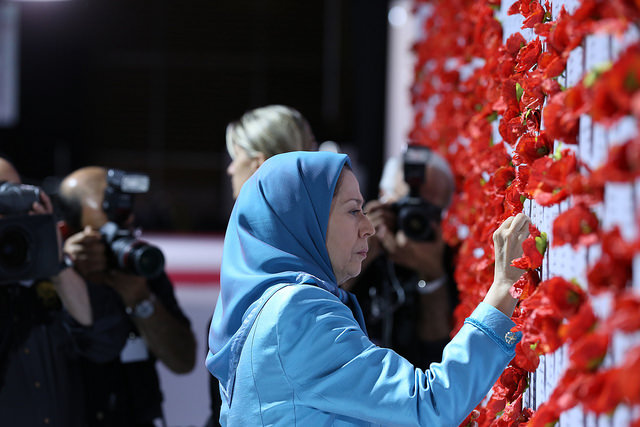
Maryam Rajavi leader of MEK with her husband Massoud (Apa Iceurope via Flickr)


By Paul R. Pillar

November 14, 2018

Among the many indicators of misdirection in the Trump administration’s policy toward Iran, one of the clearest is the fondness for the cult-cum-terrorist group known as the Mujahedin-e Khalq (MEK).

National Security Advisor John Bolton and Donald Trump’s attorney, Rudy Giuliani, are among the group’s most prominent cheerleaders, having been featured speakers at its rallies.

They and other shills for the MEK refer to the group as if it represented what it decidedly is not: a democratic alternative to the current Iranian political system.

Originally published at lobelog.com

Journalist Arron Merat, an experienced Iran-watcher who formerly was the Economist’s Tehran correspondent, has just published a 6,600-word article about the MEK in the Guardian.

            Author Paul R. Pillar

The piece is well worth reading as a richly informed and up-to-date portrait that leaves no doubt about the nature of the group and the ghastly inappropriateness of using the MEK in any way as a vehicle for U.S. policy in the region.

The MEK originated as a student movement that opposed the shah of Iran and spouted an ideology that weirdly combined Islamism and Marxism.

The group was virulently anti-American from the beginning. Its terrorist operations targeted American-owned businesses, and it killed six American citizens in addition to its far more numerous Iranian victims.

The MEK was a major player in toppling the shah in the 1979 revolution but soon had a falling out with the new Khomeini regime—among other things, the group opposed the regime’s release of the American hostages held at the U.S. embassy.

The group continued its terrorism, with the only difference being that the Islamic Republic had replaced the shah’s regime as a principal target.

With the eight-year Iran-Iraq War already underway, the MEK threw in its lot with Saddam Hussein. The Iraqi dictator gave the group weapons, cash, and a compound called Camp Ashraf in return for its continuing attacks inside Iran as well as helping Saddam suppress his own domestic opponents.

Iranians understandably viewed this phase in the MEK’s history as an unforgivable act of treason, erasing whatever support the group previously had in Iran.

Merat’s article provides details of the cult-like aspects of how the MEK has functioned, earlier at Camp Ashraf and more recently, after the group had to leave Iraq, at a compound in Albania.

As cult leaders, the husband-and-wife duo of Massoud and Maryam Rajavi have resembled the likes of Jim Jones and Shoko Asahara. Families have been broken up, married couples told to divorce, and women threatened with punishment if they did not “marry” Massoud and endure his sexual abuse. (Massoud dropped out of sight after the U.S. invasion of Iraq, and it is not known whether he is dead or alive.

Maryam continues as the public face of the group.) Stomach-turning details continue to emerge from the MEK’s current location in Albania, including stories of forced hysterectomies and would-be escapees subjected to solitary confinement.

The former head of Albanian military intelligence says that MEK members live in the group’s current compound as “hostages” amid “extraordinary psychological violence and threats of murder.”


Buying a Makeover

The MEK’s efforts over the past two decades to convey a benign public image completely at odds with this internal reality, and to pose as a force for democracy in Iran, have depended on buying the public endorsements of well-known public figures.

This has required money—lots of it. Five-figure speaking fees have flowed freely. Public disclosure forms indicate that Bolton received $40,000 for a single appearance at an MEK event in Paris last year, and Merat gives an estimate of $180,000 as the total that Bolton has received for his multiple appearances on behalf of the group.

In addition to the generous big-name fees, lobbying for the MEK has included other well-financed techniques. The crowd at the Paris event, for example, was supplemented by young people bussed in from Eastern Europe who enjoyed a free weekend in Paris.

The group used the same rent-a-crowd technique for a demonstration outside the State Department when the MEK was ramping up its lobbying a few years ago to be delisted as a foreign terrorist organization.

Some of the participants in that event were recruited at a homeless shelter in New York. They admitted knowing very little about the MEK but appreciated the free meals they were given for attending.

Where the money is coming from is still somewhat of a mystery. But some clues point to governments that are regional rivals of Iran as the most likely source.

Two further observations flow from this surprisingly successful but wholly unjustified remaking of the MEK’s image. One concerns how some famous—and perhaps otherwise respectable people—evidently have been willing to prostitute themselves to get in on those fat speaking fees.

A wide range of political figures have played the game, from Howard Dean on the left to Bolton and many others on the right. Some of the players may have had little more understanding of the MEK when they got involved than did the guys from the homeless shelter in New York.

Ed Rendell, a former Democratic governor of Pennsylvania, freely admitted that he knew little about the group when he accepted an invitation to speak at an event the MEK staged at a downtown Washington hotel.

He then told his audience—in a demonstration of the self-sustaining nature of big-name endorsements—that the reputations of the other speakers at the same event persuaded him that it must be for a worthwhile cause.

Not everyone has succumbed to the monetary temptations. Tip your hat, for example, to Elliott Abrams, a card-carrying neoconservative responsible for more than his fair share of misdirection in Middle East policy, for declining an invitation to speak at an MEK event.

Abrams cited the fact that the group was still on the foreign terrorist organization list at the time, but the politically and morally inexcusable nature of advocating for such a group does not depend on such a formal list.


Disruption, Not Democracy

The other observation is that, although the shills have taken their fees to the bank, the fact that a group as loathsome as the MEK figures so prominently in the administration’s policy on Iran demonstrates the bankruptcy of that policy.

If the MEK is in the game, the game is not about democracy, human rights, or doing right by ordinary Iranians. Bolton and at least some of the others who have touted the group are smart enough to realize that and to understand the true nature of the group.

They are interested not in democracy but in the capability for sabotage, destruction, and assassination in Iran—a capability that the MEK still has despite its claims to have forsaken violence.

Fostering that capability may serve the objectives of regional rivals who do their own sabotage, destruction, and assassination aimed at Iran and welcome the augmentation of their capabilities for mayhem that the MEK offers.

It certainly does not serve the interests of the United States. It instead increases instability in and thus around Iran, strengthens the market for hardline views in Iran, and besmirches the reputation of the United States through associating itself with the MEK.

If the MEK represents what American leaders mean when they talk about democracy, then the vast majority of Iranians want nothing to do with it.

Originally published at lobelog.com


About the author

Paul R. Pillar is Non-resident Senior Fellow at the Center for Security Studies of Georgetown University and an Associate Fellow of the Geneva Center for Security Policy. He retired in 2005 from a 28-year career in the U.S. intelligence community. His senior positions included National Intelligence Officer for the Near East and South Asia, Deputy Chief of the DCI Counterterrorist Center, and Executive Assistant to the Director of Central Intelligence. He is a Vietnam War veteran and a retired officer in the U.S. Army Reserve. Dr. Pillar’s degrees are from Dartmouth College, Oxford University, and Princeton University. His books include Negotiating Peace (1983), Terrorism and U.S. Foreign Policy (2001), Intelligence and U.S. Foreign Policy (2011), and Why America Misunderstands the World (2016). 

Related Posts

PART 2 — Diplomacy, Law and Nonviolent Power By Jan ObergTFF co-founder and director January 26, 2026 This is the second of four TFF-created idea portfolios designed to curb the global reach of the United States and, in both the short and long term, help catalyse a worldwide nonviolent resistance to what many observers describe as the Trump administration’s uniquely confrontational, destructive and world-threatening policies. These portfolios outline what governments and citizens across the world can do through dynamic diplomacy, creative initiatives, and strictly nonviolent means. They are typical TFF works in that we do not only tell what the problem is and how bad it will go – as 90+% of all commentators, experts and scholars do – we tell what we think can be done, inviting you to think of what you think you can do. It seems painfully clear to me that the current political dynamics in Washington increasingly resemble the most dangerous...
PART 1 — Media, Culture and Information Sovereignty By Jan ObergTFF co-founder and director January 20, 2026 This is the first of four TFF-created idea portfolios designed to curb the global reach of the United States and, in both the short and long term, help catalyse a worldwide nonviolent resistance to what many observers describe as the Trump administration’s uniquely confrontational, destructive and world-threatening policies. These portfolios outline what governments and citizens across the world can do through dynamic diplomacy, creative initiatives, and strictly nonviolent means. They are typical TFF works in that we do not only tell what the problem is and how bad it will go – as 90+% of all commentators, experts and scholars do – we tell what we think can be done, inviting you to think of what you think you can do. It seems painfully clear to me that the current political dynamics in Washington increasingly resemble the most...
Introduction to TFF’s forthcoming four Idea Portfolios of Diplomatic and Nonviolent Resistance By TFF’s Board & FoundersPascal Lottaz, Biljana Vankovska, Annette Schiffmann, Christina Spannar & Jan Oberg January 19, 2026 “America, you are too arrogant.” — Martin Luther King Jr. Over the course of Trump’s first term and now a year into his second, the world has witnessed a consistent pattern of actions that challenge the basic long-standing norms of international cooperation, weaken multilateral institutions, and ignore the global norms and legal frameworks established by the UN Charter. During these years, we have witnessed military operations in Iran, Syria and Ukraine without UN authorisation; the killing of Iranian General Qassem Soleimani; repeated strikes across the Middle East; and the launch of tariff wars against allies and competitors alike. We have seen a renewed emphasis on nuclearism and zero interest in arms control and disarmament negotiations. Pentagon is now The Department...

Recent Articles

Tony Robinson October 4, 2026 Violence is easy to recognise when someone is being beaten, shot or killed. It becomes more difficult when nobody is holding a weapon. Poverty, discrimination, exploitation and repression can restrict a human life just as effectively, although they do so in very different ways and with very different consequences. Simply adding more categories to an ever-growing list of forms of violence does not really solve the problem. The more interesting question is what all these different situations have in common and why it makes sense to describe them using the same word. Human beings do not simply react to what happens around them. They remember the past, imagine things that do not yet exist, make plans and undertake projects. Workers organise because they imagine different working conditions; people migrate because they imagine another life somewhere else; social movements emerge because people refuse to accept the...
It’s a matter of principles, courage, vision and pulling together – while the militarist world is falling apart… Peter Langille October 3, 2026 “Here, then, is the problem which we present to you, stark and dreadful and inescapable: Shall we put an end to the human race; or shall mankind renounce war?”The Bertrand Russell—Albert Einstein Manifesto, July 9, 1955 ⁕ The forecast for what’s ahead is worrisome. The sharp rise in armed conflicts over the past three years is adding to what was already the highest level in over seventy years. Genocides, which should be prevented are supported. A shared climate emergency that jeopardises survival is ignored. Diverse polls now suggest that people are war-weary, worried and interested in a more effective United Nations. And, there are viable policy options for a more secure world! Yet governments are doubling-down, betting on more war and investing heavily. If current trends persist,...
Johan Galtung 1930-2024October 2015 Published here on October 3, 2026 Let us focus on Civilization for conflict analysis and remedies. Major forms of disorder use violence; war is state organized violence. The most belligerent states are the United States of America and Israel, both with civilization roots. National Evangelism, the US Protestant Christian civilization– more national than evangelical–justifies US warfare as exceptionalism of a people chosen by God, with a manifest destiny to run the world. Orthodox Judaism justifies Israeli warfare to conquer and expand from Nile to Euphrates as a religious right and duty to the Eternal One. The third most belligerent country, the UK, no longer believes it is God-chosen but chosen by the USA; not quite the same but something. But the root cause of global disorder lies in the Occident–with Islam–seeing itself as the single, universal civilization valid for all at all times, all others being...

TFF on Substack

Discover and subscribe to more peace materials on TFF Substack

Most Popular

Tony Robinson October 4, 2026 Violence is easy to recognise when someone is being beaten, shot or killed. It becomes more difficult when nobody is holding a weapon. Poverty, discrimination, exploitation and repression can restrict a human life just as effectively, although they do so in very different ways and with very different consequences. Simply adding more categories to an ever-growing list of forms of violence does not really solve the problem. The more interesting question is what all these different situations have in common and why it makes sense to describe them using the same word. Human beings do not simply react to what happens around them. They remember the past, imagine things that do not yet exist, make plans and undertake projects. Workers organise because they imagine different working conditions; people migrate because they imagine another life somewhere else; social movements emerge because people refuse to accept the...
It’s a matter of principles, courage, vision and pulling together – while the militarist world is falling apart… Peter Langille October 3, 2026 “Here, then, is the problem which we present to you, stark and dreadful and inescapable: Shall we put an end to the human race; or shall mankind renounce war?”The Bertrand Russell—Albert Einstein Manifesto, July 9, 1955 ⁕ The forecast for what’s ahead is worrisome. The sharp rise in armed conflicts over the past three years is adding to what was already the highest level in over seventy years. Genocides, which should be prevented are supported. A shared climate emergency that jeopardises survival is ignored. Diverse polls now suggest that people are war-weary, worried and interested in a more effective United Nations. And, there are viable policy options for a more secure world! Yet governments are doubling-down, betting on more war and investing heavily. If current trends persist,...
Johan Galtung 1930-2024October 2015 Published here on October 3, 2026 Let us focus on Civilization for conflict analysis and remedies. Major forms of disorder use violence; war is state organized violence. The most belligerent states are the United States of America and Israel, both with civilization roots. National Evangelism, the US Protestant Christian civilization– more national than evangelical–justifies US warfare as exceptionalism of a people chosen by God, with a manifest destiny to run the world. Orthodox Judaism justifies Israeli warfare to conquer and expand from Nile to Euphrates as a religious right and duty to the Eternal One. The third most belligerent country, the UK, no longer believes it is God-chosen but chosen by the USA; not quite the same but something. But the root cause of global disorder lies in the Occident–with Islam–seeing itself as the single, universal civilization valid for all at all times, all others being...
Read More
Living-Peace-Sign-Budapest-copy
Tony Robinson October 4, 2026 Violence is easy to recognise when someone is being beaten, shot or killed. It becomes more difficult when nobody is holding a weapon. Poverty, discrimination, exploitation and repression can restrict a human life just as effectively, although they do so in very different ways and with very different consequences. Simply adding more categories to an ever-growing list of forms of violence does not really solve the problem. The more interesting question is what all these different situations have in common and why it makes sense to describe them using the same word. Human beings do not simply react to what happens around them. They remember the past, imagine things that do not yet exist, make plans and undertake projects. Workers organise because they imagine different working conditions; people migrate because they imagine another life somewhere else; social movements emerge because people refuse to accept the...
b54a1f10-8c65-4f0b-9dd5-4abc0a7d04cc_2659x2659
It’s a matter of principles, courage, vision and pulling together – while the militarist world is falling apart… Peter Langille October 3, 2026 “Here, then, is the problem which we present to you, stark and dreadful and inescapable: Shall we put an end to the human race; or shall mankind renounce war?”The Bertrand Russell—Albert Einstein Manifesto, July 9, 1955 ⁕ The forecast for what’s ahead is worrisome. The sharp rise in armed conflicts over the past three years is adding to what was already the highest level in over seventy years. Genocides, which should be prevented are supported. A shared climate emergency that jeopardises survival is ignored. Diverse polls now suggest that people are war-weary, worried and interested in a more effective United Nations. And, there are viable policy options for a more secure world! Yet governments are doubling-down, betting on more war and investing heavily. If current trends persist,...
010
Johan Galtung 1930-2024October 2015 Published here on October 3, 2026 Let us focus on Civilization for conflict analysis and remedies. Major forms of disorder use violence; war is state organized violence. The most belligerent states are the United States of America and Israel, both with civilization roots. National Evangelism, the US Protestant Christian civilization– more national than evangelical–justifies US warfare as exceptionalism of a people chosen by God, with a manifest destiny to run the world. Orthodox Judaism justifies Israeli warfare to conquer and expand from Nile to Euphrates as a religious right and duty to the Eternal One. The third most belligerent country, the UK, no longer believes it is God-chosen but chosen by the USA; not quite the same but something. But the root cause of global disorder lies in the Occident–with Islam–seeing itself as the single, universal civilization valid for all at all times, all others being...
Screenshot 2026-10-02 011738
Jan Oberg PhD, director, The Transnational Foundation for Peace and Future Research, TFFLund, Sweden October 2, 2026 This is my full original manuscript. The Chinese Academy of Social Science, CASS, makes two publications out if it. 1. China’s Five-year plan emphasized the capabilities of basic research and original innovation. It is regarded as the goal of the future social development, which, as required, should be significantly enhanced. Can you comment on the importance of original innovation in research and academic study? I believe it is easier to define “original innovation” in the natural sciences than in social sciences. The breaking points of what constitutes something new, or innovative, are not quite as sharp in the latter. But in both fields it is about opening up something that was closed, unseen, unexplored before – making manifest what was earlier latent. Innovations come in many forms and shapes – naming something that was...
arctic-circle-map
The agreement is catastrophic both because of what it says and what it doesn’t mention. It reduces further the major asset of security policies: Freedom of action. Jan Oberg TFF director September 25, 2026 A couple of hours before the agreement was signed on September 22, 2026, I published the following 13 hypotheses about what it would most likely contain on TFF Substack (in English). I was wrong on only the first point. Contrary to what Trump had written on his Truth Social platform, it does not appear to come into force immediately. In fact, it turned out to be worse than even I had anticipated. After these hypotheses now come a number of reflections in light of what the agreement actually contains, and does not contain, as well as the way in which it has generally been presented by major media outlets and by the public-service broadcaster DR. My...
girl-5894831_1280
Below are TFF-related media mentions, comments, videos and social media posts published elsewhere but not on this homepage. We happen to catch and list only a fraction. Regarding video comments and debates, we recommend that you go to the TFF Video Channel on Substack where many of them are reproduced. Jan Oberg is a contributor to China Daily – 52 million daily clicks – and Global Times, CGTN and CCTV (the national television), China Investment, Xinhua News Agency and several others. Articles and videos on these media very often multiply into countless Chinese (and Western media) that re-post them from these main media. Thanks to The China Academy, his analyses, interviews and comments are frequently posted on YouTube channels such as Thinkers Forum and Wave Media. These videos are often re-posted on Bilibili (China’s YouTube), the China Content Center on TikTok, and on the Chinese edition of TikTok, Douyin.com. This means reaching hundreds of millions of viewers worldwide over a year. While there are too many to catch on all these...




