
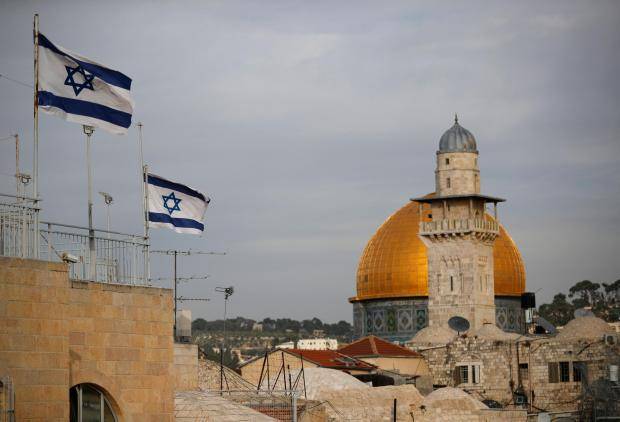
The Half-Millennium When Rome excluded Jews from Jerusalem and how Iran and Muslims Saved Them


The move of the Trump administration of the US embassy to Jerusalem is intended, according to the president, to signal a recognition of the reality that Jerusalem is the capital of Israel.

This move is controversial because Israel’s sovereignty over Jerusalem is not recognized in international law.

The 1947 partition plan suggested in the UN General Assembly for what should happen in the British Mandate of Palestine after the British decamped did not have the force of law, since it was never endorsed by the UN Security Council.


Originally published on Informed Comment here

But even the UNGA partition did not award Jerusalem to the 500,000 European Zionist settlers brought into Palestine by the British colonial authorities as part of their long-term plan to divide and rule the Middle East. (In 1799 General Bonaparte invaded Ottoman Palestine and only found about 3,000 Jews there. After the Crusades, there is no evidence for a significant Jewish presence there for some 800 years).

The 1948 war that broke out as the British began leaving ended with the Jewish forces in control of West Jerusalem. Jordan had the eastern part of the city, religiously significant for both Jews and Muslims. Israel launched the 1967 war of conquest in a bid to add the West Bank of the Jordan, the Sinai Peninsula, and the Syrian Golan Heights to Israeli territory (yes, Israel fired the first shot in that war, taking advantage of unrealistic bombast from Egypt’s Gamal Abdel Nasser, whose best troops were tied down in the Yemen War).

The scheme succeeded wildly, giving the expansionist hawks more territory and all of Jerusalem but also making Israel an Apartheid binational state with a Palestinian Bantustan under the Israeli jackboot in the West Bank and Gaza.

The Israelis illegally detached part of the West Bank and added it to their province of Jerusalem. They have ever since been using a combination of force, squatter settlement construction, and shyster legal ploys to kick Palestinians out of East Jerusalem.

It is this aggressive Israeli expansionism and colonization that Trump’s move of the embassy is intended to legitimize. It cannot do so in international law, of course, but the Israelis have all along counted on might makes right. That will work for them until might is no longer on their side.

Prime Minister Binyamin Netanyahu has a romantic nationalist view of history, trying to make Jerusalem “Jewish” for thousands of years. However, the city was founded by Canaanites or their predecessors in honor of the god Shalem, and Jewish ethnogenesis out of the Canaanites is probably a process of the first millennium BCE, and not the earliest part of that millennium.

Jews almost never ruled Jerusalem after the Babylonian conquest; Iraqis, Iranians, Romans and Muslims did.

• • •

The Romans gradually established themselves in Palestine (yes, that is what they called it), taking Judea in 63 BCE and ruling through local proxies. After a brief Iranian Parthian conquest, they came back and used Herod. But in 6 CE the Romans assumed direct rule of Palestine.

Local Jews chafed under Roman rule and got up some rebellions, the most significant 66-70. The Great Rebellion was brutally crushed by the Romans in 70 and they destroyed the Second Temple. Jews no longer had a direct ritual link to the city, and their worship became more local. After a second big revolt, 132-136 CE [AD], led by Simon bar Kochba, the Romans expelled Jews from Jerusalem.

The pagan Romans did not deal well with dissent, being perfectly willing to adopt scorched-earth tactics and to kill large numbers of people or expel them from their territory.

That famous Pax Romana came with a high price of repression, though admittedly the emperors after Augustus appear to have been less viciously brutal than had been the Republic.

So the Romans from 136 just forbade Jews to live in Jerusalem.

Then they reconfigured it as a pagan city, Aelia Capitolina. They literally wiped Jewish Jerusalem off the face of the map. And they built enormous pagan temples to Jupiter and Venus for Roman worshippers of the gods. They erected a statue of Jupiter on the abandoned Temple Mount.

The Romans did not scatter the Jews from Palestine, however, just from Jerusalem. Significant Jewish communities remained in the Galilee, Tiberias, Ptolemais (Akka), etc. And while the law forbade Jews to live in Aelia Capitolina, laws are always imperfectly enforced and there may have been a small community there that officials winked at.

• • •

The Jews in Roman Palestine were a bigger and more important community than were the small Levantine Christian community.

Imagine their surprise when the Roman Emperor Constantine in 312 adopted Christianity (well, sort of), and his successors transformed the Roman Empire into a Christian state and arranged for most urban pagans to convert to the new religion over the succeeding two centuries. (Pagan survivals in the countryside are clear from the archeology, into the 500s and 600s, and are attested in the Qur’an in the 610s).

Constantine’s mother Helena made a tour of the Near East and was appalled at the pagan dominance of Jerusalem. At her instance, the big pagan temples to Jupiter and Venus (probably viewed as the North Arabian goddess al-`Uzza by the local Nabatean and Arab populations) were pulled down. The Church of the Holy Sepulcher was built. Since Helena claimed to have found a relic of the True Cross, it was placed there. This church became the new center of the Christian New Jerusalem. The Temple Mount gradually became an abandoned esplanade with a crumbling statue of Zeus.

The new Christian masters of Jerusalem maintained the de jure ban on Jews in Jerusalem.

• • •

In 614, the Iranian Sasanian Empire took Jerusalem, having invaded the Near East. In 619 they took Egypt and deprived the Eastern Roman Empire (now based in Constantinople) of its breadbasket.

The Sasanians are said to have been helped by Palestinian Jews, who preferred the Zoroastrian Iranians to the somewhat fanatical Christian Roman emperors (Justinian even had ordered that synagogues in Roman Africa (Tunisia) be made into churches, though probably the decree was not widely implemented).

Then the Sasanians are said to have appointed Jews to rule Jerusalem until about 619.

This Jerusalem policy angered eastern Christians in the Sasanian Empire, and the bishop in Ctesiphon (today’s Madain in Iraq) lobbied to restore Christian suzerainty there. Emperor Khosrow II, who legend says had a Christian wife, Shirin, acquiesced.

But under Iranian rule 614-629, Jews were free to live and worship in Jerusalem, and may have established a makeshift altar on the temple mount.

Roman restoration of control over Palestine, circa 630-636, was brief, since Arab Muslims moved in to the Near East and perhaps Islam spread among Arab tribes in Transjordan, Palestine and Syria.

The Muslim commander of the faithful and vicar of the prophet, Omar bin al-Khattab, took Jerusalem in 636-37 and visited it that April.

Muslim rule was to last save for the short hiatus of the Crusader kingdoms until World War I, when General Allenby took Jerusalem from the Ottoman Empire.

Muslims viewed Jews as a legitimate religious community, unlike Inquisition-era Europeans such as the Spanish, and so Jews were free to live in Jerusalem, though few did since it was a small and insignificant city and many went to Muslim capitals such as Cairo, and later Istanbul, instead.

• • •

So it isn’t true that Jerusalem has throughout history been “Jewish.” For hundreds of years under the Romans, whether pagan or Christian, the city was made completely devoid of Jews, at least by law.

Ironically, it was Iran and the Muslims who rescued the Jews from that exile from Jerusalem.

I am going to tease you and say that a fuller presentation of the late-antique story of Jerusalem, and a theory about it and the rise of Islam, will be given in my book, due in October:


Announcement: Forthcoming October 9 and available for pre-order–
Muhammad: Prophet of Peace amid the Clash of Empires

Related Posts

The agreement is catastrophic both because of what it says and what it doesn’t mention. It reduces further the major asset of security policies: Freedom of action. Jan Oberg TFF director September 25, 2026 A couple of hours before the agreement was signed on September 22, 2026, I published the following 13 hypotheses about what it would most likely contain on TFF Substack (in English). I was wrong on only the first point. Contrary to what Trump had written on his Truth Social platform, it does not appear to come into force immediately. In fact, it turned out to be worse than even I had anticipated. After these hypotheses now come a number of reflections in light of what the agreement actually contains, and does not contain, as well as the way in which it has generally been presented by major media outlets and by the public-service broadcaster DR. My...
This is not another geopolitical commentary on the Arctic. It is a visionary peace proposal that can save the region from militarised rivalry and ecological ruin. A blueprint for shared security, sustainable development, and human dignity — benefitting Greenland, the Arctic, and the rest of us. Jan Oberg TFF director Lund, Sweden, February 17, 2026 I. Four Principles for a New Arctic Vision The Arctic is often framed as a cold arena of rivalry — a place where great powers test each other’s resolve. But this worldview is outdated, unimaginative, and ultimately self‑defeating. The Arctic is not a vacuum waiting to be militarised; it is a living region, a climate stabiliser, and a cultural homeland whose future will shape the future of humanity. If we begin from that understanding, a far more rational Arctic order becomes possible — one that is peaceful, cooperative, and centred on the people who actually live there. This vision rests...
PART 2 — Diplomacy, Law and Nonviolent Power By Jan ObergTFF co-founder and director January 26, 2026 This is the second of four TFF-created idea portfolios designed to curb the global reach of the United States and, in both the short and long term, help catalyse a worldwide nonviolent resistance to what many observers describe as the Trump administration’s uniquely confrontational, destructive and world-threatening policies. These portfolios outline what governments and citizens across the world can do through dynamic diplomacy, creative initiatives, and strictly nonviolent means. They are typical TFF works in that we do not only tell what the problem is and how bad it will go – as 90+% of all commentators, experts and scholars do – we tell what we think can be done, inviting you to think of what you think you can do. It seems painfully clear to me that the current political dynamics in Washington increasingly resemble the most dangerous...

Recent Articles

Jan Oberg TFF director October 28, 2026 Exactly one month has now passed since I published my criticism of the introduction to the special issue on Johan Galtung published by the Journal of Global Security Studies, JoGSS, and of Tor Egil Førland’s chapter about Galtung which serves as a preview to his forthcoming biography of Galtung to be published by PRIO. See the original on The Transnational here and the same article on TFF Substack with many general and critical comments and, in particular, the people who decided to withdraw from the biography project in protest. The special issue itself was extraordinary. It was devoted to the intellectual legacy of one of the founders of peace research and contained a number of strong assessments of his personality, scholarship, intellectual trajectory, and public role. Such assessments are, of course, entirely legitimate. No scholar is beyond criticism, and neither was Johan Galtung....
An aspect of Iran’s culture and civilisation you’ve probably never heard about. Don’t be surprised if the US and Israel also try to bomb them. Jan ObergTFF director October 26, 2026 Today – under the “USraeli” threat of new “annihilating” bombings – opens the 7th International Conference on Peace and Conflict Resolution at Tehran’s University. As far as I can tell, this is the only permanent, advanced peace research institution in West Asia/the Middle East. Perhaps more countries in that region could be inspired? I mean, how many military “security” institutes and military academies do they have? Many peace research institutes and university departments have been established since the 1950s in the West. They are now all under attack; some have closed down, some have gone mainstream, yet others kept the name but do nothing to research peace and disseminate results or advice; instead, they cooperate with militarism’s platforms such...
Let’s discuss using AI to create peace – in contrast to boring geopolitics devoid of creative healing and visions. Jan Oberg TFF director October 15, 2026 I asked VEED to create a short video exemplifying how peace is preferable to war, then chose the lady as a template. Simple as that. In less than a minute, it produced this video, which any peace-loving person would appreciate. The only problem is that human intelligence (HI), at least the one that exists among Western decision-makers, isn’t half as moral or smart as AI. I have used AI to dialogue about peace and peace plans, creative conflict resolution and visions of a better future for humankind. It so happens that I am having more stimulating, intelligent, creative and moral discussions with AI than I could possibly have with any EU or NATO leader today. Yes, AI has very problematic and dangerous aspects; used...

TFF on Substack

Discover and subscribe to more peace materials on TFF Substack

Most Popular

Jan Oberg TFF director October 28, 2026 Exactly one month has now passed since I published my criticism of the introduction to the special issue on Johan Galtung published by the Journal of Global Security Studies, JoGSS, and of Tor Egil Førland’s chapter about Galtung which serves as a preview to his forthcoming biography of Galtung to be published by PRIO. See the original on The Transnational here and the same article on TFF Substack with many general and critical comments and, in particular, the people who decided to withdraw from the biography project in protest. The special issue itself was extraordinary. It was devoted to the intellectual legacy of one of the founders of peace research and contained a number of strong assessments of his personality, scholarship, intellectual trajectory, and public role. Such assessments are, of course, entirely legitimate. No scholar is beyond criticism, and neither was Johan Galtung....
An aspect of Iran’s culture and civilisation you’ve probably never heard about. Don’t be surprised if the US and Israel also try to bomb them. Jan ObergTFF director October 26, 2026 Today – under the “USraeli” threat of new “annihilating” bombings – opens the 7th International Conference on Peace and Conflict Resolution at Tehran’s University. As far as I can tell, this is the only permanent, advanced peace research institution in West Asia/the Middle East. Perhaps more countries in that region could be inspired? I mean, how many military “security” institutes and military academies do they have? Many peace research institutes and university departments have been established since the 1950s in the West. They are now all under attack; some have closed down, some have gone mainstream, yet others kept the name but do nothing to research peace and disseminate results or advice; instead, they cooperate with militarism’s platforms such...
Let’s discuss using AI to create peace – in contrast to boring geopolitics devoid of creative healing and visions. Jan Oberg TFF director October 15, 2026 I asked VEED to create a short video exemplifying how peace is preferable to war, then chose the lady as a template. Simple as that. In less than a minute, it produced this video, which any peace-loving person would appreciate. The only problem is that human intelligence (HI), at least the one that exists among Western decision-makers, isn’t half as moral or smart as AI. I have used AI to dialogue about peace and peace plans, creative conflict resolution and visions of a better future for humankind. It so happens that I am having more stimulating, intelligent, creative and moral discussions with AI than I could possibly have with any EU or NATO leader today. Yes, AI has very problematic and dangerous aspects; used...
Read More
JoGSS-Silent
Jan Oberg TFF director October 28, 2026 Exactly one month has now passed since I published my criticism of the introduction to the special issue on Johan Galtung published by the Journal of Global Security Studies, JoGSS, and of Tor Egil Førland’s chapter about Galtung which serves as a preview to his forthcoming biography of Galtung to be published by PRIO. See the original on The Transnational here and the same article on TFF Substack with many general and critical comments and, in particular, the people who decided to withdraw from the biography project in protest. The special issue itself was extraordinary. It was devoted to the intellectual legacy of one of the founders of peace research and contained a number of strong assessments of his personality, scholarship, intellectual trajectory, and public role. Such assessments are, of course, entirely legitimate. No scholar is beyond criticism, and neither was Johan Galtung....
Screenshot 2026-10-26 115647
An aspect of Iran’s culture and civilisation you’ve probably never heard about. Don’t be surprised if the US and Israel also try to bomb them. Jan ObergTFF director October 26, 2026 Today – under the “USraeli” threat of new “annihilating” bombings – opens the 7th International Conference on Peace and Conflict Resolution at Tehran’s University. As far as I can tell, this is the only permanent, advanced peace research institution in West Asia/the Middle East. Perhaps more countries in that region could be inspired? I mean, how many military “security” institutes and military academies do they have? Many peace research institutes and university departments have been established since the 1950s in the West. They are now all under attack; some have closed down, some have gone mainstream, yet others kept the name but do nothing to research peace and disseminate results or advice; instead, they cooperate with militarism’s platforms such...
Screenshot 2026-10-15 141837
Let’s discuss using AI to create peace – in contrast to boring geopolitics devoid of creative healing and visions. Jan Oberg TFF director October 15, 2026 I asked VEED to create a short video exemplifying how peace is preferable to war, then chose the lady as a template. Simple as that. In less than a minute, it produced this video, which any peace-loving person would appreciate. The only problem is that human intelligence (HI), at least the one that exists among Western decision-makers, isn’t half as moral or smart as AI. I have used AI to dialogue about peace and peace plans, creative conflict resolution and visions of a better future for humankind. It so happens that I am having more stimulating, intelligent, creative and moral discussions with AI than I could possibly have with any EU or NATO leader today. Yes, AI has very problematic and dangerous aspects; used...
girl-5894831_1280
Below are TFF-related media mentions, comments, videos and social media posts published elsewhere but not on this homepage. We happen to catch and list only a fraction. Regarding video comments and debates, we recommend that you go to the TFF Video Channel on Substack where many of them are reproduced. Jan Oberg is a contributor to China Daily – 52 million daily clicks – and Global Times, CGTN and CCTV (the national television), China Investment, Xinhua News Agency and several others. Articles and videos on these media very often multiply into countless Chinese (and Western media) that re-post them from these main media. Thanks to The China Academy, his analyses, interviews and comments are frequently posted on YouTube channels such as Thinkers Forum and Wave Media. These videos are often re-posted on Bilibili (China’s YouTube), the China Content Center on TikTok, and on the Chinese edition of TikTok, Douyin.com. This means reaching hundreds of millions of viewers worldwide over a year. While there are too many to catch on all these...
Nobel-Prize-Plaque
Jan Oberg TFF director October 13, 2026 According to Alfred Nobel’s will, the Nobel Peace Prize shall be awarded: ”to the person who has done the most or best to advance fellowship among nations, the abolition or reduction of standing armies, and the establishment and promotion of peace congresses.” Further down, he also expresses how the prize for the “champions of peace” shall be decided: “that for champions of peace by a committee of five persons to be selected by the Norwegian Storting. Alfred Nobel’s will is remarkably short and clear. But few seem to have read it. Nobel did not say that the committee itself should consist of members of parliament. He entrusted the Storting with appointing five persons. In principle, it could have selected diplomats, mediators, peace researchers, conflict-resolution specialists, or other individuals with recognised expertise in matters of peace from around the world. Instead, the Storting gradually...
law-419057_1280
The Quest for Humane Survival Richard Falk Professor emeritus, Princeton UniversityTFF Associate since 1986October 12, 2026 After decades of teaching and writing about international law in academic frameworks that were not institutionally situated within law school environments—at Princeton and the University of California, Santa Barbara—I found myself most receptive to the TWAIL outlook. It has been especially illuminating in clarifying the extent to which international law evolved as a dialogical critique of Europe’s efforts to legitimize its colonial undertakings. In particular, TWAIL has exposed how international law has functioned to legalize the subjugation of Third World peoples, securing conditions for exploitative investment and trade relations, the coercive enforcement of public debts, and an ideology of cultural superiority. TWAIL’s exposure of these economic legacies of colonialism has influenced my understanding of the history and development of international law, broadly conceived, as an ideological project of the Western sub-system of the world...



