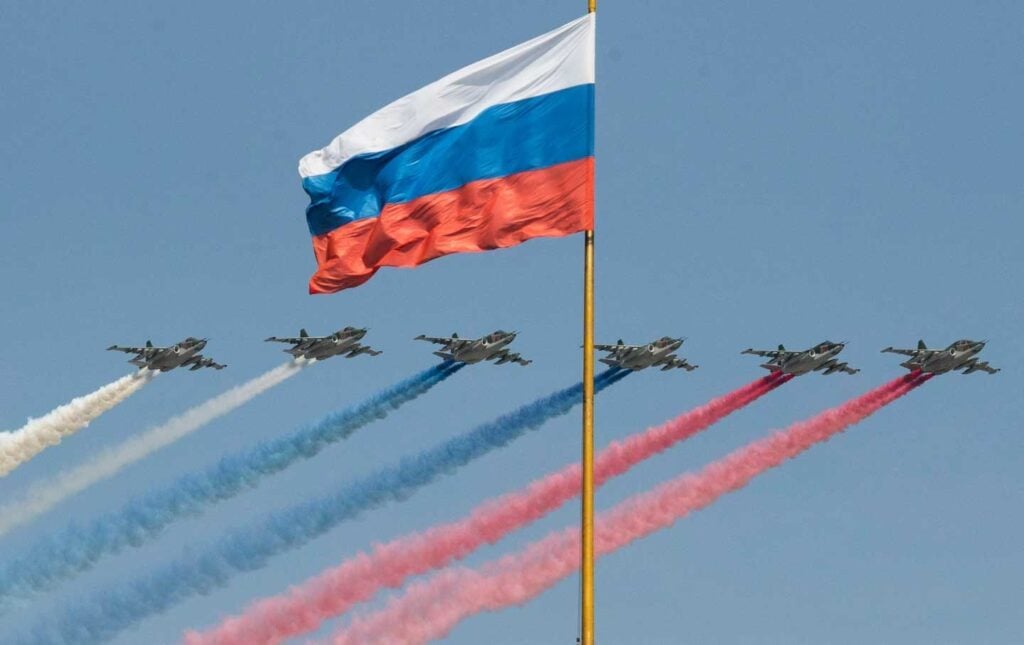
Russian Air Force Su-25 jets fly past the Russian flag on the Kremlin complex during a rehearsal for the Victory Day military parade in Moscow, Friday, May 4, 2018. (AP Photo / Pavel Golovkin)

US Cold Warriors escalate toward actual war with Russia.

By Stephen F. Cohen

March 26, 2019

The John Batchelor Show, March 20, 2019

Heedless of the consequences, or perhaps welcoming them, America’s Cold Warriors and their media platforms have recently escalated their rhetoric against Russia, especially in March.

Anyone who has lived through or studied the preceding 40-year Cold War will recognize the ominous echoes of its most dangerous periods, when actual war was on the horizon or a policy option.

Originally published by The Nation on March 20, 2019 here

Here are only a few random but representative examples:

§ In a March 8 Washington Post opinion article, two American professors, neither with any apparent substantive knowledge of Russia or Cold War history, warned that the Kremlin is trying “to undermine our trust in the institutions that sustain a strong nation and a strong democracy. The media, science, academia and the electoral process are all regular targets.” Decades ago, J. Edgar Hoover, the policeman of that Cold War, said the same, indeed made it an operational doctrine.

§ Nor is the purported threat to America only. According to (retired) Gen. David Petraeus and sitting Senator Sheldon Whitehouse, also in the Post on the following day, the “world is once again polarized between two competing visions for how to organize society.” For Putin’s Kremlin, “the existence of the United States’ rule-of-law world is intrinsically threatening.” This is an “intensifying worldwide struggle.” So much for those who dismissed post–Soviet Russia as merely a “regional” power, including former President Barack Obama, and for the myopic notion that a new Cold War was not possible.

§ But the preceding Cold War was driven by an intense ideological conflict between Soviet Communism and Western capitalism. Where is the ideological threat today, considering that post–Soviet Russia is also a capitalist country? In a perhaps unprecedented nearly 10,000-word manifesto from March 14 in the front news pages of (again) the Post, Robert Kagan provided the answer: “Today, authoritarianism has emerged as the great challenge facing the liberal democratic world—a profound ideological, as well as strategic, challenge.”

That is, “authoritarianism” has replaced Soviet Communism in our times, with Russia again in the forefront.

The substance of Kagan’s “authoritarianism” as “an ideological force” is thin, barely enough for a short opinion article, often inconsistent and rarely empirical. It amounts to a batch of “strongman” leaders (prominently Putin, of course), despite their very different kinds of societies, political cultures, states, and histories, and despite their different nationalisms and ruling styles.

Still, credit Kagan’s ambition to be the undisputed ideologist of the new American Cold War, though less the Post for taking the voluminous result so seriously.

The 40-year Cold War often flirted with hot war, and that, too, seems to be on the agenda. Words, as Russians say, are also deeds. They have consequences, especially when uttered by people of standing in influential outlets. Again, consider a few examples that might reasonably be considered warmongering:

§ The journal Foreign Policy found space for disgraced former Georgian president Mikhail Saakashvili to declare: “It is not a question of whether [Putin] will attack, but where.” (Saakashvili may be the most discredited “democratic” leader of recent times, having brought the West close to war with Russia in 2008 and since having had to flee his own country and then decamp even from US-backed Ukraine.)

§ NBC News, a reliable source of Cold War frenzy, reported, based on Estonian “intelligence,” an equally persistent source of the same mania, that “Russia is most likely to attack the Baltic States first, but a conflict between Russia and NATO would involve attacks on Western Europe.”

§ Also in March, in The Economist, another retired general, Ben Hodges, onetime commander of the US army in Europe, echoes that apocalyptic perspective: “This is not just about NATO’s eastern front.” (Readers may wish to note that “eastern front” is the designation given by Nazi Germany to its 1941 invasion of Soviet Russia. Russians certainly remember.)

§ Plenty of influential American Cold War zealots seem eager to respond to the bugle charge, among them John E. Herbst, a stalwart at the Atlantic Council (NATO’s agitprop “think tank” in Washington), and the Post’s deputy editorial-page editor, Jackson Diehl. Both want amply armed US and NATO warships sent to what Russians sometimes call their bordering “lakes,” the Sea of Azov and the Black Sea. To do so would likely mean the “war” NBC envisages.

Lest readers think all this is merely the “chattering” of opinion-makers, as Aleksandr Solzhenitsyn once termed it, consider a summary of legislation being prepared by a bipartisan US Senate committee, pointedly titled and with a fearsome acronym, DASKA (the Defending American Security from Kremlin Aggression Act of 2019).

Again, Russia is ritualistically accused of “malign influence” and “aggression” around the world, the quality of the committee’s thinking succinctly expressed by one of the Republican senators: “Putin’s Russia is an outlaw regime that is hell-bent on undermining international law and destroying the US-led liberal global order.” There is no evidence for these allegations – Russian policy-makers are constantly citing international law, and the US “liberal global order,” if it ever existed, has done a fine job of undoing itself—but with “an outlaw regime,” there can be no diplomacy, nor do the senators propose any, only war.

A recurring theme of my recently published book War with Russia? is that the new Cold War is more dangerous, more fraught with hot war, than the one we survived.

All of the above amply confirms that thesis, but there is more. Histories of the 40-year US-Soviet Cold War tell us that both sides came to understand their mutual responsibility for the conflict, a recognition that created political space for the constant peace-keeping negotiations, including nuclear arms control agreements, often known as détente.

But as I also chronicle in the book, today’s American Cold Warriors blame only Russia, specifically “Putin’s Russia,” leaving no room or incentive for rethinking any US policy toward post-Soviet Russia since 1991. (See, for example, Nataliya Bugayova’s recent piece for the Institute for the Study of War.)

Still more, as I have also long pointed out, Moscow closely follows what is said and written in the United States about US-Russian relations. Here too words have consequences.

On March 14, Russia’s National Security Council, headed by President Putin, officially raised its perception of American intentions toward Russia from “military dangers” (opasnosti) to direct “military threats” (ugrozy). In short, the Kremlin is preparing for war, however defensive its intention.

Finally, there continues to be no effective, organized American opposition to the new Cold War. This too is a major theme of my book and another reason why this Cold War is more dangerous than was its predecessor. In the 1970s and 1980s, advocates of détente were well-organized, well-funded, and well-represented, from grassroots politics and universities to think tanks, mainstream media, Congress, the State Department, and even the White House. Today there is no such opposition anywhere.

A major factor is, of course, “Russiagate.”

As evidenced in the sources I cite above, much of the extreme American Cold War advocacy we witness today is a mindless response to President Trump’s pledge to find ways to “cooperate with Russia” and to the still-unproven allegations generated by it. Certainly, the Democratic Party is not an opposition party in regard to the new Cold War.

Nancy Pelosi, the leader of its old guard, needlessly initiated an address to Congress by NATO’s secretary general, in April, which will be viewed in Moscow as a provocation. She also decried as “appalling” Trump’s diplomacy with Russian President Putin, whom she dismissed as a “thug.” Such is the state of statesmanship today in the Democratic Party.

Originally published by The Nation on March 20, 2019 here

Its shining new pennies seem little different. Beto O’Rourke, now a declared candidate for the Democratic presidential nomination, promises to lead our “indispensable country,” an elite conceit that has inspired many US wars and cold wars.

Another fledgling would-be Democratic leader, Alexandria Ocasio-Cortez, seems to have bought into Russiagate’s iconic promotion of US intelligence agencies, tweeting on January 12, “The FBI had to open inquiry on whether the most powerful person in the United States is actually working for Russia.”

Evidently, neither she nor O’Rourke understand that growing Cold War is incompatible with progressive policies at home, in America or in Russia.

Among Democrats, there is one exception, Representative Tulsi Gabbard, who is also a declared candidate for the Democratic presidential nomination. Not surprisingly, for lamenting Russiagate’s contribution to the worsening new Cold War and calling for new approaches to Russia itself, Gabbard was shrilly and misleadingly slurred by NBC News. (For a defense of Gabbard, see Glenn Greenwald in The Intercept.)

Herself a veteran of the US military forces, Representative Gabbard soldiers on, the only would-be Democratic president calling for an end to this most dangerous new Cold War.

This commentary is based on Stephen F. Cohen’s most recent weekly discussion with the host of The John Batchelor Show. Now in their fifth year, previous installments are at TheNation.com.
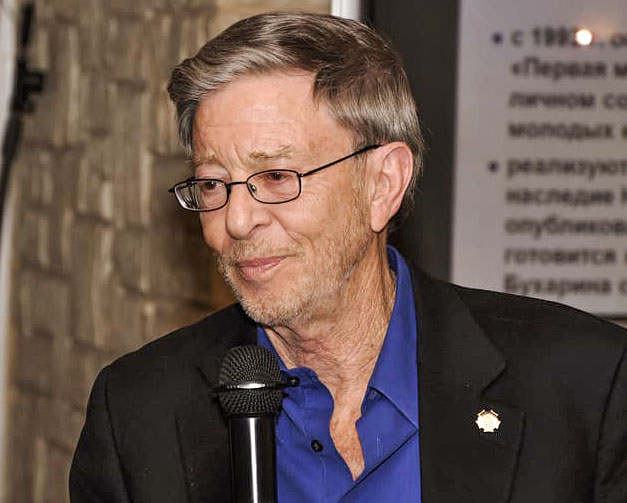
Professor Stephen F. Cohen

Stephen F. Cohen is a professor emeritus of Russian studies, history, and politics at New York University and Princeton University. A Nation contributing editor, he is the author, most recently, of War With Russia? From Putin & Ukraine to Trump & Russiagate.

One Response

  1. I am sure that if a capable psychiatrist examined some of these individuals they would be certified as mad and put under care and observation. Some others are warmongers who do not think about the consequences of what they are wishing for. If these people represent “liberal world order” and “the rule of law”, may God save us from authoritarians.

Related Posts

A friendly quarrel while we agree that the US sanctions are a weapon of mass destruction and kill more people than wars do. And that we must talk much more about sanctions than we have so far. Jan Oberg, TFF director March 16, 2026 John Mearsheimer recently stated that U.S. sanctions murdered around 38 million people between 1971 and 2021 – see the video below. It is a dramatic figure, and it has spread quickly because it captures, in one sentence, the enormous human cost of modern sanctions. I share his concern about the destructive effects of economic coercion. But the specific number he cites — and the way he attributes it — deserves a friendly academic clarification. The figure comes from a 2023 Lancet Global Health article estimating the mortality effects of unilateral U.S. and EU sanctions over the past half‑century. This is the first point where Mearsheimer’s shorthand diverges from the text: the study...
PART 2 — Diplomacy, Law and Nonviolent Power By Jan ObergTFF co-founder and director January 26, 2026 This is the second of four TFF-created idea portfolios designed to curb the global reach of the United States and, in both the short and long term, help catalyse a worldwide nonviolent resistance to what many observers describe as the Trump administration’s uniquely confrontational, destructive and world-threatening policies. These portfolios outline what governments and citizens across the world can do through dynamic diplomacy, creative initiatives, and strictly nonviolent means. They are typical TFF works in that we do not only tell what the problem is and how bad it will go – as 90+% of all commentators, experts and scholars do – we tell what we think can be done, inviting you to think of what you think you can do. It seems painfully clear to me that the current political dynamics in Washington increasingly resemble the most dangerous...
PART 1 — Media, Culture and Information Sovereignty By Jan ObergTFF co-founder and director January 20, 2026 This is the first of four TFF-created idea portfolios designed to curb the global reach of the United States and, in both the short and long term, help catalyse a worldwide nonviolent resistance to what many observers describe as the Trump administration’s uniquely confrontational, destructive and world-threatening policies. These portfolios outline what governments and citizens across the world can do through dynamic diplomacy, creative initiatives, and strictly nonviolent means. They are typical TFF works in that we do not only tell what the problem is and how bad it will go – as 90+% of all commentators, experts and scholars do – we tell what we think can be done, inviting you to think of what you think you can do. It seems painfully clear to me that the current political dynamics in Washington increasingly resemble the most...

Recent Articles

Tony Robinson October 4, 2026 Violence is easy to recognise when someone is being beaten, shot or killed. It becomes more difficult when nobody is holding a weapon. Poverty, discrimination, exploitation and repression can restrict a human life just as effectively, although they do so in very different ways and with very different consequences. Simply adding more categories to an ever-growing list of forms of violence does not really solve the problem. The more interesting question is what all these different situations have in common and why it makes sense to describe them using the same word. Human beings do not simply react to what happens around them. They remember the past, imagine things that do not yet exist, make plans and undertake projects. Workers organise because they imagine different working conditions; people migrate because they imagine another life somewhere else; social movements emerge because people refuse to accept the...
It’s a matter of principles, courage, vision and pulling together – while the militarist world is falling apart… Peter Langille October 3, 2026 “Here, then, is the problem which we present to you, stark and dreadful and inescapable: Shall we put an end to the human race; or shall mankind renounce war?”The Bertrand Russell—Albert Einstein Manifesto, July 9, 1955 ⁕ The forecast for what’s ahead is worrisome. The sharp rise in armed conflicts over the past three years is adding to what was already the highest level in over seventy years. Genocides, which should be prevented are supported. A shared climate emergency that jeopardises survival is ignored. Diverse polls now suggest that people are war-weary, worried and interested in a more effective United Nations. And, there are viable policy options for a more secure world! Yet governments are doubling-down, betting on more war and investing heavily. If current trends persist,...
Johan Galtung 1930-2024October 2015 Published here on October 3, 2026 Let us focus on Civilization for conflict analysis and remedies. Major forms of disorder use violence; war is state organized violence. The most belligerent states are the United States of America and Israel, both with civilization roots. National Evangelism, the US Protestant Christian civilization– more national than evangelical–justifies US warfare as exceptionalism of a people chosen by God, with a manifest destiny to run the world. Orthodox Judaism justifies Israeli warfare to conquer and expand from Nile to Euphrates as a religious right and duty to the Eternal One. The third most belligerent country, the UK, no longer believes it is God-chosen but chosen by the USA; not quite the same but something. But the root cause of global disorder lies in the Occident–with Islam–seeing itself as the single, universal civilization valid for all at all times, all others being...

TFF on Substack

Discover and subscribe to more peace materials on TFF Substack

Most Popular

Tony Robinson October 4, 2026 Violence is easy to recognise when someone is being beaten, shot or killed. It becomes more difficult when nobody is holding a weapon. Poverty, discrimination, exploitation and repression can restrict a human life just as effectively, although they do so in very different ways and with very different consequences. Simply adding more categories to an ever-growing list of forms of violence does not really solve the problem. The more interesting question is what all these different situations have in common and why it makes sense to describe them using the same word. Human beings do not simply react to what happens around them. They remember the past, imagine things that do not yet exist, make plans and undertake projects. Workers organise because they imagine different working conditions; people migrate because they imagine another life somewhere else; social movements emerge because people refuse to accept the...
It’s a matter of principles, courage, vision and pulling together – while the militarist world is falling apart… Peter Langille October 3, 2026 “Here, then, is the problem which we present to you, stark and dreadful and inescapable: Shall we put an end to the human race; or shall mankind renounce war?”The Bertrand Russell—Albert Einstein Manifesto, July 9, 1955 ⁕ The forecast for what’s ahead is worrisome. The sharp rise in armed conflicts over the past three years is adding to what was already the highest level in over seventy years. Genocides, which should be prevented are supported. A shared climate emergency that jeopardises survival is ignored. Diverse polls now suggest that people are war-weary, worried and interested in a more effective United Nations. And, there are viable policy options for a more secure world! Yet governments are doubling-down, betting on more war and investing heavily. If current trends persist,...
Johan Galtung 1930-2024October 2015 Published here on October 3, 2026 Let us focus on Civilization for conflict analysis and remedies. Major forms of disorder use violence; war is state organized violence. The most belligerent states are the United States of America and Israel, both with civilization roots. National Evangelism, the US Protestant Christian civilization– more national than evangelical–justifies US warfare as exceptionalism of a people chosen by God, with a manifest destiny to run the world. Orthodox Judaism justifies Israeli warfare to conquer and expand from Nile to Euphrates as a religious right and duty to the Eternal One. The third most belligerent country, the UK, no longer believes it is God-chosen but chosen by the USA; not quite the same but something. But the root cause of global disorder lies in the Occident–with Islam–seeing itself as the single, universal civilization valid for all at all times, all others being...
Read More
Living-Peace-Sign-Budapest-copy
Tony Robinson October 4, 2026 Violence is easy to recognise when someone is being beaten, shot or killed. It becomes more difficult when nobody is holding a weapon. Poverty, discrimination, exploitation and repression can restrict a human life just as effectively, although they do so in very different ways and with very different consequences. Simply adding more categories to an ever-growing list of forms of violence does not really solve the problem. The more interesting question is what all these different situations have in common and why it makes sense to describe them using the same word. Human beings do not simply react to what happens around them. They remember the past, imagine things that do not yet exist, make plans and undertake projects. Workers organise because they imagine different working conditions; people migrate because they imagine another life somewhere else; social movements emerge because people refuse to accept the...
b54a1f10-8c65-4f0b-9dd5-4abc0a7d04cc_2659x2659
It’s a matter of principles, courage, vision and pulling together – while the militarist world is falling apart… Peter Langille October 3, 2026 “Here, then, is the problem which we present to you, stark and dreadful and inescapable: Shall we put an end to the human race; or shall mankind renounce war?”The Bertrand Russell—Albert Einstein Manifesto, July 9, 1955 ⁕ The forecast for what’s ahead is worrisome. The sharp rise in armed conflicts over the past three years is adding to what was already the highest level in over seventy years. Genocides, which should be prevented are supported. A shared climate emergency that jeopardises survival is ignored. Diverse polls now suggest that people are war-weary, worried and interested in a more effective United Nations. And, there are viable policy options for a more secure world! Yet governments are doubling-down, betting on more war and investing heavily. If current trends persist,...
010
Johan Galtung 1930-2024October 2015 Published here on October 3, 2026 Let us focus on Civilization for conflict analysis and remedies. Major forms of disorder use violence; war is state organized violence. The most belligerent states are the United States of America and Israel, both with civilization roots. National Evangelism, the US Protestant Christian civilization– more national than evangelical–justifies US warfare as exceptionalism of a people chosen by God, with a manifest destiny to run the world. Orthodox Judaism justifies Israeli warfare to conquer and expand from Nile to Euphrates as a religious right and duty to the Eternal One. The third most belligerent country, the UK, no longer believes it is God-chosen but chosen by the USA; not quite the same but something. But the root cause of global disorder lies in the Occident–with Islam–seeing itself as the single, universal civilization valid for all at all times, all others being...
Screenshot 2026-10-02 011738
Jan ObergPhD, director, The Transnational Foundation for Peace and Future Research, TFFLund, Sweden October 2, 2026 This is my full original manuscript. The Chinese Academy of Social Science, CASS, makes two publications out if it. 1. China’s Five-year plan emphasized the capabilities of basic research and original innovation. It is regarded as the goal of the future social development, which, as required, should be significantly enhanced. Can you comment on the importance of original innovation in research and academic study? I believe it is easier to define “original innovation” in the natural sciences than in social sciences. The breaking points of what constitutes something new, or innovative, are not quite as sharp in the latter. But in both fields it is about opening up something that was closed, unseen, unexplored before – making manifest what was earlier latent. Innovations come in many forms and shapes – naming something that was not...
arctic-circle-map
The agreement is catastrophic both because of what it says and what it doesn’t mention. It reduces further the major asset of security policies: Freedom of action. Jan Oberg TFF director September 25, 2026 A couple of hours before the agreement was signed on September 22, 2026, I published the following 13 hypotheses about what it would most likely contain on TFF Substack (in English). I was wrong on only the first point. Contrary to what Trump had written on his Truth Social platform, it does not appear to come into force immediately. In fact, it turned out to be worse than even I had anticipated. After these hypotheses now come a number of reflections in light of what the agreement actually contains, and does not contain, as well as the way in which it has generally been presented by major media outlets and by the public-service broadcaster DR. My...
girl-5894831_1280
Below are TFF-related media mentions, comments, videos and social media posts published elsewhere but not on this homepage. We happen to catch and list only a fraction. Regarding video comments and debates, we recommend that you go to the TFF Video Channel on Substack where many of them are reproduced. Jan Oberg is a contributor to China Daily – 52 million daily clicks – and Global Times, CGTN and CCTV (the national television), China Investment, Xinhua News Agency and several others. Articles and videos on these media very often multiply into countless Chinese (and Western media) that re-post them from these main media. Thanks to The China Academy, his analyses, interviews and comments are frequently posted on YouTube channels such as Thinkers Forum and Wave Media. These videos are often re-posted on Bilibili (China’s YouTube), the China Content Center on TikTok, and on the Chinese edition of TikTok, Douyin.com. This means reaching hundreds of millions of viewers worldwide over a year. While there are too many to catch on all these...