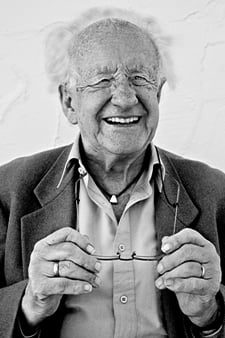
johangaltung

Testimony for Russell Tribunal on Palestine – New York City

Honorable Members of the Jury!

Sociocide is a new concept that has not found its place in positive international law. But Genocide, the unspeakable crime of massive killing of members of a genus, a nation, for no other reason than membership, has. And Ecocide, the unspeakable crime of killing Mother Earth who nourishes us all, is finding its place via the constitutions of some countries in Latin America.

Sociocide, the killing of a society’s capacity to survive and to reproduce itself, should become equally and prominently a crime against humanity. A society is a self-reproducing social system. So are human beings, with our basic needs for survival, wellness, identity, freedom. Society is also an organism, with a lifespan far beyond that of individuals. For humans to survive as humans their basic needs have to be met. For that to happen the society has to survive. For the society to survive the basic social prerequisites must be met:

* for security, against violence, killing, wounding the members;

* for economic sustainability, against their starvation, illness;

* for identity culturally, a meaning with life, against alienation;

* for autonomy politically, to be a master of their own house.

As society unfolds so do humans, and vice versa. Life breeds life.

This also holds for nomadic societies based on hunter-gatherers. Monasteries are incapable of self-reproduction biologically when based on one gender, but are highly viable societies based on recruitment.

Under modernity, identity is carried by the nation, with four characteristics: an idiom, a religion – world view, a history – of the past, present and future–and geographical attachment. Time, Space, with the means to communicate and something to believe is crucial.

Under modernity the state is the key executor of all the above.

Sociocide is the intended wounding-killing of a society by eliminating the prerequisites for a live, vibrant, dynamic society.

Sociocide molests the human members. In the longer run, lethally. Sociocide is what Western, and not only Western, colonialism has done for centuries, denying others their autonomy, imposing their own identity–language and world-view–moving others out of their own historical dialectic and into history as Western periphery, denying them the land they are attached to with their hearts and minds.

And their bodies for security and sustenance, for food, water, health. Israel is a part of that Western tradition, with one exception: the Jewish past, hidden in the fog of myths. But some past it was, and on those lands. So I myself have been and am a supporter of a state with Jewish characteristics, not a Jewish state for Jews only, within 1967 borders; having argued so strongly in Arab countries. However, I believe neither in a one-state nor in a two-state, but in a six-state solution: a community modeled on the 1958 European Community; Israel with the five Arab border states: Syria, Lebanon, Jordan, Egypt and Palestine fully recognized according to international law.

But Israeli politics has been and remains in the tradition of Western settler colonialism, bringing in more settlers, deepening the colonialism. So let us bring in the criteria of sociocide.

Security. The Palestinians are denied the right to have a military; any effort to defend themselves against occupation is to Israel a casus belli. Moreover, to Israel, nonviolence as an alternative approach to Palestinian security is met with military means, as a war. And the task of the Palestinian police is to protect Israeli settlers against Palestinians, not to protect Palestinians.

Sustenance. Depriving Palestinians of enormous swaths of land through the nakba, erasing and confiscating Palestinian villages, denying them the good soil, the water, with no end in sight.

Idiom, world-view. By and large is left untouched, but is asymmetric: Arabs have to learn Hebrew, not vice versa; no respect for Islam.

Time. Absolutely crucial. Public reference to the nakba becoming illegal, Palestinians are deprived of a major part of their past; with no monuments and none of their symbols in public space. The present is an unending harassment that impairs coherent life. And still worse: futurelessness through massive uncertainty. Israel never declares where those recognized and secured borders are located (Nile to the Euphrates?); being unpredictable, the future shrinks to survival.

Space. Sacred space, our land, not soil as resource, also shrinks below a minimum and makes Palestinians strangers in their own lands.

State. Denial; there exists only a weak “Palestinian Authority” with no “final state”. Instead of that there is exploitation of Palestinians, efforts to colonize their minds as second class citizens, Israelis using Palestinians only for the most menial tasks, fragmenting them territorially inside-outside Israel, promoting divisions between the West Bank and Gaza, inside the West Bank, and also by the Wall. Palestinians are in general marginalized.

Is Palestine the victim of sociocide by Israel? Indeed!

Security, sustenance, time, space, state, idiom, worldview, not five out of seven. Not dead, but badly wounded. No healing in sight.

Gaza is alive; but armed attacks against Israel however understandable are counterproductive. Nonviolence conveys the future one wants to see, with care, given the Israeli response. Use bi- and multilateral diplomacy, increasing international legitimacy of a Palestinian state, promoting the nation through UNESCO, and the state through the UN.

But above all working for a positive vision of the future. A live Palestinian state with all prerequisites met is indispensable. But so is an image of a community with Israel, now autistic and possibly in a process of socio-suicide, increasingly isolated. With equitable cooperation, mutual empathy and traumas cleared, in the South African way.

The USA and Israel were born in the same way, as God’s chosen people with promised lands, using sociocide and genocide (the USA). With no policy change they may also decline and fall in the same way. Even so soon.

Originally published here.

Related Posts

A Message from Jan Oberg November 6, 2026 Over the past fifty years, I have devoted roughly 175,000 hours to research and public education for a more peaceful world: thinking, researching, writing, organising, publishing, debating, maintaining websites, corresponding, reaching out, leading a foundation, work in conflict and war zones, professorships, teaching courses and giving public lectures and doing media work. In short, ten hours a day, seven days a week, for half a century. The focus was on international political peace – analysing and trying to stop wars, address underlying conflicts and making alternative peace plans – at the desk and on the ground. Important as that has been and remains, it is only one kind of peace and it is now in a tragic militarist state compared with what it could have been.  Lately, however, I have found myself thinking about a concept from economics as well as everyday...
What the West Borrowed from Asia and What It Left Behind Jan Krikke October 8, 2026 The article was originally published here In the late 1960s, the musical Hair announced that the Age of Aquarius was dawning. Its opening anthem promised a transformation of human consciousness: an era of peace, harmony and understanding. Half a century later, a familiar echo of that promise is a meditation app offered by your employer. You can find it in the same list of benefits as the pension plan and the gym discount. How did a spiritual revolution become an employee benefit? The answer lies in the history of the movement known as New Age: where it came from, what it borrowed from Asia, and why the meaning of what it borrowed changed in the process. Two definitions will help. New Age is a loose label for a wide range of spiritual practices and...
The agreement is catastrophic both because of what it says and what it doesn’t mention. It reduces further the major asset of security policies: Freedom of action. Jan Oberg TFF director September 25, 2026 A couple of hours before the agreement was signed on September 22, 2026, I published the following 13 hypotheses about what it would most likely contain on TFF Substack (in English). I was wrong on only the first point. Contrary to what Trump had written on his Truth Social platform, it does not appear to come into force immediately. In fact, it turned out to be worse than even I had anticipated. After these hypotheses now come a number of reflections in light of what the agreement actually contains, and does not contain, as well as the way in which it has generally been presented by major media outlets and by the public-service broadcaster DR. My...

Recent Articles

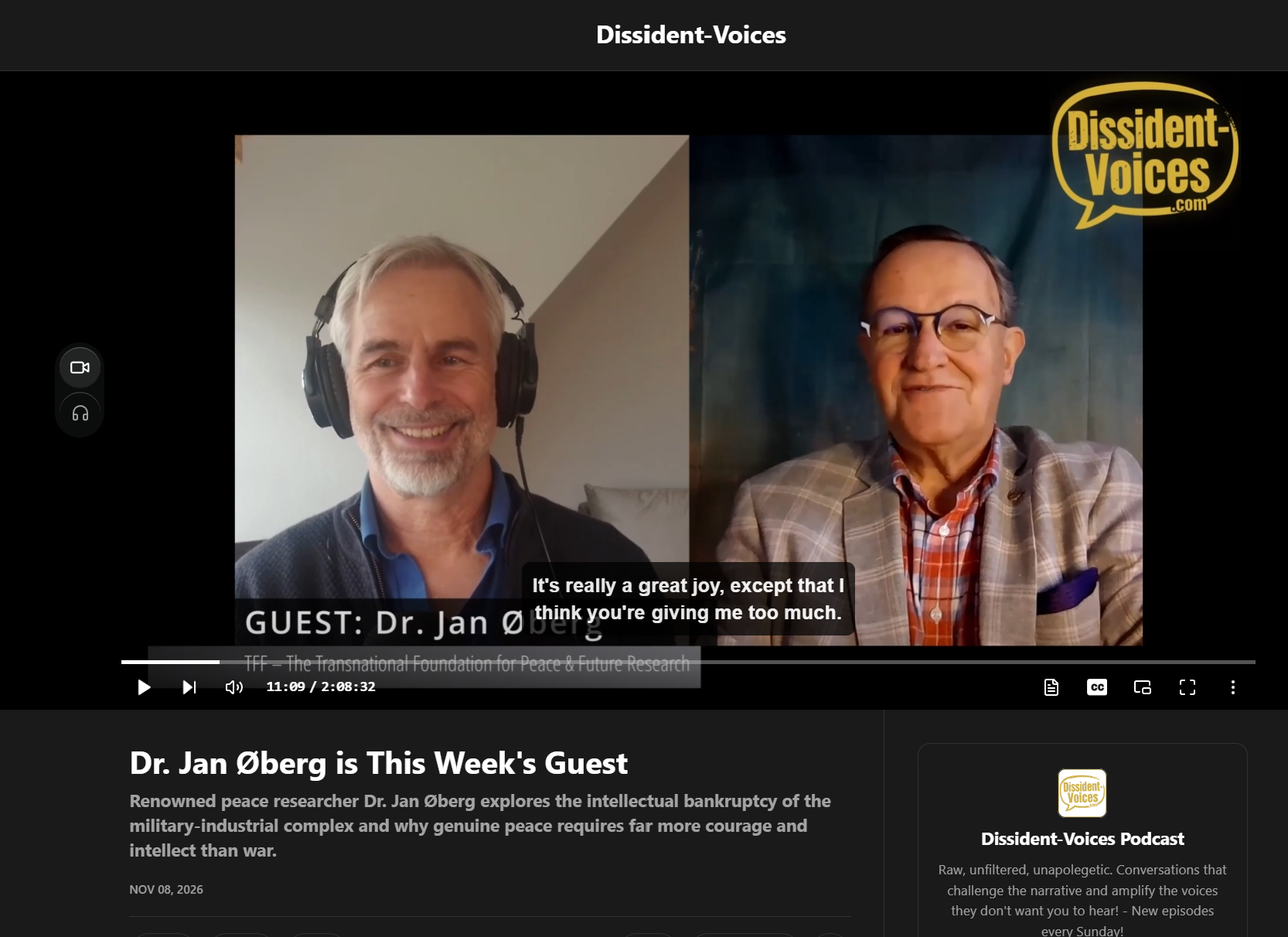
Serious but also a lot of laughs and positive energy. Because peace is also about conviviality and enchantment… Jan Oberg, TFF director November 16, 2026 This is a long (129 minutes) conversation with me. We cover very many, also personal, issues that makes a somewhat unusual media event. I am very grateful to Flemming Blicher for giving me this opportunity. I can’t remember any channel or editor who spent as much time as he did preparing it – including also asking me to answer a series of pre-interview questions, which are now posted under the conversation. If you sympathise with its content, please share it. Watch it here
A Message from Jan Oberg November 6, 2026 Over the past fifty years, I have devoted roughly 175,000 hours to research and public education for a more peaceful world: thinking, researching, writing, organising, publishing, debating, maintaining websites, corresponding, reaching out, leading a foundation, work in conflict and war zones, professorships, teaching courses and giving public lectures and doing media work. In short, ten hours a day, seven days a week, for half a century. The focus was on international political peace – analysing and trying to stop wars, address underlying conflicts and making alternative peace plans – at the desk and on the ground. Important as that has been and remains, it is only one kind of peace and it is now in a tragic militarist state compared with what it could have been.  Lately, however, I have found myself thinking about a concept from economics as well as everyday...
Photo above: Carl Fredrik Reuterswärd’s Non-Violence outside UN Headquarters in New York. Kirill Levin, CC BY-NC-SA 2. Jan Oberg November 3, 2026 I am happy to be published in Horizons which is produced by the Center for International Relations and Sustainable Development, CIRSD, in Belgrade. My contribution brings out a radical re-thinking of what concepts such as defence, security, deterrence – and peace – may mean if we want to create a more peaceful world. It also summarises a few things I have been working with the last few decades. Please read it here Og her er den på dansk, takket være Johnny Baltzersens lynhurtige oversættelse

TFF on Substack

Discover and subscribe to more peace materials on TFF Substack

Most Popular

Serious but also a lot of laughs and positive energy. Because peace is also about conviviality and enchantment… Jan Oberg, TFF director November 16, 2026 This is a long (129 minutes) conversation with me. We cover very many, also personal, issues that makes a somewhat unusual media event. I am very grateful to Flemming Blicher for giving me this opportunity. I can’t remember any channel or editor who spent as much time as he did preparing it – including also asking me to answer a series of pre-interview questions, which are now posted under the conversation. If you sympathise with its content, please share it. Watch it here
A Message from Jan Oberg November 6, 2026 Over the past fifty years, I have devoted roughly 175,000 hours to research and public education for a more peaceful world: thinking, researching, writing, organising, publishing, debating, maintaining websites, corresponding, reaching out, leading a foundation, work in conflict and war zones, professorships, teaching courses and giving public lectures and doing media work. In short, ten hours a day, seven days a week, for half a century. The focus was on international political peace – analysing and trying to stop wars, address underlying conflicts and making alternative peace plans – at the desk and on the ground. Important as that has been and remains, it is only one kind of peace and it is now in a tragic militarist state compared with what it could have been.  Lately, however, I have found myself thinking about a concept from economics as well as everyday...
Photo above: Carl Fredrik Reuterswärd’s Non-Violence outside UN Headquarters in New York. Kirill Levin, CC BY-NC-SA 2. Jan Oberg November 3, 2026 I am happy to be published in Horizons which is produced by the Center for International Relations and Sustainable Development, CIRSD, in Belgrade. My contribution brings out a radical re-thinking of what concepts such as defence, security, deterrence – and peace – may mean if we want to create a more peaceful world. It also summarises a few things I have been working with the last few decades. Please read it here Og her er den på dansk, takket være Johnny Baltzersens lynhurtige oversættelse
Read More
Screenshot 2026-11-10 174455
Serious but also a lot of laughs and positive energy. Because peace is also about conviviality and enchantment… Jan Oberg, TFF director November 16, 2026 This is a long (129 minutes) conversation with me. We cover very many, also personal, issues that makes a somewhat unusual media event. I am very grateful to Flemming Blicher for giving me this opportunity. I can’t remember any channel or editor who spent as much time as he did preparing it – including also asking me to answer a series of pre-interview questions, which are now posted under the conversation. If you sympathise with its content, please share it. Watch it here
AbstractVision_2017_#1_800 (kopia)
A Message from Jan Oberg November 6, 2026 Over the past fifty years, I have devoted roughly 175,000 hours to research and public education for a more peaceful world: thinking, researching, writing, organising, publishing, debating, maintaining websites, corresponding, reaching out, leading a foundation, work in conflict and war zones, professorships, teaching courses and giving public lectures and doing media work. In short, ten hours a day, seven days a week, for half a century. The focus was on international political peace – analysing and trying to stop wars, address underlying conflicts and making alternative peace plans – at the desk and on the ground. Important as that has been and remains, it is only one kind of peace and it is now in a tragic militarist state compared with what it could have been.  Lately, however, I have found myself thinking about a concept from economics as well as everyday...
knotted gun
Photo above: Carl Fredrik Reuterswärd’s Non-Violence outside UN Headquarters in New York. Kirill Levin, CC BY-NC-SA 2. Jan Oberg November 3, 2026 I am happy to be published in Horizons which is produced by the Center for International Relations and Sustainable Development, CIRSD, in Belgrade. My contribution brings out a radical re-thinking of what concepts such as defence, security, deterrence – and peace – may mean if we want to create a more peaceful world. It also summarises a few things I have been working with the last few decades. Please read it here Og her er den på dansk, takket være Johnny Baltzersens lynhurtige oversættelse
TFFPortfolioVign
UNITE-tillid, DREAM-velstand og andre konstruktive komponenter Normally we publish articles in English here. But this is a translation of a very important TFF document that should reach as many as possible in Denmark since this country’s government has been one of the most hardline in Europe and, up till now at least, has refused to use diplomacy and, instead, spent tremendous sums on arming Ukraine with the express goal of defeating Russia. Thus this – unique – article is in Danish. Vi er Johnny Baltzersen og hans Fælles Sikkerhed – Fælles Fremtid på Substack overmåde taknemmelige for at have oversat og publiceret TFF’s 2025-portfølje for fredsidéer med henblik på Ukraines fremtid. Vi håber den nu kan nå mange flere danskere – som også vil sprede den og skabe debat – nu den danske regerings og folketingspartiernes politik på dette område siden 2022 står nu – forudsigeligt – ved vejs ende....
JoGSS-Silent
Jan Oberg TFF director October 28, 2026 Exactly one month has now passed since I published my criticism of the introduction to the special issue on Johan Galtung published by the Journal of Global Security Studies, JoGSS, and of Tor Egil Førland’s chapter about Galtung which serves as a preview to his forthcoming biography of Galtung to be published by PRIO. See the original on The Transnational here and the same article on TFF Substack with many general and critical comments and, in particular, the people who decided to withdraw from the biography project in protest. The special issue itself was extraordinary. It was devoted to the intellectual legacy of one of the founders of peace research and contained a number of strong assessments of his personality, scholarship, intellectual trajectory, and public role. Such assessments are, of course, entirely legitimate. No scholar is beyond criticism, and neither was Johan Galtung....
Screenshot 2026-10-26 115647
An aspect of Iran’s culture and civilisation you’ve probably never heard about. Don’t be surprised if the US and Israel also try to bomb them. Jan ObergTFF director October 26, 2026 Today – under the “USraeli” threat of new “annihilating” bombings – opens the 7th International Conference on Peace and Conflict Resolution at Tehran’s University. As far as I can tell, this is the only permanent, advanced peace research institution in West Asia/the Middle East. Perhaps more countries in that region could be inspired? I mean, how many military “security” institutes and military academies do they have? Many peace research institutes and university departments have been established since the 1950s in the West. They are now all under attack; some have closed down, some have gone mainstream, yet others kept the name but do nothing to research peace and disseminate results or advice; instead, they cooperate with militarism’s platforms such...