
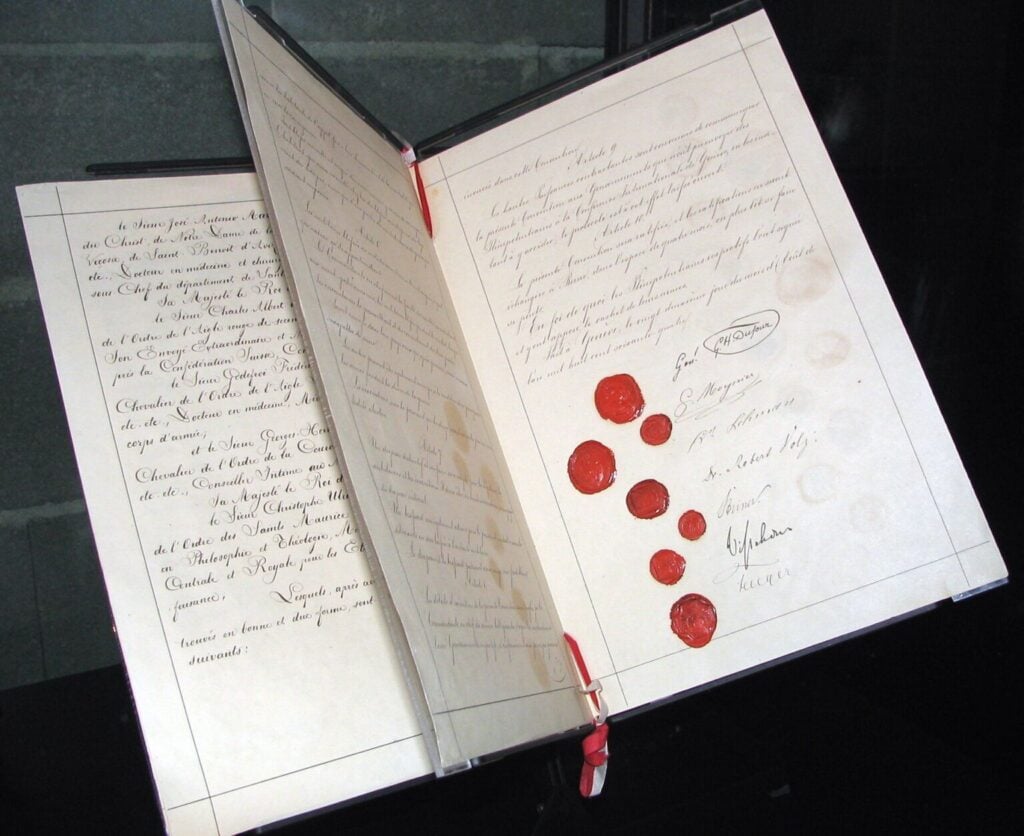
A facsimile of the signature-and-seals page of the 1864 Geneva Convention. Photograph Source: Kevin Quinn, Ohio, US – CC BY 2.0

Alfred De Zayas

September 26, 2023

Progress and retrogression characterize the reality of international law, international relations, and the concrete enjoyment of human rights by women and men throughout the planet. We hail the tides of opportunity, the times of liberation and expansion, but we should not be blind to recurrent abuses, crimes, and moments of disgrace.

Today our world is experiencing chaos, but not more so than in the 18th, 19th and 20th centuries. At least we are not burning witches or massacring indigenous Hopi, Pequots, Sioux, Quechua and Taínos, the slave trade is abolished, colonialism is drastically reduced. We welcome the landmark resolution 48/7 adopted by the UN Human Rights Council on 8 October 2021 concerning the legacies of colonialism in Africa, Asia and Latin America, particularly concerning indigenous peoples whose suffering over the centuries has not been assuaged and who continue to suffer from the sequels of structural violence[1].

Originally published on Counterpunch, September 26, 2023

On the positive side, we have witnessed a phenomenal codification of legal norms, the UN Charter, the UDHR, the Covenant on Civil and Political Rights (ICCPR), the Vienna Convention on the Law of Treaties, the Vienna Convention on Diplomatic Relations, the Geneva Red Cross Conventions, the establishment of national human rights institutions and regional human rights courts. Proposals for the creation of an International Court of Human Rights whose judgments would be enforceable[2]are under discussion.

We are justified in applauding the growing recognition of the rights of half the population of the planet – women — we hail concrete measures being taken on behalf of persons with disabilities. We welcome the entry into force in January 2021 of the Treaty on the Prohibition of Nuclear Weapons[3], the Declaration of October 2021 by the Human Rights Council recognizing the Environment as a Human Right[4].  We express relief over the gradual abolition of the aberration of “capital punishment”[5].

Notwithstanding the self-congratulatory celebrations around the 75th anniversary of the adoption of the UDHR, we must admit that there is significant retrogression in many fields, including the erosion of the concept of Peace as a Human Right, the backsliding from General Assembly Resolution 39/11 of 12 November 1984[6], the belligerent intransigence of many countries and their unwillingness to talk with each other, in spite of their hard law obligation to do so pursuant to Article 2(3) UN Charter.

We denounce the continued practice of torture in many countries, the disgrace of Abu Ghraib, Guantanamo[7], “extraordinary renditions”, secret CIA prisons, indefinite detention[8], the glorification of war, the social acceptance of war propaganda, notwithstanding the fact that it is specifically prohibited in article 20 of the ICCPR, the weaponization of the administration of justice in many countries and the breakdown of the rule of law in some countries ostensibly committed to human rights, e.g. in the US, UK, Sweden, Ecuador, as meticulously documented by UN Rapporteur on Torture, Professor Nils Melzer, in his well-sourced book on the persecution of whistleblower Julian Assange[9]. Indeed, the scandalous treatment of Assange constitutes torture under article 7 ICCPR, a gross violation of the rights of journalists, and a violation of our right to know under article 19 ICCPR.  What Professor Melzer reveals is far worse than the Dreyfus Affair of 1898. Melzer is the Emile Zola of the 21st century.

We deplore the scourge of 25 million victims of human trafficking, including 3.4 million children. We denounce the escalation of urban violence and mass-killings, the rise of international terrorism.  Notwithstanding the many institutions established to monitor adherence to human rights treaties, notwithstanding the regular meetings of the Human Rights Council, Human Rights Committee, Committee Against Torture, national human rights institutions, civil society organizations, outrageous violations of human dignity continue to occur.  Is this perhaps partly attributable to the fact that some of these institutions have been hijacked by geopolitical players, display selective indignation and practice double-standards?

Today there is scarce protection of the democratic right to know, the right to access information, the right to freedom of opinion and expression[10]. We see censorship by governments and the private sector, arbitrariness in Facebook and YouTube, the blocking of news services including RT, Sputnik and Tass in EU countries, the Orwellian new Digital Services Act, the brazen brainwashing practiced by the media, the excesses of “cancel culture”, the epidemic of self-censorship, the social acceptance of Russophobia and Sinophobia, the weaponization of sports so that sportswomen and men can be banned from competition merely on account of their nationalities.

Serious retrogression becomes evident in the weakened protection of privacy, the Orwellian surveillance of NSA and other government institutions as revealed by Edward Snowden in his watershed book Permanent Record[11]. We deplore the failure of governments to protect family life and family values, the concerted attacks on the concept of the family and parental authority, the denigration and ridicule of religious beliefs.

Retrogression is also apparent in the actions and omissions of institutions established to protect our rights. Many institutions, rapporteurs, “independent commissions”  are demonstrably in the service of certain powerful countries and lobbies, have become hostage to donors who pretend to set the agendas of monitoring bodies and mechanisms that should be rigorously neutral and professional[12].

Quis custodiet ipsos custodes?[13] Who guards over the guardians? Crucial institutions such as the UN Human Rights Council, ECHR, IACHR, OPCW, ICC are betraying their mandates, instrumentalizing human rights for purposes of geopolitical confrontation, instead of devising preventive strategies and mechanisms to secure human dignity for all women and men on the planet.

Only we can be the guardians! While we realize that governments lie to us on a daily basis, we must push back and reclaim democracy. We do not need any Ministry of Truth as in 1984. Alas, it appears that we have gradually entered the dystopia of Aldous Huxley’s Brave New World.

Among the gravest instances of retrogression is the degradation of international criminal law into a political tool of “lawfare”.  One observes an unhealthy obsession with punishment, an aggressive self-righteousness that invites us to lapidate the adulteress (John VIII, 1-11). If Christianity taught us anything, it is that we must forgive to be forgiven: et dimite nobis debita nostra sicut et nos dimitimus debitoribus nostris.  The recognition that the world is not black and white is not just a religious tenet but actually belongs to civilization.  It is easy to understand that sometimes there is bad in the good and even some good in the bad. Revenge is surely not conducive to reconciliation, and in order to live together in mutual respect, we must practice understanding and caritas.

Alas, the mainstream NGOs – with the complicity of the media — have transformed the concept of “amnesty” into a curse word. Yet, amnesties are not bad per se. Sometimes amnesties are necessary for peace. Article 6 of the Second Additional Protocol of 1977 to the Geneva Conventions stipulates “the authorities in power shall endeavour to grant the broadest possible amnesty to persons who have participated in the armed conflict”.  Article 2 of the Peace of Westphalia stipulates “there shall be on the one side and the other a perpetual Oblivion, Amnesty, or Pardon of all that has been committed since the beginning of these Troubles, in what place, or what manner soever the Hostilities have been practiced, in such a manner, that nobody, under any pretext whatsoever, shall practice any Acts of Hostility, entertain any Enmity, or cause any Trouble to each other other…”[14] Similar amnesties were agreed upon in countless peace treaties e.g. the Peace of Rijkswijk of 1697, the Congress of Vienna of 1814-15, and more recently the Evian Accords of 1962.

We are told that the establishment of the International Criminal Court in 2002 represents progress.  Some, however, consider it a significant step back to the primitive age of the law of revenge, lex talionis. Indeed, vengeance is incompatible with the acquis of civilization. Punishment is hardly a civilized answer to problems, inter alia because punishment is ex post facto, after the fact, and frequently does nothing at all for the victims. Moreover, there is scarce evidence that international criminal law has generated any deterrence.

What society really needs is prevention of crime, prevention of war, prevention of hatred. A Global Pact on Education for peace and empathy would be a way forward.  The United Nations should champion such an initiative and place all UN agencies in the service of peace, notably UNESCO.  Conflict-prevention depends on good faith, mutual respect, international solidarity – and, yes, intellectual honesty.

The Universal Declaration of Human Rights, adopted 75 years ago at the Palais Chaillot in Paris, was indeed a high point in the tide of human rights. Hitherto we have failed to implement its provisions, particularly Article 28: “Everyone is entitled to a social and international order in which the rights and freedoms set forth in this Declaration can be fully realized”. That remains our challenge, to rediscover the spirituality of the UDHR and revive the legacy of Eleanor Roosevelt[15].

Notes

[1] https://undocs.org/Home/Mobile?FinalSymbol=A%2FHRC%2FRES%2F48%2F7&Language=E&DeviceType=Desktop&LangRequested=False

[2] https://www.deepdyve.com/lp/brill/an-international-court-of-human-rights-N0d0HxEk8H

https://www.ohchr.org/en/special-procedures/ie-international-order/mr-alfred-maurice-de-zayas-former-independent-expert-2012-2018

[3] https://disarmament.unoda.org/wmd/nuclear/tpnw/

[4] https://digitallibrary.un.org/record/3945636

[5] https://www.cambridge.org/core/books/abolition-of-the-death-penalty-in-international-law/28291346A4A68C4CA2097E813007EC3A

[6] https://www.ohchr.org/en/instruments-mechanisms/instruments/declaration-right-peoples-peace

[7] https://opil.ouplaw.com/display/10.1093/law:epil/9780199231690/law-9780199231690-e301

https://searchlibrary.ohchr.org/record/6182

[8] https://www.icrc.org/en/doc/assets/files/other/irrc_857_zayas.pdf

[9] Nils Melzer, The Trial of Julian Assange, Verso Books, New York 2022.

[10] https://www.cambridge.org/core/journals/netherlands-international-law-review/article/abs/freedom-of-opinion-and-freedom-of-expression-some-reflections-on-general-comment-no-34-of-the-un-human-rights-committee/ADCD74F635F688851788E9079E1ABB76

[11] Metropolitan Books, New York, 2019.

[12] Alfred de Zayas, The Human Rights Industry, Clarity Press, 2023.

[13] Juvenal, 6th Satire.

[14] https://theranddaily.com/the-peace-of-westfalia-treaties

[15] www.eleanorlives.org

Alfred de Zayas is a law professor at the Geneva School of Diplomacy and served as a UN Independent Expert on International Order 2012-18. He is the author of twelve books, including “Building a Just World Order” (2021) “Countering Mainstream Narratives” 2022, and “The Human Rights Industry” (Clarity Press, 2021).


Related Posts

The agreement is catastrophic both because of what it says and what it doesn’t mention. It reduces further the major asset of security policies: Freedom of action. Jan Oberg TFF director September 25, 2026 A couple of hours before the agreement was signed on September 22, 2026, I published the following 13 hypotheses about what it would most likely contain on TFF Substack (in English). I was wrong on only the first point. Contrary to what Trump had written on his Truth Social platform, it does not appear to come into force immediately. In fact, it turned out to be worse than even I had anticipated. After these hypotheses now come a number of reflections in light of what the agreement actually contains, and does not contain, as well as the way in which it has generally been presented by major media outlets and by the public-service broadcaster DR. My...
This is not another geopolitical commentary on the Arctic. It is a visionary peace proposal that can save the region from militarised rivalry and ecological ruin. A blueprint for shared security, sustainable development, and human dignity — benefitting Greenland, the Arctic, and the rest of us. Jan Oberg TFF director Lund, Sweden, February 17, 2026 I. Four Principles for a New Arctic Vision The Arctic is often framed as a cold arena of rivalry — a place where great powers test each other’s resolve. But this worldview is outdated, unimaginative, and ultimately self‑defeating. The Arctic is not a vacuum waiting to be militarised; it is a living region, a climate stabiliser, and a cultural homeland whose future will shape the future of humanity. If we begin from that understanding, a far more rational Arctic order becomes possible — one that is peaceful, cooperative, and centred on the people who actually live there. This vision rests...
PART 2 — Diplomacy, Law and Nonviolent Power By Jan ObergTFF co-founder and director January 26, 2026 This is the second of four TFF-created idea portfolios designed to curb the global reach of the United States and, in both the short and long term, help catalyse a worldwide nonviolent resistance to what many observers describe as the Trump administration’s uniquely confrontational, destructive and world-threatening policies. These portfolios outline what governments and citizens across the world can do through dynamic diplomacy, creative initiatives, and strictly nonviolent means. They are typical TFF works in that we do not only tell what the problem is and how bad it will go – as 90+% of all commentators, experts and scholars do – we tell what we think can be done, inviting you to think of what you think you can do. It seems painfully clear to me that the current political dynamics in Washington increasingly resemble the most dangerous...

Recent Articles

Photo above: Carl Fredrik Reuterswärd’s Non-Violence outside UN Headquarters in New York. Kirill Levin, CC BY-NC-SA 2. Jan Oberg November 3, 2026 I am happy to be published in Horizons which is produced by the Center for International Relations and Sustainable Development, CIRSD, in Belgrade. My contribution brings out a radical re-thinking of what concepts such as defence, security, deterrence – and peace – may mean if we want to create a more peaceful world. It also summarises a few things I have been working with the last few decades. Please read it here Og her er den på dansk, takket være Johnny Baltzersens lynhurtige oversættelse
UNITE-tillid, DREAM-velstand og andre konstruktive komponenter Normally we publish articles in English here. But this is a translation of a very important TFF document that should reach as many as possible in Denmark since this country’s government has been one of the most hardline in Europe and, up till now at least, has refused to use diplomacy and, instead, spent tremendous sums on arming Ukraine with the express goal of defeating Russia. Thus this – unique – article is in Danish. Vi er Johnny Baltzersen og hans Fælles Sikkerhed – Fælles Fremtid på Substack overmåde taknemmelige for at have oversat og publiceret TFF’s 2025-portfølje for fredsidéer med henblik på Ukraines fremtid. Vi håber den nu kan nå mange flere danskere – som også vil sprede den og skabe debat – nu den danske regerings og folketingspartiernes politik på dette område siden 2022 står nu – forudsigeligt – ved vejs ende....
Jan Oberg TFF director October 28, 2026 Exactly one month has now passed since I published my criticism of the introduction to the special issue on Johan Galtung published by the Journal of Global Security Studies, JoGSS, and of Tor Egil Førland’s chapter about Galtung which serves as a preview to his forthcoming biography of Galtung to be published by PRIO. See the original on The Transnational here and the same article on TFF Substack with many general and critical comments and, in particular, the people who decided to withdraw from the biography project in protest. The special issue itself was extraordinary. It was devoted to the intellectual legacy of one of the founders of peace research and contained a number of strong assessments of his personality, scholarship, intellectual trajectory, and public role. Such assessments are, of course, entirely legitimate. No scholar is beyond criticism, and neither was Johan Galtung....

TFF on Substack

Discover and subscribe to more peace materials on TFF Substack

Most Popular

Photo above: Carl Fredrik Reuterswärd’s Non-Violence outside UN Headquarters in New York. Kirill Levin, CC BY-NC-SA 2. Jan Oberg November 3, 2026 I am happy to be published in Horizons which is produced by the Center for International Relations and Sustainable Development, CIRSD, in Belgrade. My contribution brings out a radical re-thinking of what concepts such as defence, security, deterrence – and peace – may mean if we want to create a more peaceful world. It also summarises a few things I have been working with the last few decades. Please read it here Og her er den på dansk, takket være Johnny Baltzersens lynhurtige oversættelse
UNITE-tillid, DREAM-velstand og andre konstruktive komponenter Normally we publish articles in English here. But this is a translation of a very important TFF document that should reach as many as possible in Denmark since this country’s government has been one of the most hardline in Europe and, up till now at least, has refused to use diplomacy and, instead, spent tremendous sums on arming Ukraine with the express goal of defeating Russia. Thus this – unique – article is in Danish. Vi er Johnny Baltzersen og hans Fælles Sikkerhed – Fælles Fremtid på Substack overmåde taknemmelige for at have oversat og publiceret TFF’s 2025-portfølje for fredsidéer med henblik på Ukraines fremtid. Vi håber den nu kan nå mange flere danskere – som også vil sprede den og skabe debat – nu den danske regerings og folketingspartiernes politik på dette område siden 2022 står nu – forudsigeligt – ved vejs ende....
Jan Oberg TFF director October 28, 2026 Exactly one month has now passed since I published my criticism of the introduction to the special issue on Johan Galtung published by the Journal of Global Security Studies, JoGSS, and of Tor Egil Førland’s chapter about Galtung which serves as a preview to his forthcoming biography of Galtung to be published by PRIO. See the original on The Transnational here and the same article on TFF Substack with many general and critical comments and, in particular, the people who decided to withdraw from the biography project in protest. The special issue itself was extraordinary. It was devoted to the intellectual legacy of one of the founders of peace research and contained a number of strong assessments of his personality, scholarship, intellectual trajectory, and public role. Such assessments are, of course, entirely legitimate. No scholar is beyond criticism, and neither was Johan Galtung....
Read More
knotted gun
Photo above: Carl Fredrik Reuterswärd’s Non-Violence outside UN Headquarters in New York. Kirill Levin, CC BY-NC-SA 2. Jan Oberg November 3, 2026 I am happy to be published in Horizons which is produced by the Center for International Relations and Sustainable Development, CIRSD, in Belgrade. My contribution brings out a radical re-thinking of what concepts such as defence, security, deterrence – and peace – may mean if we want to create a more peaceful world. It also summarises a few things I have been working with the last few decades. Please read it here Og her er den på dansk, takket være Johnny Baltzersens lynhurtige oversættelse
TFFPortfolioVign
UNITE-tillid, DREAM-velstand og andre konstruktive komponenter Normally we publish articles in English here. But this is a translation of a very important TFF document that should reach as many as possible in Denmark since this country’s government has been one of the most hardline in Europe and, up till now at least, has refused to use diplomacy and, instead, spent tremendous sums on arming Ukraine with the express goal of defeating Russia. Thus this – unique – article is in Danish. Vi er Johnny Baltzersen og hans Fælles Sikkerhed – Fælles Fremtid på Substack overmåde taknemmelige for at have oversat og publiceret TFF’s 2025-portfølje for fredsidéer med henblik på Ukraines fremtid. Vi håber den nu kan nå mange flere danskere – som også vil sprede den og skabe debat – nu den danske regerings og folketingspartiernes politik på dette område siden 2022 står nu – forudsigeligt – ved vejs ende....
JoGSS-Silent
Jan Oberg TFF director October 28, 2026 Exactly one month has now passed since I published my criticism of the introduction to the special issue on Johan Galtung published by the Journal of Global Security Studies, JoGSS, and of Tor Egil Førland’s chapter about Galtung which serves as a preview to his forthcoming biography of Galtung to be published by PRIO. See the original on The Transnational here and the same article on TFF Substack with many general and critical comments and, in particular, the people who decided to withdraw from the biography project in protest. The special issue itself was extraordinary. It was devoted to the intellectual legacy of one of the founders of peace research and contained a number of strong assessments of his personality, scholarship, intellectual trajectory, and public role. Such assessments are, of course, entirely legitimate. No scholar is beyond criticism, and neither was Johan Galtung....
Screenshot 2026-10-26 115647
An aspect of Iran’s culture and civilisation you’ve probably never heard about. Don’t be surprised if the US and Israel also try to bomb them. Jan ObergTFF director October 26, 2026 Today – under the “USraeli” threat of new “annihilating” bombings – opens the 7th International Conference on Peace and Conflict Resolution at Tehran’s University. As far as I can tell, this is the only permanent, advanced peace research institution in West Asia/the Middle East. Perhaps more countries in that region could be inspired? I mean, how many military “security” institutes and military academies do they have? Many peace research institutes and university departments have been established since the 1950s in the West. They are now all under attack; some have closed down, some have gone mainstream, yet others kept the name but do nothing to research peace and disseminate results or advice; instead, they cooperate with militarism’s platforms such...
Screenshot 2026-10-15 141837
Let’s discuss using AI to create peace – in contrast to boring geopolitics devoid of creative healing and visions. Jan Oberg TFF director October 15, 2026 I asked VEED to create a short video exemplifying how peace is preferable to war, then chose the lady as a template. Simple as that. In less than a minute, it produced this video, which any peace-loving person would appreciate. The only problem is that human intelligence (HI), at least the one that exists among Western decision-makers, isn’t half as moral or smart as AI. I have used AI to dialogue about peace and peace plans, creative conflict resolution and visions of a better future for humankind. It so happens that I am having more stimulating, intelligent, creative and moral discussions with AI than I could possibly have with any EU or NATO leader today. Yes, AI has very problematic and dangerous aspects; used...
girl-5894831_1280
Below are TFF-related media mentions, comments, videos and social media posts published elsewhere but not on this homepage. We happen to catch and list only a fraction. Regarding video comments and debates, we recommend that you go to the TFF Video Channel on Substack where many of them are reproduced. Jan Oberg is a contributor to China Daily – 52 million daily clicks – and Global Times, CGTN and CCTV (the national television), China Investment, Xinhua News Agency and several others. Articles and videos on these media very often multiply into countless Chinese (and Western media) that re-post them from these main media. Thanks to The China Academy, his analyses, interviews and comments are frequently posted on YouTube channels such as Thinkers Forum and Wave Media. These videos are often re-posted on Bilibili (China’s YouTube), the China Content Center on TikTok, and on the Chinese edition of TikTok, Douyin.com. This means reaching hundreds of millions of viewers worldwide over a year. While there are too many to catch on all these...



