
Present Perverse Priorities Will Undermine the UN Even Further!


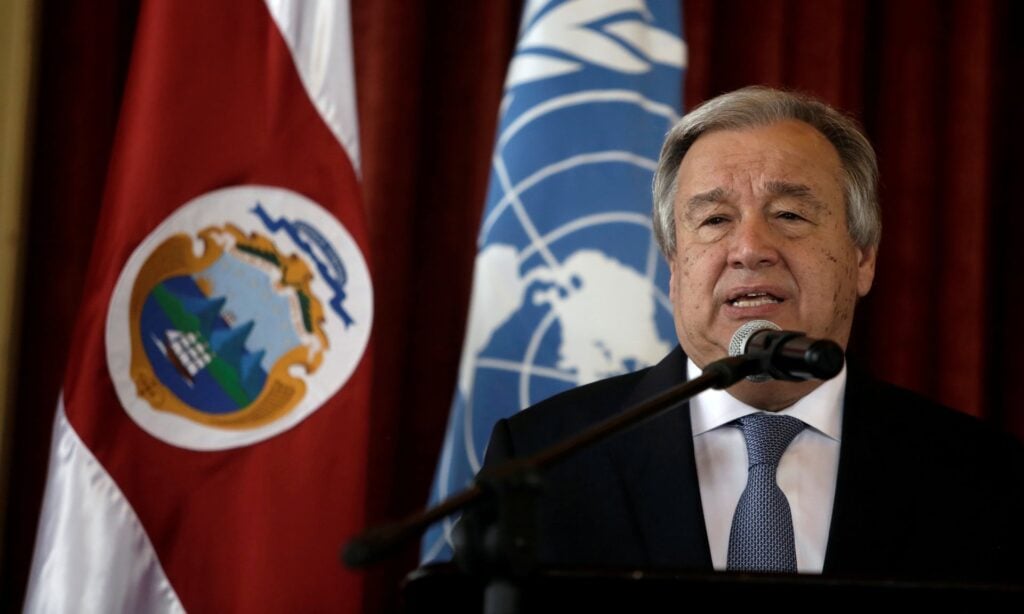
The news came a few days ago: “UN Secretary-General Antonio Guterres warned member states that the organization is facing “troubling funding issues as a result of delayed dues payments that will force reductions in non-staff costs.”
But who really cares? Any Trump tweet or football result is more important to our media and politicians. The members of the UN still give the world’s military about 340 times more than the UN for its core budget.


s: The UN will never be stronger or better than the member states want it to be.

That is the essential – and in some sense also existential – truth about the world’s potentially most important and visionary organisation.

A second truth is that the UN is not, at least not predominantly, the power house in New York (which, in passing, ought to be moved out of the US given the decade-long contempt for the UN Charter shown by that member). The real UN is the family of UN agencies that do good around the world every day and without which the world would be a much worse place.

A third truth is that a few predominantly Western states – the U.S. in particular – have done their utmost at least since the 1990 wars in Yugoslavia (and some would say since Korea and Vietnam) to undermine and marginalise the world organisation.

Those and many other member states violate the UN Charter’s Article 1 which states that peace shall be established by peaceful means on a daily basis, misuse the organisation – the Five Permanent Members in particular with their nuclear weapons and repeated violations of international law. Think of all the wars fought since Yugoslavia without a UN Security Council mandate but have destroyed countries, peoples, economies and cultures.

And the UN too.

If they could, they would love to get rid of the UN once and for all. Because it is based on a Charter that is the most Gandhian governments have ever signed. Back in time, that is, when governments and peoples knew what war was and therefore stated in the Charter’s Preamble that war shall be abolished as a socially acceptable institution – to boil it down to essentials.

And where are we then today?

Well, did you hear any of these states – the UN Security Council members in particular – insist on the point that large, robust UN peacekeeping missions should be established in, say, Libya, Syria or Ukraine? No, it is Russia and the US that keep the “peace” in Syria, right? The truth is that the US has done nothing there but to support various other militant countries and terrorist organisations and to build some 15-20 bases there. The UN wouldn’t have done any of that!

And while Russia (and Iran) have certainly had a relatively positive influence on the Syrian battlefields fighting terrorism, it is still warfare and not peacemaking. And peace – mind you – is not the same as a war dying down.

Self-appointed peacekeeping countries that are happy to have demolished the finest global organisation on earth are now doing – with nothing but tragic results – what the UN could have done much better had the world’s governments wanted it to and had they built on the accumulated UN experience since 1945.

Rampant militarism, nationalism, interventionism and anti-intellectualism among national “security” elites and political decision-makers – even in historically peaceful and humane countries such as my native Denmark – for decades have fought a war on peace and thus – perfectly logically – on the UN.

• •

When Srebrenica happened and know-nothing people blamed it all on “the Serbs” and “the UN”, who bothered to investigate how the member states deliberately blurred mandates and caused mission creep? How leading NATO countries’ military strike projects (the stupid “peace enforcement” doctrine) was devastating for the UN peace-keeping?

Who in the media asked politicians in all leading UN member states why they dispatched far too few peacekeepers – and how countries had provided the UN peacekeeping missions in Yugoslavia with less than 5% of what the UN peacekeepers estimated to be a minimum at the time to prevent things like Srebrenica from happening in the five other “safe” zones?

The then top UN Commander Lars-Erik Wahlgren required 32,000 peacekeepers from the world community and got 1200 Turks to Bosnia. That is 3,75% of what was needed!

So yes! And how easy – just blame it all on the UN!

Start wars wherever you please and then call in the UN to break its neck on one Mission Impossible after the other. In the end, it will be finished as the peace organisation it is and was meant to be. (At the time I argued that the UN S-G ought to have a right to say when members want to set up a UN mission to look good: If that is all you member states give us here at the UN, we refuse to set up the mission!)

Had anybody bothered to investigate the UN’s situation, they would have found that members avoided paying their dues so that the UN was de facto bankrupt when Srebrenica happened and would then be sure to fail. Such investigative journalism would have required more free media and research and it would have prevented all fingers being pointed at “the Serbs” (whose leader, Slobodan Milosevic in Serbia, had been called the mastermind of the massacre but was freed in two verdicts by the Hague Tribunal ten years after he died in his cell).

Another story not to be told? To cover up NATO countries’ remarkable ignorance coupled with a series of more or less law-violating efforts which all amounted to one thing: Peace prevention!


• •


And then the news came a few days ago: “UN Secretary-General Antonio Guterres warned member states that the organization is facing “troubling” funding issues as a result of delayed dues payments that will force reductions in non-staff costs.”

Here is a longer, very good background from The Guardian. To quote: “Letter sent to member states by António Guterres reveals $139m deficit in core budget…Guterres told member states that the UN’s core budget was in the red more deeply and earlier in its financial year than it had ever previously experienced…”

And then you may think: But the UN is also very expensive, isn’t it?

No, it is extremely cheap!

Read this paragraph in The Guardian article carefully: “The UN general assembly budget committee agreed in December on a $5.4bn core UN budget for 2018-19, which US ambassador Nikki Haley said was a cut of $285m from 2016-17. UN peacekeeping is funded separately.”

112 of the 193 members have paid their dues. OK. Some are unable to. OK. But then there is the United States of America paying 22% of that UN budget. Ask why others let it dominate the world institution instead of paying more themselves so the U.S. cannot dominate.

So we arrive at the terrible truth about war and peace budgets in our crisis-ridden world: The UN member states, pooling all their resources to provide the world’s most important organisation for peace, human rights, development etc. with a decent core budget, cannot find a little more than US$ 5 billion!

What do the same member states spend on their military, on warfare, death and destruction? About US$ 1700 billion!! Of which the United States alone around 700. And did we ever hear of a war stopping because of “funding issues”, delayed payments or forced military staff reductions?

In summary: 340 times more is spent on “security” and war than on the world’s best, common peace organisation’s core budget!


• •

Until the world begins to seriously question the Present Perverse Priorities (PPP) and change them fast as hell – what hope would you see for humanity’s future?

Watch your prime time TV news tonight. Read the best newspapers you know of. Listen to the debate in your parliament – or to your next dinner table conversation. And write to me if you hear anyone bringing up this world priority issue with urgency and passion or states that she/he will lift a finger to change those PPP in concrete, radical ways.

No matter how many reforms the UN needs – and yes it does – it is the member states that prevent them from being implemented.

Tell you what?

No matter how weak the UN is made by these narrowminded, warfighting states and their elites, the UN – its Charter, its idea, its professional and committed staff (I have met hundreds of them, civilian and military, around the world and admire them greatly) – will have my 110% support. And dare you to demolish it further before humanity has something new and much much better to switch to.

As long as the war on peace is on, the UN will not change – not unless we finally make it the organisation for “We, the peoples” and kick out “Them, the governments.”

Pay your dues! Increase them at least 100% within the next five year.

Or your talk about a better world is empty and opportunistic cynicism.

Stand by the UN, its norms and Charter! And do it now!


Recommended reading on priorities

Alyn Ware
Retiring one Trident missile could ensure UN does not run out of cash

Peace & future researcher + ‌Art Photographer

Related Posts

It’s a matter of principles, courage, vision and pulling together – while the militarist world is falling apart… Peter Langille October 3, 2026 “Here, then, is the problem which we present to you, stark and dreadful and inescapable: Shall we put an end to the human race; or shall mankind renounce war?”The Bertrand Russell—Albert Einstein Manifesto, July 9, 1955 ⁕ The forecast for what’s ahead is worrisome. The sharp rise in armed conflicts over the past three years is adding to what was already the highest level in over seventy years. Genocides, which should be prevented are supported. A shared climate emergency that jeopardises survival is ignored. Diverse polls now suggest that people are war-weary, worried and interested in a more effective United Nations. And, there are viable policy options for a more secure world! Yet governments are doubling-down, betting on more war and investing heavily. If current trends persist,...
A friendly quarrel while we agree that the US sanctions are a weapon of mass destruction and kill more people than wars do. And that we must talk much more about sanctions than we have so far. Jan Oberg, TFF director March 16, 2026 John Mearsheimer recently stated that U.S. sanctions murdered around 38 million people between 1971 and 2021 – see the video below. It is a dramatic figure, and it has spread quickly because it captures, in one sentence, the enormous human cost of modern sanctions. I share his concern about the destructive effects of economic coercion. But the specific number he cites — and the way he attributes it — deserves a friendly academic clarification. The figure comes from a 2023 Lancet Global Health article estimating the mortality effects of unilateral U.S. and EU sanctions over the past half‑century. This is the first point where Mearsheimer’s shorthand diverges from the text: the study...
PART 2 — Diplomacy, Law and Nonviolent Power By Jan ObergTFF co-founder and director January 26, 2026 This is the second of four TFF-created idea portfolios designed to curb the global reach of the United States and, in both the short and long term, help catalyse a worldwide nonviolent resistance to what many observers describe as the Trump administration’s uniquely confrontational, destructive and world-threatening policies. These portfolios outline what governments and citizens across the world can do through dynamic diplomacy, creative initiatives, and strictly nonviolent means. They are typical TFF works in that we do not only tell what the problem is and how bad it will go – as 90+% of all commentators, experts and scholars do – we tell what we think can be done, inviting you to think of what you think you can do. It seems painfully clear to me that the current political dynamics in Washington increasingly resemble the most dangerous...

Recent Articles

Jan Oberg TFF director October 28, 2026 Exactly one month has now passed since I published my criticism of the introduction to the special issue on Johan Galtung published by the Journal of Global Security Studies, JoGSS, and of Tor Egil Førland’s chapter about Galtung which serves as a preview to his forthcoming biography of Galtung to be published by PRIO. See the original on The Transnational here and the same article on TFF Substack with many general and critical comments and, in particular, the people who decided to withdraw from the biography project in protest. The special issue itself was extraordinary. It was devoted to the intellectual legacy of one of the founders of peace research and contained a number of strong assessments of his personality, scholarship, intellectual trajectory, and public role. Such assessments are, of course, entirely legitimate. No scholar is beyond criticism, and neither was Johan Galtung....
An aspect of Iran’s culture and civilisation you’ve probably never heard about. Don’t be surprised if the US and Israel also try to bomb them. Jan ObergTFF director October 26, 2026 Today – under the “USraeli” threat of new “annihilating” bombings – opens the 7th International Conference on Peace and Conflict Resolution at Tehran’s University. As far as I can tell, this is the only permanent, advanced peace research institution in West Asia/the Middle East. Perhaps more countries in that region could be inspired? I mean, how many military “security” institutes and military academies do they have? Many peace research institutes and university departments have been established since the 1950s in the West. They are now all under attack; some have closed down, some have gone mainstream, yet others kept the name but do nothing to research peace and disseminate results or advice; instead, they cooperate with militarism’s platforms such...
Let’s discuss using AI to create peace – in contrast to boring geopolitics devoid of creative healing and visions. Jan Oberg TFF director October 15, 2026 I asked VEED to create a short video exemplifying how peace is preferable to war, then chose the lady as a template. Simple as that. In less than a minute, it produced this video, which any peace-loving person would appreciate. The only problem is that human intelligence (HI), at least the one that exists among Western decision-makers, isn’t half as moral or smart as AI. I have used AI to dialogue about peace and peace plans, creative conflict resolution and visions of a better future for humankind. It so happens that I am having more stimulating, intelligent, creative and moral discussions with AI than I could possibly have with any EU or NATO leader today. Yes, AI has very problematic and dangerous aspects; used...

TFF on Substack

Discover and subscribe to more peace materials on TFF Substack

Most Popular

Jan Oberg TFF director October 28, 2026 Exactly one month has now passed since I published my criticism of the introduction to the special issue on Johan Galtung published by the Journal of Global Security Studies, JoGSS, and of Tor Egil Førland’s chapter about Galtung which serves as a preview to his forthcoming biography of Galtung to be published by PRIO. See the original on The Transnational here and the same article on TFF Substack with many general and critical comments and, in particular, the people who decided to withdraw from the biography project in protest. The special issue itself was extraordinary. It was devoted to the intellectual legacy of one of the founders of peace research and contained a number of strong assessments of his personality, scholarship, intellectual trajectory, and public role. Such assessments are, of course, entirely legitimate. No scholar is beyond criticism, and neither was Johan Galtung....
An aspect of Iran’s culture and civilisation you’ve probably never heard about. Don’t be surprised if the US and Israel also try to bomb them. Jan ObergTFF director October 26, 2026 Today – under the “USraeli” threat of new “annihilating” bombings – opens the 7th International Conference on Peace and Conflict Resolution at Tehran’s University. As far as I can tell, this is the only permanent, advanced peace research institution in West Asia/the Middle East. Perhaps more countries in that region could be inspired? I mean, how many military “security” institutes and military academies do they have? Many peace research institutes and university departments have been established since the 1950s in the West. They are now all under attack; some have closed down, some have gone mainstream, yet others kept the name but do nothing to research peace and disseminate results or advice; instead, they cooperate with militarism’s platforms such...
Let’s discuss using AI to create peace – in contrast to boring geopolitics devoid of creative healing and visions. Jan Oberg TFF director October 15, 2026 I asked VEED to create a short video exemplifying how peace is preferable to war, then chose the lady as a template. Simple as that. In less than a minute, it produced this video, which any peace-loving person would appreciate. The only problem is that human intelligence (HI), at least the one that exists among Western decision-makers, isn’t half as moral or smart as AI. I have used AI to dialogue about peace and peace plans, creative conflict resolution and visions of a better future for humankind. It so happens that I am having more stimulating, intelligent, creative and moral discussions with AI than I could possibly have with any EU or NATO leader today. Yes, AI has very problematic and dangerous aspects; used...
Read More
JoGSS-Silent
Jan Oberg TFF director October 28, 2026 Exactly one month has now passed since I published my criticism of the introduction to the special issue on Johan Galtung published by the Journal of Global Security Studies, JoGSS, and of Tor Egil Førland’s chapter about Galtung which serves as a preview to his forthcoming biography of Galtung to be published by PRIO. See the original on The Transnational here and the same article on TFF Substack with many general and critical comments and, in particular, the people who decided to withdraw from the biography project in protest. The special issue itself was extraordinary. It was devoted to the intellectual legacy of one of the founders of peace research and contained a number of strong assessments of his personality, scholarship, intellectual trajectory, and public role. Such assessments are, of course, entirely legitimate. No scholar is beyond criticism, and neither was Johan Galtung....
Screenshot 2026-10-26 115647
An aspect of Iran’s culture and civilisation you’ve probably never heard about. Don’t be surprised if the US and Israel also try to bomb them. Jan ObergTFF director October 26, 2026 Today – under the “USraeli” threat of new “annihilating” bombings – opens the 7th International Conference on Peace and Conflict Resolution at Tehran’s University. As far as I can tell, this is the only permanent, advanced peace research institution in West Asia/the Middle East. Perhaps more countries in that region could be inspired? I mean, how many military “security” institutes and military academies do they have? Many peace research institutes and university departments have been established since the 1950s in the West. They are now all under attack; some have closed down, some have gone mainstream, yet others kept the name but do nothing to research peace and disseminate results or advice; instead, they cooperate with militarism’s platforms such...
Screenshot 2026-10-15 141837
Let’s discuss using AI to create peace – in contrast to boring geopolitics devoid of creative healing and visions. Jan Oberg TFF director October 15, 2026 I asked VEED to create a short video exemplifying how peace is preferable to war, then chose the lady as a template. Simple as that. In less than a minute, it produced this video, which any peace-loving person would appreciate. The only problem is that human intelligence (HI), at least the one that exists among Western decision-makers, isn’t half as moral or smart as AI. I have used AI to dialogue about peace and peace plans, creative conflict resolution and visions of a better future for humankind. It so happens that I am having more stimulating, intelligent, creative and moral discussions with AI than I could possibly have with any EU or NATO leader today. Yes, AI has very problematic and dangerous aspects; used...
girl-5894831_1280
Below are TFF-related media mentions, comments, videos and social media posts published elsewhere but not on this homepage. We happen to catch and list only a fraction. Regarding video comments and debates, we recommend that you go to the TFF Video Channel on Substack where many of them are reproduced. Jan Oberg is a contributor to China Daily – 52 million daily clicks – and Global Times, CGTN and CCTV (the national television), China Investment, Xinhua News Agency and several others. Articles and videos on these media very often multiply into countless Chinese (and Western media) that re-post them from these main media. Thanks to The China Academy, his analyses, interviews and comments are frequently posted on YouTube channels such as Thinkers Forum and Wave Media. These videos are often re-posted on Bilibili (China’s YouTube), the China Content Center on TikTok, and on the Chinese edition of TikTok, Douyin.com. This means reaching hundreds of millions of viewers worldwide over a year. While there are too many to catch on all these...
Nobel-Prize-Plaque
Jan Oberg TFF director October 13, 2026 According to Alfred Nobel’s will, the Nobel Peace Prize shall be awarded: ”to the person who has done the most or best to advance fellowship among nations, the abolition or reduction of standing armies, and the establishment and promotion of peace congresses.” Further down, he also expresses how the prize for the “champions of peace” shall be decided: “that for champions of peace by a committee of five persons to be selected by the Norwegian Storting. Alfred Nobel’s will is remarkably short and clear. But few seem to have read it. Nobel did not say that the committee itself should consist of members of parliament. He entrusted the Storting with appointing five persons. In principle, it could have selected diplomats, mediators, peace researchers, conflict-resolution specialists, or other individuals with recognised expertise in matters of peace from around the world. Instead, the Storting gradually...
law-419057_1280
The Quest for Humane Survival Richard Falk Professor emeritus, Princeton UniversityTFF Associate since 1986October 12, 2026 After decades of teaching and writing about international law in academic frameworks that were not institutionally situated within law school environments—at Princeton and the University of California, Santa Barbara—I found myself most receptive to the TWAIL outlook. It has been especially illuminating in clarifying the extent to which international law evolved as a dialogical critique of Europe’s efforts to legitimize its colonial undertakings. In particular, TWAIL has exposed how international law has functioned to legalize the subjugation of Third World peoples, securing conditions for exploitative investment and trade relations, the coercive enforcement of public debts, and an ideology of cultural superiority. TWAIL’s exposure of these economic legacies of colonialism has influenced my understanding of the history and development of international law, broadly conceived, as an ideological project of the Western sub-system of the world...





