
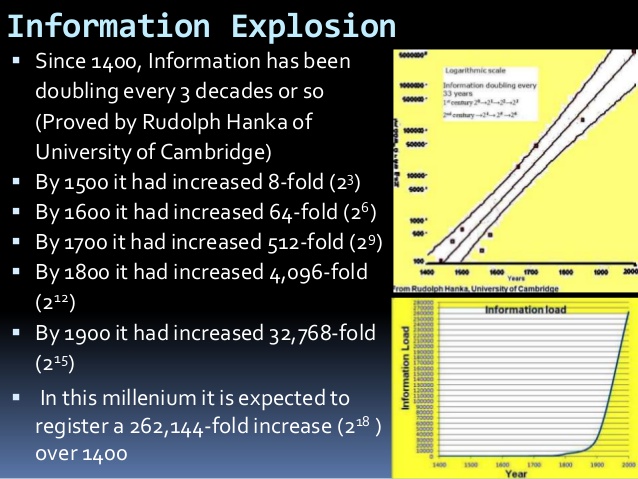
I would like to announce the publication of my new book entitled “The Information Explosion”.

This book discusses the role of information in evolution, and especially in the evolution of human culture. Articles and book chapters that I have previously written on this subject are incorporated in the text in modified forms, but more than half of the material is new.

The book may be freely downloaded and circulated from this link.

Reformed teaching of history

Human nature has two sides: It has a dark side, to which nationalism and militarism appeal; but our species also has a genius for cooperation, which we can see in the growth of culture.

Our modern civilization has been built up by means of a worldwide exchange of ideas and inventions. It is built on the achievements of many ancient cultures. China, Japan, India, Mesopotamia, Egypt, Greece, the Islamic world, Christian Europe, and the Jewish intellectual traditions all have contributed. Potatoes, corn, squash, vanilla, chocolate, chilli peppers, and quinine are gifts from the American Indians.

We need to reform our educational systems, particularly the teaching of history.

As it is taught today, history is a chronicle of power struggles and war, told from a biased national standpoint. We are taught that our own country is always heroic and in the right. We urgently need to replace this indoctrination in chauvinism by a reformed view of history, where the slow development of human culture is described, giving credit to all who have contributed.

When we teach history, it should not be about power struggles. It should be about how human culture was gradually built up over thousands of years by the patient work of millions of hands and minds.

Our common global culture, the music, science, literature and art that all of us share, should be presented as a precious heritage – far too precious to be risked in a thermonuclear war.

Many areas of science can be thought of as history:

Cosmology is history: It is the history of our entire universe.

Geology is history: It is the history of our Earth, its continents and its oceans.

Evolutionary biology is history: It is the history of all living creatures. It is the history of our own species and our place in nature.

Paleoanthropology is history: It is the history of how homonids became humans. The study of languages is history.

Relationships between languages allow us to trace the spread of humans from their origin in Africa to other parts of the earth.

Modern genetics contributes to history: The study of mitochondrial DNA and Y-chromosomal DNA allows us to trace the pathways that our ancestors followed in populating the earth.

Two sides of human nature: Compassion and Greed

Humans are capable of great compassion and unselfishness. Mothers and fathers make many sacrifices for the sake of their families. Kind teachers help us through childhood, and show us the right path. Doctors and nurses devote themselves to the welfare of their patients.

Sadly there is another, side to human nature, a darker side. Human history is stained with the blood of wars and genocides. Today, this dark, aggressive side of human nature threatens to plunge our civilization into an all-destroying thermonuclear war.

Humans often exhibit kindness to those who are closest to themselves, to their families and friends, to their own social group or nation. By contrast, the terrible aggression seen in wars and genocides is directed towards outsiders.

Human nature seems to exhibit what might be called “tribalism”: altruism towards one’s own group; aggression towards outsiders.

Today this tendency towards tribalism threatens both human civilization and the biosphere.

Greed, in particular the greed of corporations and billionaire oligarchs, is driving human civilization and the biosphere towards disaster.

The greed of giant fossil fuel corporations is driving us towards a tipping point after which human efforts to control climate change will be futile because feedback loops will have taken over.

The greed of the Military-Industrial Complex is driving us towards a Third World War that might develop into a catastrophic thermonuclear war.

The greed of our financial institutions is also driving us towards economic collapse.

Until the start of the Industrial Revolution in the 18th and 19th centuries, human society maintained a more or less sustainable relationship with nature. However, with the beginning of the industrial era, traditional ways of life, containing elements of both social and environmental ethics, were replaced by the money-centered, growth-oriented life of today, from which these vital elements are missing.

According to the followers of Adam Smith (1723-1790), self-interest (even greed) is a sufficient guide to human economic actions. The passage of time has shown that Smith was right in many respects. The free market, which he advocated, has turned out to be the optimum prescription for economic growth.

However, history has also shown that there is something horribly wrong or incomplete about the idea that self-interest alone, uninfluenced by ethical and ecological considerations, and totally free from governmental intervention, can be the main motivating force of a happy and just society.

There has also proved to be something terribly wrong with the concept of unlimited economic growth. Limitless growth of population or industry on a finite planet is a logical impossibility.

Culture, education and human solidarity

Cultural and educational activities have a small ecological footprint, and therefore are more sustainable than pollution-producing, fossil-fuel-using jobs in industry.

Furthermore, since culture and knowledge are shared among all nations, work in culture and education leads societies naturally towards internationalism and peace.

Economies based on a high level of consumption of material goods are unsustainable and will have to be abandoned by a future world that renounces the use of fossil fuels in order to avoid catastrophic climate change, a world where non-renewable resources such as metals will become increasingly rare and expensive.

How then can full employment be maintained?

The creation of renewable energy infrastructure will provide work for a large number of people; but in addition, sustainable economies of the future will need to shift many workers from jobs in industry to jobs in the service sector. Within the service sector, jobs in culture and education are particularly valuable because they will help to avoid the disastrous wars that are currently producing enormous human suffering and millions of refugees, wars that threaten to escalate into an all-destroying global thermonuclear war.

Culture is cooperative, not competitive!

Our modern civilization has been built up by means of a worldwide exchange of ideas and inventions. It is built on the achievements of all the peoples of the world throughout history. The true history of humanity is not the history of power struggles, conflicts, kings, dictators and empires.

The true history of humanity is a history of ideas, inventions, progress, shared knowledge, shared culture and cooperation.

Our cultural heritage is not only immensely valuable; it is also so great that no individual comprehends all of it. We are all specialists, who understand only a tiny fragment of the enormous edifice. No scientist understands all of science.

Perhaps Leonardo da Vinci could come close in his day, but today it is impossible. Nor do the vast majority people who use cell phones, personal computers and television sets every day understand in detail how they work.

Our health is preserved by medicines, which are made by processes that most of us do not understand, and we travel to work in automobiles and buses that we would be completely unable to construct.

The sharing of scientific and technological knowledge is essential to modern civilization. The great power of science is derived from an enormous concentration of attention and resources on the understanding of a tiny fragment of nature.

It would make no sense to proceed in this way if knowledge were not permanent, and if it were not shared by the entire world.

Science is not competitive. It is cooperative.

It is a great monument built by many thousands of hands, each adding a stone to the cairn. This is true not only of scientific knowledge but also of every aspect of our culture, history, art and literature, as well as the skills that produce everyday objects upon which our lives depend.

And civilization itself is not competitive. It is cooperative!

Please help to spread the links

I hope that in addition to downloading and spreading the pdf file of “The Information Explosion”, readers will also spread the following link, where my other books and articles on global problems are available.

The book is also available at the Danish Peace Academy website.

Thank you for your help!
2 Responses

  1. I is no coincidence that John ScalesAvery and Jan Oberg appear together as proponents of peace and better understanding of these turbulent times. They have for more than a generation devoted their lives to just that. I have just read,and must read again, Johns latest publication which is available on TFF. Reading John S.A. is like reading updates of thinkers like Albert Einstein, Hannah Ahrendt, Sigmund Freud, Alva Myrdal, Noamoi Klein. Eye- and ear openers. But the public service and main media outlets seem both blind and deaf. John Scales Avery is still among us. SPRED his wisdom!

  2. Many many thanks, Niels Erik. John is indeed a unique macro-thinker with an encyclopedic knowledge and a global living experience. In the best tradition of the ever-searching and re-searching scientific enterprise. His insights, knowledge and wisdom is urgently needed but, as you say, such towering figures like those you mention as virtually barred from public service and other state-of-the-stupidity media. – Jan Oberg

Related Posts

Photo above: Carl Fredrik Reuterswärd’s Non-Violence outside UN Headquarters in New York. Kirill Levin, CC BY-NC-SA 2. Jan Oberg November 3, 2026 I am happy to be published in Horizons which is produced by the Center for International Relations and Sustainable Development, CIRSD, in Belgrade. My contribution brings out a radical re-thinking of what concepts such as defence, security, deterrence – and peace – may mean if we want to create a more peaceful world. It also summarises a few things I have been working with the last few decades. Please read it here Og her er den på dansk, takket være Johnny Baltzersens lynhurtige oversættelse
UNITE-tillid, DREAM-velstand og andre konstruktive komponenter Normally we publish articles in English here. But this is a translation of a very important TFF document that should reach as many as possible in Denmark since this country’s government has been one of the most hardline in Europe and, up till now at least, has refused to use diplomacy and, instead, spent tremendous sums on arming Ukraine with the express goal of defeating Russia. Thus this – unique – article is in Danish. Vi er Johnny Baltzersen og hans Fælles Sikkerhed – Fælles Fremtid på Substack overmåde taknemmelige for at have oversat og publiceret TFF’s 2025-portfølje for fredsidéer med henblik på Ukraines fremtid. Vi håber den nu kan nå mange flere danskere – som også vil sprede den og skabe debat – nu den danske regerings og folketingspartiernes politik på dette område siden 2022 står nu – forudsigeligt – ved vejs ende....
Jan Oberg TFF director October 28, 2026 Exactly one month has now passed since I published my criticism of the introduction to the special issue on Johan Galtung published by the Journal of Global Security Studies, JoGSS, and of Tor Egil Førland’s chapter about Galtung which serves as a preview to his forthcoming biography of Galtung to be published by PRIO. See the original on The Transnational here and the same article on TFF Substack with many general and critical comments and, in particular, the people who decided to withdraw from the biography project in protest. The special issue itself was extraordinary. It was devoted to the intellectual legacy of one of the founders of peace research and contained a number of strong assessments of his personality, scholarship, intellectual trajectory, and public role. Such assessments are, of course, entirely legitimate. No scholar is beyond criticism, and neither was Johan Galtung....

Recent Articles

Photo above: Carl Fredrik Reuterswärd’s Non-Violence outside UN Headquarters in New York. Kirill Levin, CC BY-NC-SA 2. Jan Oberg November 3, 2026 I am happy to be published in Horizons which is produced by the Center for International Relations and Sustainable Development, CIRSD, in Belgrade. My contribution brings out a radical re-thinking of what concepts such as defence, security, deterrence – and peace – may mean if we want to create a more peaceful world. It also summarises a few things I have been working with the last few decades. Please read it here Og her er den på dansk, takket være Johnny Baltzersens lynhurtige oversættelse
UNITE-tillid, DREAM-velstand og andre konstruktive komponenter Normally we publish articles in English here. But this is a translation of a very important TFF document that should reach as many as possible in Denmark since this country’s government has been one of the most hardline in Europe and, up till now at least, has refused to use diplomacy and, instead, spent tremendous sums on arming Ukraine with the express goal of defeating Russia. Thus this – unique – article is in Danish. Vi er Johnny Baltzersen og hans Fælles Sikkerhed – Fælles Fremtid på Substack overmåde taknemmelige for at have oversat og publiceret TFF’s 2025-portfølje for fredsidéer med henblik på Ukraines fremtid. Vi håber den nu kan nå mange flere danskere – som også vil sprede den og skabe debat – nu den danske regerings og folketingspartiernes politik på dette område siden 2022 står nu – forudsigeligt – ved vejs ende....
Jan Oberg TFF director October 28, 2026 Exactly one month has now passed since I published my criticism of the introduction to the special issue on Johan Galtung published by the Journal of Global Security Studies, JoGSS, and of Tor Egil Førland’s chapter about Galtung which serves as a preview to his forthcoming biography of Galtung to be published by PRIO. See the original on The Transnational here and the same article on TFF Substack with many general and critical comments and, in particular, the people who decided to withdraw from the biography project in protest. The special issue itself was extraordinary. It was devoted to the intellectual legacy of one of the founders of peace research and contained a number of strong assessments of his personality, scholarship, intellectual trajectory, and public role. Such assessments are, of course, entirely legitimate. No scholar is beyond criticism, and neither was Johan Galtung....

TFF on Substack

Discover and subscribe to more peace materials on TFF Substack

Most Popular

Photo above: Carl Fredrik Reuterswärd’s Non-Violence outside UN Headquarters in New York. Kirill Levin, CC BY-NC-SA 2. Jan Oberg November 3, 2026 I am happy to be published in Horizons which is produced by the Center for International Relations and Sustainable Development, CIRSD, in Belgrade. My contribution brings out a radical re-thinking of what concepts such as defence, security, deterrence – and peace – may mean if we want to create a more peaceful world. It also summarises a few things I have been working with the last few decades. Please read it here Og her er den på dansk, takket være Johnny Baltzersens lynhurtige oversættelse
UNITE-tillid, DREAM-velstand og andre konstruktive komponenter Normally we publish articles in English here. But this is a translation of a very important TFF document that should reach as many as possible in Denmark since this country’s government has been one of the most hardline in Europe and, up till now at least, has refused to use diplomacy and, instead, spent tremendous sums on arming Ukraine with the express goal of defeating Russia. Thus this – unique – article is in Danish. Vi er Johnny Baltzersen og hans Fælles Sikkerhed – Fælles Fremtid på Substack overmåde taknemmelige for at have oversat og publiceret TFF’s 2025-portfølje for fredsidéer med henblik på Ukraines fremtid. Vi håber den nu kan nå mange flere danskere – som også vil sprede den og skabe debat – nu den danske regerings og folketingspartiernes politik på dette område siden 2022 står nu – forudsigeligt – ved vejs ende....
Jan Oberg TFF director October 28, 2026 Exactly one month has now passed since I published my criticism of the introduction to the special issue on Johan Galtung published by the Journal of Global Security Studies, JoGSS, and of Tor Egil Førland’s chapter about Galtung which serves as a preview to his forthcoming biography of Galtung to be published by PRIO. See the original on The Transnational here and the same article on TFF Substack with many general and critical comments and, in particular, the people who decided to withdraw from the biography project in protest. The special issue itself was extraordinary. It was devoted to the intellectual legacy of one of the founders of peace research and contained a number of strong assessments of his personality, scholarship, intellectual trajectory, and public role. Such assessments are, of course, entirely legitimate. No scholar is beyond criticism, and neither was Johan Galtung....
Read More
knotted gun
Photo above: Carl Fredrik Reuterswärd’s Non-Violence outside UN Headquarters in New York. Kirill Levin, CC BY-NC-SA 2. Jan Oberg November 3, 2026 I am happy to be published in Horizons which is produced by the Center for International Relations and Sustainable Development, CIRSD, in Belgrade. My contribution brings out a radical re-thinking of what concepts such as defence, security, deterrence – and peace – may mean if we want to create a more peaceful world. It also summarises a few things I have been working with the last few decades. Please read it here Og her er den på dansk, takket være Johnny Baltzersens lynhurtige oversættelse
TFFPortfolioVign
UNITE-tillid, DREAM-velstand og andre konstruktive komponenter Normally we publish articles in English here. But this is a translation of a very important TFF document that should reach as many as possible in Denmark since this country’s government has been one of the most hardline in Europe and, up till now at least, has refused to use diplomacy and, instead, spent tremendous sums on arming Ukraine with the express goal of defeating Russia. Thus this – unique – article is in Danish. Vi er Johnny Baltzersen og hans Fælles Sikkerhed – Fælles Fremtid på Substack overmåde taknemmelige for at have oversat og publiceret TFF’s 2025-portfølje for fredsidéer med henblik på Ukraines fremtid. Vi håber den nu kan nå mange flere danskere – som også vil sprede den og skabe debat – nu den danske regerings og folketingspartiernes politik på dette område siden 2022 står nu – forudsigeligt – ved vejs ende....
JoGSS-Silent
Jan Oberg TFF director October 28, 2026 Exactly one month has now passed since I published my criticism of the introduction to the special issue on Johan Galtung published by the Journal of Global Security Studies, JoGSS, and of Tor Egil Førland’s chapter about Galtung which serves as a preview to his forthcoming biography of Galtung to be published by PRIO. See the original on The Transnational here and the same article on TFF Substack with many general and critical comments and, in particular, the people who decided to withdraw from the biography project in protest. The special issue itself was extraordinary. It was devoted to the intellectual legacy of one of the founders of peace research and contained a number of strong assessments of his personality, scholarship, intellectual trajectory, and public role. Such assessments are, of course, entirely legitimate. No scholar is beyond criticism, and neither was Johan Galtung....
Screenshot 2026-10-26 115647
An aspect of Iran’s culture and civilisation you’ve probably never heard about. Don’t be surprised if the US and Israel also try to bomb them. Jan ObergTFF director October 26, 2026 Today – under the “USraeli” threat of new “annihilating” bombings – opens the 7th International Conference on Peace and Conflict Resolution at Tehran’s University. As far as I can tell, this is the only permanent, advanced peace research institution in West Asia/the Middle East. Perhaps more countries in that region could be inspired? I mean, how many military “security” institutes and military academies do they have? Many peace research institutes and university departments have been established since the 1950s in the West. They are now all under attack; some have closed down, some have gone mainstream, yet others kept the name but do nothing to research peace and disseminate results or advice; instead, they cooperate with militarism’s platforms such...
Screenshot 2026-10-15 141837
Let’s discuss using AI to create peace – in contrast to boring geopolitics devoid of creative healing and visions. Jan Oberg TFF director October 15, 2026 I asked VEED to create a short video exemplifying how peace is preferable to war, then chose the lady as a template. Simple as that. In less than a minute, it produced this video, which any peace-loving person would appreciate. The only problem is that human intelligence (HI), at least the one that exists among Western decision-makers, isn’t half as moral or smart as AI. I have used AI to dialogue about peace and peace plans, creative conflict resolution and visions of a better future for humankind. It so happens that I am having more stimulating, intelligent, creative and moral discussions with AI than I could possibly have with any EU or NATO leader today. Yes, AI has very problematic and dangerous aspects; used...
girl-5894831_1280
Below are TFF-related media mentions, comments, videos and social media posts published elsewhere but not on this homepage. We happen to catch and list only a fraction. Regarding video comments and debates, we recommend that you go to the TFF Video Channel on Substack where many of them are reproduced. Jan Oberg is a contributor to China Daily – 52 million daily clicks – and Global Times, CGTN and CCTV (the national television), China Investment, Xinhua News Agency and several others. Articles and videos on these media very often multiply into countless Chinese (and Western media) that re-post them from these main media. Thanks to The China Academy, his analyses, interviews and comments are frequently posted on YouTube channels such as Thinkers Forum and Wave Media. These videos are often re-posted on Bilibili (China’s YouTube), the China Content Center on TikTok, and on the Chinese edition of TikTok, Douyin.com. This means reaching hundreds of millions of viewers worldwide over a year. While there are too many to catch on all these...





