

Martin Luther King Jr. spent the last year of his life detested by the liberal establishment

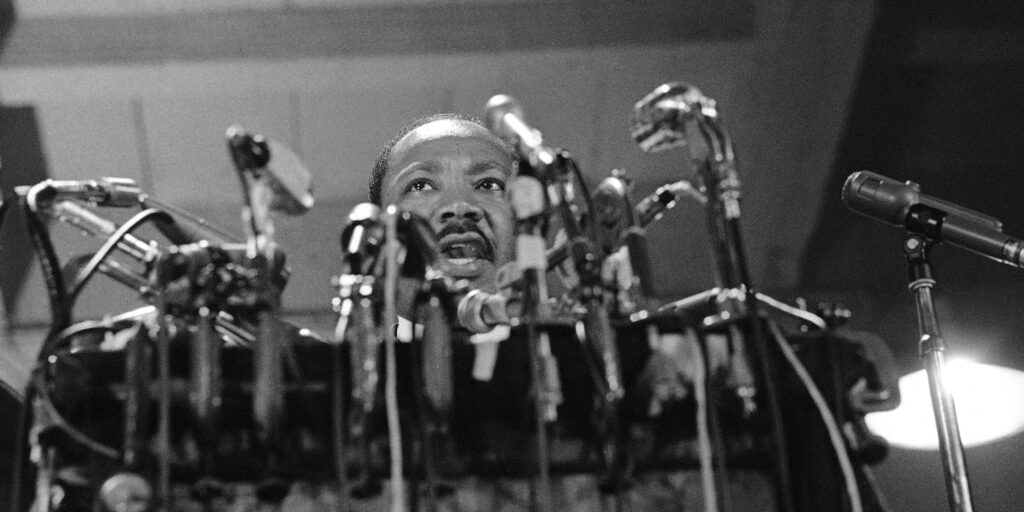
Dr. Martin Luther King, head of the Southern Christian Leadership Conference (SCLC), delivers his speech that opened the National Conference for New Politico Convention in Chicago, Sept. 1, 1967. King, facing a battery of microphones, called for an end to the Vietnam fighting.

February 22, 2021

Zaid Jilani

Martin Luther King Jr. was much more radical than he is often portrayed.

IN 1999, The polling agency Gallup set out to determine the individual American’s most admired in the 20th century.

Mother Teresa came in first, with 49 percent of Americans putting her at the top; the Rev. Dr. Martin Luther King Jr. ranked second, with 34 percent placing him on the same list. But, the polling agency would later write, “King was far from universally revered during his lifetime.”

Originally published by The Intercept

They noted that in 1966, 63 percent of Americans held a negative view of the civil rights leader, while just 32 percent held a positive one. This was a marked reversal from five years earlier, when 41 percent of Americans gave King a positive rating and 37 percent a negative one.

King’s slide in popularity coincided with his activism taking a turn from what Americans largely know him for — his campaign for civil rights in the American South — to a much more radical one aimed at the war in Vietnam and poverty.

Refusing to choose between civil rights for African-Americans and peace for Vietnamese

For years, King had been troubled by the war in Vietnam and raised it privately in conversations with the Democratic President Lyndon Johnson. As the conflict dragged on, King felt he had no choice but to publicly denounce the war.

In an April 1967 speech at Riverside Church in New York City, the civil rights leader publicly denounced American involvement in Indochina.

“This business of burning human beings with napalm, of filling our nation’s homes with orphans and widows, of injecting poisonous drugs of hate into the veins of peoples normally humane, of sending men home from dark and bloody battlefields physically handicapped and psychologically deranged, cannot be reconciled with wisdom, justice, and love,” he warned. “A nation that continues year after year to spend more money on military defense than on programs of social uplift is approaching spiritual death.”

Many in King’s inner circle warned against making the speech and publicly campaigning against the war. Their argument was that Johnson had risked his neck for the African-American community on issues like civil rights, health care, and welfare, and publicly condemning his foreign policy would irreparably harm the relationship between black activists and the president.

King reserved a section of his remarks to address these critics. He labeled the war an “enemy of the poor,” saying that its budget was draining anti-poverty programs; he also pointed out that it was hypocritical for him to preach nonviolence to activists at home, while watching his government reject that principle abroad.

But ultimately his stance came from personal moral conviction and his devoted Christian beliefs. “Beyond the calling of race or nation or creed is this vocation of sonship and brotherhood. Because I believe that the Father is deeply concerned, especially for His suffering and helpless and outcast children, I come tonight to speak for them,” he said. “This I believe to be the privilege and the burden of all of us who deem ourselves bound by allegiances and loyalties, which are broader and deeper than nationalism and which go beyond our nation’s self-defined goals and positions. We are called to speak for the weak, for the voiceless, for the victims of our nation, for those it calls ‘enemy,’ for no document from human hands can make these humans any less our brothers.”
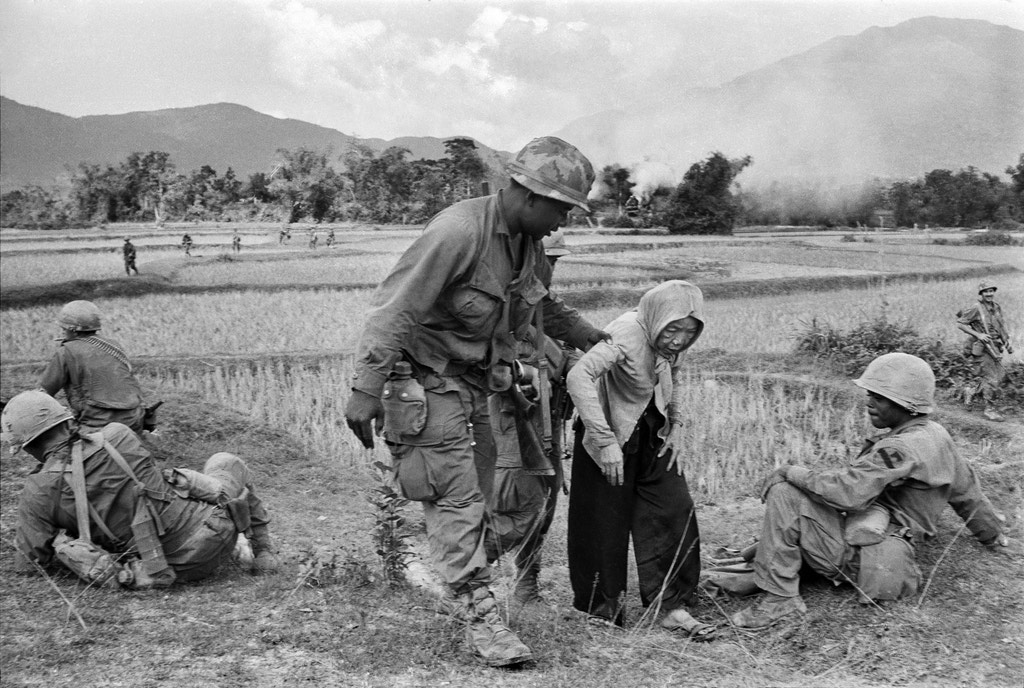
A U.S. air cavalryman lends a helping hand to an aged Vietnamese woman who grew tired as she and her neighbors were being resettled from their village to a refugee camp, Jan. 5, 1968.
 Photo: Dang Van Phuoc/AP

The liberal backlash

The backlash from a liberal establishment that had once praised King for his civil rights campaign came as hard and fast as his allies had feared.

The New York Times editorial board lambasted King for linking the war in Vietnam to the struggles of civil rights and poverty alleviation in the United States, saying it was “too facile a connection” and that he was doing a “disservice” to both causes. It concluded that there “are no simple answers to the war in Vietnam or to racial injustice in this country.”

The Washington Post editorial board said King had “diminished his usefulness to his cause, his country and his people.” A political cartoon in the Kansas City Star depicted the civil rights movement as a young black girl crying and begging for her drunk father King, who is consuming the contents of a bottle labeled “Anti-Vietnam.”

In all, 168 newspapers denounced him the next day. Johnson ended his formal relationship with King. “What is that goddamned nigger preacher doing to me?” Johnson reportedly remarked after the Riverside speech. “We gave him the Civil Rights Act of 1964, we gave him the Voting Rights Act of 1965, we gave him the war on poverty. What more does he want?”

The African-American establishment, fearful of Johnson’s reaction, also distanced itself from King.

The NAACP – National Association for the Advancement of Colored People – under the leadership of Roy Wilkins refused to oppose the war and explicitly condemned the effort to link the peace and civil rights movements.

Whitney Young, the leader of the National Urban League, warned that “Johnson needs a consensus. If we are not with him on Vietnam, then he is not going to be with us on civil rights.” Jackie Robinson, the celebrated African-American baseball player and civil rights advocate, wrote to Johnson two weeks after King’s speech to distance himself from the civil rights leader: 

“While I am certain your faith has been shaken by demonstrations against the Viet Nam war, I hope the actions of any one individual does not make you feel as Vice President Humphrey does, that Dr. King’s stand will hurt the civil rights movement. It would not be fair to the thousands of our Negro fighting men who are giving their lives because they believe, in most instances, that our Viet Nam stand is just.”

Many donors to the Southern Christian Leadership Conference wrote to King announcing they were pulling their support.
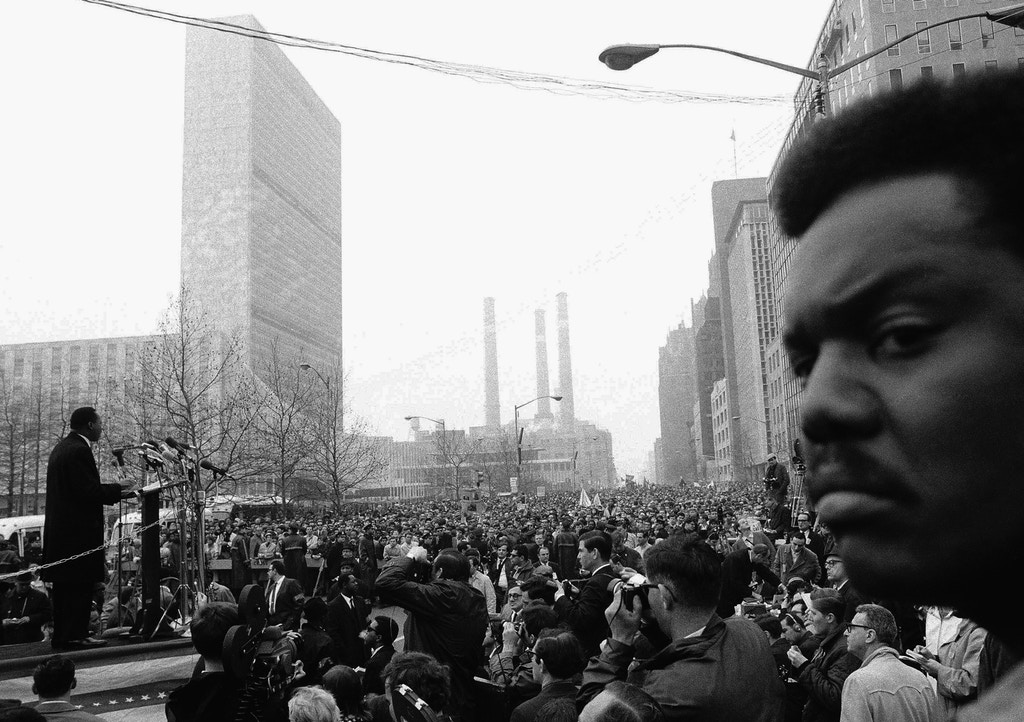
Dr. Martin Luther King on the platform talks to thousands of demonstrators on United Nations Plaza on April 15. 1967 in New York City. Photo: AP

Tolerance for civil disobedience ends at the Mason-Dixon Line

As he alienated the liberal establishment for his campaign against the Vietnam War, King also planned to mobilize mass demonstrations and civil disobedience aimed not at his old foes in the segregationist South, but politicians north of the Mason Dixon line who he believed were failing to act to stop endemic poverty.

In August 1967, he told the SCLC that he was calling for activists to “dislocate” northern cities with nonviolent civil disobedience campaigns demanding action on federal aid.

He said he would consider tactics, such as school boycotts, blocking plant gates with unemployed African-Americans, and mass sit-ins in federal buildings.

The New York Times, a steady ally of King’s civil disobedience campaign in the South, was furious. Two days after King’s SCLC address, the editorial board called his idea a “formula for discord.” The paper complained that there is an “inherent contradiction in Dr. King’s summons to Negroes to act ‘peacefully but forcefully to cripple the operations of an oppressive society.’ He himself has acknowledged that nonviolence is losing its appeal; once the spark of massive law-defiance is applied in the present overheated atmosphere, the potential for disaster becomes overwhelming.”

But King was never an advocate for violence. Although some on the left in King’s time and today argue about the utility of violence, King spent much of the end of his life trying to prevent the rioting and violent unrest that the Times was so concerned about.

In February 1968, he warned during a tour through Alabama that increased rioting could lead to a “right-wing takeover.” He pointed to segregationist George Wallace’s presidential bid, saying, “Every time a riot develops, it helps George Wallace.”

Defending his threat to take poverty protests to the doorsteps of the Democratic and Republican National Conventions, he portrayed  nonviolence as a sort of middle path between acquiescence and violence. “We need an alternative to riots and to timid supplication,” he said.

Also that year, he launched the Poor People’s Campaign, aimed at providing good jobs, housing, and a decent standard of living to all Americans. More than 40 years before American protesters took to the streets of New York City and other locales to “occupy” space to protest inequality, King proposed a massive tent encampment in Washington, D.C. to demand action on poverty.

King was assassinated during a campaign to organize sanitation workers in Tennessee in April of that year before he was able to set up the encampment. His widow Coretta Scott King, as well as fellow civil rights leader Ralph David Abernathy, went ahead with the plan to create what they called Resurrection City.

The camp lasted six weeks until police moved in to shut it down and evict all of its inhabitants, pointing to sporadic acts of hooliganism as justification.

Andrew Young, the young civil rights leader who later went on to be Jimmy Carter’s U.N. ambassador and a mayor of Atlanta, was horrified, saying the crushing of the camp was worse than the police violence he saw in the South.

“It was worse than anything I saw in Mississippi or Alabama,” he said. “You don’t shoot tear gas into an entire city because two or three hooligans are throwing rocks.”

Following King’s assassination, the mood shifted quickly. Johnson, who had once terminated all communication with King and privately cursed his name, issued a statement saying the “heart of America is heavy, the spirit of America weeps” following the activist’s death.

Georgia’s segregationist Gov. Lester Maddox, a frequent critic of King, even begrudgingly allowed Georgia’s flag to fly at half mast following his death. Bobby Kennedy, who once authorized the wiretaps of King’s phones, attended the funeral.

Coretta Scott King’s greatest concern was not for her husband’s image, but how his legacy would be carried on after his death. Rioting rocked major American cities following King’s assassination, and she feared that the nonviolence he had preached would be lost in the embers.

The Sunday following the assassination, she spoke at Ebenezer Baptist Church in Atlanta and implored his movement to continue to act as he would for the causes he believed in:

Our concern now is that his work does not die. He gave his life for the poor of the world — the garbage workers of Memphis and the peasants of Vietnam. Nothing could hurt him more than that man could attempt no way to solve problems except through violence. He gave his life in search of a more excellent way, a more effective way, a creative way rather than a destructive way.

We intend to go on in search of that way, and I hope that you who loved and admired him would join us in fulfilling his dream.

The day that Negro people and others in bondage are truly free, on the day want is abolished, on the day wars are no more, on that day I know my husband will rest in a long-deserved peace.

Originally published by The Intercept

About the author:

Zaid Jilani is a journalist who hails from Atlanta, Georgia. He has previously worked as a reporter-blogger for ThinkProgress, United Republic, the Progressive Change Campaign Committee, and Alternet.

He graduated from the University of Georgia in 2009 with a bachelor of arts in international affairs and received his master’s in public administration from Syracuse University in 2014.

Please help TFF remain truly independent by contributing if you benefited from this article. Then we can also bring you more quality articles on important issues such as this. Thanks!


Related Posts

By Jan ObergTFF co-founder and director February 11, 2026 PART 3 — ECONOMICS, TRADE & FINANCIAL SOVEREIGNTY A. Trade Measures & Market Signaling Economic pressure can be applied instantly and scaled without violence. Immediate Measures (within a week) Government boycott US goods and services  A very powerful signal which over time will be felt. Targeted tariffs on selected U.S. goods Symbolic but high-visibility sectors send a clear message. Suspend trade facilitation talks A peaceful pause that signals deep concern. Freeze U.S. participation in public procurement – military procurement in particular A nonviolent way to reduce influence. Competition law review of U.S. corporations A legal tool to scrutinise market dominance. Longer-Term Measures EU–Asia–Africa trade corridors Reducing reliance on U.S. markets. European supply chains for critical minerals Strategic autonomy in resource access. European Strategic Trade Authority Monitoring coercive practices globally. Euro-denominated commodity markets Weakening the dollar’s pricing monopoly. The EU must resume contacts and negotiations with Russia, focusing on energy cooperation To...
PART 2 — Diplomacy, Law and Nonviolent Power By Jan ObergTFF co-founder and director January 26, 2026 This is the second of four TFF-created idea portfolios designed to curb the global reach of the United States and, in both the short and long term, help catalyse a worldwide nonviolent resistance to what many observers describe as the Trump administration’s uniquely confrontational, destructive and world-threatening policies. These portfolios outline what governments and citizens across the world can do through dynamic diplomacy, creative initiatives, and strictly nonviolent means. They are typical TFF works in that we do not only tell what the problem is and how bad it will go – as 90+% of all commentators, experts and scholars do – we tell what we think can be done, inviting you to think of what you think you can do. It seems painfully clear to me that the current political dynamics in Washington increasingly resemble the most dangerous...
Introduction to TFF’s forthcoming four Idea Portfolios of Diplomatic and Nonviolent Resistance By TFF’s Board & FoundersPascal Lottaz, Biljana Vankovska, Annette Schiffmann, Christina Spannar & Jan Oberg January 19, 2026 “America, you are too arrogant.” — Martin Luther King Jr. Over the course of Trump’s first term and now a year into his second, the world has witnessed a consistent pattern of actions that challenge the basic long-standing norms of international cooperation, weaken multilateral institutions, and ignore the global norms and legal frameworks established by the UN Charter. During these years, we have witnessed military operations in Iran, Syria and Ukraine without UN authorisation; the killing of Iranian General Qassem Soleimani; repeated strikes across the Middle East; and the launch of tariff wars against allies and competitors alike. We have seen a renewed emphasis on nuclearism and zero interest in arms control and disarmament negotiations. Pentagon is now The Department...

Recent Articles

Tony Robinson October 4, 2026 Violence is easy to recognise when someone is being beaten, shot or killed. It becomes more difficult when nobody is holding a weapon. Poverty, discrimination, exploitation and repression can restrict a human life just as effectively, although they do so in very different ways and with very different consequences. Simply adding more categories to an ever-growing list of forms of violence does not really solve the problem. The more interesting question is what all these different situations have in common and why it makes sense to describe them using the same word. Human beings do not simply react to what happens around them. They remember the past, imagine things that do not yet exist, make plans and undertake projects. Workers organise because they imagine different working conditions; people migrate because they imagine another life somewhere else; social movements emerge because people refuse to accept the...
It’s a matter of principles, courage, vision and pulling together – while the militarist world is falling apart… Peter Langille October 3, 2026 “Here, then, is the problem which we present to you, stark and dreadful and inescapable: Shall we put an end to the human race; or shall mankind renounce war?”The Bertrand Russell—Albert Einstein Manifesto, July 9, 1955 ⁕ The forecast for what’s ahead is worrisome. The sharp rise in armed conflicts over the past three years is adding to what was already the highest level in over seventy years. Genocides, which should be prevented are supported. A shared climate emergency that jeopardises survival is ignored. Diverse polls now suggest that people are war-weary, worried and interested in a more effective United Nations. And, there are viable policy options for a more secure world! Yet governments are doubling-down, betting on more war and investing heavily. If current trends persist,...
Johan Galtung 1930-2024October 2015 Published here on October 3, 2026 Let us focus on Civilization for conflict analysis and remedies. Major forms of disorder use violence; war is state organized violence. The most belligerent states are the United States of America and Israel, both with civilization roots. National Evangelism, the US Protestant Christian civilization– more national than evangelical–justifies US warfare as exceptionalism of a people chosen by God, with a manifest destiny to run the world. Orthodox Judaism justifies Israeli warfare to conquer and expand from Nile to Euphrates as a religious right and duty to the Eternal One. The third most belligerent country, the UK, no longer believes it is God-chosen but chosen by the USA; not quite the same but something. But the root cause of global disorder lies in the Occident–with Islam–seeing itself as the single, universal civilization valid for all at all times, all others being...

TFF on Substack

Discover and subscribe to more peace materials on TFF Substack

Most Popular

Tony Robinson October 4, 2026 Violence is easy to recognise when someone is being beaten, shot or killed. It becomes more difficult when nobody is holding a weapon. Poverty, discrimination, exploitation and repression can restrict a human life just as effectively, although they do so in very different ways and with very different consequences. Simply adding more categories to an ever-growing list of forms of violence does not really solve the problem. The more interesting question is what all these different situations have in common and why it makes sense to describe them using the same word. Human beings do not simply react to what happens around them. They remember the past, imagine things that do not yet exist, make plans and undertake projects. Workers organise because they imagine different working conditions; people migrate because they imagine another life somewhere else; social movements emerge because people refuse to accept the...
It’s a matter of principles, courage, vision and pulling together – while the militarist world is falling apart… Peter Langille October 3, 2026 “Here, then, is the problem which we present to you, stark and dreadful and inescapable: Shall we put an end to the human race; or shall mankind renounce war?”The Bertrand Russell—Albert Einstein Manifesto, July 9, 1955 ⁕ The forecast for what’s ahead is worrisome. The sharp rise in armed conflicts over the past three years is adding to what was already the highest level in over seventy years. Genocides, which should be prevented are supported. A shared climate emergency that jeopardises survival is ignored. Diverse polls now suggest that people are war-weary, worried and interested in a more effective United Nations. And, there are viable policy options for a more secure world! Yet governments are doubling-down, betting on more war and investing heavily. If current trends persist,...
Johan Galtung 1930-2024October 2015 Published here on October 3, 2026 Let us focus on Civilization for conflict analysis and remedies. Major forms of disorder use violence; war is state organized violence. The most belligerent states are the United States of America and Israel, both with civilization roots. National Evangelism, the US Protestant Christian civilization– more national than evangelical–justifies US warfare as exceptionalism of a people chosen by God, with a manifest destiny to run the world. Orthodox Judaism justifies Israeli warfare to conquer and expand from Nile to Euphrates as a religious right and duty to the Eternal One. The third most belligerent country, the UK, no longer believes it is God-chosen but chosen by the USA; not quite the same but something. But the root cause of global disorder lies in the Occident–with Islam–seeing itself as the single, universal civilization valid for all at all times, all others being...
Read More
Living-Peace-Sign-Budapest-copy
Tony Robinson October 4, 2026 Violence is easy to recognise when someone is being beaten, shot or killed. It becomes more difficult when nobody is holding a weapon. Poverty, discrimination, exploitation and repression can restrict a human life just as effectively, although they do so in very different ways and with very different consequences. Simply adding more categories to an ever-growing list of forms of violence does not really solve the problem. The more interesting question is what all these different situations have in common and why it makes sense to describe them using the same word. Human beings do not simply react to what happens around them. They remember the past, imagine things that do not yet exist, make plans and undertake projects. Workers organise because they imagine different working conditions; people migrate because they imagine another life somewhere else; social movements emerge because people refuse to accept the...
b54a1f10-8c65-4f0b-9dd5-4abc0a7d04cc_2659x2659
It’s a matter of principles, courage, vision and pulling together – while the militarist world is falling apart… Peter Langille October 3, 2026 “Here, then, is the problem which we present to you, stark and dreadful and inescapable: Shall we put an end to the human race; or shall mankind renounce war?”The Bertrand Russell—Albert Einstein Manifesto, July 9, 1955 ⁕ The forecast for what’s ahead is worrisome. The sharp rise in armed conflicts over the past three years is adding to what was already the highest level in over seventy years. Genocides, which should be prevented are supported. A shared climate emergency that jeopardises survival is ignored. Diverse polls now suggest that people are war-weary, worried and interested in a more effective United Nations. And, there are viable policy options for a more secure world! Yet governments are doubling-down, betting on more war and investing heavily. If current trends persist,...
010
Johan Galtung 1930-2024October 2015 Published here on October 3, 2026 Let us focus on Civilization for conflict analysis and remedies. Major forms of disorder use violence; war is state organized violence. The most belligerent states are the United States of America and Israel, both with civilization roots. National Evangelism, the US Protestant Christian civilization– more national than evangelical–justifies US warfare as exceptionalism of a people chosen by God, with a manifest destiny to run the world. Orthodox Judaism justifies Israeli warfare to conquer and expand from Nile to Euphrates as a religious right and duty to the Eternal One. The third most belligerent country, the UK, no longer believes it is God-chosen but chosen by the USA; not quite the same but something. But the root cause of global disorder lies in the Occident–with Islam–seeing itself as the single, universal civilization valid for all at all times, all others being...
Screenshot 2026-10-02 011738
Jan Oberg PhD, director, The Transnational Foundation for Peace and Future Research, TFFLund, Sweden October 2, 2026 This is my full original manuscript. The Chinese Academy of Social Science, CASS, makes two publications out if it. 1. China’s Five-year plan emphasized the capabilities of basic research and original innovation. It is regarded as the goal of the future social development, which, as required, should be significantly enhanced. Can you comment on the importance of original innovation in research and academic study? I believe it is easier to define “original innovation” in the natural sciences than in social sciences. The breaking points of what constitutes something new, or innovative, are not quite as sharp in the latter. But in both fields it is about opening up something that was closed, unseen, unexplored before – making manifest what was earlier latent. Innovations come in many forms and shapes – naming something that was...
arctic-circle-map
The agreement is catastrophic both because of what it says and what it doesn’t mention. It reduces further the major asset of security policies: Freedom of action. Jan Oberg TFF director September 25, 2026 A couple of hours before the agreement was signed on September 22, 2026, I published the following 13 hypotheses about what it would most likely contain on TFF Substack (in English). I was wrong on only the first point. Contrary to what Trump had written on his Truth Social platform, it does not appear to come into force immediately. In fact, it turned out to be worse than even I had anticipated. After these hypotheses now come a number of reflections in light of what the agreement actually contains, and does not contain, as well as the way in which it has generally been presented by major media outlets and by the public-service broadcaster DR. My...
girl-5894831_1280
Below are TFF-related media mentions, comments, videos and social media posts published elsewhere but not on this homepage. We happen to catch and list only a fraction. Regarding video comments and debates, we recommend that you go to the TFF Video Channel on Substack where many of them are reproduced. Jan Oberg is a contributor to China Daily – 52 million daily clicks – and Global Times, CGTN and CCTV (the national television), China Investment, Xinhua News Agency and several others. Articles and videos on these media very often multiply into countless Chinese (and Western media) that re-post them from these main media. Thanks to The China Academy, his analyses, interviews and comments are frequently posted on YouTube channels such as Thinkers Forum and Wave Media. These videos are often re-posted on Bilibili (China’s YouTube), the China Content Center on TikTok, and on the Chinese edition of TikTok, Douyin.com. This means reaching hundreds of millions of viewers worldwide over a year. While there are too many to catch on all these...



