
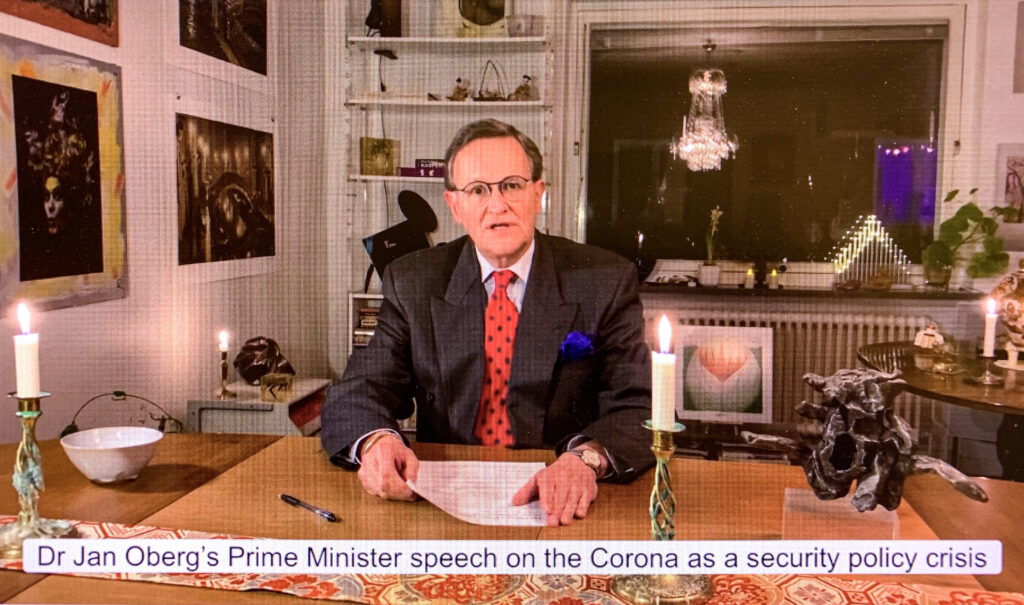
Jan Oberg’s Prime Minister Speech on the Corona crisis

Or your government leader’s Coronavirus speech that was never given.

Do not believe the future will be better before you hear leaders say something like this…

The speech can be seen as part of TFF’s Campaign “Convert Military Expenditures to Global Problem-Solving”.

https://vimeo.com/496060959

See and listen to the speech by clicking on Vimeo above, or read the transcript below.

Fellow Citizens, good evening

Tonight, I want to share with you the main lessons my government and I have drawn from the Coronavirus crisis – a crisis which has caused so much suffering and so many deaths. And a crisis that will take very long time for our economy to recover from.

That lesson – and my central message to you tonight – is that your suffering has been caused by our failed security policies. Only, secondarily, is this a crisis of our health system.

Therefore, I want to extend my most profound apology to each and everyone of you in our country on behalf of my government.

The pandemic as well as other purely civilian crises had been predicted. But we ignored the warnings. We now recognise our full responsibility and hope for your understanding and forgiveness.

So how could this pandemic take us by surprise? How could we be so unprepared?

First of all, let me say:

The main – only – reason for our Covid-19 policy failure is that we have been obsessively focused on purely military means for our so-called ”national security.” We’ve allocated literally all the resources (that is, your tax money) to the military sector – so much so that our society became highly militarized but also more and more vulnerable and indefensible. That was not the right way to spend your tax money. And not the right way to honour your trust in us!

Over time, we were blinded by arms production and export profit interests of tiny but powerful elites. We chose to listen only to advisers who were, in reality, not objective but repeatedly advocated higher military expenditures because it benefited themselves. We were also influenced by powerful lobbying groups. We chose to listen to other kinds of expertise.

In the process we created enemies and invented threats to be able to always justify these new weapons and higher military expenditures. But, in reality, we were our own worst enemies.

Because . . . if weapons could bring peace, we would today have a wonderful peaceful world with vision and optimism. We all know that we do not live in such a world.

The fact is that this government – also I myself – gave speeches about human security and common security and peace but never asked ourselves what those words meant. As a result, militarist thinking and the Military-Industrial Complex has become an unbearable burden on our civil economy and all of society. In addition, it threatens our democracy and our wellbeing as we have just seen in this crisis.

We cannot ourselves be safe with others if they do not feel safe with us. Self-defence is right and in accordance with international law; but having long-ranger offensive weapons that automatically threatens somebody far away can only lead to arms races, never bring peace, only endless war.

What we need now instead is confidence-building – bridges – not confrontation-building and walls. We need to build peace first and then secure it. Because it’s a proven fact that the present security thinking will never bring peace to the world.

Secondly…

Under my leadership, the government shall move away from the military-dominated security policies and give priority to human and common security for all.

Therefore, we have now established a national high-level and very broad-based Future Peace and Security Commission. It’s mandate is to – as quickly as possible – develop a strategy and a concrete three-years plan for a fundamental change in our defence, security and foreign policy.

This new policy shall, above all, allocate resources to provide human security in a wide sense, including protecting citizens’ lives, a first-class health care system, civil defence, storing the resources and goods needed during emergencies and prepare society’s various authorities to serve you, the citizens, in times of crises.

This new strategy called”Peace First” shall adapt our capacities and institutions to strictly adhere to the UN Charter – because all UN members – also our country – have signed that Charter and it states that ”peace shall be created by peaceful means” (Article 1).

We, the member states, must not continue to ignore international law.

Fellow citizens!

Someone has to take the first steps and we will. We’ll get nowhere if every country waits for someone else to take the first step. We will take it and thereby invite a much-needed snowball effect.

We shall then free resources – in fact billions upon billions of dollars – and re-allocate them to meet the UN Sustainable Development Goals (SDG). We have human rights but we also have duties and one of them is to reduce suffering! There is no reason that people shall go hungry to bed.

Third – and finally: What will this mean for our country?

You can expect a reduction of our military expenditure by 50% within these three years and a conversion of industrial, administrative, scientific and other resources to boost civilian human security.

It is a safe strategy. No one will take advantage of our military reduction. Instead, the countries we have characterised as enemies will be grateful to no longer feel targeted by us and thereby we open up for cooperation instead of confrontation. Security with, not against, each other.

This also means that my government shall work for the abolition of nuclear weapons. For the first time in the nuclear age, we now have a legally binding Nuclear Weapon Ban Treaty that is ratified by over 50 governments around the world and aims at total nuclear abolition.

This is civilisational progress and we want our country to be among the pioneers of that desired nuclear-free and much safer world.

You may now ask: What about our country’s highly qualified military personnel? Here is my answer: Some will continue in their present roles while we transform our national defence forces to a purely defensive mode. Others will be transferred to new civilian security sectors. I want to assure you that no one will lose her or his employment but many will change jobs so their competence, skills and experience serve all society and not just a few.

That’s common sense too for two reasons. This policy will be a boost to our economy – secondly, I am sure that no human being wants to be employed to plan – ultimately – death and destruction if there are better alternatives for the common good. And of course there are!

My government and I have drawn the main lesson from the terrible Coronavirus: We abandoned you, the people, when you most needed us and it must never happen again.

My apology would, however, be empty words if we did not make concrete changes in the wake of what we have seen worldwide in 2020. The Corona crisis is an opportunity to learn important lessons about our failed security thinking and to do things right in the future.

So, we look forward to working with you all – in our own country and worldwide – to realize the only vision that truly matters now: To reduce the violence against other people, other cultures and against Mother Nature and create peace in diversity . . . peaceful coexistence.

The world’s multi-crises call for determined action now – no more piecemeal politics and muddling through. We know that tomorrow will be decided by the choices we make – or dont make – today. We must rise over petty differences and pull together. Our common interests on this planet are much stronger than our small differences.

Humanity is faced with an existential choice now: It’s either continued violence and no existence or co-operation and peaceful co-existence.

The sooner we make that right choice, the easier it will be to save humanity from impending catastrophes.

Thank you very much for your attention! I won’t ask God to bless you or our country. Instead, let’s bless each other as peacemakers.

Thank you!

If you believe this speech presented useful perspectives, TFF shall be grateful for your support here


Peace & future researcher + ‌Art Photographer

5 Responses

  1. Sure you can build a secure state, but complete reduction of intelligent military does NOT make it safe. We need a modern effective peoples army for military safety and today that also means the ability to defend against an AI drone invasion.

  2. Thanks, Martin G – but I am sure you have missed something when you refer to “complete reduction” – I am talking about trans-armanent and not total disarament. But thanks anyhow! – Best Jan

  3. Civil resistance has its points when already invaded and might work against an army and another people with democracy and human feelings for you, but hardly against an army of lizard-brains and their robots that will only consider you low-life vermin. Then you will be slaughtered as a sitting duck. They will just use any method they can to eliminate you. Genocide. In this moment it ist too late to rethink strategy.

Related Posts

Below are TFF-related media mentions, comments, videos and social media posts published elsewhere but not on this homepage. We happen to catch and list only a fraction. Regarding video comments and debates, we recommend that you go to the TFF Video Channel on Substack where many of them are reproduced. Jan Oberg is a contributor to China Daily – 52 million daily clicks – and Global Times, CGTN and CCTV (the national television), China Investment, Xinhua News Agency and several others. Articles and videos on these media very often multiply into countless Chinese (and Western media) that re-post them from these main media. Thanks to The China Academy, his analyses, interviews and comments are frequently posted on YouTube channels such as Thinkers Forum and Wave Media. These videos are often re-posted on Bilibili (China’s YouTube), the China Content Center on TikTok, and on the Chinese edition of TikTok, Douyin.com. This means reaching hundreds of millions of viewers worldwide over a year. While there are too many to catch on all these...
Jan Oberg TFF director October 13, 2026 According to Alfred Nobel’s will, the Nobel Peace Prize shall be awarded: ”to the person who has done the most or best to advance fellowship among nations, the abolition or reduction of standing armies, and the establishment and promotion of peace congresses.” Further down, he also expresses how the prize for the “champions of peace” shall be decided: “that for champions of peace by a committee of five persons to be selected by the Norwegian Storting. Alfred Nobel’s will is remarkably short and clear. But few seem to have read it. Nobel did not say that the committee itself should consist of members of parliament. He entrusted the Storting with appointing five persons. In principle, it could have selected diplomats, mediators, peace researchers, conflict-resolution specialists, or other individuals with recognised expertise in matters of peace from around the world. Instead, the Storting gradually...
The Quest for Humane Survival Richard Falk Professor emeritus, Princeton UniversityTFF Associate since 1986October 12, 2026 After decades of teaching and writing about international law in academic frameworks that were not institutionally situated within law school environments—at Princeton and the University of California, Santa Barbara—I found myself most receptive to the TWAIL outlook. It has been especially illuminating in clarifying the extent to which international law evolved as a dialogical critique of Europe’s efforts to legitimize its colonial undertakings. In particular, TWAIL has exposed how international law has functioned to legalize the subjugation of Third World peoples, securing conditions for exploitative investment and trade relations, the coercive enforcement of public debts, and an ideology of cultural superiority. TWAIL’s exposure of these economic legacies of colonialism has influenced my understanding of the history and development of international law, broadly conceived, as an ideological project of the Western sub-system of the world...

Recent Articles

Below are TFF-related media mentions, comments, videos and social media posts published elsewhere but not on this homepage. We happen to catch and list only a fraction. Regarding video comments and debates, we recommend that you go to the TFF Video Channel on Substack where many of them are reproduced. Jan Oberg is a contributor to China Daily – 52 million daily clicks – and Global Times, CGTN and CCTV (the national television), China Investment, Xinhua News Agency and several others. Articles and videos on these media very often multiply into countless Chinese (and Western media) that re-post them from these main media. Thanks to The China Academy, his analyses, interviews and comments are frequently posted on YouTube channels such as Thinkers Forum and Wave Media. These videos are often re-posted on Bilibili (China’s YouTube), the China Content Center on TikTok, and on the Chinese edition of TikTok, Douyin.com. This means reaching hundreds of millions of viewers worldwide over a year. While there are too many to catch on all these...
Jan Oberg TFF director October 13, 2026 According to Alfred Nobel’s will, the Nobel Peace Prize shall be awarded: ”to the person who has done the most or best to advance fellowship among nations, the abolition or reduction of standing armies, and the establishment and promotion of peace congresses.” Further down, he also expresses how the prize for the “champions of peace” shall be decided: “that for champions of peace by a committee of five persons to be selected by the Norwegian Storting. Alfred Nobel’s will is remarkably short and clear. But few seem to have read it. Nobel did not say that the committee itself should consist of members of parliament. He entrusted the Storting with appointing five persons. In principle, it could have selected diplomats, mediators, peace researchers, conflict-resolution specialists, or other individuals with recognised expertise in matters of peace from around the world. Instead, the Storting gradually...
The Quest for Humane Survival Richard Falk Professor emeritus, Princeton UniversityTFF Associate since 1986October 12, 2026 After decades of teaching and writing about international law in academic frameworks that were not institutionally situated within law school environments—at Princeton and the University of California, Santa Barbara—I found myself most receptive to the TWAIL outlook. It has been especially illuminating in clarifying the extent to which international law evolved as a dialogical critique of Europe’s efforts to legitimize its colonial undertakings. In particular, TWAIL has exposed how international law has functioned to legalize the subjugation of Third World peoples, securing conditions for exploitative investment and trade relations, the coercive enforcement of public debts, and an ideology of cultural superiority. TWAIL’s exposure of these economic legacies of colonialism has influenced my understanding of the history and development of international law, broadly conceived, as an ideological project of the Western sub-system of the world...

TFF on Substack

Discover and subscribe to more peace materials on TFF Substack

Most Popular

Below are TFF-related media mentions, comments, videos and social media posts published elsewhere but not on this homepage. We happen to catch and list only a fraction. Regarding video comments and debates, we recommend that you go to the TFF Video Channel on Substack where many of them are reproduced. Jan Oberg is a contributor to China Daily – 52 million daily clicks – and Global Times, CGTN and CCTV (the national television), China Investment, Xinhua News Agency and several others. Articles and videos on these media very often multiply into countless Chinese (and Western media) that re-post them from these main media. Thanks to The China Academy, his analyses, interviews and comments are frequently posted on YouTube channels such as Thinkers Forum and Wave Media. These videos are often re-posted on Bilibili (China’s YouTube), the China Content Center on TikTok, and on the Chinese edition of TikTok, Douyin.com. This means reaching hundreds of millions of viewers worldwide over a year. While there are too many to catch on all these...
Jan Oberg TFF director October 13, 2026 According to Alfred Nobel’s will, the Nobel Peace Prize shall be awarded: ”to the person who has done the most or best to advance fellowship among nations, the abolition or reduction of standing armies, and the establishment and promotion of peace congresses.” Further down, he also expresses how the prize for the “champions of peace” shall be decided: “that for champions of peace by a committee of five persons to be selected by the Norwegian Storting. Alfred Nobel’s will is remarkably short and clear. But few seem to have read it. Nobel did not say that the committee itself should consist of members of parliament. He entrusted the Storting with appointing five persons. In principle, it could have selected diplomats, mediators, peace researchers, conflict-resolution specialists, or other individuals with recognised expertise in matters of peace from around the world. Instead, the Storting gradually...
The Quest for Humane Survival Richard Falk Professor emeritus, Princeton UniversityTFF Associate since 1986October 12, 2026 After decades of teaching and writing about international law in academic frameworks that were not institutionally situated within law school environments—at Princeton and the University of California, Santa Barbara—I found myself most receptive to the TWAIL outlook. It has been especially illuminating in clarifying the extent to which international law evolved as a dialogical critique of Europe’s efforts to legitimize its colonial undertakings. In particular, TWAIL has exposed how international law has functioned to legalize the subjugation of Third World peoples, securing conditions for exploitative investment and trade relations, the coercive enforcement of public debts, and an ideology of cultural superiority. TWAIL’s exposure of these economic legacies of colonialism has influenced my understanding of the history and development of international law, broadly conceived, as an ideological project of the Western sub-system of the world...
Read More
girl-5894831_1280
Below are TFF-related media mentions, comments, videos and social media posts published elsewhere but not on this homepage. We happen to catch and list only a fraction. Regarding video comments and debates, we recommend that you go to the TFF Video Channel on Substack where many of them are reproduced. Jan Oberg is a contributor to China Daily – 52 million daily clicks – and Global Times, CGTN and CCTV (the national television), China Investment, Xinhua News Agency and several others. Articles and videos on these media very often multiply into countless Chinese (and Western media) that re-post them from these main media. Thanks to The China Academy, his analyses, interviews and comments are frequently posted on YouTube channels such as Thinkers Forum and Wave Media. These videos are often re-posted on Bilibili (China’s YouTube), the China Content Center on TikTok, and on the Chinese edition of TikTok, Douyin.com. This means reaching hundreds of millions of viewers worldwide over a year. While there are too many to catch on all these...
Nobel-Prize-Plaque
Jan Oberg TFF director October 13, 2026 According to Alfred Nobel’s will, the Nobel Peace Prize shall be awarded: ”to the person who has done the most or best to advance fellowship among nations, the abolition or reduction of standing armies, and the establishment and promotion of peace congresses.” Further down, he also expresses how the prize for the “champions of peace” shall be decided: “that for champions of peace by a committee of five persons to be selected by the Norwegian Storting. Alfred Nobel’s will is remarkably short and clear. But few seem to have read it. Nobel did not say that the committee itself should consist of members of parliament. He entrusted the Storting with appointing five persons. In principle, it could have selected diplomats, mediators, peace researchers, conflict-resolution specialists, or other individuals with recognised expertise in matters of peace from around the world. Instead, the Storting gradually...
law-419057_1280
The Quest for Humane Survival Richard Falk Professor emeritus, Princeton UniversityTFF Associate since 1986October 12, 2026 After decades of teaching and writing about international law in academic frameworks that were not institutionally situated within law school environments—at Princeton and the University of California, Santa Barbara—I found myself most receptive to the TWAIL outlook. It has been especially illuminating in clarifying the extent to which international law evolved as a dialogical critique of Europe’s efforts to legitimize its colonial undertakings. In particular, TWAIL has exposed how international law has functioned to legalize the subjugation of Third World peoples, securing conditions for exploitative investment and trade relations, the coercive enforcement of public debts, and an ideology of cultural superiority. TWAIL’s exposure of these economic legacies of colonialism has influenced my understanding of the history and development of international law, broadly conceived, as an ideological project of the Western sub-system of the world...
images-2
Advocates of nuclear disarmament are regularly dismissed by the champions of nuclear deterrence as naïve and unrealistic, utopian or even irresponsible. Yet this ‘doctrine’ of deterrence, regarded by France as the ‘cornerstone’ of its national security, is based on quasi-religious beliefs, a theory that cannot be proven, risky gambles and fragile assumptions. So much so that one might legitimately ask which side the ‘Care Bears’ are on. Marc FinaudVice-President of Initiatives for Nuclear Disarmament (IDN) October 9, 2026 This article was originally published on Pressenza When it comes to these things being treated as religious concepts, look here. Idealists and realists It was Hubert Védrine, François Mitterrand’s former Foreign Minister, who repeatedly coined the phrase: ‘Europeans are a sort of Care Bears who don’t realise they’re living in Jurassic Park’. He applies this reference to the cartoon for well-behaved children not only to what he regards as weakness or idealism...
8824b09f-33a5-43f9-9fd0-550f28cda24d_1536x1024
What the West Borrowed from Asia and What It Left Behind Jan Krikke October 8, 2026 The article was originally published here In the late 1960s, the musical Hair announced that the Age of Aquarius was dawning. Its opening anthem promised a transformation of human consciousness: an era of peace, harmony and understanding. Half a century later, a familiar echo of that promise is a meditation app offered by your employer. You can find it in the same list of benefits as the pension plan and the gym discount. How did a spiritual revolution become an employee benefit? The answer lies in the history of the movement known as New Age: where it came from, what it borrowed from Asia, and why the meaning of what it borrowed changed in the process. Two definitions will help. New Age is a loose label for a wide range of spiritual practices and...
Screenshot 2026-10-04 210142
Small and different + among the 10% most active + 9,000 texts + 150 Associates + 60 000 a day — and a stubborn belief that peace is smarter and must be secured by peaceful means. In 2026, the Transnational Foundation for Peace and Future Research (TFF) turns 40. On Monday, October 5, 2026, a new TFF homepage will go live — a new gateway to more than 9,000 articles, analyses, research papers and other contributions produced over four decades of independent peace research. But this is not simply a new website. For four decades, TFF has worked from a simple conviction: peace is smarter than militarism and can be brought about by peaceful means. This is not merely an aspiration. It is the principle expressed in the UN Charter and the Gandhian tradition that has guided our work from the beginning. TFF is a research-based, independent and people-financed foundation....





