Draft Of Trump’s Nuclear Review. He Wants A Lot More Nukes.

His first Nuclear Posture Review: more nukes, more posturing.

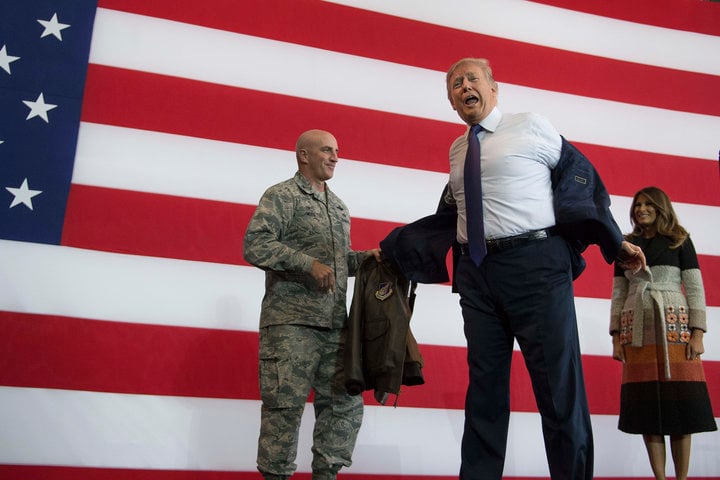
Photo: Jim Watson via Getty Images
President Donald Trump at Yokota Air Base in Tokyo on Nov. 5.


In his first year in office, President Barack Obama gave a landmark address in Prague in which he famously affirmed “clearly and with conviction America’s commitment to seek the peace and security of a world without nuclear weapons.” The commitment to total nuclear disarmament was a major departure from the George W. Bush administration — the first time, in fact, that the United States had declared a nuclear-free world a major policy goal.


The original is published at Huffington Post on January 11th, 2018 – and there you will also be able to read the whole Nuclear Posture Review


Now, eight years later, it’s the Trump administration’s turn to lay out its nuclear weapons policy. And according to a pre-decisional draft of the 2018 Nuclear Posture Review (NPR) obtained by HuffPost, Trump’s Department of Defense has gone a decidedly different route: new nukes, for no good reason.

The final version of the NPR is scheduled to be released in February. You can read the draft in full at the bottom of this article. A Defense Department spokesperson declined to comment on the draft, saying that the agency “will not discuss pre-decisional drafts of the document.”

In October, NBC reported that President Trump had told a gathering of high-ranking national security leaders that “he wanted what amounted to a nearly tenfold increase in the U.S. nuclear arsenal.” While the report doesn’t nearly go that far, it does call for the development of new, so-called low-yield nuclear weapons — warheads with a lower explosive force.

The logic of those pushing for the development of smaller nukes is that our current nuclear weapons are too big and too deadly to ever use; we are effectively self-deterred, and the world knows it. To make sure other countries believe that we’d actually use nuclear force, the thinking goes, we need more low-yield nukes.

But official language around nuclear weapons is slippery and euphemistic. “Low yield” suggests a softer sort of weaponry, diet nukes, until you realize that the bombs dropped on Hiroshima and Nagasaki were technically “low-yield” weapons.

Trump’s NPR draft euphemizes the euphemism, referring to low-yield weapons as “supplements” that will “enhance deterrence.” The document claims that Russia is threatening to use these smaller nuclear weapons; the U.S. needs to match and deter the Russians in kind.
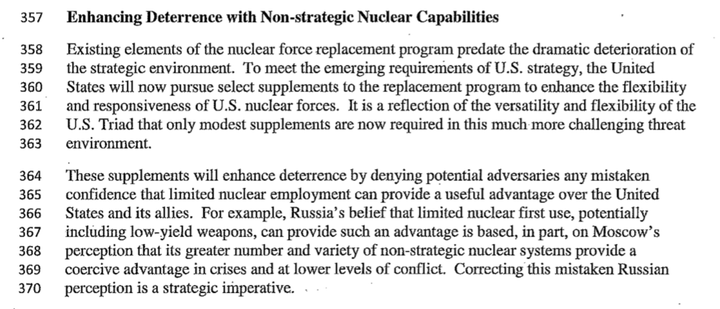
 

2018 Nuclear Posture Review Draft


What goes unmentioned is that we already have over 1,000 nuclear warheads in our arsenal with low-yield options, to say nothing of the fact that the more nuclear weapons you introduce into the world, the more likely it is that they’ll one day be used.

“Making the case that we need more low-yield options is making the case that this president needs more nuclear capabilities at his disposal,” said Alexandra Bell, a former senior adviser at the State Department and current senior policy director at the Center for Arms Control and Non-Proliferation, “regardless of the fact that we have 4,000 nuclear weapons in our active stockpile, which is more than enough to destroy the world many times over. So I don’t think it makes a convincing case that we somehow lack capabilities. And, in fact, I don’t think you can make the case that this president needs any more capabilities.”

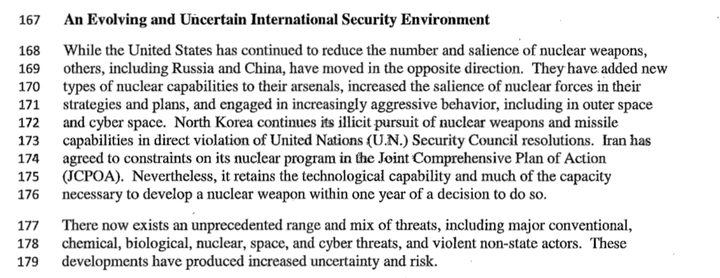
The draft itself doesn’t do all that much to convince anyone of the necessity of these low-yield weapons. One tactic it uses right up front is fear. Look no further than Page 6:
 

2018 Nuclear Posture Review Draft

This is a slightly darker picture than reality would support, according to Laura Holgate, a special assistant to Obama for weapons of mass destruction terrorism and threat reduction and a former U.S. ambassador to the International Atomic Energy Agency in Vienna. “The notion that there are uncertainties is actually not new,” Holgate told HuffPost. “That’s always going to be true about the international environment. And there were references to uncertainties in the 2010 report, as well. But this dark perspective and this uncertain view underpin the decisions to walk back some of the decisions or postures presented in the 2010 report.”

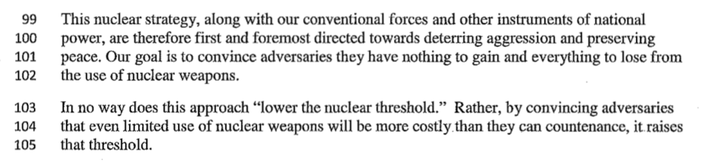
And this new low-yield weapon initiative is one of those reversals. The 2010 NPR essentially removed one tactical low-yield weapon from our arsenal. The Trump administration wants to bring more low-yield weapons back in. And when this latest NPR draft does attempt to defend the decision, it immediately contradicts itself.
 

2018 Nuclear Posture Review Draft


“If you’re saying that having low-yield nuclear weapons does not lower the threshold for use, then you’re essentially saying there’s no difference between using a low-yield and a high-yield weapon,” said Bell. “You’re saying that we would use a high-yield weapon if we have to — or one of the low-yield weapons we already have in our stockpile. If you’re saying adamantly in here that this won’t change our current posture choices, it basically negates your reason to have this capability in the first place.”

What’s more, the report never really explains how any of these new capabilities would alter our security environment.

“By their own argument, they’re concerned that somehow the other side thinks that our current stockpile is getting in the way of our willingness to use nuclear weapons,” explained Anthony Wier, a former deputy assistant secretary in the State Department’s Bureau of Legislative Affairs who now works on nuclear weapons policy for the Friends Committee on National Legislation, a Quaker lobbying organization. “Outside of the drafters of this posture review, I can hardly think of any Americans who would have woken up this morning worrying that Donald Trump was not willing enough to use nuclear weapons.”

And yet the document argues that somehow our adversaries do think that, and so we need additional options to close this imagined credibility gap. What’s missing is any evidence to support the idea that Russia or any other country believes this to be true.

One possible reason for this omission is that no such evidence exists. Back in June, Hans Kristensen, the director of the Nuclear Information Project at the Federation of American Scientists, wrote that “anyone can come up with a scenario that requires a new weapon. What’s missing from the debate is why the existing and planned capabilities are not sufficient. The United States already has flexible nuclear forces, advanced conventional capabilities, tailored war plans and low-yield warheads in its arsenal.”

What the posture review makes clear, however, is that the Trump administration wants to produce a considerable number of new nukes. This would represent a break from precedents established even by Republican administrations. The George W. Bush administration cut our nuclear stockpile by more than half, down to roughly 5,000 warheads. The George H.W. Bush administration cut our stockpile by nearly 9,500 warheads. “Basically everything about this document screams that we’re probably only going up,” Wier said. “There’s no reduction listed anywhere that I could find.

“That’s the bottom line, right? Building a lot more nuclear weapons and spending a lot more money to build it. At times it feels like they want to buy a can opener with a screwdriver attachment, but they also want to pay for a screwdriver with a can opener attachment. There’s a lot of redundancies and duplications, and they need all these extra things to keep you safe. At times, it really does feel like a lot of solutions in search of problems.”

There are other significant departures from the 2010 NPR. The role of diplomacy in nuclear relations is mostly ignored. The report does pay lip service to NATO, and there are nods here and there toward the importance of diplomatic relations.

 

2018 Nuclear Posture Review Drat


The original is published at Huffington Post on January 11th, 2018 – and there you will also be able to read the whole Nuclear Posture Review


But Bell wasn’t buying it. “If the circumstances that we now find ourselves [in] are as dire as they paint them,” she said, “it doesn’t make sense to me that you wouldn’t have put all of the relevant officials needed to do good nuclear policy diplomacy into place immediately. We’re still waiting for a lot of the leaders who should be doing these roles, particularly [in] the State Department. So the critical nature of our current threat environment they describe doesn’t really match their staffing plans.” It’s not just the State Department staffing that’s been neglected. The National Nuclear Security Administration, the very agency responsible for modernizing our nuclear arsenal, is still missing a number of appointees.

Even more strikingly, the document appears not to contain a single reference to Article VI of the U.N. Treaty on the Non-Proliferation of Nuclear Weapons, which obliges the United States, as one of the signatories, to move in the direction of nuclear disarmament. Other countries that have committed to the weapons ban treaty might be less likely to cooperate with the United States on nuclear matters, Holgate said.

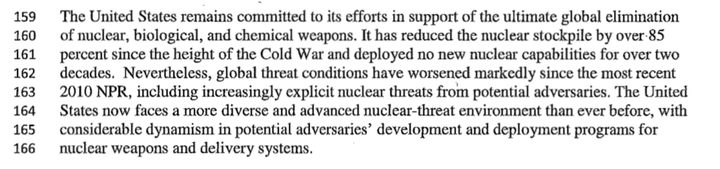
The document does mention disarmament briefly in the introduction.
 

2018 Nuclear Posture Review Drat


“What’s interesting about that is that it fudges it a little bit,” Holgate said. “Not as badly as it could have, but it uses a lot of vague weasel words like ‘committed,’ ‘efforts,’ ‘support’ and ‘ultimate.’ And then, it mushes bio and chem in with nuclear. So this is not a clear commitment.”

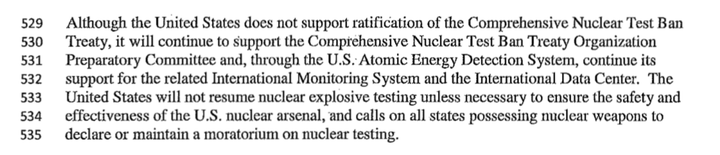
The report is also noticeably vague when it comes to the Comprehensive Nuclear Test Ban Treaty, a global ban on nuclear explosive testing. While the 2010 report reaffirms nearly a dozen times the United States’ dedication to maintaining its stockpile without nuclear testing, this latest NPR draft says the country will not resume nuclear testing “unless necessary.”
 

2018 Nuclear Posture Review Draft


The document does at least reaffirm U.S. support for NATO.

2018 Nuclear Posture Review Draft


But what the report states and what the president tweets are two very different things.

“Obviously it’s very good to see in here that the NATO alliance is the most important defensive alliance in history,” noted Bell. “But saying it in this posture review and waiting until the next time the president says NATO countries aren’t paying him enough money — you’re sort of waiting for the shoe to drop. At the end of the day, our elected leader changes his mind often and without a lot of explanation for the change. So that very much does endanger some of the ideas put forth in this document.”

The document is at pains to assure its audience that Trump isn’t going to start firing off nukes on a whim.

 

2018 Nuclear Posture Review Draft


And based on reported fears about Trump’s erraticism, the world’s leaders could definitely use some reassuring. Just last August, CNN reported that Trump’s “wildly variant public interpretations of violent, anti-Semitic rallies by neo-Nazis and white supremacists” had “caused European leaders to shake their heads in bewilderment.” And South Korea is, if not more fearful, then at least equally as terrified of Trump mouthing off as it is of Kim Jong Un sitting overhead. But, of course, none of that has stopped Trump so far.

“This is clearly not Trump’s policy,” said Jon Wolfsthal, director of the Nuclear Crisis Group and former senior director at the National Security Council for Arms Control and Nonproliferation. It is, Wolfsthal said, a representation of Secretary of Defense Jim Mattis’ policy and Secretary of State Rex Tillerson’s policy and Joint Chiefs Chairman Gen. Joseph Dunford’s policy. “And that will reassure people who hope and pray that the axis of adults is somehow going to constrain President Trump’s impulses.”

The original is published at Huffington Post on January 11th, 2018 – and there you will also be able to read the whole Nuclear Posture Review

Got a tip? Email me at

Related Posts

This is not another geopolitical commentary on the Arctic. It is a visionary peace proposal that can save the region from militarised rivalry and ecological ruin. A blueprint for shared security, sustainable development, and human dignity — benefitting Greenland, the Arctic, and the rest of us. Jan Oberg TFF director Lund, Sweden, February 17, 2026 I. Four Principles for a New Arctic Vision The Arctic is often framed as a cold arena of rivalry — a place where great powers test each other’s resolve. But this worldview is outdated, unimaginative, and ultimately self‑defeating. The Arctic is not a vacuum waiting to be militarised; it is a living region, a climate stabiliser, and a cultural homeland whose future will shape the future of humanity. If we begin from that understanding, a far more rational Arctic order becomes possible — one that is peaceful, cooperative, and centred on the people who actually live there. This vision rests...
PART 2 — Diplomacy, Law and Nonviolent Power By Jan ObergTFF co-founder and director January 26, 2026 This is the second of four TFF-created idea portfolios designed to curb the global reach of the United States and, in both the short and long term, help catalyse a worldwide nonviolent resistance to what many observers describe as the Trump administration’s uniquely confrontational, destructive and world-threatening policies. These portfolios outline what governments and citizens across the world can do through dynamic diplomacy, creative initiatives, and strictly nonviolent means. They are typical TFF works in that we do not only tell what the problem is and how bad it will go – as 90+% of all commentators, experts and scholars do – we tell what we think can be done, inviting you to think of what you think you can do. It seems painfully clear to me that the current political dynamics in Washington increasingly resemble the most dangerous...
Jan Oberg June 19, 2025 Does she think we are idiots? Does Denmark’s foreign policy establishment? I am a Danish citizen, and this fraudulent speech with a gross lie through omission is morally and politically unacceptable. H. E. Ambassador, Christina Markus Lassen, spoke at the UN Security Council’s urgent meeting caused by Israel’s attack on Iran. Read her short – shocking – speech here. She is an experienced Danish diplomat, partly educated in the US (of course), and has been her country’s ambassador to Syria, where she collaborated with the US (the famous Mr Ford!), France, and the UK to shape a “Western approach” – to changing the government of Bashar al-Assad, one must assume. Perversely as hard to believe, she does not mention that Israel has attacked Iran! No, she starts with the US/Israeli mantra – they are both major nuclear powers, of course – that Iran shall never...

Recent Articles

Tony Robinson October 4, 2026 Violence is easy to recognise when someone is being beaten, shot or killed. It becomes more difficult when nobody is holding a weapon. Poverty, discrimination, exploitation and repression can restrict a human life just as effectively, although they do so in very different ways and with very different consequences. Simply adding more categories to an ever-growing list of forms of violence does not really solve the problem. The more interesting question is what all these different situations have in common and why it makes sense to describe them using the same word. Human beings do not simply react to what happens around them. They remember the past, imagine things that do not yet exist, make plans and undertake projects. Workers organise because they imagine different working conditions; people migrate because they imagine another life somewhere else; social movements emerge because people refuse to accept the...
It’s a matter of principles, courage, vision and pulling together – while the militarist world is falling apart… Peter Langille October 3, 2026 “Here, then, is the problem which we present to you, stark and dreadful and inescapable: Shall we put an end to the human race; or shall mankind renounce war?”The Bertrand Russell—Albert Einstein Manifesto, July 9, 1955 ⁕ The forecast for what’s ahead is worrisome. The sharp rise in armed conflicts over the past three years is adding to what was already the highest level in over seventy years. Genocides, which should be prevented are supported. A shared climate emergency that jeopardises survival is ignored. Diverse polls now suggest that people are war-weary, worried and interested in a more effective United Nations. And, there are viable policy options for a more secure world! Yet governments are doubling-down, betting on more war and investing heavily. If current trends persist,...
Johan Galtung 1930-2024October 2015 Published here on October 3, 2026 Let us focus on Civilization for conflict analysis and remedies. Major forms of disorder use violence; war is state organized violence. The most belligerent states are the United States of America and Israel, both with civilization roots. National Evangelism, the US Protestant Christian civilization– more national than evangelical–justifies US warfare as exceptionalism of a people chosen by God, with a manifest destiny to run the world. Orthodox Judaism justifies Israeli warfare to conquer and expand from Nile to Euphrates as a religious right and duty to the Eternal One. The third most belligerent country, the UK, no longer believes it is God-chosen but chosen by the USA; not quite the same but something. But the root cause of global disorder lies in the Occident–with Islam–seeing itself as the single, universal civilization valid for all at all times, all others being...

TFF on Substack

Discover and subscribe to more peace materials on TFF Substack

Most Popular

Tony Robinson October 4, 2026 Violence is easy to recognise when someone is being beaten, shot or killed. It becomes more difficult when nobody is holding a weapon. Poverty, discrimination, exploitation and repression can restrict a human life just as effectively, although they do so in very different ways and with very different consequences. Simply adding more categories to an ever-growing list of forms of violence does not really solve the problem. The more interesting question is what all these different situations have in common and why it makes sense to describe them using the same word. Human beings do not simply react to what happens around them. They remember the past, imagine things that do not yet exist, make plans and undertake projects. Workers organise because they imagine different working conditions; people migrate because they imagine another life somewhere else; social movements emerge because people refuse to accept the...
It’s a matter of principles, courage, vision and pulling together – while the militarist world is falling apart… Peter Langille October 3, 2026 “Here, then, is the problem which we present to you, stark and dreadful and inescapable: Shall we put an end to the human race; or shall mankind renounce war?”The Bertrand Russell—Albert Einstein Manifesto, July 9, 1955 ⁕ The forecast for what’s ahead is worrisome. The sharp rise in armed conflicts over the past three years is adding to what was already the highest level in over seventy years. Genocides, which should be prevented are supported. A shared climate emergency that jeopardises survival is ignored. Diverse polls now suggest that people are war-weary, worried and interested in a more effective United Nations. And, there are viable policy options for a more secure world! Yet governments are doubling-down, betting on more war and investing heavily. If current trends persist,...
Johan Galtung 1930-2024October 2015 Published here on October 3, 2026 Let us focus on Civilization for conflict analysis and remedies. Major forms of disorder use violence; war is state organized violence. The most belligerent states are the United States of America and Israel, both with civilization roots. National Evangelism, the US Protestant Christian civilization– more national than evangelical–justifies US warfare as exceptionalism of a people chosen by God, with a manifest destiny to run the world. Orthodox Judaism justifies Israeli warfare to conquer and expand from Nile to Euphrates as a religious right and duty to the Eternal One. The third most belligerent country, the UK, no longer believes it is God-chosen but chosen by the USA; not quite the same but something. But the root cause of global disorder lies in the Occident–with Islam–seeing itself as the single, universal civilization valid for all at all times, all others being...
Read More
Living-Peace-Sign-Budapest-copy
Tony Robinson October 4, 2026 Violence is easy to recognise when someone is being beaten, shot or killed. It becomes more difficult when nobody is holding a weapon. Poverty, discrimination, exploitation and repression can restrict a human life just as effectively, although they do so in very different ways and with very different consequences. Simply adding more categories to an ever-growing list of forms of violence does not really solve the problem. The more interesting question is what all these different situations have in common and why it makes sense to describe them using the same word. Human beings do not simply react to what happens around them. They remember the past, imagine things that do not yet exist, make plans and undertake projects. Workers organise because they imagine different working conditions; people migrate because they imagine another life somewhere else; social movements emerge because people refuse to accept the...
b54a1f10-8c65-4f0b-9dd5-4abc0a7d04cc_2659x2659
It’s a matter of principles, courage, vision and pulling together – while the militarist world is falling apart… Peter Langille October 3, 2026 “Here, then, is the problem which we present to you, stark and dreadful and inescapable: Shall we put an end to the human race; or shall mankind renounce war?”The Bertrand Russell—Albert Einstein Manifesto, July 9, 1955 ⁕ The forecast for what’s ahead is worrisome. The sharp rise in armed conflicts over the past three years is adding to what was already the highest level in over seventy years. Genocides, which should be prevented are supported. A shared climate emergency that jeopardises survival is ignored. Diverse polls now suggest that people are war-weary, worried and interested in a more effective United Nations. And, there are viable policy options for a more secure world! Yet governments are doubling-down, betting on more war and investing heavily. If current trends persist,...
010
Johan Galtung 1930-2024October 2015 Published here on October 3, 2026 Let us focus on Civilization for conflict analysis and remedies. Major forms of disorder use violence; war is state organized violence. The most belligerent states are the United States of America and Israel, both with civilization roots. National Evangelism, the US Protestant Christian civilization– more national than evangelical–justifies US warfare as exceptionalism of a people chosen by God, with a manifest destiny to run the world. Orthodox Judaism justifies Israeli warfare to conquer and expand from Nile to Euphrates as a religious right and duty to the Eternal One. The third most belligerent country, the UK, no longer believes it is God-chosen but chosen by the USA; not quite the same but something. But the root cause of global disorder lies in the Occident–with Islam–seeing itself as the single, universal civilization valid for all at all times, all others being...
Screenshot 2026-10-02 011738
Jan ObergPhD, director, The Transnational Foundation for Peace and Future Research, TFFLund, Sweden October 2, 2026 This is my full original manuscript. The Chinese Academy of Social Science, CASS, makes two publications out if it. 1. China’s Five-year plan emphasized the capabilities of basic research and original innovation. It is regarded as the goal of the future social development, which, as required, should be significantly enhanced. Can you comment on the importance of original innovation in research and academic study? I believe it is easier to define “original innovation” in the natural sciences than in social sciences. The breaking points of what constitutes something new, or innovative, are not quite as sharp in the latter. But in both fields it is about opening up something that was closed, unseen, unexplored before – making manifest what was earlier latent. Innovations come in many forms and shapes – naming something that was not...
arctic-circle-map
The agreement is catastrophic both because of what it says and what it doesn’t mention. It reduces further the major asset of security policies: Freedom of action. Jan Oberg TFF director September 25, 2026 A couple of hours before the agreement was signed on September 22, 2026, I published the following 13 hypotheses about what it would most likely contain on TFF Substack (in English). I was wrong on only the first point. Contrary to what Trump had written on his Truth Social platform, it does not appear to come into force immediately. In fact, it turned out to be worse than even I had anticipated. After these hypotheses now come a number of reflections in light of what the agreement actually contains, and does not contain, as well as the way in which it has generally been presented by major media outlets and by the public-service broadcaster DR. My...
girl-5894831_1280
Below are TFF-related media mentions, comments, videos and social media posts published elsewhere but not on this homepage. We happen to catch and list only a fraction. Regarding video comments and debates, we recommend that you go to the TFF Video Channel on Substack where many of them are reproduced. Jan Oberg is a contributor to China Daily – 52 million daily clicks – and Global Times, CGTN and CCTV (the national television), China Investment, Xinhua News Agency and several others. Articles and videos on these media very often multiply into countless Chinese (and Western media) that re-post them from these main media. Thanks to The China Academy, his analyses, interviews and comments are frequently posted on YouTube channels such as Thinkers Forum and Wave Media. These videos are often re-posted on Bilibili (China’s YouTube), the China Content Center on TikTok, and on the Chinese edition of TikTok, Douyin.com. This means reaching hundreds of millions of viewers worldwide over a year. While there are too many to catch on all these...
Since 1986 about 9001 articles for a better understanding of our world and times.
In a nutshell
9001+ peace research and policy articles and publications – one of the world’s largest reservoirs of its kind • Covering four decades of global affairs. 150 uniquely qualified & experienced Associates • A leading source for peace research, public education and policy alternatives • A platform for informed debate and action • Critique that lasts • Predictions that come true • Entirely people-financed, all-volunteer and therefore independent

Registered public-not-for-profit organization under Swedish law # 855001-4637 You are welcome to repost/reproduce anything on this homepage but only with full reference to the original here and without changing any post in any way.