Peace theory

Category

Year

Author / Contributor

Region

Sort by

Showing 1-10 of 69 stories

david-loy
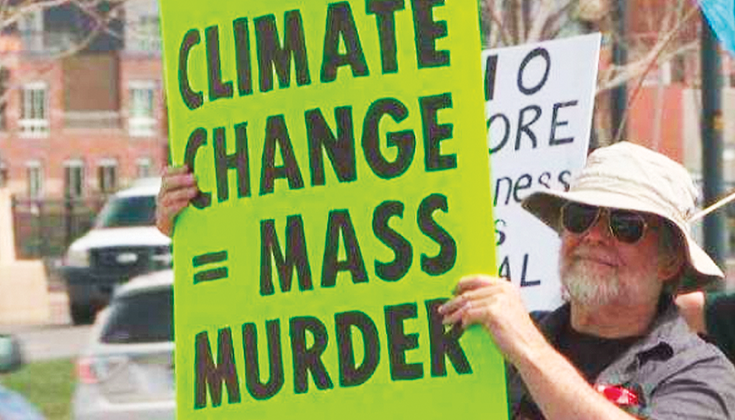
Photo: David Loy at an Extinction Rebellion protest in Denver. Photo by denver.cbslocal.com How do bodhisattvas respond to the greatest crisis of our time? Appropriately, says Buddhist teacher, activist and TFF Associate, David Loy. By David Loy One of my favorite Zen stories is short and simple. A student asks the master, “What is the constant activity of all the buddhas and bodhisattvas?” In other words, what’s special about the day-to-day lives of awakened people? The master replies: “Responding appropriately.” That’s all. No special powers, except being fully attentive to what’s actually happening and acting accordingly. “We don’t know what is possible, we don’t know what will work, but we do our best.” That’s an easy thing to do in a monastery. When the bell rings, you put on your robe and go to the Buddha Hall for meditation. But what about when one leaves the monastery gates and steps...
6134159648_65ce7e9024_z
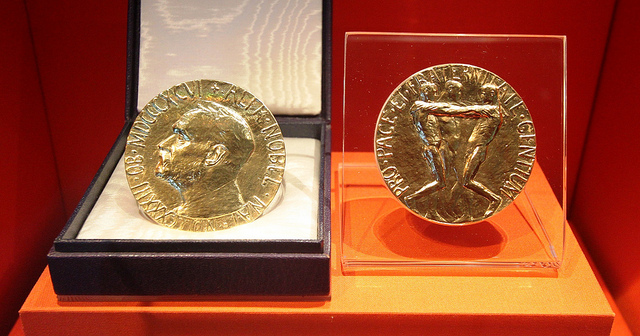
February 3, 2020 By Fredrik Heffermehl The annual screening of candidates for the Nobel Peace Prize 2020 by the Nobel Peace Prize Watch (NPPW) has now been posted on its website and sent to the Nobel Committee. We have found 30 of the known candidates qualified and eligible, within the purpose of Nobel’s will. NPPW offers advice and assistance to nominators and candidates and each year supplies the committee with a wide range of genuine candidates. Believing in openness and transparency as indispensable to reaching good decisions and preventing corruption, here as everywhere else, we also publish the secret nominations. In 2020, the NPPW recommends the Committee to recognize the indispensable role of international law, pointing in particular to Klaus Schlichtmann and Ikuro Anzai, both Japan. Their efforts to complete the original security structure of the UN by empowering the Security Council is at the epicentre of the “brotherhood of...
Mahatma-gandhiquote
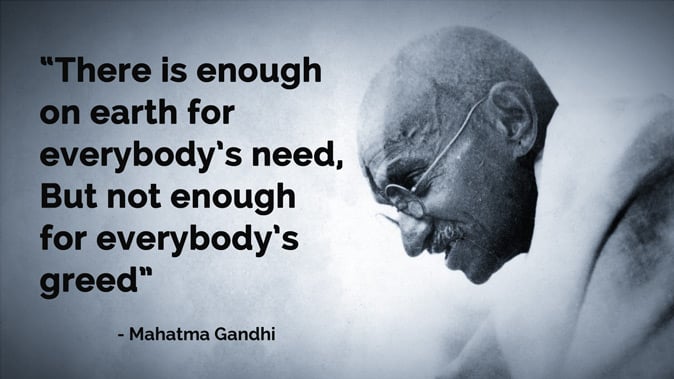
By David Cortright December 11, 2019 Last month I was invited by the Indian Permanent Mission to the United Nations to give a presentation on the International Day of Nonviolence, which was also the 150th anniversary of Gandhi’s birth. Below is the full text of my remarks, which were delivered at the United Nations headquarters in New York. Originally posted on Davidcortright.net on November 9, 2019 here In the remarks, I identified three aspects of Gandhian thought and action that are directly relevant to the challenge of protecting the environment and preventing climate disruption. At the end of my presentation, I added a brief comment on the situation in Kashmir, which seemed necessary to include in an event organized by the Indian government. “Gandhi’s message is highly relevant to today’s global climate crisis. I emphasize here three of his most important themes: simplicity, equity and nonviolence. Simplicity Gandhi became the “greatest...
IMG_9126
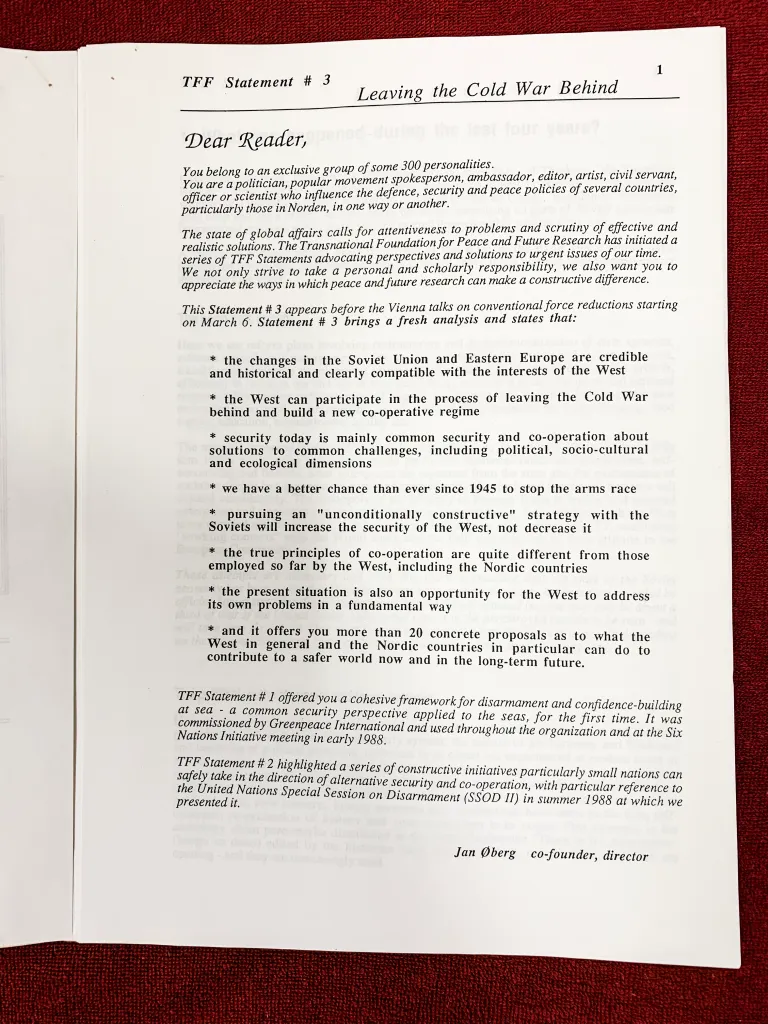
This is the digitalized version of a TFF Statement published by TFF’s Board almost 31 years ago. Could that be of any interest today? First, it reflects the situation and the issues discussed at the time as well as the hopes for a better future – now sadly lost. Secondly, it is one example of how peace researchers were thinking and made constructive political recommendations, available for anyone to take inspiration from – which virtually no one in power did. So, it’s a piece of international political as well as intellectual history. Third, it is an indicator of what the West could – and should – have done to have been in a much better situation than it is today. Admittedly, this is a contra-factual argument, but it can be defended on intellectual grounds although not empirically proven. Fourth, the authors pointed out a series of longterm priorities which match...
Picture1
The Future of Human Rights: Regressive Trends and Restorative Prospects Points of Departure Reviewing the global situation, the then UN High Commissioner for Human Rights, Zaed Raad Al Hussein of Jordan, opened a 2018 conference devoted to the 25th anniversary of the 1993 UN Conference on Human Rights and Development held in Vienna, on a decidedly pessimistic note. Instead of doing the usual on such occasions, that is, celebrating the progress made since the earlier event, Prince Zaed emphasized the disturbing evidence of regression with respect to a broad range of issues bearing on the protection of human rights embedded in international treaty instruments as evidenced by the practice of states. He insisted that without fundamental changes in patterns of governance by sovereign states and in the operation of the world economy it would be naïve to expect an improved international atmosphere for human rights. Originally posted on Richard Falk’s blog...
GandhiVirtues
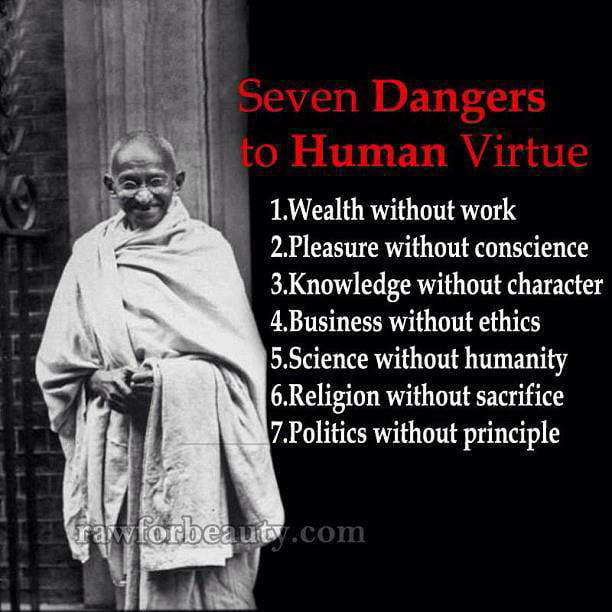
This is what TFF sent out as TFF PressInfo 532 today. It gives you an impression of what you will get if you have not already subscribed to this, one of the oldest peace mail services. Just fill in the form to your right. Above Gandhi’s prophetic diagnosis of today’s Western, or O/Accidental, malaise. Gandhi’s message is not backed up by statistics, figures and charts. It’s the type of statement of wisdom which seems to have disappeared in our modern times. He was born today 150 years ago. Some believe his theory and practice is just historical or irrelevant. However… Millions of people believe in and use non-violence every day. About a week ago, 6 million marched for humans and societies to re-learn to relate non-violently to Nature. Many other millions practice dialogue, negotiations, friendly quarrels, mediation, meetings, writings, speeches, humour etc to deal with their conflicts. It’s non-violence even...
China-s-meat-majors-focus-on-convenience-as-incomes-rise_strict_xxl
By Martin Jacques, Cambridge University August 28, 2019 A delightful conversation about the essential difference between the West and China and why they have vitally different ways of relating to other countries and cultures. If you do business in China, travel as a tourist – which far too few Westerners do – teach international relations and the future of the world, this half an hour is about the best investment you can make to understand better what China is about – and to see the West from outside. Be sure to also visit Jacques’ homepage – and see other videos on his YouTube Channel. Jan Oberg, editor
The-enlargement-of-NATO-1949-2018_cropped_3x2
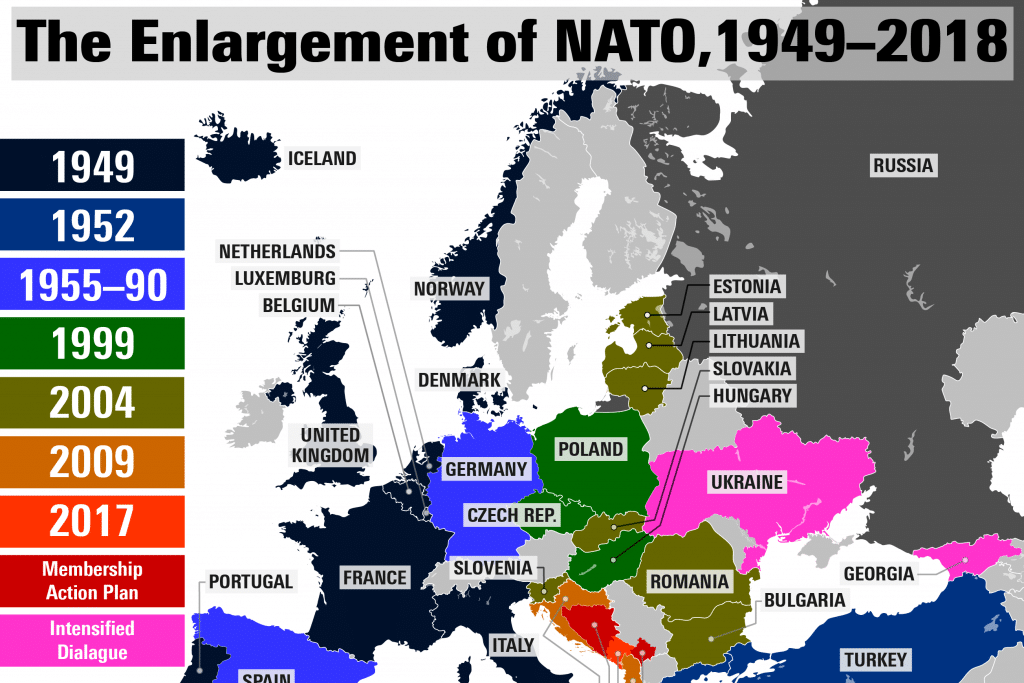
By Gordon M. Hahn July 25, 2019 NATO expansion has contributed to the causal matrix of two wars: the 2008 Georgian-South Ossetiyan/Russian Five-Day War and the ongoing Donbass civil war. The West’s April 2008 promise that both Georgia and Ukraine will become NATO members encouraged Georgian nationalism and Saakashvili’s war in South Ossetiya and consequently led to Georgia’s de facto loss of its South Ossetiyan as well as Abkhaziyan territories. Originally published on Gordon M. Hahn homepage – while Poroshenko was still president. Similarly, NATO expansion encouraged the rise of ultranationalism in Ukraine, especially western Ukraine, and the ultra-nationalist-led February 2014 Maidan revolt, leading to Ukraine’s loss of Crimea and civil war in eastern Ukraine’s Donbass regions of Donetsk and Luhansk. NATO expansion now is poised to help re-start the Donbass civil war or spark a larger Ukrainian civil war (and/or similar conflicts involving Moldova and its breakaway republic of...
Peace-Sign-HD-Background-620x349
March 26, 2010, and July 3, 2019 Why Johan Galtung (born 1930) decided to devote his life to waging peace through research and action. Galtung who is one of the world’s most prolific and innovative social scientists – for instance, the author of more than 160 books and a global lecturer, mediator and professor – has been a TFF Associate since 1986 and has been published hundreds of times at TFF’s old and present site. He is also one of my two mentors in peace research – the other being Håkan Wiberg – says TFF director and co-founder, Jan Oberg.
GretaT
The amazing person and phenomenon called Greta Thunberg can be looked at from many perspectives. What connects them all is the energies of hope. Thus, for instance, her own personal story and what drives her so passionately – and scientifically – at the age of only 16. Or, how she is challenging the entire global establishment as a youth leader not allowed to vote herself but demanding that decision-makers take into account the millions and millions she speaks for as well as the yet unborn generations. That’s a non-contractual, non-reciprocal way of thinking foreign to Western culture’s “I do something for you if/when you do something for me”. And you can’t ask something in return from the yet unborn. Or, how the role she plays now makes visible and catapults a fundamentally moral criticism into the political discourse where it hasn’t existed, I would say, for decades. Or, how her...
1-19-Martin-Luther-King-ftr
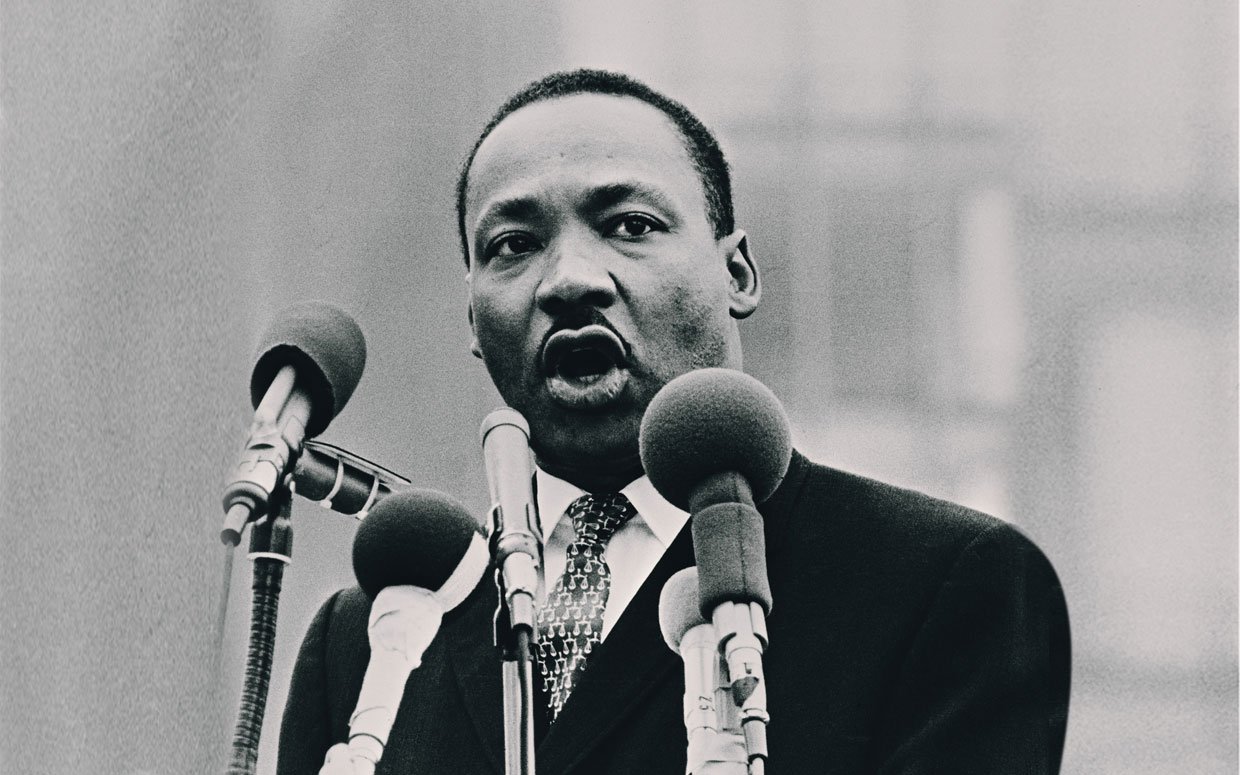
– Martin Luther King Day Since The Transnational is also a public education site, we believe a handy, comprehensive guide to materials about Martin Luther King, Jr. should be found here: For his indisputable greatness as a human being, thinker and activist and for you to see just how far today’s United States of America is from its basic ideals, ideals that he stated so clearly and convincingly. Such ideals must never be allowed to die, neither be turned into lifeless traditions over time that are only paid lip service to at memorial occasions. Martin Luther King, Jr. has a series of messages for today’s world – and inspires anyone who wants to bring about change towards peace. We are particularly fascinated by his elaborations of the concept of The Beloved Community. And we’ve published two other guides earlier: Michel Chossudovsky, TFF Associate, Global Research Guide to Martin Luther King,...
mishra-768x480
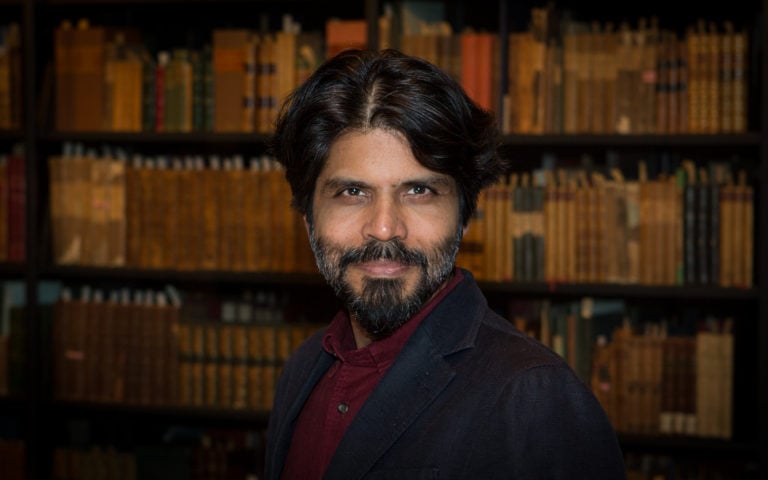
By Pankaj Mishra January 15, 2019 Mohandas Gandhi was the twentieth century’s most famous advocate of nonviolent politics. But was he also its most spectacular political failure? The possibility is usually overshadowed by his immense and immensely elastic appeal. Even Glenn Beck recently claimed to be a follower, and Gandhi’s example has inspired many globally revered figures, such as Martin Luther King, Jr., Nelson Mandela, the Dalai Lama, and Aung San Suu Kyi. Gandhi, rather than Mark Zuckerberg, may have been the presiding deity of the Arab Spring, his techniques of resistance—nonviolent mass demonstrations orchestrated in the full glare of the world’s media—fully absorbed by the demonstrators who prayed unflinchingly on Kasr al-Nil, in Cairo, as they were assaulted by Hosni Mubarak’s water cannons. This article was originally published by The New Yorker on May 2, 2011 And yet the Indian leader failed to achieve his most important aims, and...

Categories

Year

Author / Contributor

Region