
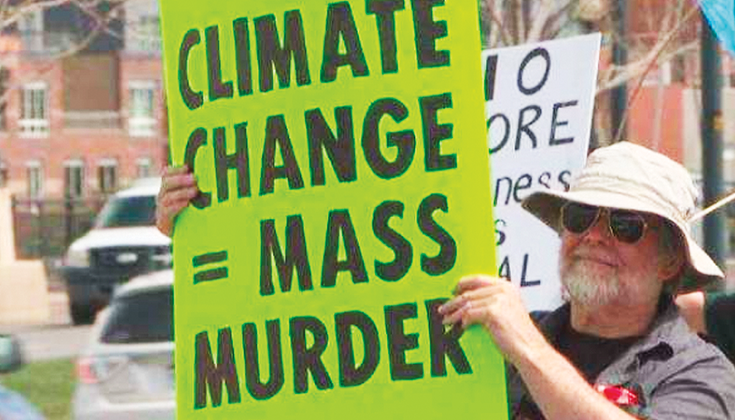
Photo: David Loy at an Extinction Rebellion protest in Denver. Photo by denver.cbslocal.com

How do bodhisattvas respond to the greatest crisis of our time?
Appropriately, says Buddhist teacher, activist and TFF Associate, David Loy.

By David Loy

One of my favorite Zen stories is short and simple. A student asks the master, “What is the constant activity of all the buddhas and bodhisattvas?” In other words, what’s special about the day-to-day lives of awakened people?

The master replies: “Responding appropriately.”

That’s all. No special powers, except being fully attentive to what’s actually happening and acting accordingly.


“We don’t know what is possible, we don’t know what will work, but we do our best.”

That’s an easy thing to do in a monastery. When the bell rings, you put on your robe and go to the Buddha Hall for meditation. But what about when one leaves the monastery gates and steps out into a world with many problems, most ominously an ecological crisis that is severely degrading the biosphere.

How do we respond appropriately to a climate emergency that threatens even the survival of our own species?

Some might say that this is not a Buddhist problem, that Buddhism is only about individual awakening and personal transformation. But is the goal to transcend—escape—this world, or to realize our nonduality with it?

If the latter, then the Buddhist path involves not only focusing on our own meditative practice, but integrating what we realize into how we actually live in the world.

Wisdom founders without compassion, and today that involves responding to the greatest challenge that humanity has ever faced.

Originally published at lionsroar.com

It seems to me that public consciousness has shifted over the last year. More people are aware that our ecological situation has become very precarious, and continues to deteriorate rapidly.

“Business as usual,” along with “politics as usual,” is leading to disaster. In light of this, what should we do? How should we respond appropriately? Today that is our collective koan.

Buddhism originated and developed in a very different social and environmental context than today, so unsurprisingly it has little to tell us about what to do.

But its teachings say a great deal to say about how to do it. That’s called the bodhisattva path. In fact, I wonder if the bodhisattva (or ecosattva) path is the most important contribution that Buddhism can offer today.

Acknowledging the importance of social engagement is a big step for many Buddhists since we have usually been taught to focus on what is happening in our own minds.

On the other side, those committed to social action tend to suffer from frustration, anger, and burnout. The engaged bodhisattva path provides what each needs because it involves a double practice, inner and outer, each reinforcing the other.

Combining meditation and activism enables deep engagement without burnout. Activism also helps meditators avoid self-stultifying preoccupation with their own mental condition and spiritual progress.

Insofar as a sense of separate self is the basic problem, compassionate commitment to the well-being of others is an important part of the solution. Engagement with the ecological crisis is therefore not a distraction from our personal contemplative practice but essential to it.

Although there are many aspects to the bodhisattva path, the equanimity and insight it cultivates supports what is most distinctive and powerful about spiritual activism: acting without attachment to the results of action.

The Buddha said that enlightened people are nirasa: “wishless, desireless, without expectation.” This doesn’t mean inaction or disengagement but what the Bhagavad-Gita calls “karma yoga”: “Your right is to the work, never to the fruits. Be neither motivated by the fruits of action nor inclined to give up action.” Do what is needed, but without attachment to the outcome.

Nonattachment to results is easily misunderstood, however.

It doesn’t mean our approach to our task or nonchalance. In response to the ongoing devastation of the earth, we are called upon to do the very best we can, not knowing what the consequences will be, not knowing if our efforts will make any difference whatsoever.

This is an important aspect of the “don’t-know mind” that Zen practice explicitly cultivates. One of my teachers, Robert Aitken Roshi, liked to say that our task is not to clear up the mystery. It’s to make the mystery clear.

The spiritual path isn’t about coming to understand everything but opening up to a sacred and mysterious world that we access not by grasping it but in being taken by it.

Bodhisattvas always manifest something greater than their own egos. “You are not Atlas carrying the world on your shoulder,” Vandana Shiva said. “It is good to remember that the planet is carrying you.”

We don’t know what is possible, we don’t know what will work, but we do our best. We don’t know if what we do is important, but we know that it’s important for us to do it.

Have we already passed ecological tipping points and civilization as we know it is doomed? We don’t know—and that’s okay.

Of course, we would like our efforts to bear fruit, yet ultimately they are our gift to the earth, gratis, and gifts should be made without any expectation of return.

On April 20, I was part of a group of six Extinction Rebellion protestors, inspired by the ongoing XR actions in London, who briefly blocked a busy street in downtown Denver. Police detained us and issued a summons; our court cases are pending.

Was that the best thing for us to do, inconveniencing many drivers that Saturday afternoon?

I don’t know, but it has become clear that, without some radical changes, we face much more than an inconvenience in the next few years.

I don’t know if what Extinction Rebellion is doing is the most appropriate response, but right now I don’t have a better one, and our backs are against the wall.

We need to hold politicians’ feet to the fire, for the time for humanity to get its act together is short, and getting shorter every day.

A few days after our action, some of the Denver protestors asked if I would offer a workshop meditation retreat for XR activists up at our new Rocky Mountain Ecodharma Retreat Center near Boulder.

We’re holding it in mid-September, just before another week of XR activities worldwide. Doing the inner and outer practice of ecosattvas, we’ll train to respond appropriately.

Originally published at lionsroar.com

If you think this was an interesting approach…

About the author
David Loy

David Loy is a scholar and a Zen teacher in the Sanbo Zen tradition. His latest book is A New Buddhist Path: Enlightenment, Evolution, and Ethics in the Modern World; he is also co-editor of A Buddhist Response to the Climate Emergency.

Related Posts

Below are TFF-related media mentions, comments, videos and social media posts published elsewhere but not on this homepage. We happen to catch and list only a fraction. Regarding video comments and debates, we recommend that you go to the TFF Video Channel on Substack where many of them are reproduced. Jan Oberg is a contributor to China Daily – 52 million daily clicks – and Global Times, CGTN and CCTV (the national television), China Investment, Xinhua News Agency and several others. Articles and videos on these media very often multiply into countless Chinese (and Western media) that re-post them from these main media. Thanks to The China Academy, his analyses, interviews and comments are frequently posted on YouTube channels such as Thinkers Forum and Wave Media. These videos are often re-posted on Bilibili (China’s YouTube), the China Content Center on TikTok, and on the Chinese edition of TikTok, Douyin.com. This means reaching hundreds of millions of viewers worldwide over a year. While there are too many to catch on all these...
Jan Oberg TFF director October 13, 2026 According to Alfred Nobel’s will, the Nobel Peace Prize shall be awarded: ”to the person who has done the most or best to advance fellowship among nations, the abolition or reduction of standing armies, and the establishment and promotion of peace congresses.” Further down, he also expresses how the prize for the “champions of peace” shall be decided: “that for champions of peace by a committee of five persons to be selected by the Norwegian Storting. Alfred Nobel’s will is remarkably short and clear. But few seem to have read it. Nobel did not say that the committee itself should consist of members of parliament. He entrusted the Storting with appointing five persons. In principle, it could have selected diplomats, mediators, peace researchers, conflict-resolution specialists, or other individuals with recognised expertise in matters of peace from around the world. Instead, the Storting gradually...
The Quest for Humane Survival Richard Falk Professor emeritus, Princeton UniversityTFF Associate since 1986October 12, 2026 After decades of teaching and writing about international law in academic frameworks that were not institutionally situated within law school environments—at Princeton and the University of California, Santa Barbara—I found myself most receptive to the TWAIL outlook. It has been especially illuminating in clarifying the extent to which international law evolved as a dialogical critique of Europe’s efforts to legitimize its colonial undertakings. In particular, TWAIL has exposed how international law has functioned to legalize the subjugation of Third World peoples, securing conditions for exploitative investment and trade relations, the coercive enforcement of public debts, and an ideology of cultural superiority. TWAIL’s exposure of these economic legacies of colonialism has influenced my understanding of the history and development of international law, broadly conceived, as an ideological project of the Western sub-system of the world...

Recent Articles

Below are TFF-related media mentions, comments, videos and social media posts published elsewhere but not on this homepage. We happen to catch and list only a fraction. Regarding video comments and debates, we recommend that you go to the TFF Video Channel on Substack where many of them are reproduced. Jan Oberg is a contributor to China Daily – 52 million daily clicks – and Global Times, CGTN and CCTV (the national television), China Investment, Xinhua News Agency and several others. Articles and videos on these media very often multiply into countless Chinese (and Western media) that re-post them from these main media. Thanks to The China Academy, his analyses, interviews and comments are frequently posted on YouTube channels such as Thinkers Forum and Wave Media. These videos are often re-posted on Bilibili (China’s YouTube), the China Content Center on TikTok, and on the Chinese edition of TikTok, Douyin.com. This means reaching hundreds of millions of viewers worldwide over a year. While there are too many to catch on all these...
Jan Oberg TFF director October 13, 2026 According to Alfred Nobel’s will, the Nobel Peace Prize shall be awarded: ”to the person who has done the most or best to advance fellowship among nations, the abolition or reduction of standing armies, and the establishment and promotion of peace congresses.” Further down, he also expresses how the prize for the “champions of peace” shall be decided: “that for champions of peace by a committee of five persons to be selected by the Norwegian Storting. Alfred Nobel’s will is remarkably short and clear. But few seem to have read it. Nobel did not say that the committee itself should consist of members of parliament. He entrusted the Storting with appointing five persons. In principle, it could have selected diplomats, mediators, peace researchers, conflict-resolution specialists, or other individuals with recognised expertise in matters of peace from around the world. Instead, the Storting gradually...
The Quest for Humane Survival Richard Falk Professor emeritus, Princeton UniversityTFF Associate since 1986October 12, 2026 After decades of teaching and writing about international law in academic frameworks that were not institutionally situated within law school environments—at Princeton and the University of California, Santa Barbara—I found myself most receptive to the TWAIL outlook. It has been especially illuminating in clarifying the extent to which international law evolved as a dialogical critique of Europe’s efforts to legitimize its colonial undertakings. In particular, TWAIL has exposed how international law has functioned to legalize the subjugation of Third World peoples, securing conditions for exploitative investment and trade relations, the coercive enforcement of public debts, and an ideology of cultural superiority. TWAIL’s exposure of these economic legacies of colonialism has influenced my understanding of the history and development of international law, broadly conceived, as an ideological project of the Western sub-system of the world...

TFF on Substack

Discover and subscribe to more peace materials on TFF Substack

Most Popular

Below are TFF-related media mentions, comments, videos and social media posts published elsewhere but not on this homepage. We happen to catch and list only a fraction. Regarding video comments and debates, we recommend that you go to the TFF Video Channel on Substack where many of them are reproduced. Jan Oberg is a contributor to China Daily – 52 million daily clicks – and Global Times, CGTN and CCTV (the national television), China Investment, Xinhua News Agency and several others. Articles and videos on these media very often multiply into countless Chinese (and Western media) that re-post them from these main media. Thanks to The China Academy, his analyses, interviews and comments are frequently posted on YouTube channels such as Thinkers Forum and Wave Media. These videos are often re-posted on Bilibili (China’s YouTube), the China Content Center on TikTok, and on the Chinese edition of TikTok, Douyin.com. This means reaching hundreds of millions of viewers worldwide over a year. While there are too many to catch on all these...
Jan Oberg TFF director October 13, 2026 According to Alfred Nobel’s will, the Nobel Peace Prize shall be awarded: ”to the person who has done the most or best to advance fellowship among nations, the abolition or reduction of standing armies, and the establishment and promotion of peace congresses.” Further down, he also expresses how the prize for the “champions of peace” shall be decided: “that for champions of peace by a committee of five persons to be selected by the Norwegian Storting. Alfred Nobel’s will is remarkably short and clear. But few seem to have read it. Nobel did not say that the committee itself should consist of members of parliament. He entrusted the Storting with appointing five persons. In principle, it could have selected diplomats, mediators, peace researchers, conflict-resolution specialists, or other individuals with recognised expertise in matters of peace from around the world. Instead, the Storting gradually...
The Quest for Humane Survival Richard Falk Professor emeritus, Princeton UniversityTFF Associate since 1986October 12, 2026 After decades of teaching and writing about international law in academic frameworks that were not institutionally situated within law school environments—at Princeton and the University of California, Santa Barbara—I found myself most receptive to the TWAIL outlook. It has been especially illuminating in clarifying the extent to which international law evolved as a dialogical critique of Europe’s efforts to legitimize its colonial undertakings. In particular, TWAIL has exposed how international law has functioned to legalize the subjugation of Third World peoples, securing conditions for exploitative investment and trade relations, the coercive enforcement of public debts, and an ideology of cultural superiority. TWAIL’s exposure of these economic legacies of colonialism has influenced my understanding of the history and development of international law, broadly conceived, as an ideological project of the Western sub-system of the world...
Read More
girl-5894831_1280
Below are TFF-related media mentions, comments, videos and social media posts published elsewhere but not on this homepage. We happen to catch and list only a fraction. Regarding video comments and debates, we recommend that you go to the TFF Video Channel on Substack where many of them are reproduced. Jan Oberg is a contributor to China Daily – 52 million daily clicks – and Global Times, CGTN and CCTV (the national television), China Investment, Xinhua News Agency and several others. Articles and videos on these media very often multiply into countless Chinese (and Western media) that re-post them from these main media. Thanks to The China Academy, his analyses, interviews and comments are frequently posted on YouTube channels such as Thinkers Forum and Wave Media. These videos are often re-posted on Bilibili (China’s YouTube), the China Content Center on TikTok, and on the Chinese edition of TikTok, Douyin.com. This means reaching hundreds of millions of viewers worldwide over a year. While there are too many to catch on all these...
Nobel-Prize-Plaque
Jan Oberg TFF director October 13, 2026 According to Alfred Nobel’s will, the Nobel Peace Prize shall be awarded: ”to the person who has done the most or best to advance fellowship among nations, the abolition or reduction of standing armies, and the establishment and promotion of peace congresses.” Further down, he also expresses how the prize for the “champions of peace” shall be decided: “that for champions of peace by a committee of five persons to be selected by the Norwegian Storting. Alfred Nobel’s will is remarkably short and clear. But few seem to have read it. Nobel did not say that the committee itself should consist of members of parliament. He entrusted the Storting with appointing five persons. In principle, it could have selected diplomats, mediators, peace researchers, conflict-resolution specialists, or other individuals with recognised expertise in matters of peace from around the world. Instead, the Storting gradually...
law-419057_1280
The Quest for Humane Survival Richard Falk Professor emeritus, Princeton UniversityTFF Associate since 1986October 12, 2026 After decades of teaching and writing about international law in academic frameworks that were not institutionally situated within law school environments—at Princeton and the University of California, Santa Barbara—I found myself most receptive to the TWAIL outlook. It has been especially illuminating in clarifying the extent to which international law evolved as a dialogical critique of Europe’s efforts to legitimize its colonial undertakings. In particular, TWAIL has exposed how international law has functioned to legalize the subjugation of Third World peoples, securing conditions for exploitative investment and trade relations, the coercive enforcement of public debts, and an ideology of cultural superiority. TWAIL’s exposure of these economic legacies of colonialism has influenced my understanding of the history and development of international law, broadly conceived, as an ideological project of the Western sub-system of the world...
images-2
Advocates of nuclear disarmament are regularly dismissed by the champions of nuclear deterrence as naïve and unrealistic, utopian or even irresponsible. Yet this ‘doctrine’ of deterrence, regarded by France as the ‘cornerstone’ of its national security, is based on quasi-religious beliefs, a theory that cannot be proven, risky gambles and fragile assumptions. So much so that one might legitimately ask which side the ‘Care Bears’ are on. Marc FinaudVice-President of Initiatives for Nuclear Disarmament (IDN) October 9, 2026 This article was originally published on Pressenza When it comes to these things being treated as religious concepts, look here. Idealists and realists It was Hubert Védrine, François Mitterrand’s former Foreign Minister, who repeatedly coined the phrase: ‘Europeans are a sort of Care Bears who don’t realise they’re living in Jurassic Park’. He applies this reference to the cartoon for well-behaved children not only to what he regards as weakness or idealism...
8824b09f-33a5-43f9-9fd0-550f28cda24d_1536x1024
What the West Borrowed from Asia and What It Left Behind Jan Krikke October 8, 2026 The article was originally published here In the late 1960s, the musical Hair announced that the Age of Aquarius was dawning. Its opening anthem promised a transformation of human consciousness: an era of peace, harmony and understanding. Half a century later, a familiar echo of that promise is a meditation app offered by your employer. You can find it in the same list of benefits as the pension plan and the gym discount. How did a spiritual revolution become an employee benefit? The answer lies in the history of the movement known as New Age: where it came from, what it borrowed from Asia, and why the meaning of what it borrowed changed in the process. Two definitions will help. New Age is a loose label for a wide range of spiritual practices and...
Screenshot 2026-10-04 210142
Small and different + among the 10% most active + 9,000 texts + 150 Associates + 60 000 a day — and a stubborn belief that peace is smarter and must be secured by peaceful means. In 2026, the Transnational Foundation for Peace and Future Research (TFF) turns 40. On Monday, October 5, 2026, a new TFF homepage will go live — a new gateway to more than 9,000 articles, analyses, research papers and other contributions produced over four decades of independent peace research. But this is not simply a new website. For four decades, TFF has worked from a simple conviction: peace is smarter than militarism and can be brought about by peaceful means. This is not merely an aspiration. It is the principle expressed in the UN Charter and the Gandhian tradition that has guided our work from the beginning. TFF is a research-based, independent and people-financed foundation....




