By David Cortright

December 11, 2019

Last month I was invited by the Indian Permanent Mission to the United Nations to give a presentation on the International Day of Nonviolence, which was also the 150th anniversary of Gandhi’s birth. Below is the full text of my remarks, which were delivered at the United Nations headquarters in New York.

Originally posted on Davidcortright.net on November 9, 2019 here

In the remarks, I identified three aspects of Gandhian thought and action that are directly relevant to the challenge of protecting the environment and preventing climate disruption. At the end of my presentation, I added a brief comment on the situation in Kashmir, which seemed necessary to include in an event organized by the Indian government.

image

“Gandhi’s message is highly relevant to today’s global climate crisis. I emphasize here three of his most important themes: simplicity, equity and nonviolence.

Simplicity

Gandhi became the “greatest person in the world” (as many called him) not through power and wealth but through selflessness and humble service to others.

He didn’t have anything. All of his possessions at the end of his life fit into a small box.

He lived simply and rejected materialism. He moved from a large home to live communally in an ashram. He shed his three-piece suit to became a man in loincloth, wearing a simple dhoti and shawl of homespun, even in cold and rainy London.

In 1931, while participating in the round table negotiations with the British government, Gandhi and other Indian delegates were invited to tea with the king. When Gandhi arrived at Buckingham Palace in his usual sparse attire, ‘half-naked’ Churchill once derisively commented, a reporter asked if he was underdressed for the occasion. Gandhi replied, “Don’t worry. His majesty has on enough for both of us.”

In his emphasis on simplicity and non-possession, Gandhi was revealing a profound truth about the roots of our current crisis, and he was pointing toward the pathway to a more sustainable future.

In his early book, Hind Swaraj, he described the quest for material goods and the endless multiplication of wants as “satanic.” If India were to follow the industrialism and economic imperialism of the West, he later warned, it would “strip the world bare like locusts.”

Gandhi’s critique of excessive materialism calls into question today our constant striving and demand for more goods. Are we consuming too much? Have our wants out-stripped our needs?

His critique also calls into question our model of economics. Our modern economic system is predicated upon endless growth, but there are unavoidable limits to the earth’s biological carrying capacity. We cannot keep dumping ever greater amounts of waste products into the atmosphere and the oceans.

The current global effort to stem carbon emissions focuses on the supply side. Produce more efficiently with less energy. Use renewal materials and resources. All good, but it is insufficient. We must also look at the demand side and explore ways to produce less, to consume less.

The global supply chains of today stretch from the high consuming West, to the high producing East, especially India and China. While emission levels have moderated slightly in the West, they are rising in the East, to satisfy the excess wants and manufacture the superfluous goods demanded in the West.

Curbing our demand for products does not mean that we abandon the struggle against poverty. On the contrary, we must continue and accelerate the work of fulfilling the Sustainable Development Goals, as was discussed recently at the UN. But surely we can find a way to continue lifting people out of poverty without further ruining the environment or undermining the life support systems that are necessary to sustain human dignity into the future.

In calling for fewer wants and less consumption, I am not saying we should go about in loincloth or live in an ashram. But we can and must commit ourselves to living more simply and modestly.

Those of us who have achieved middle class status must demand less for ourselves and share more with others, especially the disinherited.

Equity

Gandhi devoted himself to serving the poor. In his famous Talisman, he said we should ask ourselves how our actions will affect the poorest and the weakest. We should act in ways that will help to liberate the hungry and lift up the least of these.

We know that the harmful effects of pollution and climate chaos fall disproportionately upon the poor and powerless. The rich and mighty can move to higher ground or cooler climes, but the impoverished do not have that option.

We should heed the wisdom of Pope Francis on this issue. The Holy Father links the marginalization of the poor to the exploitation of the environment. In his historic encyclical Laudato Si, he calls us to be in solidarity with the miserando, the lowly who are “mired in desperate and degrading poverty, with no way out, while others … [are] vainly showing off their supposed superiority and leaving behind so much waste that, if it were the case everywhere, would destroy the planet.”

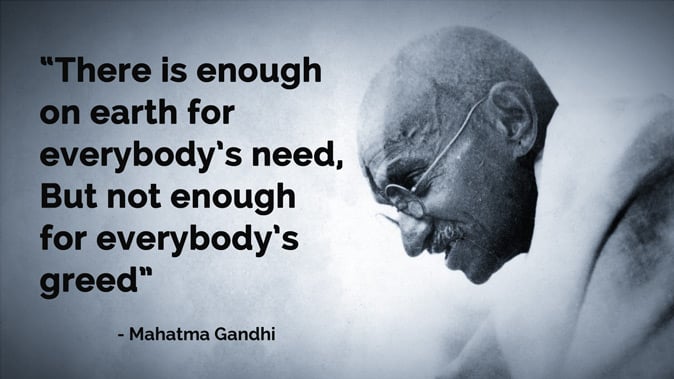
Gandhi would agree with that. He thought of excess consumption as thievery. If we take more than is necessary for own needs, he believed, we take it from others. All people must have an equal opportunity, Gandhi said. This does not mean that everyone literally has the same amount, rather that everybody has enough for his or her needs.

Nonviolence

Gandhi’s most important contribution to the world, I believe, is his philosophy and method of nonviolence. He demonstrated the power of disciplined peaceful disobedience, how mass noncooperation with injustice can change the course of history.

His philosophy of nonviolence is based on the principle of ahimsa, non-harm, the refusal to hurt another person, and also the responsibility to stand up for those who are harmed or threatened by others. He said that love and nonviolence are the pathway to spiritual fulfillment and divine truth, and he showed that they can also be means of overcoming oppression and injustice.

We reject violence because it is based on domination and coercion. Peace on the other hand is rooted in cooperation and freedom. Peace and nonviolence are indivisible. Life is sacred, and all living beings are interrelated. We are inescapably bound together in a web of mutuality through the interdependence of all living beings and the natural world.

As we strive to live peacefully with our fellow human beings, we must also be at peace with the earth. With all of our energy and strength, we must take up the responsibility to protect and preserve this precious, vulnerable envelope of air, water and soil that sustains all life and that is increasingly in peril due to our own actions.

Kashmir

As we reflect today upon Gandhi’s teachings on nonviolence, we would be remiss, I believe, if we did not mention the current situation in Kashmir.

Gandhi played a role in Kashmir in 1947, traveling to Srinagar to meet with Maharaja Hari Singh. When discontent and violence ensued after Kashmir acceded to India, Gandhi said, “If anyone can save Kashmir, it is only the Muslims, the Kashmiri Pandits, the Rajputs and the Sikhs who can do so.”

Today there is renewed discontent, and a risk of violence, but this must be avoided, as Gandhi would insist. The only path to a just settlement in Kashmir is through nonviolent democratic means.

Long live the spirit and message of Mahatma Gandhi!”

References

Pope Francis, Laudato Si: On Care for Our Common Home, Encyclical Letter, Hunting, Our Sunday Visitor Publishing Division, 2015, 62-63, 91

Quoted in Ramachandra Guha, Gandhi: The Years That Changed The World, 1914-1948, New York, Alfred A. Knopf, 2018, p, 823
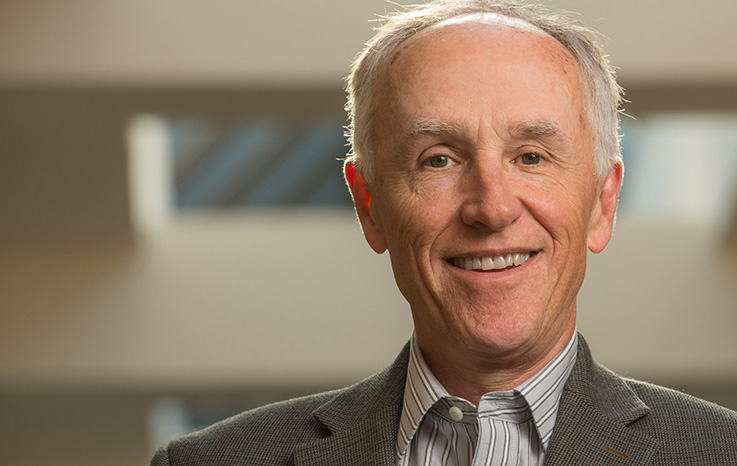
David Cortright teaches peace studies and nonviolent social change at the University of Notre Dame and is the Director of Policy Studies at Notre Dame’s Kroc Institute for International Peace Studies. He researches and writes about peace and security; Iraq, Iran, and Afghanistan; the abolition of nuclear weapons; counter-terrorism; sanctions; and peace ideas and movements.


Related Posts

Tony Robinson October 4, 2026 Violence is easy to recognise when someone is being beaten, shot or killed. It becomes more difficult when nobody is holding a weapon. Poverty, discrimination, exploitation and repression can restrict a human life just as effectively, although they do so in very different ways and with very different consequences. Simply adding more categories to an ever-growing list of forms of violence does not really solve the problem. The more interesting question is what all these different situations have in common and why it makes sense to describe them using the same word. Human beings do not simply react to what happens around them. They remember the past, imagine things that do not yet exist, make plans and undertake projects. Workers organise because they imagine different working conditions; people migrate because they imagine another life somewhere else; social movements emerge because people refuse to accept the...
It’s a matter of principles, courage, vision and pulling together – while the militarist world is falling apart… Peter Langille October 3, 2026 “Here, then, is the problem which we present to you, stark and dreadful and inescapable: Shall we put an end to the human race; or shall mankind renounce war?”The Bertrand Russell—Albert Einstein Manifesto, July 9, 1955 ⁕ The forecast for what’s ahead is worrisome. The sharp rise in armed conflicts over the past three years is adding to what was already the highest level in over seventy years. Genocides, which should be prevented are supported. A shared climate emergency that jeopardises survival is ignored. Diverse polls now suggest that people are war-weary, worried and interested in a more effective United Nations. And, there are viable policy options for a more secure world! Yet governments are doubling-down, betting on more war and investing heavily. If current trends persist,...
Johan Galtung 1930-2024October 2015 Published here on October 3, 2026 Let us focus on Civilization for conflict analysis and remedies. Major forms of disorder use violence; war is state organized violence. The most belligerent states are the United States of America and Israel, both with civilization roots. National Evangelism, the US Protestant Christian civilization– more national than evangelical–justifies US warfare as exceptionalism of a people chosen by God, with a manifest destiny to run the world. Orthodox Judaism justifies Israeli warfare to conquer and expand from Nile to Euphrates as a religious right and duty to the Eternal One. The third most belligerent country, the UK, no longer believes it is God-chosen but chosen by the USA; not quite the same but something. But the root cause of global disorder lies in the Occident–with Islam–seeing itself as the single, universal civilization valid for all at all times, all others being...

Recent Articles

Tony Robinson October 4, 2026 Violence is easy to recognise when someone is being beaten, shot or killed. It becomes more difficult when nobody is holding a weapon. Poverty, discrimination, exploitation and repression can restrict a human life just as effectively, although they do so in very different ways and with very different consequences. Simply adding more categories to an ever-growing list of forms of violence does not really solve the problem. The more interesting question is what all these different situations have in common and why it makes sense to describe them using the same word. Human beings do not simply react to what happens around them. They remember the past, imagine things that do not yet exist, make plans and undertake projects. Workers organise because they imagine different working conditions; people migrate because they imagine another life somewhere else; social movements emerge because people refuse to accept the...
It’s a matter of principles, courage, vision and pulling together – while the militarist world is falling apart… Peter Langille October 3, 2026 “Here, then, is the problem which we present to you, stark and dreadful and inescapable: Shall we put an end to the human race; or shall mankind renounce war?”The Bertrand Russell—Albert Einstein Manifesto, July 9, 1955 ⁕ The forecast for what’s ahead is worrisome. The sharp rise in armed conflicts over the past three years is adding to what was already the highest level in over seventy years. Genocides, which should be prevented are supported. A shared climate emergency that jeopardises survival is ignored. Diverse polls now suggest that people are war-weary, worried and interested in a more effective United Nations. And, there are viable policy options for a more secure world! Yet governments are doubling-down, betting on more war and investing heavily. If current trends persist,...
Johan Galtung 1930-2024October 2015 Published here on October 3, 2026 Let us focus on Civilization for conflict analysis and remedies. Major forms of disorder use violence; war is state organized violence. The most belligerent states are the United States of America and Israel, both with civilization roots. National Evangelism, the US Protestant Christian civilization– more national than evangelical–justifies US warfare as exceptionalism of a people chosen by God, with a manifest destiny to run the world. Orthodox Judaism justifies Israeli warfare to conquer and expand from Nile to Euphrates as a religious right and duty to the Eternal One. The third most belligerent country, the UK, no longer believes it is God-chosen but chosen by the USA; not quite the same but something. But the root cause of global disorder lies in the Occident–with Islam–seeing itself as the single, universal civilization valid for all at all times, all others being...

TFF on Substack

Discover and subscribe to more peace materials on TFF Substack

Most Popular

Tony Robinson October 4, 2026 Violence is easy to recognise when someone is being beaten, shot or killed. It becomes more difficult when nobody is holding a weapon. Poverty, discrimination, exploitation and repression can restrict a human life just as effectively, although they do so in very different ways and with very different consequences. Simply adding more categories to an ever-growing list of forms of violence does not really solve the problem. The more interesting question is what all these different situations have in common and why it makes sense to describe them using the same word. Human beings do not simply react to what happens around them. They remember the past, imagine things that do not yet exist, make plans and undertake projects. Workers organise because they imagine different working conditions; people migrate because they imagine another life somewhere else; social movements emerge because people refuse to accept the...
It’s a matter of principles, courage, vision and pulling together – while the militarist world is falling apart… Peter Langille October 3, 2026 “Here, then, is the problem which we present to you, stark and dreadful and inescapable: Shall we put an end to the human race; or shall mankind renounce war?”The Bertrand Russell—Albert Einstein Manifesto, July 9, 1955 ⁕ The forecast for what’s ahead is worrisome. The sharp rise in armed conflicts over the past three years is adding to what was already the highest level in over seventy years. Genocides, which should be prevented are supported. A shared climate emergency that jeopardises survival is ignored. Diverse polls now suggest that people are war-weary, worried and interested in a more effective United Nations. And, there are viable policy options for a more secure world! Yet governments are doubling-down, betting on more war and investing heavily. If current trends persist,...
Johan Galtung 1930-2024October 2015 Published here on October 3, 2026 Let us focus on Civilization for conflict analysis and remedies. Major forms of disorder use violence; war is state organized violence. The most belligerent states are the United States of America and Israel, both with civilization roots. National Evangelism, the US Protestant Christian civilization– more national than evangelical–justifies US warfare as exceptionalism of a people chosen by God, with a manifest destiny to run the world. Orthodox Judaism justifies Israeli warfare to conquer and expand from Nile to Euphrates as a religious right and duty to the Eternal One. The third most belligerent country, the UK, no longer believes it is God-chosen but chosen by the USA; not quite the same but something. But the root cause of global disorder lies in the Occident–with Islam–seeing itself as the single, universal civilization valid for all at all times, all others being...
Read More
Living-Peace-Sign-Budapest-copy
Tony Robinson October 4, 2026 Violence is easy to recognise when someone is being beaten, shot or killed. It becomes more difficult when nobody is holding a weapon. Poverty, discrimination, exploitation and repression can restrict a human life just as effectively, although they do so in very different ways and with very different consequences. Simply adding more categories to an ever-growing list of forms of violence does not really solve the problem. The more interesting question is what all these different situations have in common and why it makes sense to describe them using the same word. Human beings do not simply react to what happens around them. They remember the past, imagine things that do not yet exist, make plans and undertake projects. Workers organise because they imagine different working conditions; people migrate because they imagine another life somewhere else; social movements emerge because people refuse to accept the...
b54a1f10-8c65-4f0b-9dd5-4abc0a7d04cc_2659x2659
It’s a matter of principles, courage, vision and pulling together – while the militarist world is falling apart… Peter Langille October 3, 2026 “Here, then, is the problem which we present to you, stark and dreadful and inescapable: Shall we put an end to the human race; or shall mankind renounce war?”The Bertrand Russell—Albert Einstein Manifesto, July 9, 1955 ⁕ The forecast for what’s ahead is worrisome. The sharp rise in armed conflicts over the past three years is adding to what was already the highest level in over seventy years. Genocides, which should be prevented are supported. A shared climate emergency that jeopardises survival is ignored. Diverse polls now suggest that people are war-weary, worried and interested in a more effective United Nations. And, there are viable policy options for a more secure world! Yet governments are doubling-down, betting on more war and investing heavily. If current trends persist,...
010
Johan Galtung 1930-2024October 2015 Published here on October 3, 2026 Let us focus on Civilization for conflict analysis and remedies. Major forms of disorder use violence; war is state organized violence. The most belligerent states are the United States of America and Israel, both with civilization roots. National Evangelism, the US Protestant Christian civilization– more national than evangelical–justifies US warfare as exceptionalism of a people chosen by God, with a manifest destiny to run the world. Orthodox Judaism justifies Israeli warfare to conquer and expand from Nile to Euphrates as a religious right and duty to the Eternal One. The third most belligerent country, the UK, no longer believes it is God-chosen but chosen by the USA; not quite the same but something. But the root cause of global disorder lies in the Occident–with Islam–seeing itself as the single, universal civilization valid for all at all times, all others being...
Screenshot 2026-10-02 011738
Jan ObergPhD, director, The Transnational Foundation for Peace and Future Research, TFFLund, Sweden October 2, 2026 This is my full original manuscript. The Chinese Academy of Social Science, CASS, makes two publications out if it. 1. China’s Five-year plan emphasized the capabilities of basic research and original innovation. It is regarded as the goal of the future social development, which, as required, should be significantly enhanced. Can you comment on the importance of original innovation in research and academic study? I believe it is easier to define “original innovation” in the natural sciences than in social sciences. The breaking points of what constitutes something new, or innovative, are not quite as sharp in the latter. But in both fields it is about opening up something that was closed, unseen, unexplored before – making manifest what was earlier latent. Innovations come in many forms and shapes – naming something that was not...
arctic-circle-map
The agreement is catastrophic both because of what it says and what it doesn’t mention. It reduces further the major asset of security policies: Freedom of action. Jan Oberg TFF director September 25, 2026 A couple of hours before the agreement was signed on September 22, 2026, I published the following 13 hypotheses about what it would most likely contain on TFF Substack (in English). I was wrong on only the first point. Contrary to what Trump had written on his Truth Social platform, it does not appear to come into force immediately. In fact, it turned out to be worse than even I had anticipated. After these hypotheses now come a number of reflections in light of what the agreement actually contains, and does not contain, as well as the way in which it has generally been presented by major media outlets and by the public-service broadcaster DR. My...
girl-5894831_1280
Below are TFF-related media mentions, comments, videos and social media posts published elsewhere but not on this homepage. We happen to catch and list only a fraction. Regarding video comments and debates, we recommend that you go to the TFF Video Channel on Substack where many of them are reproduced. Jan Oberg is a contributor to China Daily – 52 million daily clicks – and Global Times, CGTN and CCTV (the national television), China Investment, Xinhua News Agency and several others. Articles and videos on these media very often multiply into countless Chinese (and Western media) that re-post them from these main media. Thanks to The China Academy, his analyses, interviews and comments are frequently posted on YouTube channels such as Thinkers Forum and Wave Media. These videos are often re-posted on Bilibili (China’s YouTube), the China Content Center on TikTok, and on the Chinese edition of TikTok, Douyin.com. This means reaching hundreds of millions of viewers worldwide over a year. While there are too many to catch on all these...