Media and conflict

Category

Year

Author / Contributor

Region

Sort by

Showing 1-10 of 206 stories

StephenFCohen
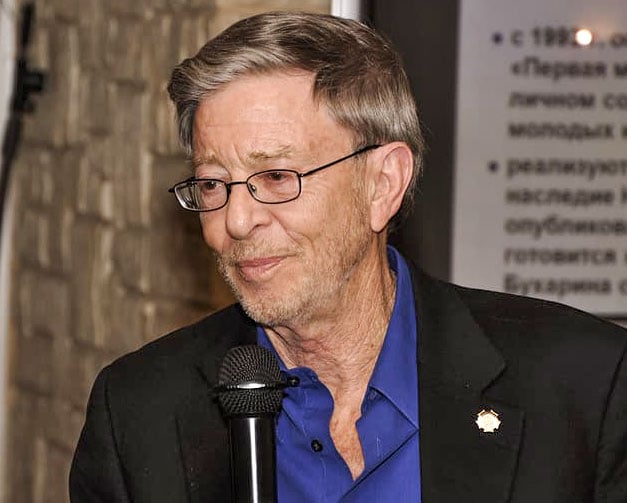
Its allegations and practices suggest disdain for American institutions, principles, best interests, and indeed for the American people. Stephen F. Cohen, professor emeritus of Russian Studies and Politics at NYU and Princeton, and John Batchelor continue their (usually) weekly discussions of the new US-Russian Cold War. (Previous installments, now in their fourth year, are at TheNation.com.) The nearly two-year-long series of allegations and investigations now known as “Russiagate” was instigated by top American political, media, and (probably) intelligence elites (mostly Democratic or pro-Democratic, but not only). What they have wrought suggests profoundly disturbing characteristics of people who play a very large role in governing this country. Cohen specifies six such barely concealed truths, which he and Batchelor then discuss. 1. Russiagate promoters evidently have little regard for the current or future institution of the American presidency. At the center of their many allegations is the claim that the current president,...
1101960715_400
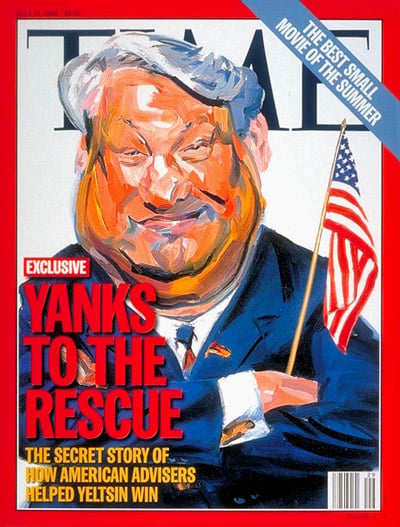
The time of the Clinton administration. There is a very good article with links and a PDF on OffGuardian here. It’s a mind-boggling story about how five Americans were tasked with influencing the election of Boris Yeltsin in competition with other candidates who, when they started working in Moscow, had much higher poll figures than he had. This was a couple of years after Bill Clinton had broken all important Western politicians promises to Mikhail Gorbachev to the effect that NATO would not expand “an inch” and started doing exactly that – a process that ended with the crisis and tension in today’s Ukraine. Fortunately, there are Western media that have told you quite a bit about US meddling in the elections and other political affairs of other countries: Huffington Post“The US has been meddling in other countries’ elections for a century. It doesn’t feel good.” Los Angeles TimesThe US...
NoEvidence
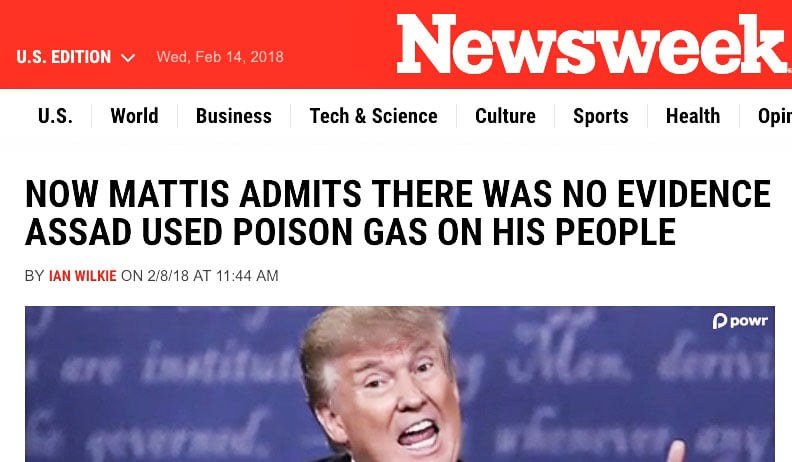
82b7f244a4b771c73a0b601ec5″>Associated Press – right out of the Secretary of Defence’s own mouth. Newsweek picked up this – breaking – story but virtually no one else. Compare that with thousands upon thousands of articles throughout the Western press just parroting American officials’ statements, including President Trump’s when he found it appropriate in April 2017 to attack Syria with cruise missiles to teach “the regime” and its “dictator” a lesson for its alleged attack on Khan Seykhoun, stating that “there can be no dispute that Syria used banned chemical weapons.” Some of us thought it was a bit too early because there could be no dispute either about another, much more important, thing – namely that, at the time, there could not have been any evidence collected or analysed. TFF and its Associates has stated a few things about the media coverage of Syria in general and the chemical attacks in particular...
IranFlag
By Mike Whitney January 16, 2018   The Trump administration has settled on a plan for sabotaging the Iranian Nuclear deal that does not explicitly violate the terms of the agreement. Trump will continue to suspend sanctions, as is required under the terms of the deal, but at the same time, he will warn that if the agreement isn’t changed to meet his specific demands,  he will terminate it unilaterally. “If at any time I judge that such an agreement is not within reach, I will withdraw from the deal immediately,” Trump said. We can expect Trump to continue to issue these same threats in the months ahead as it helps to maximize the uncertainty as to whether the agreement will survive or not. As a businessman and investor,  Trump  knows that uncertainly is nearly as effective as sanctions when it comes to dampening foreign investment in the country’s businesses...
GrahamFuller
By Graham Fuller • With the emergence of demonstrations and rioting in various Iranian cities earlier this month, Washington’s neoconservatives and interventionist/ imperial-minded “liberals” have been given a new lease on life in promoting their aspirations for “regime change” in Tehran. Indeed, of the three current potential global flashpoints—North Korea, Russian borderlands, and Iran in the Gulf—Iran arguably presents the most likely situation to actually turn into war. Originally published on LobeLog and Graham Fuller’s blog   The other two regions, Russia and Korea, pose such potentially appalling nuclear dangers that, rhetoric aside, one would hope will seriously deter national leadership from contemplating. War with Iran, on the other hand, presents no such nuclear threats. It is therefore perhaps the more dangerous situation since conflict with Iran is therefore quite “thinkable” and could potentially drag in Saudi Arabia, Qatar, Syria, Iraq, Russia, Turkey, and of course the supreme fomenter of...

Screenshot
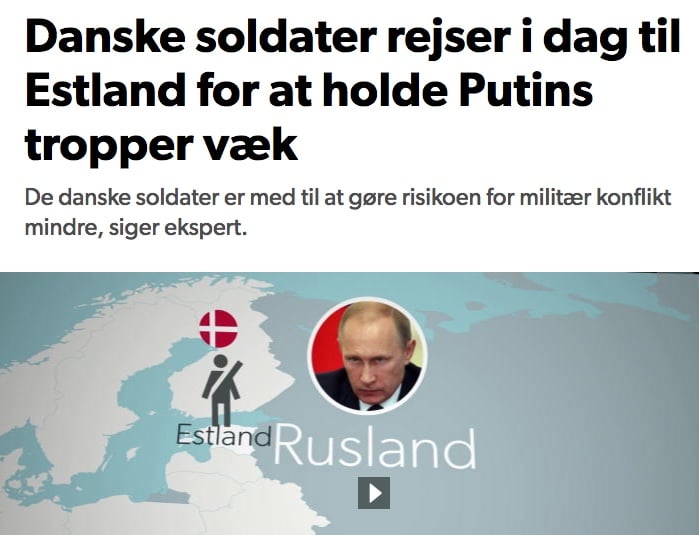
Af Jan Øberg • Danmark sendte den 10. januar 2018, 200 soldater til Estland som en del af NATOs indsatser vis-a-vis Rusland. På DR.dk mener man at det bør gives den journalistiske behanding, man kan se her under overskriften: Danske soldater rejser i dag til Estland for at holde Putins tropper væk Givet dette har jeg fundet at der var grund til at skrive en indsigelse til journalisten bag teksten, Sune Gudmann Christiani. Om hans – militære – baggrund kan man læse på Linkedin her. Det fremgår at han også har en flerårig baggrund på Forsvarsakademiet hvor hans – eneste – udvalgte militære ekspert også har sin gang. Jeg skrev derfor samme dag til ham. Og afventer nu svar.   Kære Sune Gudmann Christiani Din artikel i dag om danske soldaters udstationering i Estland lader en del tilbage at ønske – fra såvel et sagligt som journalistisk perspektiv. Forhåndsstationering er...
MichelChossudovsky
  • What is now unfolding in both North America and Western Europe is fake social activism, controlled and funded by the corporate establishment. This manipulated process precludes the formation of a real mass movement against war, racism and social injustice.   The anti-war movement is dead. The war on Syria is tagged as “a civil war”. The war on Yemen is also portrayed as a civil war.  While the bombing is by Saudi Arabia, the insidious role of the US is downplayed or casually ignored. “The US is not directly involved so there is no need for us to wage an anti-war campaign”. (paraphrase) In turn, dissent has become compartmentalized. Separate “issue oriented” protest movements (e.g. environment, anti-globalization, peace, women’s rights, LGBT) are encouraged and generously funded as opposed to a cohesive mass movement against global capitalism. This mosaic was already prevalent in the counter G7 summits and People’s Summits of the 1990s...
cropped-img_3146
By Tim Hayward July 22, 2017 • These past six months I have been getting to know the inter-media. They’re not formally part of mainstream, and they’re not very social, so I call them inter-media. They are like the maintenance team for the mainstream. To explain this, I’ll first say how I came to meet them. The context of these encounters is writing posts on Syria. Doing so, I rely entirely on what others say. But the fact that we hear directly contradictory narratives provides a rare opportunity to test whose tale is the truer. Lies, whatever some bluffers and braggers may think, are infinitely harder to sustain, over time, than is the truth.[1] The impulse to write about Syria originated at a very specific moment, even if my curiosity had been piqued earlier by the Netflix White Helmets: Where are the fighters that are holding off the combined military might...
file-20171128-7450-19olpkk
  By Michael Greenwell* • It came as a slight relief to see at least some measured coverage of Donald Trump’s recent visit to South Korea. Sections of the media have been predicting World War III – and focusing on barbed and incendiary comments between Trump and North Korean leader Kim Jon-un – so stories that take a more measured tone should be welcomed … by everyone. North Korea has now launched another ballistic missile, and further doomsday journalism could inflame current hostilities in the region. Any positive influence to avoid actual military action and encourage all nations to stick to a peaceful, negotiated resolution is in the whole world’s interest. The US president missed the press opportunity to stand at the border of North Korea on his recent trip, and it’s encouraging that he didn’t glower at the checkpoint, eyeballing his opponent like a boxer before a fight. It...
jake-lynch-180x167-150x150
 Peace journalism is when editors and reporters make choices – about what to report, and how to report it – that create opportunities for society at large to consider and to value non-violent responses to conflict. If readers and audiences are furnished with such opportunities, but still decide they prefer war to peace, there is nothing more journalism can do about it, while remaining journalism. On the other hand, there is no matching commitment to ensuring a fair hearing for violent responses, if only because they seldom struggle for a place on the news agenda. How come? To report is to choose. ‘We just report the facts’, journalists say, but ‘the facts’ is a category of practically infinite size. Even in these days of media profusion, that category has to be shrunk to fit into the news. The journalist is a ‘gatekeeper’, allowing some aspects of reality through, to emerge,...
Destruct2
December 12, 2017, marks the anniversary of the liberation – the West called it fall – of Aleppo in Syria. What happened is conveniently forgotten today by the West. Some of us can’t and won’t forget what was both world, regional and local history. Important for Syria, for the West and for the future world order – for at least 5 reasons:   1. The Western mainstream media’s deceptive – constructed, ignorant, or both – narrative since 2011 was debunked. Perspectives that media and political decision-makers deliberately omitted (remember omitted stuff is more important than fake): • History and the colonialists’ role in Syria. • The immense complexity of the Syrian society. • Syria as a 7000 year-old civilisation and as end of the Silk Road. • The decades-long conflicts underlying the violence, since CIA’s coup in 1949. • The Western-driven regime change policies years since before 2011. • Other...
RianeEisler
By Riane Eisler Via ahtribune.com • Mohsen Abdelmoumen: Can you explain us the term “domination culture”? Dr. Riane Eisler: Many people today believe that elections will lead to freedom and equality. But people often vote for regressive leaders – as dramatically illustrated by the recent election as U.S. President of a man who promised strong – man rule, condoned violence, degraded women, and stoked fear and scapegoating. To understand, and change, this, we need new thinking. Psychological linguists have found that the terms available to us channel our thinking. So new thinking requires new language. Our traditional social categories – such as ancient vs. modern, technologically developed vs. undeveloped, capitalist vs. socialist, Eastern vs. Western, and religious vs. secular – fragment our thinking. Each describes only a particular aspect of a social system. And all fail to take into account findings from psychology and neuroscience showing that what children experience...
Categories

Year

Author / Contributor

Region