The Quest for Humane Survival
Richard Falk
Professor emeritus, Princeton University
TFF Associate since 1986
October 12, 2026
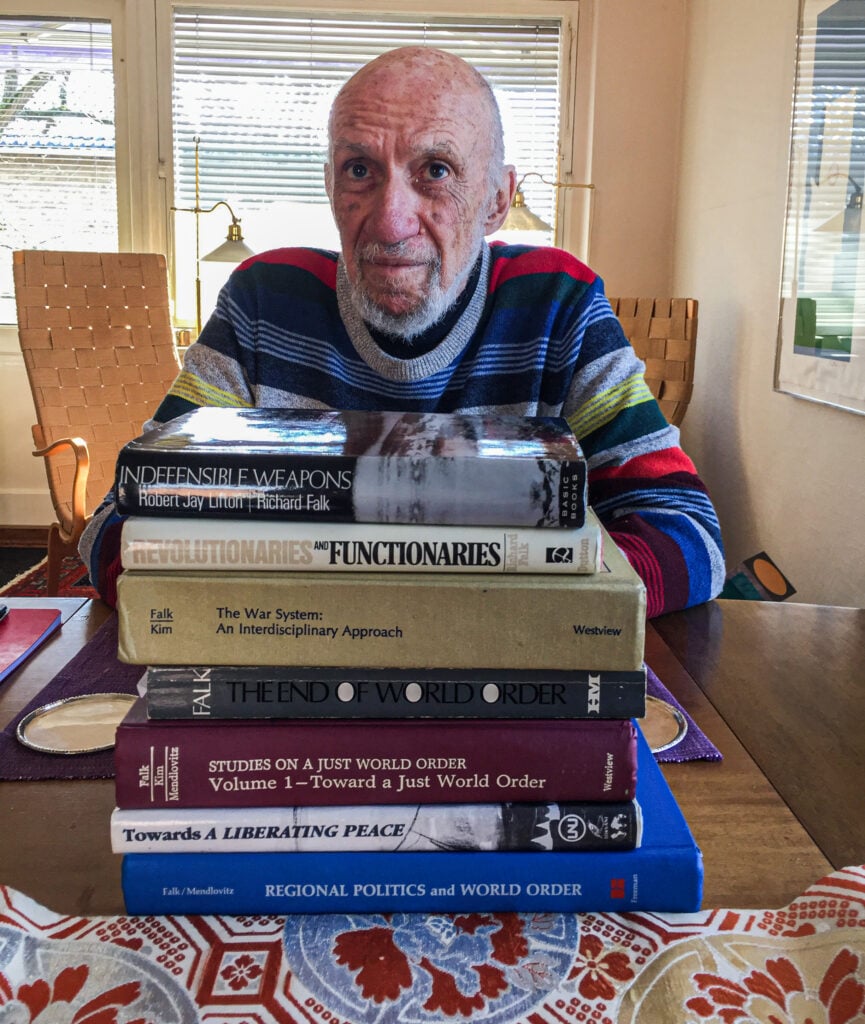
After decades of teaching and writing about international law in academic frameworks that were not institutionally situated within law school environments—at Princeton and the University of California, Santa Barbara—I found myself most receptive to the TWAIL outlook. It has been especially illuminating in clarifying the extent to which international law evolved as a dialogical critique of Europe’s efforts to legitimize its colonial undertakings. In particular, TWAIL has exposed how international law has functioned to legalize the subjugation of Third World peoples, securing conditions for exploitative investment and trade relations, the coercive enforcement of public debts, and an ideology of cultural superiority.
TWAIL’s exposure of these economic legacies of colonialism has influenced my understanding of the history and development of international law, broadly conceived, as an ideological project of the Western sub-system of the world order framework, relying on misleading universalist rhetoric embedded in its articulations of Westphalian perspectives as constituted by evolvutionary stages ever since 1648. This rhetoric speaks as if the formal equality of sovereign states expressed the behavioral realities of international relations, rather than obscuring the actuality of hierarchy and inequality among states.
From my student days—and as a result of early efforts to invoke international law in opposition to United States engagement in the Vietnam War—I argued that the best defense of U.S. national interests would be served by adherence to international law as objectively interpreted.[1] In this period stretching from the mid-1960s to the mid-1970s, the U.S. government made a diligent (if unconvincing) effort to reconcile its foreign policy with the rules, principles, and procedures of international law.[2]
As the Vietnam War wound down, the weakness of this argumentative approach to international law became gradually exposed for what it was: a rationalization for an unlawful intervention in the internal affairs of a sovereign state in defense of Western colonial interests, motivated to some extent by the containment imperatives of Cold War geopolitics. Through my academic engagement in the international law debates of the Vietnam era—most comprehensively in an exchange of views in the pages of the Yale Law Journal between a pro-war international jurist, John Norton Moore, and myself—I developed an oppositional identity grounded in my reliance on international law to critique the U.S. role in the Vietnam War.[3]
After a period of quietude, the U.S. government abandoned any pretense of conforming its foreign policy to the constraints of international law where global security and strategic alignment were concerned. Instead, it relied more and more on discretionary recourses to force, in accord with a growing disposition to resolve legal disputes by coercive means, especially since the end of the Cold War in the early 1990s. In mainstream venues—such as the Council on Foreign Relations and the New York Times—legal dimensions of war/peace decisions by the U.S. received scant attention. Foreign policy assessments shifted instead to matters of costs, interests, and goals, with an overarching economistic concern of whether the undertaking seemed justified by an political and economic calculus.
Former State Department insider Richard Haass, for instance, claimed that American war policies rested on assessments of “wars of choice” (as contrasted with “wars of necessity”).[4] While such analysis started with the Iraq War of 2003, the same framework is currently being relied upon in establishment circles to evaluate the Iran War.[5]
The public discourse has accordingly shifted to misleading pronouncements that the UN and international law are presently dead, as compared to their place in the normative order established after World War II and embodied in the UN Charter.
In that period, international law was invoked to justify the collective response to North Korea’s attack on South Korea. More significantly, it justified the U.S. opposition to the 1956 Suez Operation of the UK, France, and Israel, on grounds that their recourse to force was contrary to the core international law prohibition of non-defensive uses of international force as set forth in Articles 2(4) and 51 of the UN Charter. This act of seventy years ago gave priority to international law when in conflict with Atlanticism—that is, alliance geopolitics—and has thus been sharply criticized ever since in mainstream Washington foreign policy circles, and never repeated in subsequent decades. Revealingly, current European governmental criticisms of the Iran War or Israel’s behavior are now couched in prudential language of success and failure, rather than made with reference to international law.
There is a revealing exception to this emergent dominant pattern of lawlessness—carried to brazen extremes by Trump’s diplomacy—and that is in relation to violations of international law by the main geopolitical rivals of the United States: China and Russia.
The hypocrisy entailed by (correctly) condemning Russia’s attack on Ukraine while (incorrectly) shielding Israel from censure and obligations to uphold international law treats international law as a tool of state propaganda, rather than the source of a regulative norm applicable to all states as generally understood.
To my knowledge, TWAIL so far has not been as responsive to this dangerous and unacceptable series of developments as it has been in its contributions to subaltern and anti-colonialist literature. This can be partly explained by TWAIL’s preoccupations with the policy agendas of the Global South, focusing on economic development and economic and social rights, although the Gaza genocide has engaged such TWAIL stalwarts as Noura Erakat and John Reynolds, in condemnations of Israel’s behavior toward the Palestinian people since the October 7 attack.
In one central respect, the above evaluation of international law in relation to the management of global security is incomplete. The architects of the post-1945 world order designed the UN and the system of enforcement of and accountability to international law for the benefit of the winners of World War II. These winners would enjoy an effective exemption from any obligation to obey international law for the sake of war prevention through the right of veto conferred on the permanent members of the Security Council.
At the same time, accountability for war crimes would be limited to the losers as it was at the Nuremberg and Tokyo tribunals: international law institutions and procedures would continue to refrain from any investigation of the alleged crimes of the winners—dramatized in World War II by the atomic bomb attacks on Hiroshima and Nagasaki, as well as the indiscriminate strategic bombing of German and Japanese cities. One can only wonder what the legal status of nuclear weapons would be had the Germans won the race to develop the atomic bomb, used it against British and American cities, and yet gone on to lose the war.
The reconstruction of world order during the Cold War restrained geopolitical aggressiveness because of the shared interest of these geopolitical adversaries in the avoidance of World War III. This forebearance was not because of the inhibitions of international law, but rather through the mechanisms of mutual deterrence as reinforced in Europe, the region most prone to the outbreak of a major war.
These mechanisms worked because of the widespread recognition in both Moscow and Washington that World War III would be a lose/lose catastrophe, unlike the prior experience of World War II as a winner-takes-all outcome. Deterrence was reinforced by geopolitical fault lines agreed to and maintained by the rival superpowers, that prohibited interventions across the boundaries separating Western Europe from Eastern Europe and West Berlin from East Berlin, as well as the two divided Asian countries of Korea and Vietnam.
The fragility of this ad hoc ordering scheme was revealed during the 1962 Cuban Missile Crisis. That frightening incident did not lead these two superpower rivals to recommit to international law, but it did enhance bilateral voluntary mechanisms of crisis avoidance in the future. So far, with ambiguous exceptions, war prevention has benefited from the adherence of nuclear weapons states to an informal taboo on threats and uses of such weapons of mass destruction.[6] This already flimsy guardrail has become frighteningly frail in the shadow of Trump’s mindlessly imperial diplomacy consisting of threats, bluffs, and militarism and Putin’s unilateral and aggressive efforts to restore Russia as a geopolitical actor.
A broader read of our current moment against the history of international law shows that the contemporary “failures” of international law—such as the failure to stop the genocide in Gaza, or to halt aggression against Iran and other neighbors of Israel—are not true failures at all. They are simply manifestations of a design feature of international relations that never claimed the authority or displayed the political will to establish a credible framework of international law to fulfill war prevention goals.
A final observation draws on my academic experience.
The present tendency to view the viability of international law and the UN as a systemic failure by appraising performance from the sole perspective of global security. Such overall denigration is deeply misleading. It overlooks vast areas of international life that are effectively regulated by international law—including maritime and air safety, routine commercial transactions, diplomatic immunity, travel and tourism, and communications. International law works so well in these policy domains that its effective performance tends to be taken for granted. Familiar examples of effective regulation of international behavior include upholding the immunities of diplomatic representatives of foreign countries, the facilitation of travel by the equitable management of border control, and the maintenance of freedom of navigation. Instances of non-compliance exist, as they do in the context of national legal systems, and indeed any form of legal control of human behavior.
This can be explained. When law is sustained by perceptions of self-interest and the logic of reciprocity, it induces compliance and is generally self-enforcing. Its absence would indeed render valid the dark anarchic visions of Hobbes and make the interactive stability of the modern world a pipe dream. This poses an ambitious challenge to TWAIL scholarship: nothing less than to develop a jurisprudential framework that addresses the functional underpinnings of international relations without sacrificing TWAIL’s own critical focus on bringing peace, justice, health, economic viability, and ecological resilience to all peoples inhabiting Planet Earth.
[1] Richard A. Falk, Law, Lawyers, and the Conduct of American Foreign Relations, 78 Yale L.J. 919 (1968).
[2] Richard A. Falk, The Six Legal Dimensions of the Vietnam War (Princeton Univ. Ctr. of Int’l Stud., Research Monograph No. 34, 1968).
[3] Richard A. Falk, International Law and the United States Role in the Viet Nam War, 75 Yale L.J. 1122 (1966); John Norton Moore, International Law and the United States Role in Viet Nam: A Reply, 76 Yale L.J. 1051 (1967); Richard A. Falk, International Law and the United States Role in Viet Nam: A Response to Professor Moore, 76 Yale L.J. 1095 (1967).
[4] Richard N. Haass, War of Necessity, War of Choice: A Memoir of Two Iraq Wars (2009).
[5] See, e.g., Richard Haass, Trump’s Risky War of Choice in Iran, Project Syndicate (Mar. 1, 2026), https://www.project-syndicate.org/commentary/trump-reckless-war-of-choice-in-iran-by-richard-haass-2026-03.
[6] See Daniel Ellsberg, The Doomsday Machine: Confessions of a Nuclear War Planner 5–20 (2017) (describing U.S. “uses” of nuclear weapons since the atomic bombings at the end of World War II).
◪