
Gordon M. Hahn: ‘Putin’s nuclear threat’ ‘Putin’s nuclear threat’ Putin’s nuclear threat’….

Gordon M. Hahn

October 27th 2022

The title above has been placed within quotation marks for a reason: Russian President Vladimir Putin made no nuclear threat unless one considers that a threat to respond to nuclear threats or to respond to a hypothetical nuclear attack amounts to a threat to use nuclear weapons. The West has attempted to spread the impression that Putin made an unprovoked nuclear threat, the same way it has asserted that Russia undertook an unprovoked invasion of Ukraine on 24 February 2022.

Repeat a lie often enough, and it becomes the truth, sort of. Yes a repeated lie can become a virtual truth, and in our virtual times, virtual reality is having a profound impact on actual reality and not in any positive way. Quite to the contrary.

Originally posted on October 11th, 2022 on Gordon Hahn’s homepage

The quote that is said to have constituted Putin making a threat to use nuclear weapons against Ukraine and/or its NATO allies came in Putin’s September 21 announcement regarding his decision to begin a partial mobilization of reservists. In his TV speech, Putin did not mention nuclear weapons per se and alluded to ‘different types of weapons’ in Russia’s possession that could counter the nuclear weapons that Western leaders have explicitly threatened to use.

Putin said on September 21:

“They (the Ukrainians) have even resorted to the nuclear blackmail. I am referring not only to the Western-encouraged shelling of the Zaporozhye Nuclear Power Plant, which poses a threat of a nuclear disaster, but also to the statements made by some high-ranking representatives of the leading NATO countries on the possibility and admissibility of using weapons of mass destruction – nuclear weapons – against Russia.

“I would like to remind those who make such statements regarding Russia that our country has different types of weapons as well, and some of them are more modern than the weapons NATO countries have. In the event of a threat to the territorial integrity of our country and to defend Russia and our people, we will certainly make use of all weapon systems available to us. This is not a bluff.

“The citizens of Russia can rest assured that the territorial integrity of our Motherland, our independence and freedom will be defended – I repeat – by all the systems available to us. Those who are using nuclear blackmail against us should know that the wind rose can turn around.”


Some might say that no Western leaders prior to ‘Putin’s threat’ had made threats or indicated that they are prepared to use nuclear weapons against Russia. This, of course, is false. The quasi-Iron Lady, now-former British Prime Minister Liz Truss, said in the context of discussing the Russo-NATO Ukrainian war during her campaign to succeed Boris Johnson that she was ready to ‘press the button’ if required (source).

A US Senator, Republican Roger Wicker, emphasized that the US “does not rule out first-use nuclear action” against Russia and urged US President Joe Biden “not to take anything off the table” (source). This was said in December 2021 – before Putin’s move into Ukraine in February 22.

Days before Putin’s move, Ukrainian President Volodymyr Zelenskiy threatened to re-nuclearize Ukraine by abandoning Ukraine’s participation in the Budapest Memorandum which denuclearized post-Soviet Ukraine in exchange for Russia’s recognition of Kyiv’s sovereignty over Crimea and Russian-Western guarantees of Ukrainian sovereignty and non-interference in its internal affairs. As I noted in another article of mine, this could have been another factor in a long line of Western and Ukrainian provocations that pushed Putin to act as he did (source).

More recently, days after ‘Putin’s nuclear threat’, Zelenskiy appeared to appeal to NATO to bring to fruition Wicker’s portentous proposal and carry out a first strike against Moscow: “What should NATO do? Exclude the possibility of Russia using nuclear weapons. But, importantly, I once again appeal to the international community, as it was before February 24: preventive strikes, so that they know what will happen to them, if they use them, and not the other way around, to wait for Russia’s nuclear strikes, to then say: “Ah, that’s what you do? Well, get it from us!” (source).

Finally, we have Ukrainian armed forces repeatedly firing at Russian troops occupying the Zaporozhe Nuclear Power Plant complex and the Ukrainian staff that works there, risking a new Chernobyl at Europe’s largest nuclear energy plant.

I will leave it to the reader to determine which side is engaged in dangerous nuclear brinksmanship.

I will only add that the nuclear shadow now hanging over Europe’s and the world’s head is precisely:

  • why NATO should not have expanded beyond reunified Germany as the West promised Moscow,
  • why the West should not have been seeding instability in Kiev for over a decade,
  • why the West should not have been promising Kiev NATO membership in the future,
  • why the Obama administration should not have recognized the snipers’ massacre, false flag-induced Maidan overthrown of Viktor Yanukovych and thrown away the February 20th agreement intended to end the Maidan crisis and signed by European states and backed by Putin,
  • why Putin should not have seized Crimea,
  • why Kiev should not have declared war on the Donbass,
  • why Washington should have pressed Kiev to carry out its Minsk 2 obligations,
  • why the US and NATO should not have been training, arming, and encouraging Ukraine to attempt to seize back Crimea and Donbass by force,
  • why Putin should not have escalated the low-scale Donbass conflict,
  • why the West should have agreed on a new security architecture with Russia and abandon plans to expand to Ukraine and Georgia, and
  • why the West should now be using all its power and influence to get Moscow and Kiev to sit at the negotiating table rather than arming Kiev and antagonizing Moscow with ill-conceived sanctions, insulting rhetoric, and nuclear talk.

To be sure, some Russian officials have also made nuclear threats and done so out of any context of retaliation against hypothetical Western nuclear attack or threats to undertake such an attack. It is worth noting, however, it was Westerners who talked this way first—Wicker and Zelenskiy before the February 24th Russian offensive. Such talk should be avoided, and this is probably why Putin did not use the word ‘nuclear’ in his threat to use all means at Russia’s disposal if necessary.

Please help TFF remain truly independent by contributing if you benefited from this article
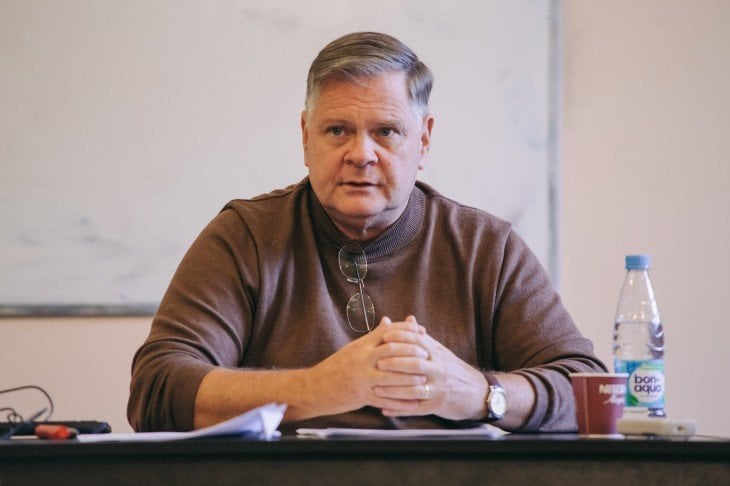
Gordon M. Hahn, Ph.D., is an Expert Analyst at Corr Analytics and a Senior Researcher at the Center for Terrorism and Intelligence Studies (CETIS), Akribis Group. Dr Hahn is the author of The Russian Dilemma: Security, Vigilance, and Relations with the West from Ivan III to Putin (McFarland, 2021), Ukraine Over the Edge: Russia, the West, and the “New Cold War” (McFarland, 2018), The Caucasus Emirate Mujahedin: Global Jihadism in Russia’s North Caucasus and Beyond (McFarland, 2014), Russia’s Islamic Threat (Yale University Press, 2007), and Russia’s Revolution From Above: Reform, Transition and Revolution in the Fall of the Soviet Communist Regime, 1985-2000 (Transaction, 2002). He also has published numerous think tank reports, academic articles, analyses, and commentaries in both English and Russian language media.

Dr. Hahn also has taught at Boston, American, Stanford, San Jose State, and San Francisco State Universities and as a Fulbright Scholar at Saint Petersburg State University, Russia and has been a senior associate and visiting fellow at the Center for Strategic and International Studies, the Kennan Institute in Washington DC, and the Hoover Institution.


Related Posts

In contrast to most, we’ll bring alternatives, solutions, hope and strategies for a better future. Times are dangerous, yes, but that only intensifies the need for constructive thinking and action! Jan Oberg, TFF director April 13, 2026 The new TFF Peace Pulse uses video messages in a new way: Max 3-5-minute-long comments, ideas or perhaps mini-lectures, all about peace – positive peace. We launch them today on April 13, 2026 with a carefully crafted visual aesthetic fitting the content. We hope to publish them regularly from now on. We launch Peace Pulse (PP) – for a number of reasons. The world is in chaos, and there are countless reasons to feel concerned, frustrated, even angry. The atmosphere is saturated with doom and gloom, with negative energy and rear‑mirror thinking, while vision, imagination, alternatives, strategies and genuine future‑mindedness remain in short supply. And without them, we simply can’t save the world. Looking at problems from a hundred angles will...
This is not another geopolitical commentary on the Arctic. It is a visionary peace proposal that can save the region from militarised rivalry and ecological ruin. A blueprint for shared security, sustainable development, and human dignity — benefitting Greenland, the Arctic, and the rest of us. Jan Oberg TFF director Lund, Sweden, February 17, 2026 I. Four Principles for a New Arctic Vision The Arctic is often framed as a cold arena of rivalry — a place where great powers test each other’s resolve. But this worldview is outdated, unimaginative, and ultimately self‑defeating. The Arctic is not a vacuum waiting to be militarised; it is a living region, a climate stabiliser, and a cultural homeland whose future will shape the future of humanity. If we begin from that understanding, a far more rational Arctic order becomes possible — one that is peaceful, cooperative, and centred on the people who actually live there. This vision rests...
The MSC’s closed groupthink militarism offers only one prescription — more weapons — even as record military expenditures, squeezed from taxpayers in economic crisis, destroy diplomacy and drive escalation to the highest war risks in decades. Jan Oberg TFF director February 13, 2026 From Dialogue Forum to Militarised Ritual For decades, the Munich Security Conference (MSC) – which opened today and runs till Sunday – was one of the few places where adversaries could meet without theatrics. Founded in 1963 as the Wehrkundetagung, it served as a discreet Cold War dialogue forum between NATO and the Warsaw Pact. Even at moments of high tension, Soviet and later Russian representatives were present, and Munich allowed uncomfortable messages to be delivered directly rather than through press releases or military manoeuvres. That era has vanished. The MSC has become something entirely different: a €13–20 million annual gathering of a closed Western security elite, a polished meeting...

Recent Articles

Tony Robinson October 4, 2026 Violence is easy to recognise when someone is being beaten, shot or killed. It becomes more difficult when nobody is holding a weapon. Poverty, discrimination, exploitation and repression can restrict a human life just as effectively, although they do so in very different ways and with very different consequences. Simply adding more categories to an ever-growing list of forms of violence does not really solve the problem. The more interesting question is what all these different situations have in common and why it makes sense to describe them using the same word. Human beings do not simply react to what happens around them. They remember the past, imagine things that do not yet exist, make plans and undertake projects. Workers organise because they imagine different working conditions; people migrate because they imagine another life somewhere else; social movements emerge because people refuse to accept the...
It’s a matter of principles, courage, vision and pulling together – while the militarist world is falling apart… Peter Langille October 3, 2026 “Here, then, is the problem which we present to you, stark and dreadful and inescapable: Shall we put an end to the human race; or shall mankind renounce war?”The Bertrand Russell—Albert Einstein Manifesto, July 9, 1955 ⁕ The forecast for what’s ahead is worrisome. The sharp rise in armed conflicts over the past three years is adding to what was already the highest level in over seventy years. Genocides, which should be prevented are supported. A shared climate emergency that jeopardises survival is ignored. Diverse polls now suggest that people are war-weary, worried and interested in a more effective United Nations. And, there are viable policy options for a more secure world! Yet governments are doubling-down, betting on more war and investing heavily. If current trends persist,...
Johan Galtung 1930-2024October 2015 Published here on October 3, 2026 Let us focus on Civilization for conflict analysis and remedies. Major forms of disorder use violence; war is state organized violence. The most belligerent states are the United States of America and Israel, both with civilization roots. National Evangelism, the US Protestant Christian civilization– more national than evangelical–justifies US warfare as exceptionalism of a people chosen by God, with a manifest destiny to run the world. Orthodox Judaism justifies Israeli warfare to conquer and expand from Nile to Euphrates as a religious right and duty to the Eternal One. The third most belligerent country, the UK, no longer believes it is God-chosen but chosen by the USA; not quite the same but something. But the root cause of global disorder lies in the Occident–with Islam–seeing itself as the single, universal civilization valid for all at all times, all others being...

TFF on Substack

Discover and subscribe to more peace materials on TFF Substack

Most Popular

Tony Robinson October 4, 2026 Violence is easy to recognise when someone is being beaten, shot or killed. It becomes more difficult when nobody is holding a weapon. Poverty, discrimination, exploitation and repression can restrict a human life just as effectively, although they do so in very different ways and with very different consequences. Simply adding more categories to an ever-growing list of forms of violence does not really solve the problem. The more interesting question is what all these different situations have in common and why it makes sense to describe them using the same word. Human beings do not simply react to what happens around them. They remember the past, imagine things that do not yet exist, make plans and undertake projects. Workers organise because they imagine different working conditions; people migrate because they imagine another life somewhere else; social movements emerge because people refuse to accept the...
It’s a matter of principles, courage, vision and pulling together – while the militarist world is falling apart… Peter Langille October 3, 2026 “Here, then, is the problem which we present to you, stark and dreadful and inescapable: Shall we put an end to the human race; or shall mankind renounce war?”The Bertrand Russell—Albert Einstein Manifesto, July 9, 1955 ⁕ The forecast for what’s ahead is worrisome. The sharp rise in armed conflicts over the past three years is adding to what was already the highest level in over seventy years. Genocides, which should be prevented are supported. A shared climate emergency that jeopardises survival is ignored. Diverse polls now suggest that people are war-weary, worried and interested in a more effective United Nations. And, there are viable policy options for a more secure world! Yet governments are doubling-down, betting on more war and investing heavily. If current trends persist,...
Johan Galtung 1930-2024October 2015 Published here on October 3, 2026 Let us focus on Civilization for conflict analysis and remedies. Major forms of disorder use violence; war is state organized violence. The most belligerent states are the United States of America and Israel, both with civilization roots. National Evangelism, the US Protestant Christian civilization– more national than evangelical–justifies US warfare as exceptionalism of a people chosen by God, with a manifest destiny to run the world. Orthodox Judaism justifies Israeli warfare to conquer and expand from Nile to Euphrates as a religious right and duty to the Eternal One. The third most belligerent country, the UK, no longer believes it is God-chosen but chosen by the USA; not quite the same but something. But the root cause of global disorder lies in the Occident–with Islam–seeing itself as the single, universal civilization valid for all at all times, all others being...
Read More
Living-Peace-Sign-Budapest-copy
Tony Robinson October 4, 2026 Violence is easy to recognise when someone is being beaten, shot or killed. It becomes more difficult when nobody is holding a weapon. Poverty, discrimination, exploitation and repression can restrict a human life just as effectively, although they do so in very different ways and with very different consequences. Simply adding more categories to an ever-growing list of forms of violence does not really solve the problem. The more interesting question is what all these different situations have in common and why it makes sense to describe them using the same word. Human beings do not simply react to what happens around them. They remember the past, imagine things that do not yet exist, make plans and undertake projects. Workers organise because they imagine different working conditions; people migrate because they imagine another life somewhere else; social movements emerge because people refuse to accept the...
b54a1f10-8c65-4f0b-9dd5-4abc0a7d04cc_2659x2659
It’s a matter of principles, courage, vision and pulling together – while the militarist world is falling apart… Peter Langille October 3, 2026 “Here, then, is the problem which we present to you, stark and dreadful and inescapable: Shall we put an end to the human race; or shall mankind renounce war?”The Bertrand Russell—Albert Einstein Manifesto, July 9, 1955 ⁕ The forecast for what’s ahead is worrisome. The sharp rise in armed conflicts over the past three years is adding to what was already the highest level in over seventy years. Genocides, which should be prevented are supported. A shared climate emergency that jeopardises survival is ignored. Diverse polls now suggest that people are war-weary, worried and interested in a more effective United Nations. And, there are viable policy options for a more secure world! Yet governments are doubling-down, betting on more war and investing heavily. If current trends persist,...
010
Johan Galtung 1930-2024October 2015 Published here on October 3, 2026 Let us focus on Civilization for conflict analysis and remedies. Major forms of disorder use violence; war is state organized violence. The most belligerent states are the United States of America and Israel, both with civilization roots. National Evangelism, the US Protestant Christian civilization– more national than evangelical–justifies US warfare as exceptionalism of a people chosen by God, with a manifest destiny to run the world. Orthodox Judaism justifies Israeli warfare to conquer and expand from Nile to Euphrates as a religious right and duty to the Eternal One. The third most belligerent country, the UK, no longer believes it is God-chosen but chosen by the USA; not quite the same but something. But the root cause of global disorder lies in the Occident–with Islam–seeing itself as the single, universal civilization valid for all at all times, all others being...
Screenshot 2026-10-02 011738
Jan ObergPhD, director, The Transnational Foundation for Peace and Future Research, TFFLund, Sweden October 2, 2026 This is my full original manuscript. The Chinese Academy of Social Science, CASS, makes two publications out if it. 1. China’s Five-year plan emphasized the capabilities of basic research and original innovation. It is regarded as the goal of the future social development, which, as required, should be significantly enhanced. Can you comment on the importance of original innovation in research and academic study? I believe it is easier to define “original innovation” in the natural sciences than in social sciences. The breaking points of what constitutes something new, or innovative, are not quite as sharp in the latter. But in both fields it is about opening up something that was closed, unseen, unexplored before – making manifest what was earlier latent. Innovations come in many forms and shapes – naming something that was not...
arctic-circle-map
The agreement is catastrophic both because of what it says and what it doesn’t mention. It reduces further the major asset of security policies: Freedom of action. Jan Oberg TFF director September 25, 2026 A couple of hours before the agreement was signed on September 22, 2026, I published the following 13 hypotheses about what it would most likely contain on TFF Substack (in English). I was wrong on only the first point. Contrary to what Trump had written on his Truth Social platform, it does not appear to come into force immediately. In fact, it turned out to be worse than even I had anticipated. After these hypotheses now come a number of reflections in light of what the agreement actually contains, and does not contain, as well as the way in which it has generally been presented by major media outlets and by the public-service broadcaster DR. My...
girl-5894831_1280
Below are TFF-related media mentions, comments, videos and social media posts published elsewhere but not on this homepage. We happen to catch and list only a fraction. Regarding video comments and debates, we recommend that you go to the TFF Video Channel on Substack where many of them are reproduced. Jan Oberg is a contributor to China Daily – 52 million daily clicks – and Global Times, CGTN and CCTV (the national television), China Investment, Xinhua News Agency and several others. Articles and videos on these media very often multiply into countless Chinese (and Western media) that re-post them from these main media. Thanks to The China Academy, his analyses, interviews and comments are frequently posted on YouTube channels such as Thinkers Forum and Wave Media. These videos are often re-posted on Bilibili (China’s YouTube), the China Content Center on TikTok, and on the Chinese edition of TikTok, Douyin.com. This means reaching hundreds of millions of viewers worldwide over a year. While there are too many to catch on all these...



