
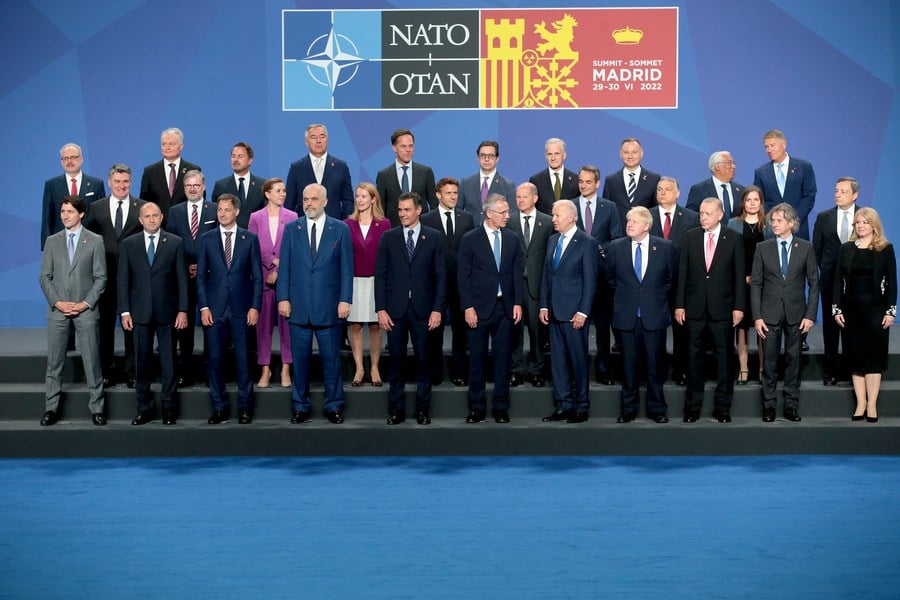
Jan Oberg interview with Xinhua News Agency: Since 1949 NATO has failed to make peace. And now it’s more offensive than ever…

My answers were submitted to Xinhua in Stockholm on June 27, 2022 – but the editors changed their minds and chose to do this series of comments instead.

1. What do you see are the potential consequences (geopolitical, military) as NATO incorporates Finland and Sweden in its latest military expansion in the Nordics? Does this make the Baltic Sea region and Europe safer or the opposite?

All alliances by definition build on a we-and-them conceptualization, or worldview. The NATO 1949 Treaty is defensive in the sense that it is basically a copy of the UN Charter with Article 5 added, i.e. that all NATO members shall assist in defending another member that has been attacked. Most people are not aware of that text’s real content – and therefore do not see how very far NATO is from its own Charter.

Secondly, given the Cold War or adversary structure in Europe, tension automatically increases when you cancel what could be called buffer zones, demilitarised areas etc. Reaction times are reduces the closer two adversaries come to each other. If the US or Russia for some foolish reason want a war with each other, all alliance members will be drawn in and dragged down in that war – with no opportunities and no time for mediation, tension-reduction, facilitating negotiations etc., instead.

These two new members will also say goodbye to everything positive they have, historically and also to some extent today, been standing for: Non-allignedness, go-between, a possible independent foreign and security policy formation, etc. Both Finland and Sweden now sell their – potential as well as de facto and de jure – capability to act as sovereign states and play a possible future role as confidence-builders and peace-makers.

If you believe in freedom of choice, democratic decision-making and long-term intelligent peace and security thinking, these two membership applications amount to a tragedy caused by hard pressure from abroad to knee-jerk, emotionalist response to Russia’s – unacceptable and international law-violating – invasion. And it is, in my view, obvious that Russia will see the next adaption to NATO infrastructure in these countries as a very negative development, logically, it will then point its missiles on these two countries in case of an escalating emergency, thus decreasing the security of the Swedes and Finns.

So, no – this is conflict- and insecurity-production and militates against every kind of peace thinking.

If I may add: Sweden made this decision with only 48% in favour of NATO membership and a completely one-sided pro-NATO public media discussion. If it were a decent democracy, it would have had a substantial discussion and then a referendum in which at least 75% would be in favour because this membership is extremely important for Sweden as a state. No such thing was even discussed.

2. Is NATO’s new expansion justified? What road is NATO pursuing, making the world less stable? What does it say about U.S.’s global hegemony?

In my view, NATO should have been abolished and a new all-European architecture for conflict-management established in its place when, thirty years ago, NATO’s only raison d’etre (reason to exist) disappeared, namely the existence of the Soviet Union and the Warsaw Pact.

The last Soviet President, Mikhail Gorbachev, was promised that the alliance would not expand one inch – there is tons of hard evidence of that including M. E. Sarotte’s excellent 550-page analysis “Not One Inch” although NATO advocates now lie about that. Regrettably, the Clinton Administration decided to break all those promises and began NATO’s reckless and unnecessary expansion with Georgia and Ukraine (the first NATO office was established in Kiev as early as 1994).

Dozens of Realpolitik scholars and all Russian leaders have protested this expansion, but NATO has become autistic and since its core task is based on outdated military or militarist thinking, it can only survive by expanding itself instead of reforming itself. That’s why NATO and its leaders insist on saying that Russia’s war in Ukraine is ‘unprovoked.’ It certainly isn’t – although Moscow, in my view, could have reacted differently.

All this is extremely dangerous also because NATO is now seeking to go global in complete violation of its North Atlantic-focussed mission and mandate.

It’s true that the US is calling the shots but that is a declining empire destined to fall, sooner rather than later. For the allies to put all their eggs in one NATO basket with a military-dominated philosophy is an example of the pervasive intellectual disarmament that is NATO today. The EU could have become an “alternative West” to Washington, an interesting partner for the rest of the world to cooperate with – but that is now way too late.

The EU’s incredibly irrational and infantile, reaction to Russia’s invasion – arming Ukraine, sanctions on Russia ad absurdum, cancelling Russia as such from Europe and not working for mediation and a peaceful solution in Ukraine illustrates that the EU is also not able to adhere to its own Lisbon Treaty or do something intelligent when most needed. Its policies will be extremely harmful to its own citizens. Just look at the G7 meeting a few days back: one big exercise in more hatred of Russia and then damage-limitation on the boomerang effects of these measures.

3. Turkey has by far rejected Finland and Sweden’s possible NATO membership, dragging their accession processes much longer than NATO previously claimed (could be as fast as within weeks). Apart from differences between Turkey and the two Nordic states, what are the much deeper differences that lie between the U.S.and Turkey? Could we read it as a setback of NATO’s expansion? And what does it say about NATO’S self-proclaimed “unity”?

It’s indeed a conflictual relationship – as has been seen in cases such as policies in Syria, Turkey’s cooperation with both Russia and Iran, the EU’s – which are also NATO members – shameful paying Turkey for taking care of refugees in 2015 from wars fought by the US and NATO members, etc. That “unity” will increasingly show cracks as the policy of the US, particularly vis-a-vis Russia will turn out to be incompatible in more than one way with European interests. The officially stated US goal of weakening Russia’s military may end up increasing substantially the risk that Russia as a smaller military power will feel compelled at some point to threaten or use nuclear weapons to survive.

The undermining of Russia’s economy back home by unconditioned and non-time-limited hard sanctions will, over time, probably be more harmful to the Europeans than to Russia because it is only some 15% of the world’s population that supports these sanctions and Russia, therefore, will find ways to survive. If the Russian invasion was a strategic blunder, so was NATO’s expansion and also the reaction to the Russian invasion. In my view, it will create huge socio-economic and political problems and even upheavals in Europe as time goes by.

And this NATO/EU “pincer” movement on Russia’s military and society simply is not in Europe’s long-term interest and will reduce the continent’s ability to solve its own serious problems and cause new ones. The US may benefit from it – for a time – but then it will be exhausted too. In summary, it is all self-destructive and caused by the Western/NATO response to the invasion and much less by the invasion itself.

4. NATO said in its Communiqué on June 14 that the military bloc would“ engage China with a view to defending the security interests of the Alliance.  NATO Summit in Madrid is expected to work on its long-term strategy, including in its so-called Strategic Concept for the first time the need to counter the growing military reach of China. Four Asian and Pacific nations have been invited as partners to the Summit.  What’s your perspective on NATO’s “need” to counter China? What consequences do you envision NATO expanding its influences in the Asia-Pacific region?

Well, you just have to read the first sentences of NATO’s “NATO 2030” document from 2021:

– “NATO 2030 is an ambitious agenda to make sure NATO remains ready, strong and united for a new era of increased global competition … NATO adapts to growing global competition and more unpredictable threats, including terrorism, cyber-attacks, disruptive technologies, climate change, and Russia and China’s challenges to the rules-based international order. Standing strong together to face a more unpredictable and competitive world is what the NATO 2030 initiative is about.”

So, NATO is already on the path to globalise itself although it is only a transatlantic alliance with a focus on Europe. As I said, you must see enemies everywhere – how else would you serve what I call the Military-Industrial-Media-Academic Complex, MIMAC, that NATO is the superior representative of?

NATO’s mission is to serve that MIMAC – and then use the mantra of “stability, security and peace” about whatever it does allegedly to protect its citizens.

As a social scientist with a few decades of observation and experience, I can tell you that that has nothing to do with empirical reality. If that was the truth, someone should explain to us why NATO since 1949 has extracted trillions of dollars out of its taxpayers in exchange for promising, or guaranteeing, peace while we are, at the moment of this interview, in a more dangerous European and global situation than we have ever been over those 73 years.

And – no! – it can’t be explained by Mr Putin doing this or that or suddenly going crazy, that is populist fake and omission. Russia is responsible for the war, yes – but NATO is responsible for the underlying conflict built upon the perverse idea that there are no limits to expansion. And it continues now with military expansion and Sweden’s and Finland’s membership.

I am tempted to say that you can make peace in about any other way but by NATO’s philosophy and mode of operation.

So, in the minds of these intellectually and morally disarmed elites of the MIMAC, you want to first eliminate Russia as an important player (perhaps also by spreading the war to Russia itself) and when that is done – they think – they can turn together against China.

There is already a Cold War going on as we have documented in the “Behind The Smokescreen” Report from the Transnational Foundation for Peace and Future Research (TFF) and – who knows – there may, sooner or later, be a military confrontation too with China.

It honestly feels like the discourse of peace and cooperation has been cancelled in the entire West and that has to do with its own decline. Everybody else is seen as a threat – potential, real or imagined – that “we” have to combat – either by means of a Bible (about democracy, human rights, market economy etc) or a Sword (bases, provocations, threats, war, demonisation, economic warfare etc).

It’s not a healthy culture that has only such tools in its toolbox. And can stand united only about one thing: Hating everything Russia.

5. Finland and Sweden’s NATO accession process is temporarily delayed/paused with Turkey’s red light.  What impact of this do you see on the status quo of Russia-West confrontation and what impact do you see on China?

Well, I think that is kind of embedded in what I just said. I believe one can say that the war in Ukraine is about two – a-symmetric – combatants using that country for their own cynical purposes – however Russia in what it sees as a defensive mode whereas the US/NATO side cannot feel threatened if Ukraine does not become a NATO member but instead some kind of neutral and non-aligned Switzerland with security guarantees. Russia sees this as existential, NATO aims at power expansion.

So that is going to take a long time – NATO fighting, so to speak, to the last Ukrainian. The longer it takes – and the longer Turkey may succeed in preventing Sweden and Finland from becoming new members – the more difficult/impossible it will be to find a solution and for us in Europe to live in anything deserving the word ‘peace.’

It’s tragic that this conflict is completely unnecessary, Ukraine being of no importance (except pathetic prestige) for NATO and that Russia – the European – will turn away from Europe.
The longer it lasts, the more the US will decline and the cracks in the alliance in Europe will appear.

The United Nations should have been asked to engage with a huge mission in Ukraine in 2014 – as a disarmer, security-keeper, mediator and negotiating facility. At the time President Putin suggested it and it so happens that back then I did that too.

I am a staunch believer in the provisions of the UN Charter – and ‘making peace by peaceful means’ – but that is not the interest of NATO that promotes something very different, name a “rules-based international order.” That, however, is either devoid of rules or filled with exceptionalist double standards or a disastrous dis-order, or both. It has nothing to do with international law as it has been developed over the last good 100 years.

I am genuinely sorry, but in the short-term perspective, I see nothing good coming out of all this. If we survive the next few years, however, I do see a multipolar, UN-normative world built on unity in diversity and – why not? – The Five Principles of Peaceful Coexistence (Chinese: 和平共处五项原则), also known as Panchsheel-like ways of operating where the overarching concept and policy is cooperation about solving humanity’s real problems humanity which is urgently needed instead of wasting all our resources on warfare.

Please support TFF’s work for peace through research and public education. We are all-volunteer, people-financed and do not accept money from governments or corporations. In other words, one of the very last free research think tanks in this world – and for a noble purpose: Peace by peaceful – intelligent – means. Now click here! Thanks!

Peace & future researcher + ‌Art Photographer

One Response

Related Posts

The MSC’s closed groupthink militarism offers only one prescription — more weapons — even as record military expenditures, squeezed from taxpayers in economic crisis, destroy diplomacy and drive escalation to the highest war risks in decades. Jan Oberg TFF director February 13, 2026 From Dialogue Forum to Militarised Ritual For decades, the Munich Security Conference (MSC) – which opened today and runs till Sunday – was one of the few places where adversaries could meet without theatrics. Founded in 1963 as the Wehrkundetagung, it served as a discreet Cold War dialogue forum between NATO and the Warsaw Pact. Even at moments of high tension, Soviet and later Russian representatives were present, and Munich allowed uncomfortable messages to be delivered directly rather than through press releases or military manoeuvres. That era has vanished. The MSC has become something entirely different: a €13–20 million annual gathering of a closed Western security elite, a polished meeting...
PART 2 — Diplomacy, Law and Nonviolent Power By Jan ObergTFF co-founder and director January 26, 2026 This is the second of four TFF-created idea portfolios designed to curb the global reach of the United States and, in both the short and long term, help catalyse a worldwide nonviolent resistance to what many observers describe as the Trump administration’s uniquely confrontational, destructive and world-threatening policies. These portfolios outline what governments and citizens across the world can do through dynamic diplomacy, creative initiatives, and strictly nonviolent means. They are typical TFF works in that we do not only tell what the problem is and how bad it will go – as 90+% of all commentators, experts and scholars do – we tell what we think can be done, inviting you to think of what you think you can do. It seems painfully clear to me that the current political dynamics in Washington increasingly resemble the most dangerous...
OK, Trump did not get it. But he got a full endorsement of a possible future US regime change in Venezuela. And that is what Ms Machado has advocated. Jan Oberg October 10, 2025 On October 10, 2025, the Norwegian Nobel Committee awarded its Peace Prize to Venezuelan opposition figure María Corina Machado. The citation praised her “tireless work promoting democratic rights.” But Ms Machado has openly called for U.S. military intervention in Venezuela, stating on CBS: “The only way to stop the suppression is by force—U.S. force.” She or her party has received funding from the National Endowment for Democracy (NED), a U.S. government-backed body known as a CIA front organisation and for supporting regime-change operations worldwide. And in 2018, she sent a letter to Israeli Prime Minister Benjamin Netanyahu, asking him to use “force and influence” to help dismantle Venezuela’s government—citing alleged ties to terrorism, Iran and narcotrafficking....

Recent Articles

Tony Robinson October 4, 2026 Violence is easy to recognise when someone is being beaten, shot or killed. It becomes more difficult when nobody is holding a weapon. Poverty, discrimination, exploitation and repression can restrict a human life just as effectively, although they do so in very different ways and with very different consequences. Simply adding more categories to an ever-growing list of forms of violence does not really solve the problem. The more interesting question is what all these different situations have in common and why it makes sense to describe them using the same word. Human beings do not simply react to what happens around them. They remember the past, imagine things that do not yet exist, make plans and undertake projects. Workers organise because they imagine different working conditions; people migrate because they imagine another life somewhere else; social movements emerge because people refuse to accept the...
It’s a matter of principles, courage, vision and pulling together – while the militarist world is falling apart… Peter Langille October 3, 2026 “Here, then, is the problem which we present to you, stark and dreadful and inescapable: Shall we put an end to the human race; or shall mankind renounce war?”The Bertrand Russell—Albert Einstein Manifesto, July 9, 1955 ⁕ The forecast for what’s ahead is worrisome. The sharp rise in armed conflicts over the past three years is adding to what was already the highest level in over seventy years. Genocides, which should be prevented are supported. A shared climate emergency that jeopardises survival is ignored. Diverse polls now suggest that people are war-weary, worried and interested in a more effective United Nations. And, there are viable policy options for a more secure world! Yet governments are doubling-down, betting on more war and investing heavily. If current trends persist,...
Johan Galtung 1930-2024October 2015 Published here on October 3, 2026 Let us focus on Civilization for conflict analysis and remedies. Major forms of disorder use violence; war is state organized violence. The most belligerent states are the United States of America and Israel, both with civilization roots. National Evangelism, the US Protestant Christian civilization– more national than evangelical–justifies US warfare as exceptionalism of a people chosen by God, with a manifest destiny to run the world. Orthodox Judaism justifies Israeli warfare to conquer and expand from Nile to Euphrates as a religious right and duty to the Eternal One. The third most belligerent country, the UK, no longer believes it is God-chosen but chosen by the USA; not quite the same but something. But the root cause of global disorder lies in the Occident–with Islam–seeing itself as the single, universal civilization valid for all at all times, all others being...

TFF on Substack

Discover and subscribe to more peace materials on TFF Substack

Most Popular

Tony Robinson October 4, 2026 Violence is easy to recognise when someone is being beaten, shot or killed. It becomes more difficult when nobody is holding a weapon. Poverty, discrimination, exploitation and repression can restrict a human life just as effectively, although they do so in very different ways and with very different consequences. Simply adding more categories to an ever-growing list of forms of violence does not really solve the problem. The more interesting question is what all these different situations have in common and why it makes sense to describe them using the same word. Human beings do not simply react to what happens around them. They remember the past, imagine things that do not yet exist, make plans and undertake projects. Workers organise because they imagine different working conditions; people migrate because they imagine another life somewhere else; social movements emerge because people refuse to accept the...
It’s a matter of principles, courage, vision and pulling together – while the militarist world is falling apart… Peter Langille October 3, 2026 “Here, then, is the problem which we present to you, stark and dreadful and inescapable: Shall we put an end to the human race; or shall mankind renounce war?”The Bertrand Russell—Albert Einstein Manifesto, July 9, 1955 ⁕ The forecast for what’s ahead is worrisome. The sharp rise in armed conflicts over the past three years is adding to what was already the highest level in over seventy years. Genocides, which should be prevented are supported. A shared climate emergency that jeopardises survival is ignored. Diverse polls now suggest that people are war-weary, worried and interested in a more effective United Nations. And, there are viable policy options for a more secure world! Yet governments are doubling-down, betting on more war and investing heavily. If current trends persist,...
Johan Galtung 1930-2024October 2015 Published here on October 3, 2026 Let us focus on Civilization for conflict analysis and remedies. Major forms of disorder use violence; war is state organized violence. The most belligerent states are the United States of America and Israel, both with civilization roots. National Evangelism, the US Protestant Christian civilization– more national than evangelical–justifies US warfare as exceptionalism of a people chosen by God, with a manifest destiny to run the world. Orthodox Judaism justifies Israeli warfare to conquer and expand from Nile to Euphrates as a religious right and duty to the Eternal One. The third most belligerent country, the UK, no longer believes it is God-chosen but chosen by the USA; not quite the same but something. But the root cause of global disorder lies in the Occident–with Islam–seeing itself as the single, universal civilization valid for all at all times, all others being...
Read More
Living-Peace-Sign-Budapest-copy
Tony Robinson October 4, 2026 Violence is easy to recognise when someone is being beaten, shot or killed. It becomes more difficult when nobody is holding a weapon. Poverty, discrimination, exploitation and repression can restrict a human life just as effectively, although they do so in very different ways and with very different consequences. Simply adding more categories to an ever-growing list of forms of violence does not really solve the problem. The more interesting question is what all these different situations have in common and why it makes sense to describe them using the same word. Human beings do not simply react to what happens around them. They remember the past, imagine things that do not yet exist, make plans and undertake projects. Workers organise because they imagine different working conditions; people migrate because they imagine another life somewhere else; social movements emerge because people refuse to accept the...
b54a1f10-8c65-4f0b-9dd5-4abc0a7d04cc_2659x2659
It’s a matter of principles, courage, vision and pulling together – while the militarist world is falling apart… Peter Langille October 3, 2026 “Here, then, is the problem which we present to you, stark and dreadful and inescapable: Shall we put an end to the human race; or shall mankind renounce war?”The Bertrand Russell—Albert Einstein Manifesto, July 9, 1955 ⁕ The forecast for what’s ahead is worrisome. The sharp rise in armed conflicts over the past three years is adding to what was already the highest level in over seventy years. Genocides, which should be prevented are supported. A shared climate emergency that jeopardises survival is ignored. Diverse polls now suggest that people are war-weary, worried and interested in a more effective United Nations. And, there are viable policy options for a more secure world! Yet governments are doubling-down, betting on more war and investing heavily. If current trends persist,...
010
Johan Galtung 1930-2024October 2015 Published here on October 3, 2026 Let us focus on Civilization for conflict analysis and remedies. Major forms of disorder use violence; war is state organized violence. The most belligerent states are the United States of America and Israel, both with civilization roots. National Evangelism, the US Protestant Christian civilization– more national than evangelical–justifies US warfare as exceptionalism of a people chosen by God, with a manifest destiny to run the world. Orthodox Judaism justifies Israeli warfare to conquer and expand from Nile to Euphrates as a religious right and duty to the Eternal One. The third most belligerent country, the UK, no longer believes it is God-chosen but chosen by the USA; not quite the same but something. But the root cause of global disorder lies in the Occident–with Islam–seeing itself as the single, universal civilization valid for all at all times, all others being...
Screenshot 2026-10-02 011738
Jan ObergPhD, director, The Transnational Foundation for Peace and Future Research, TFFLund, Sweden October 2, 2026 This is my full original manuscript. The Chinese Academy of Social Science, CASS, makes two publications out if it. 1. China’s Five-year plan emphasized the capabilities of basic research and original innovation. It is regarded as the goal of the future social development, which, as required, should be significantly enhanced. Can you comment on the importance of original innovation in research and academic study? I believe it is easier to define “original innovation” in the natural sciences than in social sciences. The breaking points of what constitutes something new, or innovative, are not quite as sharp in the latter. But in both fields it is about opening up something that was closed, unseen, unexplored before – making manifest what was earlier latent. Innovations come in many forms and shapes – naming something that was not...
arctic-circle-map
The agreement is catastrophic both because of what it says and what it doesn’t mention. It reduces further the major asset of security policies: Freedom of action. Jan Oberg TFF director September 25, 2026 A couple of hours before the agreement was signed on September 22, 2026, I published the following 13 hypotheses about what it would most likely contain on TFF Substack (in English). I was wrong on only the first point. Contrary to what Trump had written on his Truth Social platform, it does not appear to come into force immediately. In fact, it turned out to be worse than even I had anticipated. After these hypotheses now come a number of reflections in light of what the agreement actually contains, and does not contain, as well as the way in which it has generally been presented by major media outlets and by the public-service broadcaster DR. My...
girl-5894831_1280
Below are TFF-related media mentions, comments, videos and social media posts published elsewhere but not on this homepage. We happen to catch and list only a fraction. Regarding video comments and debates, we recommend that you go to the TFF Video Channel on Substack where many of them are reproduced. Jan Oberg is a contributor to China Daily – 52 million daily clicks – and Global Times, CGTN and CCTV (the national television), China Investment, Xinhua News Agency and several others. Articles and videos on these media very often multiply into countless Chinese (and Western media) that re-post them from these main media. Thanks to The China Academy, his analyses, interviews and comments are frequently posted on YouTube channels such as Thinkers Forum and Wave Media. These videos are often re-posted on Bilibili (China’s YouTube), the China Content Center on TikTok, and on the Chinese edition of TikTok, Douyin.com. This means reaching hundreds of millions of viewers worldwide over a year. While there are too many to catch on all these...




