

Image credit: Pixabay

Dr Andrew Glikson

January 20, 2021

As the world is trying to hopefully recover from the tragic effects of COVID-19, it is reminded there is no vaccine for the existential threat for its life support systems posed by global warming, nor for the looming threats of future wars and nuclear wars fueled by warmongers and $trillion preparations by military-industrial complexes.

Originally published at Countercurrents

Between 1740 and 1897 some 230 wars and revolutions in Europe suggested war remained deeply ingrained in the human psyche and civilization. The question is whether the currently approaching catastrophes can be averted.

No one wishes to believe in the projections made in the recent book ‘The Uninhabitable Earth’, except that these projections, made by David Wallace-Wells, are disturbingly consistent with the current shift in state of the climate toward +4 degrees and even +6 degrees Celsius above pre-industrial levels, as indicated by the current trends (Figure 1) and conveyed by leading climate scientists and the International Panel for Climate Change (IPCC).
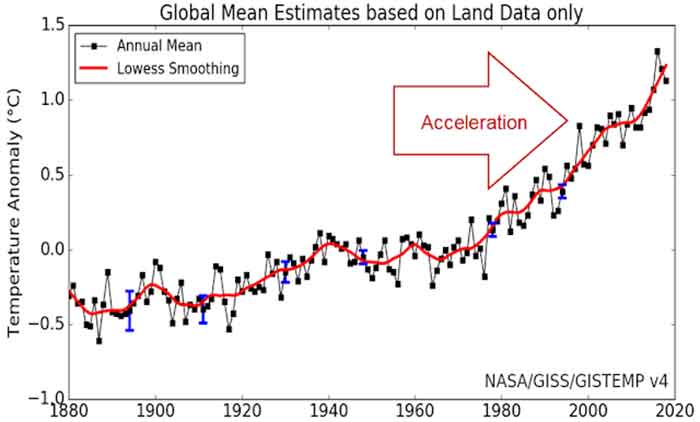
Figure 1. Global mean temperature estimates for land areas (NASA).

Facing the unthinkable consequences of global warming is pushing climate scientists into a quandary. In private conversations, many scientists express far greater concern at the trend of global warming than they do in public.

However, faced with social and psychological barriers, as well as threats of losing positions and jobs, in business, public service and academia, a majority keeps silent, displaying lesser courage than school children.

According to James Hansen (2012), NASA’s former chief climate scientist: “You can’t burn all of these fossil fuels without creating a different planet”. According to Joachim Schellnhuber (2015), Germany’s chief climate scientist: ‘We’re simply talking about the very life support system of this planet’, and ‘If we don’t solve the climate crisis, we can forget about the rest’.

Referring to a phenomenon he termed “scientific reticence”, James Hansen (2007) states: “I suggest that a “scientific reticence” (namely a reluctance to convey worrying news) is inhibiting the communication of a threat of a potentially large sea level rise”.

According to Bajaj (2019): “when it comes to climate change, the need for excessive caution and absolute certainty of the results is manifesting as silence from the mainstream science on the worst yet probable consequences and the worst-case scenarios that are looking increasingly likely”. A paradox emerges where scientists who experience scientific reticence are still accused of being alarmists.

This is because an evaluation of the probability of a risk needs to be related to the magnitude of the risk. For example, the inspection of the engines of a Jumbo Jet carrying 300 passengers need to be even more rigorous than that of a commuter van, or evaluation of the risk posed by a potential failure of a nuclear reactor even more critical than that of a conventional power plant, as is the absolute safety of a particle accelerator.

By analogy with the dictum “Those who do not learn from history are doomed to repeat it” projections of future climate trajectories need to take account of studies of the past behaviour of the atmosphere-ocean system.

The pace of current global warming exceeds those of the last 2.6 million years by an order of magnitude, with calamitous consequences for biological systems.

As indicated by the basic laws of physics, the principles of climate science and empirical observations in nature, under an increase of greenhouse gas concentrations by about 50 percent, global warming is inevitable.

While modeled future climate change trajectories may vary, depending whether observations are based on recent measurements, paleoclimate data or models, the consequences of such an increase are inevitably catastrophic.

Whereas IPCC models portray linear warming trends to 2300, other models take account of the flow of ice melt water from Greenland and Antarctica into the oceans and thereby irregular warming (Glikson, 2019).

Given the warnings issued by leading climate scientists and the IPCC, while nations keep investing their dwindling $trillions in its military-industrial complexes in preparations for future war/s, our world is losing its last chance to save its planetary life support systems.

Orignially published at Countercurrents

The author

Dr Andrew Glikson is a Earth and Climate scientist. More about him here.

Please help TFF remain truly independent by contributing if you benefited from this article
Related Posts

This is not another geopolitical commentary on the Arctic. It is a visionary peace proposal that can save the region from militarised rivalry and ecological ruin. A blueprint for shared security, sustainable development, and human dignity — benefitting Greenland, the Arctic, and the rest of us. Jan Oberg TFF director Lund, Sweden, February 17, 2026 I. Four Principles for a New Arctic Vision The Arctic is often framed as a cold arena of rivalry — a place where great powers test each other’s resolve. But this worldview is outdated, unimaginative, and ultimately self‑defeating. The Arctic is not a vacuum waiting to be militarised; it is a living region, a climate stabiliser, and a cultural homeland whose future will shape the future of humanity. If we begin from that understanding, a far more rational Arctic order becomes possible — one that is peaceful, cooperative, and centred on the people who actually live there. This vision rests...
OK, Trump did not get it. But he got a full endorsement of a possible future US regime change in Venezuela. And that is what Ms Machado has advocated. Jan Oberg October 10, 2025 On October 10, 2025, the Norwegian Nobel Committee awarded its Peace Prize to Venezuelan opposition figure María Corina Machado. The citation praised her “tireless work promoting democratic rights.” But Ms Machado has openly called for U.S. military intervention in Venezuela, stating on CBS: “The only way to stop the suppression is by force—U.S. force.” She or her party has received funding from the National Endowment for Democracy (NED), a U.S. government-backed body known as a CIA front organisation and for supporting regime-change operations worldwide. And in 2018, she sent a letter to Israeli Prime Minister Benjamin Netanyahu, asking him to use “force and influence” to help dismantle Venezuela’s government—citing alleged ties to terrorism, Iran and narcotrafficking....
Officially, the drones were not identified. By simply thinking critically – which journalists and selected experts no longer do – there may be a good reason for that. And this article will never be mentioned in Denmark… Jan Oberg October 3, 2025 Drones over Denmark. No damage. No trace. No answers. Yet the headlines scream “Russian threat,” and Prime Minister Mette Frederiksen speaks with a certainty that defies logic: “We don’t know they were Russian—but we know Russia is the biggest threat to Europe.” It could be nobody else – unless you make an interest analysis which I did two days ago. This is not security policy. It’s theatre. And the audience is being played. Let’s rewind. These drones—unphotographed, untracked, unclaimed—appear and vanish like ghosts. Airports shut down. Panic spreads. Military budgets swell. And the narrative hardens: Russia is behind it. But what if that’s not just wrong but deliberately...

Recent Articles

Serious but also a lot of laughs and positive energy. Because peace is also about conviviality and enchantment… Jan Oberg, TFF director November 16, 2026 This is a long (129 minutes) conversation with me. We cover very many, also personal, issues that makes a somewhat unusual media event. I am very grateful to Flemming Blicher for giving me this opportunity. I can’t remember any channel or editor who spent as much time as he did preparing it – including also asking me to answer a series of pre-interview questions, which are now posted under the conversation. If you sympathise with its content, please share it. Watch it here
A Message from Jan Oberg November 6, 2026 Over the past fifty years, I have devoted roughly 175,000 hours to research and public education for a more peaceful world: thinking, researching, writing, organising, publishing, debating, maintaining websites, corresponding, reaching out, leading a foundation, work in conflict and war zones, professorships, teaching courses and giving public lectures and doing media work. In short, ten hours a day, seven days a week, for half a century. The focus was on international political peace – analysing and trying to stop wars, address underlying conflicts and making alternative peace plans – at the desk and on the ground. Important as that has been and remains, it is only one kind of peace and it is now in a tragic militarist state compared with what it could have been.  Lately, however, I have found myself thinking about a concept from economics as well as everyday...
Photo above: Carl Fredrik Reuterswärd’s Non-Violence outside UN Headquarters in New York. Kirill Levin, CC BY-NC-SA 2. Jan Oberg November 3, 2026 I am happy to be published in Horizons which is produced by the Center for International Relations and Sustainable Development, CIRSD, in Belgrade. My contribution brings out a radical re-thinking of what concepts such as defence, security, deterrence – and peace – may mean if we want to create a more peaceful world. It also summarises a few things I have been working with the last few decades. Please read it here Og her er den på dansk, takket være Johnny Baltzersens lynhurtige oversættelse

TFF on Substack

Discover and subscribe to more peace materials on TFF Substack

Most Popular

Serious but also a lot of laughs and positive energy. Because peace is also about conviviality and enchantment… Jan Oberg, TFF director November 16, 2026 This is a long (129 minutes) conversation with me. We cover very many, also personal, issues that makes a somewhat unusual media event. I am very grateful to Flemming Blicher for giving me this opportunity. I can’t remember any channel or editor who spent as much time as he did preparing it – including also asking me to answer a series of pre-interview questions, which are now posted under the conversation. If you sympathise with its content, please share it. Watch it here
A Message from Jan Oberg November 6, 2026 Over the past fifty years, I have devoted roughly 175,000 hours to research and public education for a more peaceful world: thinking, researching, writing, organising, publishing, debating, maintaining websites, corresponding, reaching out, leading a foundation, work in conflict and war zones, professorships, teaching courses and giving public lectures and doing media work. In short, ten hours a day, seven days a week, for half a century. The focus was on international political peace – analysing and trying to stop wars, address underlying conflicts and making alternative peace plans – at the desk and on the ground. Important as that has been and remains, it is only one kind of peace and it is now in a tragic militarist state compared with what it could have been.  Lately, however, I have found myself thinking about a concept from economics as well as everyday...
Photo above: Carl Fredrik Reuterswärd’s Non-Violence outside UN Headquarters in New York. Kirill Levin, CC BY-NC-SA 2. Jan Oberg November 3, 2026 I am happy to be published in Horizons which is produced by the Center for International Relations and Sustainable Development, CIRSD, in Belgrade. My contribution brings out a radical re-thinking of what concepts such as defence, security, deterrence – and peace – may mean if we want to create a more peaceful world. It also summarises a few things I have been working with the last few decades. Please read it here Og her er den på dansk, takket være Johnny Baltzersens lynhurtige oversættelse
Read More
Screenshot 2026-11-10 174455
Serious but also a lot of laughs and positive energy. Because peace is also about conviviality and enchantment… Jan Oberg, TFF director November 16, 2026 This is a long (129 minutes) conversation with me. We cover very many, also personal, issues that makes a somewhat unusual media event. I am very grateful to Flemming Blicher for giving me this opportunity. I can’t remember any channel or editor who spent as much time as he did preparing it – including also asking me to answer a series of pre-interview questions, which are now posted under the conversation. If you sympathise with its content, please share it. Watch it here
AbstractVision_2017_#1_800 (kopia)
A Message from Jan Oberg November 6, 2026 Over the past fifty years, I have devoted roughly 175,000 hours to research and public education for a more peaceful world: thinking, researching, writing, organising, publishing, debating, maintaining websites, corresponding, reaching out, leading a foundation, work in conflict and war zones, professorships, teaching courses and giving public lectures and doing media work. In short, ten hours a day, seven days a week, for half a century. The focus was on international political peace – analysing and trying to stop wars, address underlying conflicts and making alternative peace plans – at the desk and on the ground. Important as that has been and remains, it is only one kind of peace and it is now in a tragic militarist state compared with what it could have been.  Lately, however, I have found myself thinking about a concept from economics as well as everyday...
knotted gun
Photo above: Carl Fredrik Reuterswärd’s Non-Violence outside UN Headquarters in New York. Kirill Levin, CC BY-NC-SA 2. Jan Oberg November 3, 2026 I am happy to be published in Horizons which is produced by the Center for International Relations and Sustainable Development, CIRSD, in Belgrade. My contribution brings out a radical re-thinking of what concepts such as defence, security, deterrence – and peace – may mean if we want to create a more peaceful world. It also summarises a few things I have been working with the last few decades. Please read it here Og her er den på dansk, takket være Johnny Baltzersens lynhurtige oversættelse
TFFPortfolioVign
UNITE-tillid, DREAM-velstand og andre konstruktive komponenter Normally we publish articles in English here. But this is a translation of a very important TFF document that should reach as many as possible in Denmark since this country’s government has been one of the most hardline in Europe and, up till now at least, has refused to use diplomacy and, instead, spent tremendous sums on arming Ukraine with the express goal of defeating Russia. Thus this – unique – article is in Danish. Vi er Johnny Baltzersen og hans Fælles Sikkerhed – Fælles Fremtid på Substack overmåde taknemmelige for at have oversat og publiceret TFF’s 2025-portfølje for fredsidéer med henblik på Ukraines fremtid. Vi håber den nu kan nå mange flere danskere – som også vil sprede den og skabe debat – nu den danske regerings og folketingspartiernes politik på dette område siden 2022 står nu – forudsigeligt – ved vejs ende....
JoGSS-Silent
Jan Oberg TFF director October 28, 2026 Exactly one month has now passed since I published my criticism of the introduction to the special issue on Johan Galtung published by the Journal of Global Security Studies, JoGSS, and of Tor Egil Førland’s chapter about Galtung which serves as a preview to his forthcoming biography of Galtung to be published by PRIO. See the original on The Transnational here and the same article on TFF Substack with many general and critical comments and, in particular, the people who decided to withdraw from the biography project in protest. The special issue itself was extraordinary. It was devoted to the intellectual legacy of one of the founders of peace research and contained a number of strong assessments of his personality, scholarship, intellectual trajectory, and public role. Such assessments are, of course, entirely legitimate. No scholar is beyond criticism, and neither was Johan Galtung....
Screenshot 2026-10-26 115647
An aspect of Iran’s culture and civilisation you’ve probably never heard about. Don’t be surprised if the US and Israel also try to bomb them. Jan ObergTFF director October 26, 2026 Today – under the “USraeli” threat of new “annihilating” bombings – opens the 7th International Conference on Peace and Conflict Resolution at Tehran’s University. As far as I can tell, this is the only permanent, advanced peace research institution in West Asia/the Middle East. Perhaps more countries in that region could be inspired? I mean, how many military “security” institutes and military academies do they have? Many peace research institutes and university departments have been established since the 1950s in the West. They are now all under attack; some have closed down, some have gone mainstream, yet others kept the name but do nothing to research peace and disseminate results or advice; instead, they cooperate with militarism’s platforms such...




