
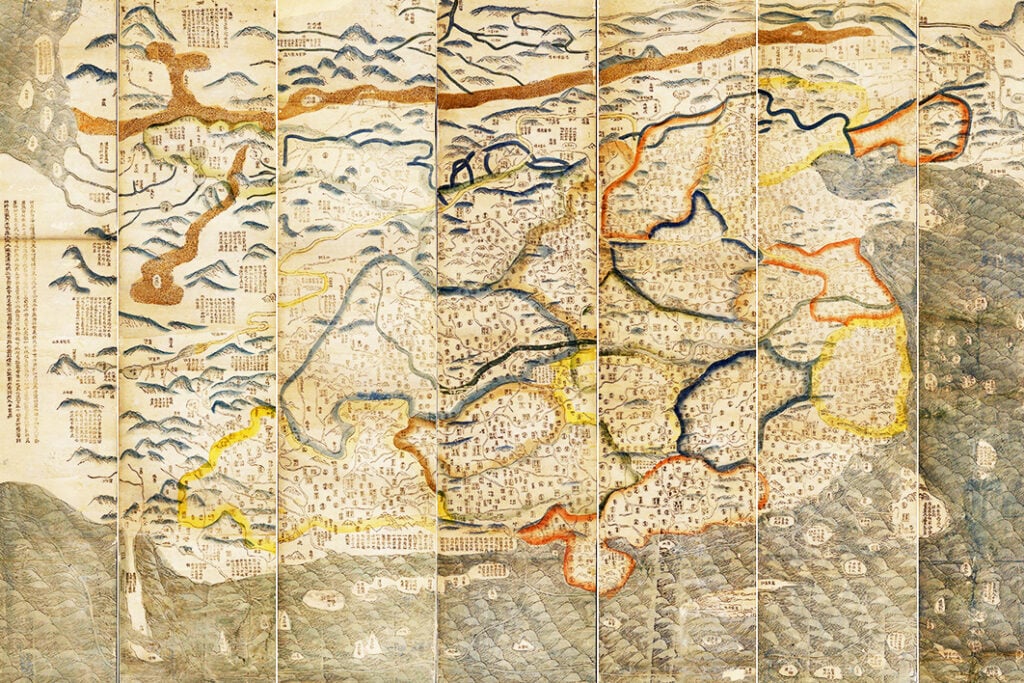
Photo: Creating a nation: a nineteenth-century copy of a 1767 map titled “Da Qing wan nian yi tong tian xia quan tu” (The great Qing Dynasty’s complete map of all under heaven). Science Photo Library/Alamy.

By Kerry Brown

November 24, 2020

In the desire to change China do we risk rewriting its history?

Review of the book “The Invention of China” by Bill Hayton 

Bill Hayton is a journalist and historian whose career has included periods working in Asia. His decades of producing news and reportage have given him a sharp sense of what makes good stories, and a clear, uncluttered style with which to write them.

That experience stood him in good stead in his previous book, The South China Sea: The Struggle for Power in Asia, which had the great merit of taking a hugely complicated subject and, using vivid characterisation, personal testimony and clear thinking, making it comprehensible. It remains one of the very few books to shed light on a theatre of conflict that — perhaps more through its core participants’ design than anything else — can all too easily deteriorate into confusing minutiae.

Originally published at Inside History

Hayton’s target in his latest book is far trickier. Anyone who grows familiar with the People’s Republic in the twenty-first century becomes alert, very early on, to how hard it is to define that key word, “China.”

One obvious fact is that alongside the People’s Republic there exists the Republic of China, or Taiwan. Already we are talking about two places that use the same word to cover very different realities.

Then there is the puzzle of how the entity that came into existence in 1949, with its radical, revolutionary founding mission, relates to the imperial entities, and their claimed antiquity, that existed in the preceding centuries. Before we’ve looked too far, we’re overwhelmed by the number of different ways this one word is used. Terminological neatness slips rapidly away.

Some modern-day scholars have tried to tackle this problem by defining China in ways that provide scope for very different meanings.

American sinologist Lucian Pye went very broad in the 1960s, talking of China as a “civilisational” power, giving it an almost generic, abstract quality unencumbered by a physical country. More recently, Canadian historian Timothy Brook has gone the other way, tracing any coherence to the practical business of government under the dynasties of the past millennium.

In his view, they were the ones who constructed the bureaucratic administrative structure that lives on in today’s centralised state.

Unfortunately this huge and complex subject doesn’t lend itself particularly well to Hayton’s favoured narrative technique of focusing on key individuals — Liang Qichao and Kang Youwei in the Qing era, for instance, and Sun Yatsen in the Republican era — and investing their work with great symbolic importance and practical impact.

These figures were certainly important, but they existed in a much broader context than is given here, amid developments and movements that Hayton seems unwilling, or unable, to examine closely.

He states early in the book, rightly in my view, that construction of the notion of a Chinese nation during the Qing era (1644–1912) and into the post-1949 period parallels the processes that went into making Italy and Germany, for instance, or for that matter Russia and Turkey.

But after tantalising the reader with the thought that China’s path was also exceptional in important ways, he doesn’t show with any real conviction why and how that might be the case.

His assumption is that its path to national consciousness has been different and problematic in ways everyone implicitly understands — a point he doesn’t state as cogently as Prasenjit Duara does in Rescuing History from the Nation: Questioning Narratives of Modern China, a key work that he seems not to have drawn on.

Also undeveloped is Hayton’s important assertion that modern China is more the result of foreign ideas, impulses and influences than of its own intellectual traditions. China as the passive target of the outside world is a familiar trope, but one to be wary of.

For Hayton, the external world influenced China in three ways. One was its introduction of the concept of sovereignty, a notion that he argues cut across the fluid, almost boundaryless idea of “All Under Heaven” that prevailed in imperial times.

Sovereignty somehow infiltrated into Qing-era China via its 1882 treaty with Korea, which undermined notions of Qing special influence over the Chosen Korean court in ways that privileged the European notion of the autonomous nation-state.

The second was the spread of social Darwinism, which Hayton links to the rise of the Han ethnic category and its increasing dominance of national discourse in modern times.

And the third was the arrival of the notion that possession of physical space, including maritime territory, is intrinsically linked to what a country is.

Foreign thinking of this kind undoubtedly had an impact among key groups in the nineteenth century and subsequently. But Hayton, at the start and end of the book, makes the overly strong claim that in many ways it played the key role in inventing the entity we see before us today. This denial of agency, and privileging of Europeans comes across as an act of intellectual colonisation.

The potential cultural and intellectual hubris brings with it a sense that neat and straightforward stories were needed to achieve the underlying aim of the book, which is as much about the present as the past.

What happened before is presented as being neatly linked to and entwined with the present. Xi Jinping’s country keeps coming into view, coming into focus for a second and then dissipating.

What Hayton really has in his sights is the nationalistic tone and pushiness of contemporary China, and it becomes clear that he is undertaking an act of deconstruction — an attempt to undermine and weaken a Frankenstein’s monster cooked up in the intellectual West but thriving in the alien environment of Asia.

If we can undermine the foundations, his premise seems to be, then we have a shot at toppling the thing we see standing in all its problematic glory before us. We created this beast: we can bring it down.

This is not to say that Hayton doesn’t alight on interesting and striking phenomena. For the Han-dominated leadership of modern China, the uncomfortable fact is, as he discusses, that the great Qing era was ruled by Manchus, a different ethnic group.

And his treatment of Beijing’s fulminating against “historical nihilism” in accounts that dwell too much on recent years (which could have taken up more space than the few pages allocated here) — as evidenced by recent attacks on foreign scholars who have shown how different the Manchu rulers were and how contested their rule throughout the 260 years plus of their dynasty —indicates something important and meaningful about how the party shapes history. The chapter on maritime territory is also successful and coherent.

But the nagging sensation remains that The Invention of China is guided by a fierce resistance to an inconvenient fact: that “China,” as the Middle Kingdom, has proved to be potent and enduring, and has ultimately transcended the boundaries of the Western-originated notions that provided some of the scaffolding for its original construction.

Even if it is an invented notion, and even if Xi and his colleagues stand accused of manipulating and reinforcing it, the simple fact remains that they have chosen something that has deep appeal to the complex population that lives in the country today, and seems to speak to them in ways that go far beyond party propaganda.

How this notion arose and developed is an interesting question, and Hayton’s efforts to analyse it aren’t wasted. But the far more interesting question is why “China” as a spiritual, almost abstract entity — as a place with physical boundaries that also exist powerfully and convincingly as an emotional reality, while often defying neat characterisation — has proved so successful.

It has emerged slowly, but overwhelmingly, as history has unfolded. Linked to cultural, historical, ethnographic, social and mythical factors, and despite all the energy invested by so many in wishing or explaining it away, it constitutes one of the most successful symbolic achievements of the modern world. Explain that!

Originally published at Inside History

About the author

Kerry Brown is Professor of Chinese Studies and Director of the Lau China Institute at King’s College, London. From 2012 to 2015, he was Professor and Director of the China Studies Centre at the University of Sydney.

And you may read all about Bill Hayton on his homepage.

If you enjoyed this piece about China, you can contribute to TFF here:

Related Posts

November 16, 2024 I. Introduction The initiative for the “Nordic Delegation to China, September 7-15, 2024” was taken from the Norwegian side. Journalist and former editor Arild Vollan wanted to investigate claims in the media about an ongoing genocide against the Uyghurs in the autonomous region of Xinjiang in western China. Vollan selected an independent, cross-disciplinary and cross-political delegation group consisting of people who have worked with China and who wanted to get personal impressions of the conditions described in the previous section. The delegation consisted of: • Remi Strand, lawyer. • Thore Vestby, a former member of parliament (H) and former mayor of Frogn. • Arild Vollan (head of delegation), journalist and former editor. • Jan Øberg, PhD sociology, director of the Transnational Foundation for Peace and Future Research, TFF, in Lund, Sweden. (1) The delegation itself developed the project’s mandate. Following an excursion to Xinjiang province, the delegation’s...
1. Israel: The policy’s background As a small country with a tiny population surrounded by large and hostile countries, Israel’s policy ever since its establishment has been to rely on some external forces, the British Empire at the beginning of its creation and later on the American superpower to protect herself. It has also involved the creation of a nuclear arsenal in contravention of the Non-Proliferation Treaty (the NPT) and by means of lies and deception, while being the most vociferous opponent of any other country in the Middle East to even have a peaceful nuclear programme for producing energy. Another aspect of this policy of self-preservation has been to divide and partition the neighbouring countries so that they would lose their advantage of larger size and greater population vis-à-vis Israel. As early as 1982, the Israeli scholar Oded Yinon authored an essay called “A Strategy for Israel in the...
Liberal democracies remain shamefully complicit with Israel, despite its ongoing genocide against the Palestinian people Students of world politics have long understood that when it comes to the strategic interests of leading states, international law is marginalised unless it is useful in waging a propaganda war against adversaries.  Indeed, the United Nations was designed in ways that recognised this feature of international political life. Otherwise, giving the winners of World War II a right of veto would make no sense.  Such an exemption from international law was also evident at the war crimes trials held in Nuremberg and Tokyo after World War II, at which only the crimes of the losers were scrutinised for legal accountability, and obvious crimes of the victors – such as the indiscriminate bombing of Dresden and the atomic bomb attacks on Hiroshima and Nagasaki – were not prosecuted.  To this day, for understandable reasons, many...

Recent Articles

Tony Robinson October 4, 2026 Violence is easy to recognise when someone is being beaten, shot or killed. It becomes more difficult when nobody is holding a weapon. Poverty, discrimination, exploitation and repression can restrict a human life just as effectively, although they do so in very different ways and with very different consequences. Simply adding more categories to an ever-growing list of forms of violence does not really solve the problem. The more interesting question is what all these different situations have in common and why it makes sense to describe them using the same word. Human beings do not simply react to what happens around them. They remember the past, imagine things that do not yet exist, make plans and undertake projects. Workers organise because they imagine different working conditions; people migrate because they imagine another life somewhere else; social movements emerge because people refuse to accept the...
It’s a matter of principles, courage, vision and pulling together – while the militarist world is falling apart… Peter Langille October 3, 2026 “Here, then, is the problem which we present to you, stark and dreadful and inescapable: Shall we put an end to the human race; or shall mankind renounce war?”The Bertrand Russell—Albert Einstein Manifesto, July 9, 1955 ⁕ The forecast for what’s ahead is worrisome. The sharp rise in armed conflicts over the past three years is adding to what was already the highest level in over seventy years. Genocides, which should be prevented are supported. A shared climate emergency that jeopardises survival is ignored. Diverse polls now suggest that people are war-weary, worried and interested in a more effective United Nations. And, there are viable policy options for a more secure world! Yet governments are doubling-down, betting on more war and investing heavily. If current trends persist,...
Johan Galtung 1930-2024October 2015 Published here on October 3, 2026 Let us focus on Civilization for conflict analysis and remedies. Major forms of disorder use violence; war is state organized violence. The most belligerent states are the United States of America and Israel, both with civilization roots. National Evangelism, the US Protestant Christian civilization– more national than evangelical–justifies US warfare as exceptionalism of a people chosen by God, with a manifest destiny to run the world. Orthodox Judaism justifies Israeli warfare to conquer and expand from Nile to Euphrates as a religious right and duty to the Eternal One. The third most belligerent country, the UK, no longer believes it is God-chosen but chosen by the USA; not quite the same but something. But the root cause of global disorder lies in the Occident–with Islam–seeing itself as the single, universal civilization valid for all at all times, all others being...

TFF on Substack

Discover and subscribe to more peace materials on TFF Substack

Most Popular

Tony Robinson October 4, 2026 Violence is easy to recognise when someone is being beaten, shot or killed. It becomes more difficult when nobody is holding a weapon. Poverty, discrimination, exploitation and repression can restrict a human life just as effectively, although they do so in very different ways and with very different consequences. Simply adding more categories to an ever-growing list of forms of violence does not really solve the problem. The more interesting question is what all these different situations have in common and why it makes sense to describe them using the same word. Human beings do not simply react to what happens around them. They remember the past, imagine things that do not yet exist, make plans and undertake projects. Workers organise because they imagine different working conditions; people migrate because they imagine another life somewhere else; social movements emerge because people refuse to accept the...
It’s a matter of principles, courage, vision and pulling together – while the militarist world is falling apart… Peter Langille October 3, 2026 “Here, then, is the problem which we present to you, stark and dreadful and inescapable: Shall we put an end to the human race; or shall mankind renounce war?”The Bertrand Russell—Albert Einstein Manifesto, July 9, 1955 ⁕ The forecast for what’s ahead is worrisome. The sharp rise in armed conflicts over the past three years is adding to what was already the highest level in over seventy years. Genocides, which should be prevented are supported. A shared climate emergency that jeopardises survival is ignored. Diverse polls now suggest that people are war-weary, worried and interested in a more effective United Nations. And, there are viable policy options for a more secure world! Yet governments are doubling-down, betting on more war and investing heavily. If current trends persist,...
Johan Galtung 1930-2024October 2015 Published here on October 3, 2026 Let us focus on Civilization for conflict analysis and remedies. Major forms of disorder use violence; war is state organized violence. The most belligerent states are the United States of America and Israel, both with civilization roots. National Evangelism, the US Protestant Christian civilization– more national than evangelical–justifies US warfare as exceptionalism of a people chosen by God, with a manifest destiny to run the world. Orthodox Judaism justifies Israeli warfare to conquer and expand from Nile to Euphrates as a religious right and duty to the Eternal One. The third most belligerent country, the UK, no longer believes it is God-chosen but chosen by the USA; not quite the same but something. But the root cause of global disorder lies in the Occident–with Islam–seeing itself as the single, universal civilization valid for all at all times, all others being...
Read More
Living-Peace-Sign-Budapest-copy
Tony Robinson October 4, 2026 Violence is easy to recognise when someone is being beaten, shot or killed. It becomes more difficult when nobody is holding a weapon. Poverty, discrimination, exploitation and repression can restrict a human life just as effectively, although they do so in very different ways and with very different consequences. Simply adding more categories to an ever-growing list of forms of violence does not really solve the problem. The more interesting question is what all these different situations have in common and why it makes sense to describe them using the same word. Human beings do not simply react to what happens around them. They remember the past, imagine things that do not yet exist, make plans and undertake projects. Workers organise because they imagine different working conditions; people migrate because they imagine another life somewhere else; social movements emerge because people refuse to accept the...
b54a1f10-8c65-4f0b-9dd5-4abc0a7d04cc_2659x2659
It’s a matter of principles, courage, vision and pulling together – while the militarist world is falling apart… Peter Langille October 3, 2026 “Here, then, is the problem which we present to you, stark and dreadful and inescapable: Shall we put an end to the human race; or shall mankind renounce war?”The Bertrand Russell—Albert Einstein Manifesto, July 9, 1955 ⁕ The forecast for what’s ahead is worrisome. The sharp rise in armed conflicts over the past three years is adding to what was already the highest level in over seventy years. Genocides, which should be prevented are supported. A shared climate emergency that jeopardises survival is ignored. Diverse polls now suggest that people are war-weary, worried and interested in a more effective United Nations. And, there are viable policy options for a more secure world! Yet governments are doubling-down, betting on more war and investing heavily. If current trends persist,...
010
Johan Galtung 1930-2024October 2015 Published here on October 3, 2026 Let us focus on Civilization for conflict analysis and remedies. Major forms of disorder use violence; war is state organized violence. The most belligerent states are the United States of America and Israel, both with civilization roots. National Evangelism, the US Protestant Christian civilization– more national than evangelical–justifies US warfare as exceptionalism of a people chosen by God, with a manifest destiny to run the world. Orthodox Judaism justifies Israeli warfare to conquer and expand from Nile to Euphrates as a religious right and duty to the Eternal One. The third most belligerent country, the UK, no longer believes it is God-chosen but chosen by the USA; not quite the same but something. But the root cause of global disorder lies in the Occident–with Islam–seeing itself as the single, universal civilization valid for all at all times, all others being...
Screenshot 2026-10-02 011738
Jan ObergPhD, director, The Transnational Foundation for Peace and Future Research, TFFLund, Sweden October 2, 2026 This is my full original manuscript. The Chinese Academy of Social Science, CASS, makes two publications out if it. 1. China’s Five-year plan emphasized the capabilities of basic research and original innovation. It is regarded as the goal of the future social development, which, as required, should be significantly enhanced. Can you comment on the importance of original innovation in research and academic study? I believe it is easier to define “original innovation” in the natural sciences than in social sciences. The breaking points of what constitutes something new, or innovative, are not quite as sharp in the latter. But in both fields it is about opening up something that was closed, unseen, unexplored before – making manifest what was earlier latent. Innovations come in many forms and shapes – naming something that was not...
arctic-circle-map
The agreement is catastrophic both because of what it says and what it doesn’t mention. It reduces further the major asset of security policies: Freedom of action. Jan Oberg TFF director September 25, 2026 A couple of hours before the agreement was signed on September 22, 2026, I published the following 13 hypotheses about what it would most likely contain on TFF Substack (in English). I was wrong on only the first point. Contrary to what Trump had written on his Truth Social platform, it does not appear to come into force immediately. In fact, it turned out to be worse than even I had anticipated. After these hypotheses now come a number of reflections in light of what the agreement actually contains, and does not contain, as well as the way in which it has generally been presented by major media outlets and by the public-service broadcaster DR. My...
girl-5894831_1280
Below are TFF-related media mentions, comments, videos and social media posts published elsewhere but not on this homepage. We happen to catch and list only a fraction. Regarding video comments and debates, we recommend that you go to the TFF Video Channel on Substack where many of them are reproduced. Jan Oberg is a contributor to China Daily – 52 million daily clicks – and Global Times, CGTN and CCTV (the national television), China Investment, Xinhua News Agency and several others. Articles and videos on these media very often multiply into countless Chinese (and Western media) that re-post them from these main media. Thanks to The China Academy, his analyses, interviews and comments are frequently posted on YouTube channels such as Thinkers Forum and Wave Media. These videos are often re-posted on Bilibili (China’s YouTube), the China Content Center on TikTok, and on the Chinese edition of TikTok, Douyin.com. This means reaching hundreds of millions of viewers worldwide over a year. While there are too many to catch on all these...




