
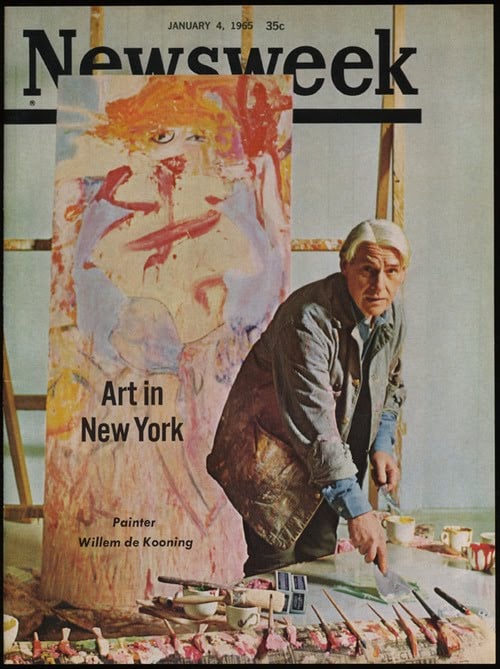
For decades in art circles it was either a rumour or a joke, but now it is confirmed as a fact. The Central Intelligence Agency used American modern art – including the works of such artists as Jackson Pollock, Robert Motherwell, Willem de Kooning and Mark Rothko – as a weapon in the Cold War.

In the manner of a Renaissance prince – except that it acted secretly – the CIA fostered and promoted American Abstract Expressionist painting around the world for more than 20 years.

Originally published in 1995 at The Independent and Voltairenet.org

The connection is improbable. This was a period, in the 1950s and 1960s, when the great majority of Americans disliked or even despised modern art – President Truman summed up the popular view when he said: “If that’s art, then I’m a Hottentot.”

As for the artists themselves, many were ex-communists barely acceptable in the America of the McCarthyite era, and certainly not the sort of people normally likely to receive US government backing.

Why did the CIA support them? Because in the propaganda war with the Soviet Union, this new artistic movement could be held up as proof of the creativity, the intellectual freedom, and the cultural power of the US. Russian art, strapped into the communist ideological straitjacket, could not compete.

The existence of this policy, rumoured and disputed for many years, has now been confirmed for the first time by former CIA officials. Unknown to the artists, the new American art was secretly promoted under a policy known as the “long leash” – arrangements similar in some ways to the indirect CIA backing of the journal Encounter, edited by Stephen Spender.

The decision to include culture and art in the US Cold War arsenal was taken as soon as the CIA was founded in 1947. Dismayed at the appeal communism still had for many intellectuals and artists in the West, the new agency set up a division, the Propaganda Assets Inventory, which at its peak could influence more than 800 newspapers, magazines and public information organisations.

They joked that it was like a Wurlitzer jukebox: when the CIA pushed a button it could hear whatever tune it wanted playing across the world.

The next key step came in 1950, when the International Organisations Division (IOD) was set up under Tom Braden. It was this office which subsidised the animated version of George Orwell’s Animal Farm, which sponsored American jazz artists, opera recitals, the Boston Symphony Orchestra’s international touring programme.

Its agents were placed in the film industry, in publishing houses, even as travel writers for the celebrated Fodor guides. And, we now know, it promoted America’s anarchic avant-garde movement, Abstract Expressionism.

Initially, more open attempts were made to support the new American art. In 1947 the State Department organised and paid for a touring international exhibition entitled “Advancing American Art“, with the aim of rebutting Soviet suggestions that America was a cultural desert.

But the show caused outrage at home, prompting Truman to make his Hottentot remark and one bitter congressman to declare: “I am just a dumb American who pays taxes for this kind of trash.” The tour had to be canceled.

The US government now faced a dilemma. This philistinism, combined with Joseph McCarthy’s hysterical denunciations of all that was avant-garde or unorthodox, was deeply embarrassing. It discredited the idea that America was a sophisticated, culturally rich democracy. It also prevented the US government from consolidating the shift in cultural supremacy from Paris to New York since the 1930s. To resolve this dilemma, the CIA was brought in.

The connection is not quite as odd as it might appear. At this time the new agency, staffed mainly by Yale and Harvard graduates, many of whom collected art and wrote novels in their spare time, was a haven of liberalism when compared with a political world dominated by McCarthy or with J. Edgar Hoover’s FBI.

If any official institution was in a position to celebrate the collection of Leninists, Trotskyites and heavy drinkers that made up the New York School, it was the CIA.

Until now there has been no first-hand evidence to prove that this connection was made, but for the first time a former case officer, Donald Jameson, has broken the silence. Yes, he says, the agency saw Abstract Expressionism as an opportunity, and yes, it ran with it.

“Regarding Abstract Expressionism, I’d love to be able to say that the CIA invented it just to see what happens in New York and downtown SoHo tomorrow!” he joked. “But I think that what we did really was to recognise the difference. It was recognised that Abstract Expression-ism was the kind of art that made Socialist Realism look even more stylised and more rigid and confined than it was. And that relationship was exploited in some of the exhibitions.

“In a way our understanding was helped because Moscow in those days was very vicious in its denunciation of any kind of non-conformity to its own very rigid patterns. And so one could quite adequately and accurately reason that anything they criticised that much and that heavy-handedly was worth support one way or another.”

To pursue its underground interest in America’s lefty avant-garde, the CIA had to be sure its patronage could not be discovered. “Matters of this sort could only have been done at two or three removes,” Mr. Jameson explained, “so that there wouldn’t be any question of having to clear Jackson Pollock, for example, or do anything that would involve these people in the organisation. And it couldn’t have been any closer, because most of them were people who had very little respect for the government, in particular, and certainly none for the CIA. If you had to use people who considered themselves one way or another to be closer to Moscow than to Washington, well, so much the better perhaps.”

This was the “long leash”. The centrepiece of the CIA campaign became the Congress for Cultural Freedom, a vast jamboree of intellectuals, writers, historians, poets, and artists which was set up with CIA funds in 1950 and run by a CIA agent.

It was the beach-head from which culture could be defended against the attacks of Moscow and its “fellow travellers” in the West. At its height, it had offices in 35 countries and published more than two dozen magazines, including Encounter.

The Congress for Cultural Freedom also gave the CIA the ideal front to promote its covert interest in Abstract Expressionism. It would be the official sponsor of touring exhibitions; its magazines would provide useful platforms for critics favourable to the new American painting; and no one, the artists included, would be any the wiser.

This organisation put together several exhibitions of Abstract Expressionism during the 1950s. One of the most significant, “The New American Painting”, visited every big European city in 1958-59. Other influential shows included “Modern Art in the United States” (1955) and “Masterpieces of the Twentieth Century” (1952).

Because Abstract Expressionism was expensive to move around and exhibit, millionaires and museums were called into play. Pre-eminent among these was Nelson Rockefeller, whose mother had co-founded the Museum of Modern Art in New York.

As president of what he called “Mummy’s museum”, Rockefeller was one of the biggest backers of Abstract Expressionism (which he called “free enterprise painting”). His museum was contracted to the Congress for Cultural Freedom to organise and curate most of its important art shows.

The museum was also linked to the CIA by several other bridges. William Paley, the president of CBS broadcasting and a founding father of the CIA, sat on the members’ board of the museum’s International Programme.

John Hay Whitney, who had served in the agency’s wartime predecessor, the OSS, was its chairman. And Tom Braden, first chief of the CIA’s International Organisations Division, was executive secretary of the museum in 1949.

Now in his eighties, Mr. Braden lives in Woodbridge, Virginia, in a house packed with Abstract Expressionist works and guarded by enormous Alsatians. He explained the purpose of the IOD.

“We wanted to unite all the people who were writers, who were musicians, who were artists, to demonstrate that the West and the United States was devoted to freedom of expression and to intellectual achievement, without any rigid barriers as to what you must write, and what you must say, and what you must do, and what you must paint, which was what was going on in the Soviet Union. I think it was the most important division that the agency had, and I think that it played an enormous role in the Cold War.”

He confirmed that his division had acted secretly because of the public hostility to the avant-garde: “It was very difficult to get Congress to go along with some of the things we wanted to do – send art abroad, send symphonies abroad, publish magazines abroad. That’s one of the reasons it had to be done covertly. It had to be a secret. In order to encourage openness we had to be secret.”

If this meant playing pope to this century’s Michelangelos, well, all the better: “It takes a pope or somebody with a lot of money to recognise art and to support it,” Mr. Braden said. “And after many centuries people say, ’Oh look! the Sistine Chapel, the most beautiful creation on Earth!’ It’s a problem that civilisation has faced ever since the first artist and the first millionaire or pope who supported him. And yet if it hadn’t been for the multi-millionaires or the popes, we wouldn’t have had the art.”

Would Abstract Expressionism have been the dominant art movement of the post-war years without this patronage? The answer is probably yes. Equally, it would be wrong to suggest that when you look at an Abstract Expressionist painting you are being duped by the CIA.

But look where this art ended up: in the marble halls of banks, in airports, in city halls, boardrooms and great galleries. For the Cold Warriors who promoted them, these paintings were a logo, a signature for their culture and system which they wanted to display everywhere that counted. They succeeded.

Covert Operation

In 1958 the touring exhibition “The New American Painting”, including works by Pollock, de Kooning, Motherwell and others, was on show in Paris. The Tate Gallery was keen to have it next, but could not afford to bring it over. Late in the day, an American millionaire and art lover, Julius Fleischmann, stepped in with the cash and the show was brought to London.

The money that Fleischmann provided, however, was not his but the CIA’s. It came through a body called the Farfield Foundation, of which Fleischmann was president, but far from being a millionaire’s charitable arm, the foundation was a secret conduit for CIA funds.

So, unknown to the Tate, the public or the artists, the exhibition was transferred to London at American taxpayers’ expense to serve subtle Cold War propaganda purposes.

A former CIA man, Tom Braden, described how such conduits as the Farfield Foundation were set up. “We would go to somebody in New York who was a well-known rich person and we would say, ’We want to set up a foundation.’ We would tell him what we were trying to do and pledge him to secrecy, and he would say, ’Of course I’ll do it,’ and then you would publish a letterhead and his name would be on it and there would be a foundation. It was really a pretty simple device.”

Julius Fleischmann was well placed for such a role. He sat on the board of the International Programme of the Museum of Modern Art in New York – as did several powerful figures close to the CIA.

Originally published at voltairenet.org

About the author

Frances Stonor Saunders is author of a masterful study on the CIA and the cultural Cold War, which provided a detailed account of the CIA’s covert role in sponsoring Abstract Expressionist painting in the United States – and many other CIA operations in various fields of culture.
The CIA exploited this artistic movement as a showcase of freedom and free enterprise, and to counteract the influence that communist ideology still had for many intellectuals and artists in the West.
In 2000, Saunders published it all in Who Pays The Piper? CIA and the Cultural Cold War, Granta, 509 pages.

Did you enjoy this article? You can show it here:
Related Posts

America’s Strategic Assault on Art, Academia, and the Imagination That Sustains Peace Jan Oberg September 29, 2025 The United States once stood as a beacon of cultural audacity—a place where dissent could be beautiful, and beauty and innovation could challenge the present order of things. Its museums, universities, and artists helped inspire a worldwide imagination rooted in creative freedom and innovation. But today, under the Trump regime’s second term, those dynamic qualities are being systematically dismantled. Just read this. As Trump goes after the arts, many museums remain silent | CNN As CNN reports, the administration has launched an aggressive campaign to “eradicate improper ideology” from federally funded museums. Exhibitions involving race, gender, and identity are being censored or cancelled. Amy Sherald’s reimagining of the Statue of Liberty as a Black, trans woman was pulled from the Smithsonian after curators objected to its symbolism. Sherald warned that “history shows us what...
People’s criticism without offering any solutions and their focus on the past and present, but almost never on the future, are the two biggest obstacles to real change. And to making peace… Jan Oberg August 21, 2025 This conversation is not about Endless Militarism. The real title of Pascal Nottaz’ and my conversation is the one on top – “If You Want Peace, Be Creative And Focus On The Future.”  Jan Oberg considers it one of his most important online conversations.
Launched on November 17, 2024Updated with new materials regularly TFF Board members Thore Vest. Everywhere, the delegation was met with a sincere wish to develop knowledge, dialogue, cooperative projects, and initiatives based on citizens’ diplomacy – in general, but with the West in particular. For more, see “Report from the Nordic delegation to China’s Xinjiang Province, September 7-15, 2024.” While the delegation was in Xinjiang, various ideas were already being discussed from the local to the top level, i.e., with the governor and party leaders of Xinjiang. The two TFF Associates suggested that TFF set up a special section – in addition to its “China and Silk” – where various quality materials about Xinjiang would regularly be published to promote public education about Xinjiang, particularly its contemporary development – worldwide but in the West in particular. This is now a reality – as can be seen below – but it...

Recent Articles

Tony Robinson October 4, 2026 Violence is easy to recognise when someone is being beaten, shot or killed. It becomes more difficult when nobody is holding a weapon. Poverty, discrimination, exploitation and repression can restrict a human life just as effectively, although they do so in very different ways and with very different consequences. Simply adding more categories to an ever-growing list of forms of violence does not really solve the problem. The more interesting question is what all these different situations have in common and why it makes sense to describe them using the same word. Human beings do not simply react to what happens around them. They remember the past, imagine things that do not yet exist, make plans and undertake projects. Workers organise because they imagine different working conditions; people migrate because they imagine another life somewhere else; social movements emerge because people refuse to accept the...
It’s a matter of principles, courage, vision and pulling together – while the militarist world is falling apart… Peter Langille October 3, 2026 “Here, then, is the problem which we present to you, stark and dreadful and inescapable: Shall we put an end to the human race; or shall mankind renounce war?”The Bertrand Russell—Albert Einstein Manifesto, July 9, 1955 ⁕ The forecast for what’s ahead is worrisome. The sharp rise in armed conflicts over the past three years is adding to what was already the highest level in over seventy years. Genocides, which should be prevented are supported. A shared climate emergency that jeopardises survival is ignored. Diverse polls now suggest that people are war-weary, worried and interested in a more effective United Nations. And, there are viable policy options for a more secure world! Yet governments are doubling-down, betting on more war and investing heavily. If current trends persist,...
Johan Galtung 1930-2024October 2015 Published here on October 3, 2026 Let us focus on Civilization for conflict analysis and remedies. Major forms of disorder use violence; war is state organized violence. The most belligerent states are the United States of America and Israel, both with civilization roots. National Evangelism, the US Protestant Christian civilization– more national than evangelical–justifies US warfare as exceptionalism of a people chosen by God, with a manifest destiny to run the world. Orthodox Judaism justifies Israeli warfare to conquer and expand from Nile to Euphrates as a religious right and duty to the Eternal One. The third most belligerent country, the UK, no longer believes it is God-chosen but chosen by the USA; not quite the same but something. But the root cause of global disorder lies in the Occident–with Islam–seeing itself as the single, universal civilization valid for all at all times, all others being...

TFF on Substack

Discover and subscribe to more peace materials on TFF Substack

Most Popular

Tony Robinson October 4, 2026 Violence is easy to recognise when someone is being beaten, shot or killed. It becomes more difficult when nobody is holding a weapon. Poverty, discrimination, exploitation and repression can restrict a human life just as effectively, although they do so in very different ways and with very different consequences. Simply adding more categories to an ever-growing list of forms of violence does not really solve the problem. The more interesting question is what all these different situations have in common and why it makes sense to describe them using the same word. Human beings do not simply react to what happens around them. They remember the past, imagine things that do not yet exist, make plans and undertake projects. Workers organise because they imagine different working conditions; people migrate because they imagine another life somewhere else; social movements emerge because people refuse to accept the...
It’s a matter of principles, courage, vision and pulling together – while the militarist world is falling apart… Peter Langille October 3, 2026 “Here, then, is the problem which we present to you, stark and dreadful and inescapable: Shall we put an end to the human race; or shall mankind renounce war?”The Bertrand Russell—Albert Einstein Manifesto, July 9, 1955 ⁕ The forecast for what’s ahead is worrisome. The sharp rise in armed conflicts over the past three years is adding to what was already the highest level in over seventy years. Genocides, which should be prevented are supported. A shared climate emergency that jeopardises survival is ignored. Diverse polls now suggest that people are war-weary, worried and interested in a more effective United Nations. And, there are viable policy options for a more secure world! Yet governments are doubling-down, betting on more war and investing heavily. If current trends persist,...
Johan Galtung 1930-2024October 2015 Published here on October 3, 2026 Let us focus on Civilization for conflict analysis and remedies. Major forms of disorder use violence; war is state organized violence. The most belligerent states are the United States of America and Israel, both with civilization roots. National Evangelism, the US Protestant Christian civilization– more national than evangelical–justifies US warfare as exceptionalism of a people chosen by God, with a manifest destiny to run the world. Orthodox Judaism justifies Israeli warfare to conquer and expand from Nile to Euphrates as a religious right and duty to the Eternal One. The third most belligerent country, the UK, no longer believes it is God-chosen but chosen by the USA; not quite the same but something. But the root cause of global disorder lies in the Occident–with Islam–seeing itself as the single, universal civilization valid for all at all times, all others being...
Read More
Living-Peace-Sign-Budapest-copy
Tony Robinson October 4, 2026 Violence is easy to recognise when someone is being beaten, shot or killed. It becomes more difficult when nobody is holding a weapon. Poverty, discrimination, exploitation and repression can restrict a human life just as effectively, although they do so in very different ways and with very different consequences. Simply adding more categories to an ever-growing list of forms of violence does not really solve the problem. The more interesting question is what all these different situations have in common and why it makes sense to describe them using the same word. Human beings do not simply react to what happens around them. They remember the past, imagine things that do not yet exist, make plans and undertake projects. Workers organise because they imagine different working conditions; people migrate because they imagine another life somewhere else; social movements emerge because people refuse to accept the...
b54a1f10-8c65-4f0b-9dd5-4abc0a7d04cc_2659x2659
It’s a matter of principles, courage, vision and pulling together – while the militarist world is falling apart… Peter Langille October 3, 2026 “Here, then, is the problem which we present to you, stark and dreadful and inescapable: Shall we put an end to the human race; or shall mankind renounce war?”The Bertrand Russell—Albert Einstein Manifesto, July 9, 1955 ⁕ The forecast for what’s ahead is worrisome. The sharp rise in armed conflicts over the past three years is adding to what was already the highest level in over seventy years. Genocides, which should be prevented are supported. A shared climate emergency that jeopardises survival is ignored. Diverse polls now suggest that people are war-weary, worried and interested in a more effective United Nations. And, there are viable policy options for a more secure world! Yet governments are doubling-down, betting on more war and investing heavily. If current trends persist,...
010
Johan Galtung 1930-2024October 2015 Published here on October 3, 2026 Let us focus on Civilization for conflict analysis and remedies. Major forms of disorder use violence; war is state organized violence. The most belligerent states are the United States of America and Israel, both with civilization roots. National Evangelism, the US Protestant Christian civilization– more national than evangelical–justifies US warfare as exceptionalism of a people chosen by God, with a manifest destiny to run the world. Orthodox Judaism justifies Israeli warfare to conquer and expand from Nile to Euphrates as a religious right and duty to the Eternal One. The third most belligerent country, the UK, no longer believes it is God-chosen but chosen by the USA; not quite the same but something. But the root cause of global disorder lies in the Occident–with Islam–seeing itself as the single, universal civilization valid for all at all times, all others being...
Screenshot 2026-10-02 011738
Jan ObergPhD, director, The Transnational Foundation for Peace and Future Research, TFFLund, Sweden October 2, 2026 This is my full original manuscript. The Chinese Academy of Social Science, CASS, makes two publications out if it. 1. China’s Five-year plan emphasized the capabilities of basic research and original innovation. It is regarded as the goal of the future social development, which, as required, should be significantly enhanced. Can you comment on the importance of original innovation in research and academic study? I believe it is easier to define “original innovation” in the natural sciences than in social sciences. The breaking points of what constitutes something new, or innovative, are not quite as sharp in the latter. But in both fields it is about opening up something that was closed, unseen, unexplored before – making manifest what was earlier latent. Innovations come in many forms and shapes – naming something that was not...
arctic-circle-map
The agreement is catastrophic both because of what it says and what it doesn’t mention. It reduces further the major asset of security policies: Freedom of action. Jan Oberg TFF director September 25, 2026 A couple of hours before the agreement was signed on September 22, 2026, I published the following 13 hypotheses about what it would most likely contain on TFF Substack (in English). I was wrong on only the first point. Contrary to what Trump had written on his Truth Social platform, it does not appear to come into force immediately. In fact, it turned out to be worse than even I had anticipated. After these hypotheses now come a number of reflections in light of what the agreement actually contains, and does not contain, as well as the way in which it has generally been presented by major media outlets and by the public-service broadcaster DR. My...
girl-5894831_1280
Below are TFF-related media mentions, comments, videos and social media posts published elsewhere but not on this homepage. We happen to catch and list only a fraction. Regarding video comments and debates, we recommend that you go to the TFF Video Channel on Substack where many of them are reproduced. Jan Oberg is a contributor to China Daily – 52 million daily clicks – and Global Times, CGTN and CCTV (the national television), China Investment, Xinhua News Agency and several others. Articles and videos on these media very often multiply into countless Chinese (and Western media) that re-post them from these main media. Thanks to The China Academy, his analyses, interviews and comments are frequently posted on YouTube channels such as Thinkers Forum and Wave Media. These videos are often re-posted on Bilibili (China’s YouTube), the China Content Center on TikTok, and on the Chinese edition of TikTok, Douyin.com. This means reaching hundreds of millions of viewers worldwide over a year. While there are too many to catch on all these...





