
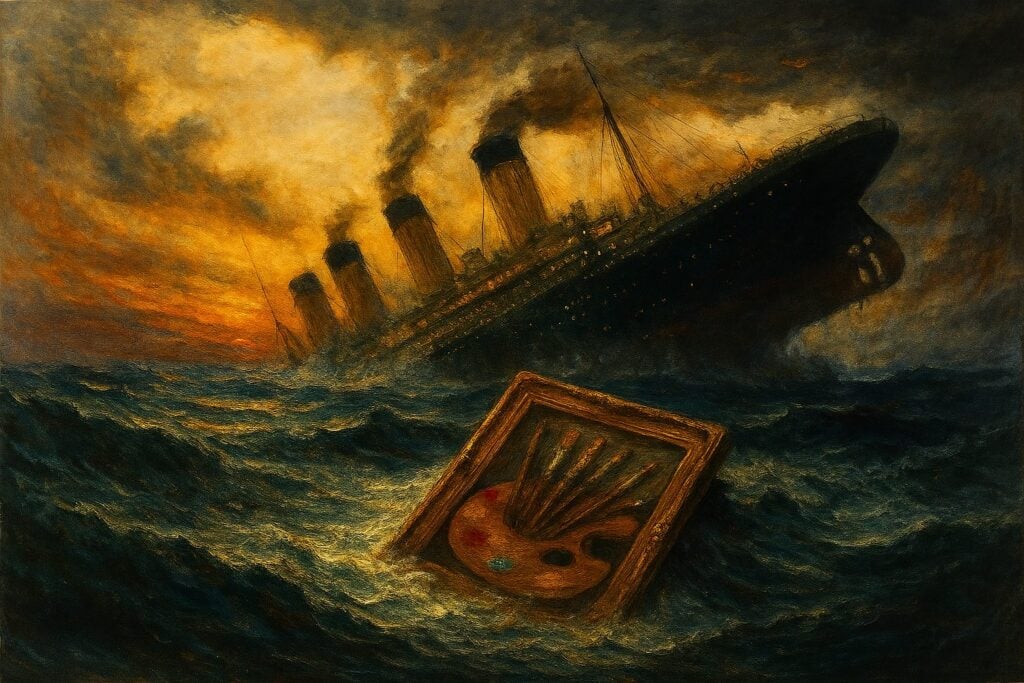
When Empires Fall and Militarism Arrives, Cultural Freedom Must Be Reduced

America’s Strategic Assault on Art, Academia, and the Imagination That Sustains Peace

Jan Oberg

September 29, 2025

The United States once stood as a beacon of cultural audacity—a place where dissent could be beautiful, and beauty and innovation could challenge the present order of things. Its museums, universities, and artists helped inspire a worldwide imagination rooted in creative freedom and innovation.

But today, under the Trump regime’s second term, those dynamic qualities are being systematically dismantled. Just read this.

As Trump goes after the arts, many museums remain silent | CNN

As CNN reports, the administration has launched an aggressive campaign to “eradicate improper ideology” from federally funded museums. Exhibitions involving race, gender, and identity are being censored or cancelled.

Amy Sherald’s reimagining of the Statue of Liberty as a Black, trans woman was pulled from the Smithsonian after curators objected to its symbolism. Sherald warned that “history shows us what happens when governments demand loyalty from cultural institutions”—a chilling echo of regimes past.

This is not merely a cultural skirmish. It is a strategic silencing. And it is inseparable from the logic of militarism.

Militarism does not come only with uniforms, tanks, and constant war planning and fighting. It begins with uniformity. It demands loyalty, punishes ambiguity, and flattens complexity. It thrives on control—of borders, of bodies, of thought. And in its kakistocratic urge to dominate, it targets the spaces where alternative visions might emerge: the arts, universities, independent media, and also replaces broad public debate with deceptive, reality-defying narratives.

The Trump administration’s assault on the arts is part of a broader campaign to reshape American identity into a narrow patriotic spectacle. Grants worth tens of millions have been rescinded. The administration has declared many DEI programs—short for Diversity, Equity, and Inclusion—as “illegal,” targeting them across both government and cultural sectors.

These initiatives, designed to broaden representation and ensure access for historically marginalised communities, have become flashpoints in a broader campaign to mainstream American identity into a narrow, militarised narrative. It undermines every concept of democracy.

Museum directors, fearing financial collapse or loss of tax-exempt status, remain largely silent. According to CNN, one-third of U.S. museums have had federal grants cancelled, and many have begun self-censoring exhibitions to avoid federal assaults.

This impulse—to destroy one’s finest values in order to build ideological uniformity—is the hallmark of declining empires. It is not a sign of strength, but of weakness. Like an ailing individual who cannot tolerate other voices because they threaten the fragile illusion of control, this regime rearranges the cultural deck chairs on the Titanic – while the ship of democratic imagination sinks. They seem not to even see it.

Peace is not the absence of war. It is the presence of possibility. And possibility cannot survive in a climate of fear, where every brushstroke or syllabus is judged by its loyalty to power.

Museums that self-censor become instruments of propaganda, not of public memory. Universities that scrub their websites of diversity programs cease to be spaces of inquiry. And when artists are forced to choose between funding and freedom, society loses its pulse, its decency and future.

This erosion of cultural autonomy accelerates authoritarianism. It replaces dialogue with dogma. It narrows identity. It rewrites history. And it is self-destructive.

As Cesáreo Moreno of the National Museum of Mexican Art warns in this article, “If you don’t look at the ugly things as well as the beautiful things… then you are getting a one-sided, incorrect history, and there will be ramifications for that”.

The ramifications are already here. The administration’s censorship is not just reactive—it is preemptive. It seeks to prevent the emergence of alternative narratives before they can even be imagined. This is how militarism operates: not just through violence, but through erasure of self-reflection and meaning: “Everything according to us!”

And so we must name the more profound truth: that peace and cultural freedom are inseparable. Because both require the courage to imagine alternatives. To ask uncomfortable questions. To embrace contradiction. And to refuse the tyranny of politically correct mainstreaming.

The Trump regime’s campaign against the arts is not just a political maneuver. It is an attack on ambiguity, on nuance, on the very idea that truth might be contested rather than imposed. It is an attempt to replace democratic imagination with militarist uniformity.

But the fact that museums are being targeted is proof that they matter. As Scott Stulen of the Seattle Art Museum puts it, “The fact that they are trying to change didactics in a museum… is indicative that those things are important, and they’re an important part of our culture”.

Let us respond not just with outrage, but with imagination. With exhibitions that provoke. With essays that question. With manifestos that refuse to flatter power.

Because when cultural institutions are forced to glorify the state, they cease to reflect society and begin to control it. And every act of censorship is a prelude to deeper violence: against memory, against meaning, against the future freedom.

Authoritarianism doesn’t arrive only with tanks. It arrives with silence—curated, funded, and enforced. It is an aspect of fearology.

And so we must resist it not only just with facts, but with intensified creative productivity. With the kind of art that asks: What if things could be otherwise?


PhD, Peace & future researcher + ‌Art Photographer, Professor Emeritus and media commentator

Related Posts

Photo above: Carl Fredrik Reuterswärd’s Non-Violence outside UN Headquarters in New York. Kirill Levin, CC BY-NC-SA 2. Jan Oberg November 3, 2026 I am happy to be published in Horizons which is produced by the Center for International Relations and Sustainable Development, CIRSD, in Belgrade. My contribution brings out a radical re-thinking of what concepts such as defence, security, deterrence – and peace – may mean if we want to create a more peaceful world. It also summarises a few things I have been working with the last few decades. Please read it here Og her er den på dansk, takket være Johnny Baltzersens lynhurtige oversættelse
UNITE-tillid, DREAM-velstand og andre konstruktive komponenter Normally we publish articles in English here. But this is a translation of a very important TFF document that should reach as many as possible in Denmark since this country’s government has been one of the most hardline in Europe and, up till now at least, has refused to use diplomacy and, instead, spent tremendous sums on arming Ukraine with the express goal of defeating Russia. Thus this – unique – article is in Danish. Vi er Johnny Baltzersen og hans Fælles Sikkerhed – Fælles Fremtid på Substack overmåde taknemmelige for at have oversat og publiceret TFF’s 2025-portfølje for fredsidéer med henblik på Ukraines fremtid. Vi håber den nu kan nå mange flere danskere – som også vil sprede den og skabe debat – nu den danske regerings og folketingspartiernes politik på dette område siden 2022 står nu – forudsigeligt – ved vejs ende....
Jan Oberg TFF director October 28, 2026 Exactly one month has now passed since I published my criticism of the introduction to the special issue on Johan Galtung published by the Journal of Global Security Studies, JoGSS, and of Tor Egil Førland’s chapter about Galtung which serves as a preview to his forthcoming biography of Galtung to be published by PRIO. See the original on The Transnational here and the same article on TFF Substack with many general and critical comments and, in particular, the people who decided to withdraw from the biography project in protest. The special issue itself was extraordinary. It was devoted to the intellectual legacy of one of the founders of peace research and contained a number of strong assessments of his personality, scholarship, intellectual trajectory, and public role. Such assessments are, of course, entirely legitimate. No scholar is beyond criticism, and neither was Johan Galtung....

Recent Articles

Photo above: Carl Fredrik Reuterswärd’s Non-Violence outside UN Headquarters in New York. Kirill Levin, CC BY-NC-SA 2. Jan Oberg November 3, 2026 I am happy to be published in Horizons which is produced by the Center for International Relations and Sustainable Development, CIRSD, in Belgrade. My contribution brings out a radical re-thinking of what concepts such as defence, security, deterrence – and peace – may mean if we want to create a more peaceful world. It also summarises a few things I have been working with the last few decades. Please read it here Og her er den på dansk, takket være Johnny Baltzersens lynhurtige oversættelse
UNITE-tillid, DREAM-velstand og andre konstruktive komponenter Normally we publish articles in English here. But this is a translation of a very important TFF document that should reach as many as possible in Denmark since this country’s government has been one of the most hardline in Europe and, up till now at least, has refused to use diplomacy and, instead, spent tremendous sums on arming Ukraine with the express goal of defeating Russia. Thus this – unique – article is in Danish. Vi er Johnny Baltzersen og hans Fælles Sikkerhed – Fælles Fremtid på Substack overmåde taknemmelige for at have oversat og publiceret TFF’s 2025-portfølje for fredsidéer med henblik på Ukraines fremtid. Vi håber den nu kan nå mange flere danskere – som også vil sprede den og skabe debat – nu den danske regerings og folketingspartiernes politik på dette område siden 2022 står nu – forudsigeligt – ved vejs ende....
Jan Oberg TFF director October 28, 2026 Exactly one month has now passed since I published my criticism of the introduction to the special issue on Johan Galtung published by the Journal of Global Security Studies, JoGSS, and of Tor Egil Førland’s chapter about Galtung which serves as a preview to his forthcoming biography of Galtung to be published by PRIO. See the original on The Transnational here and the same article on TFF Substack with many general and critical comments and, in particular, the people who decided to withdraw from the biography project in protest. The special issue itself was extraordinary. It was devoted to the intellectual legacy of one of the founders of peace research and contained a number of strong assessments of his personality, scholarship, intellectual trajectory, and public role. Such assessments are, of course, entirely legitimate. No scholar is beyond criticism, and neither was Johan Galtung....

TFF on Substack

Discover and subscribe to more peace materials on TFF Substack

Most Popular

Photo above: Carl Fredrik Reuterswärd’s Non-Violence outside UN Headquarters in New York. Kirill Levin, CC BY-NC-SA 2. Jan Oberg November 3, 2026 I am happy to be published in Horizons which is produced by the Center for International Relations and Sustainable Development, CIRSD, in Belgrade. My contribution brings out a radical re-thinking of what concepts such as defence, security, deterrence – and peace – may mean if we want to create a more peaceful world. It also summarises a few things I have been working with the last few decades. Please read it here Og her er den på dansk, takket være Johnny Baltzersens lynhurtige oversættelse
UNITE-tillid, DREAM-velstand og andre konstruktive komponenter Normally we publish articles in English here. But this is a translation of a very important TFF document that should reach as many as possible in Denmark since this country’s government has been one of the most hardline in Europe and, up till now at least, has refused to use diplomacy and, instead, spent tremendous sums on arming Ukraine with the express goal of defeating Russia. Thus this – unique – article is in Danish. Vi er Johnny Baltzersen og hans Fælles Sikkerhed – Fælles Fremtid på Substack overmåde taknemmelige for at have oversat og publiceret TFF’s 2025-portfølje for fredsidéer med henblik på Ukraines fremtid. Vi håber den nu kan nå mange flere danskere – som også vil sprede den og skabe debat – nu den danske regerings og folketingspartiernes politik på dette område siden 2022 står nu – forudsigeligt – ved vejs ende....
Jan Oberg TFF director October 28, 2026 Exactly one month has now passed since I published my criticism of the introduction to the special issue on Johan Galtung published by the Journal of Global Security Studies, JoGSS, and of Tor Egil Førland’s chapter about Galtung which serves as a preview to his forthcoming biography of Galtung to be published by PRIO. See the original on The Transnational here and the same article on TFF Substack with many general and critical comments and, in particular, the people who decided to withdraw from the biography project in protest. The special issue itself was extraordinary. It was devoted to the intellectual legacy of one of the founders of peace research and contained a number of strong assessments of his personality, scholarship, intellectual trajectory, and public role. Such assessments are, of course, entirely legitimate. No scholar is beyond criticism, and neither was Johan Galtung....
Read More
knotted gun
Photo above: Carl Fredrik Reuterswärd’s Non-Violence outside UN Headquarters in New York. Kirill Levin, CC BY-NC-SA 2. Jan Oberg November 3, 2026 I am happy to be published in Horizons which is produced by the Center for International Relations and Sustainable Development, CIRSD, in Belgrade. My contribution brings out a radical re-thinking of what concepts such as defence, security, deterrence – and peace – may mean if we want to create a more peaceful world. It also summarises a few things I have been working with the last few decades. Please read it here Og her er den på dansk, takket være Johnny Baltzersens lynhurtige oversættelse
TFFPortfolioVign
UNITE-tillid, DREAM-velstand og andre konstruktive komponenter Normally we publish articles in English here. But this is a translation of a very important TFF document that should reach as many as possible in Denmark since this country’s government has been one of the most hardline in Europe and, up till now at least, has refused to use diplomacy and, instead, spent tremendous sums on arming Ukraine with the express goal of defeating Russia. Thus this – unique – article is in Danish. Vi er Johnny Baltzersen og hans Fælles Sikkerhed – Fælles Fremtid på Substack overmåde taknemmelige for at have oversat og publiceret TFF’s 2025-portfølje for fredsidéer med henblik på Ukraines fremtid. Vi håber den nu kan nå mange flere danskere – som også vil sprede den og skabe debat – nu den danske regerings og folketingspartiernes politik på dette område siden 2022 står nu – forudsigeligt – ved vejs ende....
JoGSS-Silent
Jan Oberg TFF director October 28, 2026 Exactly one month has now passed since I published my criticism of the introduction to the special issue on Johan Galtung published by the Journal of Global Security Studies, JoGSS, and of Tor Egil Førland’s chapter about Galtung which serves as a preview to his forthcoming biography of Galtung to be published by PRIO. See the original on The Transnational here and the same article on TFF Substack with many general and critical comments and, in particular, the people who decided to withdraw from the biography project in protest. The special issue itself was extraordinary. It was devoted to the intellectual legacy of one of the founders of peace research and contained a number of strong assessments of his personality, scholarship, intellectual trajectory, and public role. Such assessments are, of course, entirely legitimate. No scholar is beyond criticism, and neither was Johan Galtung....
Screenshot 2026-10-26 115647
An aspect of Iran’s culture and civilisation you’ve probably never heard about. Don’t be surprised if the US and Israel also try to bomb them. Jan ObergTFF director October 26, 2026 Today – under the “USraeli” threat of new “annihilating” bombings – opens the 7th International Conference on Peace and Conflict Resolution at Tehran’s University. As far as I can tell, this is the only permanent, advanced peace research institution in West Asia/the Middle East. Perhaps more countries in that region could be inspired? I mean, how many military “security” institutes and military academies do they have? Many peace research institutes and university departments have been established since the 1950s in the West. They are now all under attack; some have closed down, some have gone mainstream, yet others kept the name but do nothing to research peace and disseminate results or advice; instead, they cooperate with militarism’s platforms such...
Screenshot 2026-10-15 141837
Let’s discuss using AI to create peace – in contrast to boring geopolitics devoid of creative healing and visions. Jan Oberg TFF director October 15, 2026 I asked VEED to create a short video exemplifying how peace is preferable to war, then chose the lady as a template. Simple as that. In less than a minute, it produced this video, which any peace-loving person would appreciate. The only problem is that human intelligence (HI), at least the one that exists among Western decision-makers, isn’t half as moral or smart as AI. I have used AI to dialogue about peace and peace plans, creative conflict resolution and visions of a better future for humankind. It so happens that I am having more stimulating, intelligent, creative and moral discussions with AI than I could possibly have with any EU or NATO leader today. Yes, AI has very problematic and dangerous aspects; used...
girl-5894831_1280
Below are TFF-related media mentions, comments, videos and social media posts published elsewhere but not on this homepage. We happen to catch and list only a fraction. Regarding video comments and debates, we recommend that you go to the TFF Video Channel on Substack where many of them are reproduced. Jan Oberg is a contributor to China Daily – 52 million daily clicks – and Global Times, CGTN and CCTV (the national television), China Investment, Xinhua News Agency and several others. Articles and videos on these media very often multiply into countless Chinese (and Western media) that re-post them from these main media. Thanks to The China Academy, his analyses, interviews and comments are frequently posted on YouTube channels such as Thinkers Forum and Wave Media. These videos are often re-posted on Bilibili (China’s YouTube), the China Content Center on TikTok, and on the Chinese edition of TikTok, Douyin.com. This means reaching hundreds of millions of viewers worldwide over a year. While there are too many to catch on all these...




