Xinjiang – A Public Education Library in the Making

Launched on November 17, 2024
Updated with new materials regularly

TFF Board members Thore Vest. Everywhere, the delegation was met with a sincere wish to develop knowledge, dialogue, cooperative projects, and initiatives based on citizens’ diplomacy – in general, but with the West in particular. For more, see “Report from the Nordic delegation to China’s Xinjiang Province, September 7-15, 2024.”

While the delegation was in Xinjiang, various ideas were already being discussed from the local to the top level, i.e., with the governor and party leaders of Xinjiang. The two TFF Associates suggested that TFF set up a special section – in addition to its “China and Silk” – where various quality materials about Xinjiang would regularly be published to promote public education about Xinjiang, particularly its contemporary development – worldwide but in the West in particular.

This is now a reality – as can be seen below – but it is only the beginning.

We hope that people who are much more knowledgeable about China and Xinjiang than we are will contact us and suggest materials and that, over time, this will become an important Go-To library for research, travel accounts, commentaries, and the like.

What you find here are texts. Videos from Xinjiang will soon be posted on TFF Substack – check the top menu there later in November.

The Xinjiang Province—formally the Xinjiang Uygur Autonomous Region—is China’s largest province; it’s larger than France. It is extremely rich in ethnicity and cultural expressions thanks to its role and history as a meeting point of both the old Silk Roads and the present Belt and Road Initiative. It has borders with eight neighbouring countries and many amazingly beautiful natural scenery.

Here is a succinct description of Xinjiang, as found in “DeepChina: “Over the past two millennia, this region has witnessed the convergence of Chinese, Indian, Persian, Arab, and even ancient Greek and Roman civilizations, creating a rich mosaic of political, religious, ethnic, linguistic, and cultural interactions. Islam is now the dominant religion in Xinjiang, Buddhism was once the preeminent faith here.”

This Xinjiang Library does not express any standpoint concerning the repeated Western accusations about gross human rights violations taking place in Xinjiang, including genocide, concentration camps, forced labour, etc., disseminated by politicians and media. Regrettably, that is probably the main – perhaps even only – thing Westerners, in general, associate with when hearing the word “Xinjiang”. However, it is also 25 million people, their fascinating history, contemporary development and immense diversity just described so well by DeepChina.

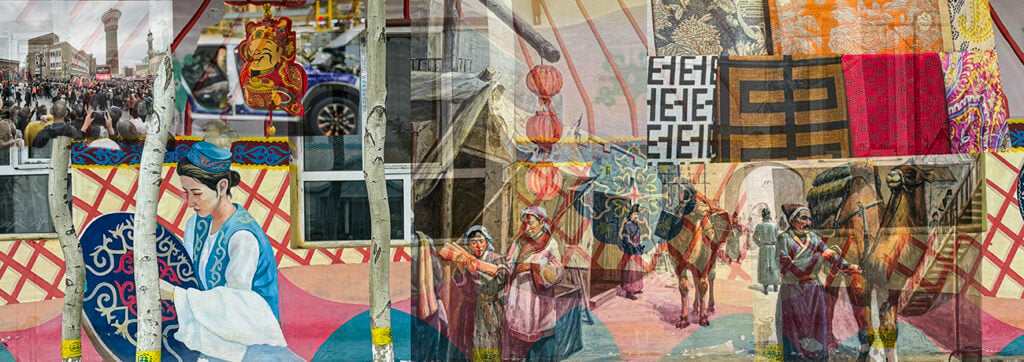
“Xinjiang Collage # 1” – Jan Oberg 2024

TFF has published three reports relevant to these accusations about Xinjiang: Behind the Smokescreen: An Analysis of the West’s Destructive China Cold War Agenda and Why It Must Stop (2021), The Xinjiang Genocide Determination as Agenda (2021), and the 2024 delegation’s report mentioned above. These reports contain references to this discussion.

While we do include some other reports below with that theme, this library does not prioritize this theme.

To put it simply, there are other aspects of Xinjiang—’ other Xinjiangs’—than the one Washington and Brussels (politicians, media, and some scholars) seem bent on disseminating worldwide for political reasons.

In this library, we prioritize materials created by qualified scholars – Western as well as Chinese/Xinjiangian, other Chinese sources, and people who live in or have visited Xinjiang.

We have not applied any catalogue guidelines until now. We keep it simple by adding materials as we find them or they are suggested to us.

TFF’s Special Section on Xinjiang

Everything published by TFF about Xinjiang – updated continuously.

TFF’s Video Library about Xinjiang on Substack

CGTN – from September 2025
About 100 videos on very diverse aspects of Xinjiang’s development over 70 years

China Daily, September-October, 2025*
Celebrating 70 years of progress in the Uygur Autonomous Region

The Asia Review, September 30, 2025
China’s Xinjiang Development Gains Momentum with Xi Jinping’s Strategic Visit

Xinhua English News, September 26, 2025
70 years of progress: Xinjiang’s growth, unity, and vitality

CGTN, September 19, 2025
Graphics: Xinjiang Uygur Autonomous Region’s all-round development in 70 years

Yahoo Finance, GlobeNewsWire & Huanqiu, September 19, 2025
Xinjiang at 70: A Thriving Showcase of Culture and Tourism

South China Morning Post, August 9, 2025
China counts down to start of work on Xinjiang-Tibet Railway

Jerry’s Substack & Jerry’s Take On China, August 1, 2025
What about the Camps? Some truth about China’s Xinjiang

People’s Daily Online, July 16, 2025
China’s successful experience of overcoming terrorism: A model for global peace and development

South China Morning Post, June 16, 2025
China’s Xinjiang turns salt desert into fertile farmland in food security push.

Deep China, Substack, May 29, 2025
Was the historical governance of Xinjiang colonial rule in essence?
Historical evidence rebuts the alleged colonial rule in China’s history, demonstrating the central government’s governance of Xinjiang.

Global Times, May 9, 2025
National People’s Congress from Xinjiang welcomes people to experience local charm, refutes West’s smear.

Global Times, April 22, 2025
Those who visit Xinjiang will return with ‘their eyes full of light.’

South China Morning Post, January 16, 2025
China hits back at US curbs with multifront probes into American firms

Pakistan Observer, January 15, 2025
Xinjiang: A Key Hub for BRI, CPEC & European Connectivity

South China Morning Post, January 9, 2025
China concerned by reports of Uygur militants given senior roles in Syrian army

Terje Alnes, Substack, January 4, 2025
Will the US support a proxy war against China in Xinjiang?

Yang Xiaotong, Asia Times, December 13, 2024
China has cause to be terrified of rebel-run Syria.
Victorious rebel leader al-Golani has fought arm-in-arm with Turkestan Islamic Party militants who seek an Islamic state in Xinjiang

Mike Whitney, The Unz Review, December 21, 2024
Washington Deploys Proxies to Xinjiang to Scuttle China’s Giant Infrastructure Project

Run Unz, The Unz Review • An alternative media selection, December 16, 2024
Propaganda-Hoaxes vs. Chinese Reality
An extremely long and well-documented analysis with lots of texts, videos, links and references.

The Economic Times, India, December 14, 2024
After toppling Syria’s Bashar Al-Assad, Uyghur fighters warn Xi Jinping; say next stop China, vow to free East Turkistan

Encyclopædia Britannica’s entry on “Xinjiang.”

China Discovery – Travel Guide Xinjiang 2024

Xinjiang and Uyghurs – What you’re not being told
World Affairs blog written and edited by Chris Kanthan in San Franciscoo.

Unearthing the ancestry of Uygurs: A glimpse into China’s ethnic diversity
DeepChina, 2024

Three basic facts about Xinjiang
DeepChina, 2024, by Mahemuti Jiang Kadir and Madina Jumalifu, Institute of History, Xinjiang Academy of Social Sciences

Whose historical homeland was China’s Xinjiang?
DeepChina, 2024

Lawmaker calls for turning Xinjiang into green energy hub
Global Times, March 8, 2022.

China raises Xinjiang cotton with parent firm for Calvin Klein and Tommy Hilfiger
South China Morning Post, September 24, 2024.

Why minority languages are disappearing from some classrooms in Xinjiang but not Tibet
Barry Sautman, South China Morning Post & TFF, September 2024.

How labour mobility shapes lives in Xinjiang
DeepChina, 2024, the author is Nilerbaiyer, the Institute for Communication and Borderland Governance at Jinan University

Xinjiang deserves to be seen with eyes wide open!
Biljana Vankovska, The Transnational, October 31, 2024.

Unity in Diversity in Xinjiang
Pan Yue, DeepChina, June 12, 2024.

Introduction. Narratives from Xinjiang: social and political significance (Abstract)
Asian Ethnicity, Taylor & Francis, 2021.

The Rise of Xinjiang Studies: A Journal of Asian Studies New Author Forum
Journal of Asian Studies, Cambridge University Press, 10 January, 2018.

‘Xinjiang’ on Amazon.com
Search ‘Xinjiang’ and almost 50 publications appear

Peace & future researcher + ‌Art Photographer

1972-2003 IT and business-related education by IBM in economy, sales, marketing and business development.1971-1972 Military service1968-1971 Gymnasium, mathematics and physics1965-1968 High-school

Related Posts

Johan Galtung 1930-2024October 2015 Published here on October 3, 2026 Let us focus on Civilization for conflict analysis and remedies. Major forms of disorder use violence; war is state organized violence. The most belligerent states are the United States of America and Israel, both with civilization roots. National Evangelism, the US Protestant Christian civilization– more national than evangelical–justifies US warfare as exceptionalism of a people chosen by God, with a manifest destiny to run the world. Orthodox Judaism justifies Israeli warfare to conquer and expand from Nile to Euphrates as a religious right and duty to the Eternal One. The third most belligerent country, the UK, no longer believes it is God-chosen but chosen by the USA; not quite the same but something. But the root cause of global disorder lies in the Occident–with Islam–seeing itself as the single, universal civilization valid for all at all times, all others being...
Jan ObergPhD, director, The Transnational Foundation for Peace and Future Research, TFFLund, Sweden October 2, 2026 This is my full original manuscript. The Chinese Academy of Social Science, CASS, makes two publications out if it. 1. China’s Five-year plan emphasized the capabilities of basic research and original innovation. It is regarded as the goal of the future social development, which, as required, should be significantly enhanced. Can you comment on the importance of original innovation in research and academic study? I believe it is easier to define “original innovation” in the natural sciences than in social sciences. The breaking points of what constitutes something new, or innovative, are not quite as sharp in the latter. But in both fields it is about opening up something that was closed, unseen, unexplored before – making manifest what was earlier latent. Innovations come in many forms and shapes – naming something that was not...
The agreement is catastrophic both because of what it says and what it doesn’t mention. It reduces further the major asset of security policies: Freedom of action. Jan Oberg TFF director September 25, 2026 A couple of hours before the agreement was signed on September 22, 2026, I published the following 13 hypotheses about what it would most likely contain on TFF Substack (in English). I was wrong on only the first point. Contrary to what Trump had written on his Truth Social platform, it does not appear to come into force immediately. In fact, it turned out to be worse than even I had anticipated. After these hypotheses now come a number of reflections in light of what the agreement actually contains, and does not contain, as well as the way in which it has generally been presented by major media outlets and by the public-service broadcaster DR. My...

Recent Articles

Tony Robinson October 4, 2026 Violence is easy to recognise when someone is being beaten, shot or killed. It becomes more difficult when nobody is holding a weapon. Poverty, discrimination, exploitation and repression can restrict a human life just as effectively, although they do so in very different ways and with very different consequences. Simply adding more categories to an ever-growing list of forms of violence does not really solve the problem. The more interesting question is what all these different situations have in common and why it makes sense to describe them using the same word. Human beings do not simply react to what happens around them. They remember the past, imagine things that do not yet exist, make plans and undertake projects. Workers organise because they imagine different working conditions; people migrate because they imagine another life somewhere else; social movements emerge because people refuse to accept the...
It’s a matter of principles, courage, vision and pulling together – while the militarist world is falling apart… Peter Langille October 3, 2026 “Here, then, is the problem which we present to you, stark and dreadful and inescapable: Shall we put an end to the human race; or shall mankind renounce war?”The Bertrand Russell—Albert Einstein Manifesto, July 9, 1955 ⁕ The forecast for what’s ahead is worrisome. The sharp rise in armed conflicts over the past three years is adding to what was already the highest level in over seventy years. Genocides, which should be prevented are supported. A shared climate emergency that jeopardises survival is ignored. Diverse polls now suggest that people are war-weary, worried and interested in a more effective United Nations. And, there are viable policy options for a more secure world! Yet governments are doubling-down, betting on more war and investing heavily. If current trends persist,...
Johan Galtung 1930-2024October 2015 Published here on October 3, 2026 Let us focus on Civilization for conflict analysis and remedies. Major forms of disorder use violence; war is state organized violence. The most belligerent states are the United States of America and Israel, both with civilization roots. National Evangelism, the US Protestant Christian civilization– more national than evangelical–justifies US warfare as exceptionalism of a people chosen by God, with a manifest destiny to run the world. Orthodox Judaism justifies Israeli warfare to conquer and expand from Nile to Euphrates as a religious right and duty to the Eternal One. The third most belligerent country, the UK, no longer believes it is God-chosen but chosen by the USA; not quite the same but something. But the root cause of global disorder lies in the Occident–with Islam–seeing itself as the single, universal civilization valid for all at all times, all others being...

TFF on Substack

Discover and subscribe to more peace materials on TFF Substack

Most Popular

Tony Robinson October 4, 2026 Violence is easy to recognise when someone is being beaten, shot or killed. It becomes more difficult when nobody is holding a weapon. Poverty, discrimination, exploitation and repression can restrict a human life just as effectively, although they do so in very different ways and with very different consequences. Simply adding more categories to an ever-growing list of forms of violence does not really solve the problem. The more interesting question is what all these different situations have in common and why it makes sense to describe them using the same word. Human beings do not simply react to what happens around them. They remember the past, imagine things that do not yet exist, make plans and undertake projects. Workers organise because they imagine different working conditions; people migrate because they imagine another life somewhere else; social movements emerge because people refuse to accept the...
It’s a matter of principles, courage, vision and pulling together – while the militarist world is falling apart… Peter Langille October 3, 2026 “Here, then, is the problem which we present to you, stark and dreadful and inescapable: Shall we put an end to the human race; or shall mankind renounce war?”The Bertrand Russell—Albert Einstein Manifesto, July 9, 1955 ⁕ The forecast for what’s ahead is worrisome. The sharp rise in armed conflicts over the past three years is adding to what was already the highest level in over seventy years. Genocides, which should be prevented are supported. A shared climate emergency that jeopardises survival is ignored. Diverse polls now suggest that people are war-weary, worried and interested in a more effective United Nations. And, there are viable policy options for a more secure world! Yet governments are doubling-down, betting on more war and investing heavily. If current trends persist,...
Johan Galtung 1930-2024October 2015 Published here on October 3, 2026 Let us focus on Civilization for conflict analysis and remedies. Major forms of disorder use violence; war is state organized violence. The most belligerent states are the United States of America and Israel, both with civilization roots. National Evangelism, the US Protestant Christian civilization– more national than evangelical–justifies US warfare as exceptionalism of a people chosen by God, with a manifest destiny to run the world. Orthodox Judaism justifies Israeli warfare to conquer and expand from Nile to Euphrates as a religious right and duty to the Eternal One. The third most belligerent country, the UK, no longer believes it is God-chosen but chosen by the USA; not quite the same but something. But the root cause of global disorder lies in the Occident–with Islam–seeing itself as the single, universal civilization valid for all at all times, all others being...
Read More
Living-Peace-Sign-Budapest-copy
Tony Robinson October 4, 2026 Violence is easy to recognise when someone is being beaten, shot or killed. It becomes more difficult when nobody is holding a weapon. Poverty, discrimination, exploitation and repression can restrict a human life just as effectively, although they do so in very different ways and with very different consequences. Simply adding more categories to an ever-growing list of forms of violence does not really solve the problem. The more interesting question is what all these different situations have in common and why it makes sense to describe them using the same word. Human beings do not simply react to what happens around them. They remember the past, imagine things that do not yet exist, make plans and undertake projects. Workers organise because they imagine different working conditions; people migrate because they imagine another life somewhere else; social movements emerge because people refuse to accept the...
b54a1f10-8c65-4f0b-9dd5-4abc0a7d04cc_2659x2659
It’s a matter of principles, courage, vision and pulling together – while the militarist world is falling apart… Peter Langille October 3, 2026 “Here, then, is the problem which we present to you, stark and dreadful and inescapable: Shall we put an end to the human race; or shall mankind renounce war?”The Bertrand Russell—Albert Einstein Manifesto, July 9, 1955 ⁕ The forecast for what’s ahead is worrisome. The sharp rise in armed conflicts over the past three years is adding to what was already the highest level in over seventy years. Genocides, which should be prevented are supported. A shared climate emergency that jeopardises survival is ignored. Diverse polls now suggest that people are war-weary, worried and interested in a more effective United Nations. And, there are viable policy options for a more secure world! Yet governments are doubling-down, betting on more war and investing heavily. If current trends persist,...
010
Johan Galtung 1930-2024October 2015 Published here on October 3, 2026 Let us focus on Civilization for conflict analysis and remedies. Major forms of disorder use violence; war is state organized violence. The most belligerent states are the United States of America and Israel, both with civilization roots. National Evangelism, the US Protestant Christian civilization– more national than evangelical–justifies US warfare as exceptionalism of a people chosen by God, with a manifest destiny to run the world. Orthodox Judaism justifies Israeli warfare to conquer and expand from Nile to Euphrates as a religious right and duty to the Eternal One. The third most belligerent country, the UK, no longer believes it is God-chosen but chosen by the USA; not quite the same but something. But the root cause of global disorder lies in the Occident–with Islam–seeing itself as the single, universal civilization valid for all at all times, all others being...
Screenshot 2026-10-02 011738
Jan ObergPhD, director, The Transnational Foundation for Peace and Future Research, TFFLund, Sweden October 2, 2026 This is my full original manuscript. The Chinese Academy of Social Science, CASS, makes two publications out if it. 1. China’s Five-year plan emphasized the capabilities of basic research and original innovation. It is regarded as the goal of the future social development, which, as required, should be significantly enhanced. Can you comment on the importance of original innovation in research and academic study? I believe it is easier to define “original innovation” in the natural sciences than in social sciences. The breaking points of what constitutes something new, or innovative, are not quite as sharp in the latter. But in both fields it is about opening up something that was closed, unseen, unexplored before – making manifest what was earlier latent. Innovations come in many forms and shapes – naming something that was not...
arctic-circle-map
The agreement is catastrophic both because of what it says and what it doesn’t mention. It reduces further the major asset of security policies: Freedom of action. Jan Oberg TFF director September 25, 2026 A couple of hours before the agreement was signed on September 22, 2026, I published the following 13 hypotheses about what it would most likely contain on TFF Substack (in English). I was wrong on only the first point. Contrary to what Trump had written on his Truth Social platform, it does not appear to come into force immediately. In fact, it turned out to be worse than even I had anticipated. After these hypotheses now come a number of reflections in light of what the agreement actually contains, and does not contain, as well as the way in which it has generally been presented by major media outlets and by the public-service broadcaster DR. My...
girl-5894831_1280
Below are TFF-related media mentions, comments, videos and social media posts published elsewhere but not on this homepage. We happen to catch and list only a fraction. Regarding video comments and debates, we recommend that you go to the TFF Video Channel on Substack where many of them are reproduced. Jan Oberg is a contributor to China Daily – 52 million daily clicks – and Global Times, CGTN and CCTV (the national television), China Investment, Xinhua News Agency and several others. Articles and videos on these media very often multiply into countless Chinese (and Western media) that re-post them from these main media. Thanks to The China Academy, his analyses, interviews and comments are frequently posted on YouTube channels such as Thinkers Forum and Wave Media. These videos are often re-posted on Bilibili (China’s YouTube), the China Content Center on TikTok, and on the Chinese edition of TikTok, Douyin.com. This means reaching hundreds of millions of viewers worldwide over a year. While there are too many to catch on all these...