
Pulling down statues may make us feel good but will
not eliminate the root causes of racism and discrimination

Farhang Jahanpour
TFF Associate

June 23, 2020

Part Two – Part 1 here

The protests to the cruel killing of George Floyd and many others before him and even some after him have not remained confined to the United States or among black people alone, but have given rise to a global movement for change and an end to racism and discrimination.

Many protestors in the United States have called for the toppling of the statues of Confederate generals and for the names of places and institutions named after them to be changed, while in many European countries demonstrators have called for the toppling of statues of those who are symbols of racism, imperialism and white supremacy.

Clearly, toppling a few statues may give temporary satisfaction to those who have been the victims of racism, but is it the best or a lasting solution?

There is a difference between “feel good politics” and “do good politics”.

What is needed is not to vent our anger against a few statues, but to think of long-term solutions to the phenomenon of racism and discrimination.

When I first arrived in Britain as a young student in 1960, I caught a taxi at the then BOAC terminal in London and asked the driver to take me to an inexpensive hotel. He dropped me in front of the Cromwell Hotel in Cromwell Road, Kensington.

Oliver Cromwell was the leader of the Puritan Movement who led the Parliament’s armies against Charles I during the English Civil War, and signed the warrant for the execution of King Charles I in 1649. On 20 April 1653, he dismissed the Rump Parliament by force, setting up a nominated assembly known as Barebone’s Parliament before being invited to rule as Lord Protector. The Puritans also engaged in a great deal of artistic vandalism, destroying many beautiful religious buildings and artefacts.

This road in London, was actually named after Cromwell’s son who once owned a house there.

Having come from what was then royal Iran and being partly familiar with British history, I found it odd that Cromwell who had tried to abolish the monarchy and who had killed a king would have his name given to a road and a hotel without any government action.

The following day I asked a British friend of mine about why Cromwell’s name had not been erased from all records after the Restoration of the monarchy and why various monuments commemorated him.

He replied: “Because he was a part of British history”.

I found that attitude a much more mature approach compared to the practice of many third world countries where every new regime tries to eliminate the traces of the previous one. This also happened in Iran. The Pahlavi Dynasty (1925-79) that succeeded the Qajar Dynasty (1789-1925) tried to erase or undermine all the achievements of the previous dynasty.

Cities, buildings and roads changed their names to new names associated with the Pahlavis. The ancient city of Urumiyyeh became Rezaiyyeh, named after Reza Shah, Anzali port became Pahlavi port, Tehran’s longest street was called Pahlavi Street, and many statues of both Pahlavi kings were erected all over the place.

The same pattern was followed after the fall of the Pahlavis. One of the first things that the leaders of the Islamic Republic did was to try to erase the monuments and statues of the Pahlavi dynasty. The “hanging judge” Ayatollah Khalkhali led the crowd towards Reza Shah’s mausoleum and raised it to the ground.

The monument that the Shah had built in the middle of Tehran to commemorate Iran’s 2,500 years of monarchy, but most specifically to perpetuate his own name, called Shahyad, changed its name to “Freedom Square”, and Tehran’s longest thoroughfare, the Pahlavi Street, was renamed Valiasr Street (after the so-called Hidden Imam).

No doubt, when the Islamic Republic is replaced with a new regime, new rulers will also try to destroy Khomeini’s huge mausoleum and will change many names associated with the Islamic regime.

The toppling of the monuments associated with an old era may be tempting and may provide some momentary emotional relief, but they also destroy a part of history, and a nation without history is like a tree which has had the roots cut off.

One can easily understand the depth of anger of those who have been the victims of racism in the past or at present, and their desire to remove the statues of some slaver owners or colonialists that remind them of the period of their oppression.

How can one learn about the background of those monsters and not sympathise with those who wish to remove the stain of shame from their cities?

Tens of thousands of mainly peaceful demonstrators took to the streets in different parts of Britain demanding racial justice. In Bristol, demonstrators pulled down the statue of Edward Colston from its pedestal, reminiscent of American soldiers pulling down Saddam Hussein’s statue in Baghdad, and threw it into a canal.

Colston who became a major benefactor to the city of Bristol and whose name honours/shames many streets and buildings, built his enormous fortune on slavery. He transported more than 80,000 African men, women and children across the Atlantic, many of them to their death during transit or in the plantations.

Thousands of demonstrators gathered outside Oriel College in Oxford demanding the removal of the statue of imperialist Cecil Rhodes. Rhodes was an ardent believer in British imperialism who founded the southern African territory which was named Rhodesia after him (renamed later as Zimbabwe when it achieved independence after nearly 70 years as a British colony), and in some ways he was the author of apartheid in South Africa.

His primary motivation in politics was based on his professed belief that the Anglo-Saxon race was “the first race in the world”, adding that “the more of the world we inhabit the better it is for the human race.”[1]

Sadly, such sentiments do not only belong in the past but are repeated in different forms by some arrogant politicians right up to the present time. During his Senate hearing, US Secretary of State Mike Pompeo said that America was not only exceptional but unique. Pompeo, a US Army veteran, addressing The American Legion 101st National Convention on 27 August 2019, boasted: “Americanism means recognising America as ‘an exceptional nation’”.

After referring to the US’s “achievements” in Afghanistan and Venezuela, galvanising international support for sanctions on North Korea and Iran, etc., he told his military audience: “It’s very simple: you have contributed mightily to proud American achievements. By doing so you, your organization, each of you as individuals, is a proud American achievement unto itself.”

He added: “In fact, America itself – the idea of America and her promise – is at the core of everything that you do.”[2]

This is the language of all past imperialists and colonialists who made use of high-sounding ideals to invade and suppress other nations. But no government has acted in a more parochial and racist manner than the administration of which Pompeo is a member.

From banning Muslim immigrants, to savagely separating children from their parents at US borders in the south, selling huge volumes of deadly weapons to dictatorial regimes that are engaged in genocidal wars in Yemen and elsewhere, imposing illegal sanctions on numerous countries, organising clumsy coup attempts against Venezuela and Bolivia, violating international law and granting Jerusalem and parts of the occupied territories to the apartheid Israeli regime, withdrawing from a number of international treaties such as the Paris Climate Accord, the nuclear deal with Iran, the Start Treaty with Russia, undermining various vital UN organisations such as the WHO in the middle of a pandemic, or UNESCO or International Court of Justice, etc. the current US regime has a terrible record hardly matched by any previous administration.

It requires an exceptional, indeed a unique, degree of arrogance and blindness to ignore this unenviable record of aggression, violation of international law and human rights, and talk about US exceptionalism for allegedly spreading freedom and democracy throughout the world. 

Nevertheless, the answer to this and past examples of racism and arrogance is not to engage in acts of demolition, although on 18th June, Oriel College finally promised to remove Rhodes statue. There must be a better way of tackling the root-causes of all that injustice.

In fact, by removing the statues of racists and imperialists one has done them a great favour, because with their removal their memory also fades gradually and people forget about their crimes.

Far better to keep them where they are but add a plaque to them explaining what they did.

A nation that demolishes its history cuts its own roots and dims its memory. In fact, it is impossible to erase the past and pretend that it did not exist. We are the products of our past and we must accept it for good or ill.

As the American novelist William Falkner said: “The past is not dead, it is not even past.” In the words of Iranian poet Omar Khayyam:

The Moving Finger writes; and, having writ,
Moves on: nor all thy Piety nor Wit
Shall lure it back to cancel half a Line,
Nor all thy Tears wash out a Word of it.

We cannot erase the past, but we can admit our past mistakes, learn from them and try to put them right.

Don’t pull down statues, pull down statutes

One of the ways that unjust governments have perpetuated past injustices has been by passing unfair statutes and giving legal legitimacy to their racist behaviour. It’s well past time for changing the laws that discriminate against black and ethnic groups and on the whole the poorer classes of society, and to introduce new legislation. One such area is systemic police reform.

American politicians have been aware of police bias but have done little to address it. As early as 2006, an FBI report revealed that law-enforcement forces had been “infiltrated” by White Supremacists and in fact, it called it an epidemic.[3]

It is appalling that black people are 40 times more likely to be subjected to “Stop and Search” than white people. The rate of death under detention is proportionately much higher for black people than for whites, as is the rate of incarceration.

This means that one of the first steps that needs to be taken is to fundamentally change the culture of policing and make it more accountable.

The issue of violence and the militarisation of the police is closely connected with the issue of America’s growing militarisation abroad. The United States spends nearly as much on its military as the rest of the world combined, and it is by far the largest exporter of deadly weapons. It also has hundreds of bases in way over hundred countries.

In order to reduce this excessive reliance on military force at home and abroad, people should demand massive cuts in the budgets of the Pentagon and the police and instead spend the money on removing economic disparity.

One can think of dozens of other measures that can be taken in the United States and in the West as a whole, which are more effective than pulling down some statues. Those measures would have a permanent effect and would make America and the West much more humane, more equal and more desirable places for their citizens to live.

Farhang Jahanpour is a former professor and dean of the Faculty of Languages at the University of Isfahan, and a former Senior Research Scholar at Harvard.
He is also a TFF Associate and former Board member of the foundation.
For the past 30 years, he has been teaching courses on the Middle East at the Department of Continuing Education and is a member of Kellogg College at the University of Oxford.

Part 1 of ‘George Floyd’s killing and its international repercussions”

Please help TFF remain truly independent here if you benefited from this article


Notes

[1] William Thomas Stead, ed. “The Last Will and Testament of Cecil John Rhodes”, London, 1902, p. 58.

[2] See Steven B. Brooks, Pompeo: Americanism means recognizing America as an ‘exceptional nation’, American Legion, Aug 27, 2019.

[3] “White Supremacist Infiltration of Law Enforcement,” 17 October, 2006.

Photo on top
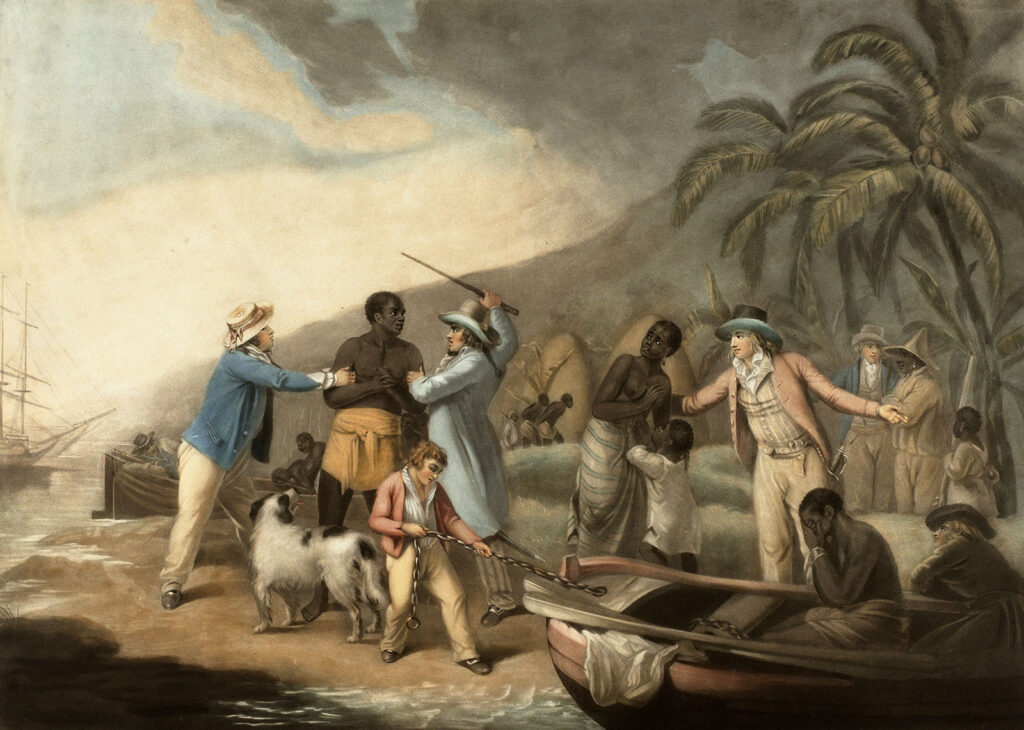
John Raphael Smith: Slave TradeSlave Trade, print on paper by John Raphael Smith after George Morland, 1762–1812; in the Rijksmuseum, Amsterdam.Courtesy of the Rijksmuseum, Amsterdam (RP-P-1969-83)


The PRIO & ISA Effort to Excommunicate Johan Galtung from Peace Research – And Why It Failed

How Oxford University Press allowed …
Warm Peace: A Theory of Transition from Cold Peace

New pathbreaking theory-of-peace book by …
Militarist Absurd Theatre with Dead Horse Punditry? No. There Are Only Alternatives

Jan ObergTFF director ☮️ When …
The One West

A Civilizational Interpretation of the …

One Response

  1. None of the police forces in the 20 biggest cities in the US, live up to the most basic norm of Human Rights by a study of University of Chicagos Lawschool called “Deadly Discretion: The Failure of Police Use of Force Policies to Deadly Discretion: The Failure of Police Use of Force Policies to Meet Fundamental International Human Rights Law and Meet Fundamental International Human Rights Law and Standards Standards “. Having statues of Confederate Generals all over the Southern States – mainly raised during the period between 1900 – 1930, is based on Southern Mytology of how nice the slavemasters were to their slaves – but they are raised by the Daughters of the Confederacy – a white supremacy group during the years of Jim Crow laws – i order to tell the blacks to keep in line. They must go. What the Brits are doing to their former Imperialistic slavetraders, seems fair – why would you honour people who has committed such atrocities – put them in the British Museum the department for Imperialism with foot notes.

Related Posts

Johan Galtung 1930-2024October 2015 Published here on October 3, 2026 Let us focus on Civilization for conflict analysis and remedies. Major forms of disorder use violence; war is state organized violence. The most belligerent states are the United States of America and Israel, both with civilization roots. National Evangelism, the US Protestant Christian civilization– more national than evangelical–justifies US warfare as exceptionalism of a people chosen by God, with a manifest destiny to run the world. Orthodox Judaism justifies Israeli warfare to conquer and expand from Nile to Euphrates as a religious right and duty to the Eternal One. The third most belligerent country, the UK, no longer believes it is God-chosen but chosen by the USA; not quite the same but something. But the root cause of global disorder lies in the Occident–with Islam–seeing itself as the single, universal civilization valid for all at all times, all others being...
Jan ObergPhD, director, The Transnational Foundation for Peace and Future Research, TFFLund, Sweden October 2, 2026 This is my full original manuscript. The Chinese Academy of Social Science, CASS, makes two publications out if it. 1. China’s Five-year plan emphasized the capabilities of basic research and original innovation. It is regarded as the goal of the future social development, which, as required, should be significantly enhanced. Can you comment on the importance of original innovation in research and academic study? I believe it is easier to define “original innovation” in the natural sciences than in social sciences. The breaking points of what constitutes something new, or innovative, are not quite as sharp in the latter. But in both fields it is about opening up something that was closed, unseen, unexplored before – making manifest what was earlier latent. Innovations come in many forms and shapes – naming something that was not...
The agreement is catastrophic both because of what it says and what it doesn’t mention. It reduces further the major asset of security policies: Freedom of action. Jan Oberg TFF director September 25, 2026 A couple of hours before the agreement was signed on September 22, 2026, I published the following 13 hypotheses about what it would most likely contain on TFF Substack (in English). I was wrong on only the first point. Contrary to what Trump had written on his Truth Social platform, it does not appear to come into force immediately. In fact, it turned out to be worse than even I had anticipated. After these hypotheses now come a number of reflections in light of what the agreement actually contains, and does not contain, as well as the way in which it has generally been presented by major media outlets and by the public-service broadcaster DR. My...

Recent Articles

Tony Robinson October 4, 2026 Violence is easy to recognise when someone is being beaten, shot or killed. It becomes more difficult when nobody is holding a weapon. Poverty, discrimination, exploitation and repression can restrict a human life just as effectively, although they do so in very different ways and with very different consequences. Simply adding more categories to an ever-growing list of forms of violence does not really solve the problem. The more interesting question is what all these different situations have in common and why it makes sense to describe them using the same word. Human beings do not simply react to what happens around them. They remember the past, imagine things that do not yet exist, make plans and undertake projects. Workers organise because they imagine different working conditions; people migrate because they imagine another life somewhere else; social movements emerge because people refuse to accept the...
It’s a matter of principles, courage, vision and pulling together – while the militarist world is falling apart… Peter Langille October 3, 2026 “Here, then, is the problem which we present to you, stark and dreadful and inescapable: Shall we put an end to the human race; or shall mankind renounce war?”The Bertrand Russell—Albert Einstein Manifesto, July 9, 1955 ⁕ The forecast for what’s ahead is worrisome. The sharp rise in armed conflicts over the past three years is adding to what was already the highest level in over seventy years. Genocides, which should be prevented are supported. A shared climate emergency that jeopardises survival is ignored. Diverse polls now suggest that people are war-weary, worried and interested in a more effective United Nations. And, there are viable policy options for a more secure world! Yet governments are doubling-down, betting on more war and investing heavily. If current trends persist,...
Johan Galtung 1930-2024October 2015 Published here on October 3, 2026 Let us focus on Civilization for conflict analysis and remedies. Major forms of disorder use violence; war is state organized violence. The most belligerent states are the United States of America and Israel, both with civilization roots. National Evangelism, the US Protestant Christian civilization– more national than evangelical–justifies US warfare as exceptionalism of a people chosen by God, with a manifest destiny to run the world. Orthodox Judaism justifies Israeli warfare to conquer and expand from Nile to Euphrates as a religious right and duty to the Eternal One. The third most belligerent country, the UK, no longer believes it is God-chosen but chosen by the USA; not quite the same but something. But the root cause of global disorder lies in the Occident–with Islam–seeing itself as the single, universal civilization valid for all at all times, all others being...

TFF on Substack

Discover and subscribe to more peace materials on TFF Substack

Most Popular

Tony Robinson October 4, 2026 Violence is easy to recognise when someone is being beaten, shot or killed. It becomes more difficult when nobody is holding a weapon. Poverty, discrimination, exploitation and repression can restrict a human life just as effectively, although they do so in very different ways and with very different consequences. Simply adding more categories to an ever-growing list of forms of violence does not really solve the problem. The more interesting question is what all these different situations have in common and why it makes sense to describe them using the same word. Human beings do not simply react to what happens around them. They remember the past, imagine things that do not yet exist, make plans and undertake projects. Workers organise because they imagine different working conditions; people migrate because they imagine another life somewhere else; social movements emerge because people refuse to accept the...
It’s a matter of principles, courage, vision and pulling together – while the militarist world is falling apart… Peter Langille October 3, 2026 “Here, then, is the problem which we present to you, stark and dreadful and inescapable: Shall we put an end to the human race; or shall mankind renounce war?”The Bertrand Russell—Albert Einstein Manifesto, July 9, 1955 ⁕ The forecast for what’s ahead is worrisome. The sharp rise in armed conflicts over the past three years is adding to what was already the highest level in over seventy years. Genocides, which should be prevented are supported. A shared climate emergency that jeopardises survival is ignored. Diverse polls now suggest that people are war-weary, worried and interested in a more effective United Nations. And, there are viable policy options for a more secure world! Yet governments are doubling-down, betting on more war and investing heavily. If current trends persist,...
Johan Galtung 1930-2024October 2015 Published here on October 3, 2026 Let us focus on Civilization for conflict analysis and remedies. Major forms of disorder use violence; war is state organized violence. The most belligerent states are the United States of America and Israel, both with civilization roots. National Evangelism, the US Protestant Christian civilization– more national than evangelical–justifies US warfare as exceptionalism of a people chosen by God, with a manifest destiny to run the world. Orthodox Judaism justifies Israeli warfare to conquer and expand from Nile to Euphrates as a religious right and duty to the Eternal One. The third most belligerent country, the UK, no longer believes it is God-chosen but chosen by the USA; not quite the same but something. But the root cause of global disorder lies in the Occident–with Islam–seeing itself as the single, universal civilization valid for all at all times, all others being...
Read More
Living-Peace-Sign-Budapest-copy
Tony Robinson October 4, 2026 Violence is easy to recognise when someone is being beaten, shot or killed. It becomes more difficult when nobody is holding a weapon. Poverty, discrimination, exploitation and repression can restrict a human life just as effectively, although they do so in very different ways and with very different consequences. Simply adding more categories to an ever-growing list of forms of violence does not really solve the problem. The more interesting question is what all these different situations have in common and why it makes sense to describe them using the same word. Human beings do not simply react to what happens around them. They remember the past, imagine things that do not yet exist, make plans and undertake projects. Workers organise because they imagine different working conditions; people migrate because they imagine another life somewhere else; social movements emerge because people refuse to accept the...
b54a1f10-8c65-4f0b-9dd5-4abc0a7d04cc_2659x2659
It’s a matter of principles, courage, vision and pulling together – while the militarist world is falling apart… Peter Langille October 3, 2026 “Here, then, is the problem which we present to you, stark and dreadful and inescapable: Shall we put an end to the human race; or shall mankind renounce war?”The Bertrand Russell—Albert Einstein Manifesto, July 9, 1955 ⁕ The forecast for what’s ahead is worrisome. The sharp rise in armed conflicts over the past three years is adding to what was already the highest level in over seventy years. Genocides, which should be prevented are supported. A shared climate emergency that jeopardises survival is ignored. Diverse polls now suggest that people are war-weary, worried and interested in a more effective United Nations. And, there are viable policy options for a more secure world! Yet governments are doubling-down, betting on more war and investing heavily. If current trends persist,...
010
Johan Galtung 1930-2024October 2015 Published here on October 3, 2026 Let us focus on Civilization for conflict analysis and remedies. Major forms of disorder use violence; war is state organized violence. The most belligerent states are the United States of America and Israel, both with civilization roots. National Evangelism, the US Protestant Christian civilization– more national than evangelical–justifies US warfare as exceptionalism of a people chosen by God, with a manifest destiny to run the world. Orthodox Judaism justifies Israeli warfare to conquer and expand from Nile to Euphrates as a religious right and duty to the Eternal One. The third most belligerent country, the UK, no longer believes it is God-chosen but chosen by the USA; not quite the same but something. But the root cause of global disorder lies in the Occident–with Islam–seeing itself as the single, universal civilization valid for all at all times, all others being...
Screenshot 2026-10-02 011738
Jan ObergPhD, director, The Transnational Foundation for Peace and Future Research, TFFLund, Sweden October 2, 2026 This is my full original manuscript. The Chinese Academy of Social Science, CASS, makes two publications out if it. 1. China’s Five-year plan emphasized the capabilities of basic research and original innovation. It is regarded as the goal of the future social development, which, as required, should be significantly enhanced. Can you comment on the importance of original innovation in research and academic study? I believe it is easier to define “original innovation” in the natural sciences than in social sciences. The breaking points of what constitutes something new, or innovative, are not quite as sharp in the latter. But in both fields it is about opening up something that was closed, unseen, unexplored before – making manifest what was earlier latent. Innovations come in many forms and shapes – naming something that was not...
arctic-circle-map
The agreement is catastrophic both because of what it says and what it doesn’t mention. It reduces further the major asset of security policies: Freedom of action. Jan Oberg TFF director September 25, 2026 A couple of hours before the agreement was signed on September 22, 2026, I published the following 13 hypotheses about what it would most likely contain on TFF Substack (in English). I was wrong on only the first point. Contrary to what Trump had written on his Truth Social platform, it does not appear to come into force immediately. In fact, it turned out to be worse than even I had anticipated. After these hypotheses now come a number of reflections in light of what the agreement actually contains, and does not contain, as well as the way in which it has generally been presented by major media outlets and by the public-service broadcaster DR. My...
girl-5894831_1280
Below are TFF-related media mentions, comments, videos and social media posts published elsewhere but not on this homepage. We happen to catch and list only a fraction. Regarding video comments and debates, we recommend that you go to the TFF Video Channel on Substack where many of them are reproduced. Jan Oberg is a contributor to China Daily – 52 million daily clicks – and Global Times, CGTN and CCTV (the national television), China Investment, Xinhua News Agency and several others. Articles and videos on these media very often multiply into countless Chinese (and Western media) that re-post them from these main media. Thanks to The China Academy, his analyses, interviews and comments are frequently posted on YouTube channels such as Thinkers Forum and Wave Media. These videos are often re-posted on Bilibili (China’s YouTube), the China Content Center on TikTok, and on the Chinese edition of TikTok, Douyin.com. This means reaching hundreds of millions of viewers worldwide over a year. While there are too many to catch on all these...




