
By Ellen Brown

September 1, 2019

When the Federal Reserve cut interest rates on July 31st for the first time in more than a decade, commentators were asking why. According to official data, the economy was rebounding, unemployment was below 4%, and GDP growth was above 3%. If anything, by the Fed’s own reasoning, it should have been raising rates.

Originally posted Ellen Brown’s official website on August 9, 2019 here

The explanation of market pundits was that we’re in a trade war and a currency war. Other central banks were cutting their rates and the Fed had to follow suit, in order to prevent the dollar from becoming overvalued relative to other currencies. The theory is that a cheaper dollar will make American products more attractive on foreign markets, helping our manufacturing and labor bases.

Over the weekend, President Trump followed the rate cuts by threatening to impose a new 10% tariff on $300 billion worth of Chinese products effective September 1st. China responded by suspending imports of U.S. agricultural products by state-owned companies and letting the value of the yuan drop. On Monday, August 5, the Dow Jones Industrial Average dropped nearly 770 points, its worst day in 2019. The war was on.

The problem with a currency war is that it is a war without winners. This was demonstrated in the beggar-thy-neighbor policies of the 1930s, which just prolonged the Great Depression. As economist Michael Hudson observed in a June 2019 interview with Bonnie Faulkner, making American products cheaper abroad will do little for the American economy, because we no longer have a competitive manufacturing base or products to sell.

Today’s workers are largely in the service industries – cab drivers, hospital workers, insurance agents and the like. A cheaper dollar abroad just makes consumer goods at Walmart and imported raw materials for US businesses more expensive. What is mainly devalued when a currency is devalued, says Hudson, is the price of the country’s labor and the working conditions of its laborers.

The reason American workers cannot compete with foreign workers is not that the dollar is overvalued. It is due to their higher costs of housing, education, medical services and transportation. In most competitor countries, these costs are subsidized by the government.

America’s chief competitor in the trade war is obviously China, which subsidizes not just worker costs but the costs of its businesses. The government owns 80% of the banks, which make loans on favorable terms to domestic businesses, especially state-owned businesses.

Typically, if the businesses cannot repay the loans, neither the banks nor the businesses are put into bankruptcy, since that would mean losing jobs and factories. The non-performing loans are just carried on the books or written off. No private creditors are hurt, since the creditor is the government, and the loans were created on the banks’ books in the first place (following standard banking practice globally).

As observed by Jeff Spross in a May 2018 Reuters article titled “China’s Banks Are Big. Too Big?”:

“[B]ecause the Chinese government owns most of the banks, and it prints the currency, it can technically keep those banks alive and lending forever.…It may sound weird to say that China’s banks will never collapse, no matter how absurd their lending positions get. But banking systems are just about the flow of money.”

Spross quoted former bank CEO Richard Vague, chair of The Governor’s Woods Foundation, who explained, “China has committed itself to a high level of growth. And growth, very simply, is contingent on financing.” Beijing will “come in and fix the profitability, fix the capital, fix the bad debt, of the state-owned banks … by any number of means that you and I would not see happen in the United States.”

To avoid political and labor unrest, Spross wrote, the government keeps everyone happy by keeping economic growth high and spreading the proceeds to the citizenry. About two-thirds of Chinese debt is owed just by the corporations, which are also largely state-owned. Corporate lending is thus a roundabout form of government-financed industrial policy – a policy financed not through taxes but through the unique privilege of banks to create money on their books.

China thinks this is a better banking model than the private Western system focused on short-term profits for private shareholders. But U.S. policymakers consider China’s subsidies to its businesses and workers to be “unfair trade practices.” They want China to forgo state subsidization an it’s other protectionist policies in order to level the playing field. But Beijing contends that the demanded reforms amount to “economic regime change.” As Michael Hudson puts it:

“This is the fight that Trump has against China.  He wants to tell it to let the banks run China and have a free market.  He says that China has grown rich over the last fifty years by unfair means, with government help and public enterprise.  In effect, he wants the Chinese to be as threatened and insecure as American workers.  They should get rid of their public transportation.  They should get rid of their subsidies.  They should let a lot of their companies go bankrupt so that Americans can buy them.  They should have the same kind of free market that has wrecked the US economy. [Emphasis added.]”

Kurt Campbell and Jake Sullivan, writing on August 1st in Foreign Affairs (the journal of the Council on Foreign Relations), call it “an emerging contest of models.”

An Economic Cold War

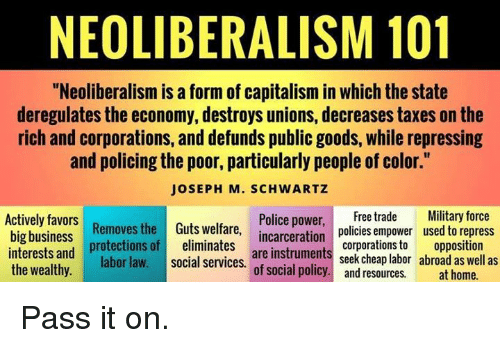
In order to understand what is happening here, it is useful to review some history. The free market model hollowed out America’s manufacturing base beginning in the Thatcher/Reagan era of the 1970s, when neoliberal economic policies took hold.

Meanwhile, emerging Asian economies, led by Japan, were exploding on the scene with a new economic model called “state-guided market capitalism.” The state determined the priorities and commissioned the work, then hired private enterprise to carry it out. The model overcame the defects of the communist system, which put ownership and control in the hands of the state.

The Japanese state-guided market system was effective and efficient – so effective that it was regarded as an existential threat to the neoliberal model of debt-based money and “free markets” promoted by the International Monetary Fund (IMF). According to William Engdahl in A Century of War, by the end of the 1980s Japan was considered the leading economic and banking power in the world.

Its state-guided model was also proving to be highly successful in South Korea and the other “Asian Tiger” economies. When the Soviet Union collapsed at the end of the Cold War, Japan proposed its model for the former communist countries, and many began looking to it and to South Korea as viable alternatives to the U.S. free-market system. State-guided capitalism provided for the general welfare without destroying capitalist incentive. Engdahl wrote:

“The Tiger economies were a major embarrassment to the IMF free-market model.  Their very success in blending private enterprise with a strong state economic role was a threat to the IMF free-market agenda.  So long as the Tigers appeared to succeed with a model based on a strong state role, the former communist states and others could argue against taking the extreme IMF course.  In east Asia during the 1980s, economic growth rates of 7-8 per cent per year, rising social security, universal education and a high worker productivity were all backed by state guidance and planning, albeit in a market economy – an Asian form of benevolent paternalism.”

Just as the US had engaged in a Cold War to destroy the Soviet communist model, so Western financial interests set out to destroy this emerging Asian threat. It was defused when Western neoliberal economists persuaded Japan and the Asian Tigers to adopt the free-market system and open their economies and their companies to foreign investors.

Western speculators then took down the vulnerable countries one by one in the “Asian crisis” of 1997-98. China alone was left as an economic threat to the Western neoliberal model, and it is this existential threat that is the target of the trade and currency wars today.

If You Can’t Beat Them …

In their August 1st Foreign Affairs article, titled “Competition without Catastrophe,” Campbell and Sullivan write that the temptation is to compare these economic trade wars with the Cold War with Russia; but the analogy, they say, is inapt:

China today is a peer competitor that is more formidable economically, more sophisticated diplomatically, and more flexible ideologically than the Soviet Union ever was. And unlike the Soviet Union, China is deeply integrated into the world and intertwined with the U.S. economy.

Unlike the Soviet Communist system, the Chinese system cannot be expected to “crumble under its own weight.” The US should not expect or want to destroy China, say Campbell and Sullivan. Rather, we should aim for a state of “coexistence on terms favorable to U.S. interests and values.”

The implication is that China, being too strong to be knocked out of the game as the Soviet Union was, needs to be coerced or cajoled into adopting the neoliberal model. It needs to abandon state support of its industries and ownership of its banks. But the Chinese system, while obviously not perfect, has an impressive track record for sustaining long-term growth and development.

While the U.S. manufacturing base was being hollowed out under the free-market model, China was systematically building up its own manufacturing base, investing heavily in infrastructure and emerging technologies; and it was doing this with credit generated by its state-owned banks. Rather than trying to destroy China’s economic system, it might be more “favorable to U.S. interests and values” for us to adopt its more effective industrial and banking practices.

We cannot win a currency war by competitive currency devaluations that trigger a “race to the bottom,” and we cannot win a trade war by competitive trade barriers that simply cut us off from the benefits of cooperative trade. More favorable to our interests and values than warring with our trading partners would be to cooperate in sharing solutions, including banking and credit solutions.

The Chinese have proven the effectiveness of their public banking system in supporting their industries and their workers. Rather than seeing it as an existential threat, we could thank them for test-driving the model and take a spin in it ourselves.

Ellen Brown

This article was first posted on Truthdig.com. Ellen Brown chairs the Public Banking Institute and has written thirteen books, including her latest, Banking on the People: Democratizing Money in the Digital Age.  She also co-hosts a radio program on PRN.FM called “It’s Our Money.” Her 300+ blog articles are posted at EllenBrown.com.

Recommended further reading

Robert Kuttner, Political success, economic failure
The American Prospect, June 2019

Noam Chomsky, Neoliberalism is destroying our democracy
The Nation, June 2017

Kean Birch, What exactly is neoliberalism?
The Conversation, November 2017

Related Posts

By Jan ObergTFF co-founder and director February 11, 2026 PART 3 — ECONOMICS, TRADE & FINANCIAL SOVEREIGNTY A. Trade Measures & Market Signaling Economic pressure can be applied instantly and scaled without violence. Immediate Measures (within a week) Government boycott US goods and services  A very powerful signal which over time will be felt. Targeted tariffs on selected U.S. goods Symbolic but high-visibility sectors send a clear message. Suspend trade facilitation talks A peaceful pause that signals deep concern. Freeze U.S. participation in public procurement – military procurement in particular A nonviolent way to reduce influence. Competition law review of U.S. corporations A legal tool to scrutinise market dominance. Longer-Term Measures EU–Asia–Africa trade corridors Reducing reliance on U.S. markets. European supply chains for critical minerals Strategic autonomy in resource access. European Strategic Trade Authority Monitoring coercive practices globally. Euro-denominated commodity markets Weakening the dollar’s pricing monopoly. The EU must resume contacts and negotiations with Russia, focusing on energy cooperation To...
PART 2 — Diplomacy, Law and Nonviolent Power By Jan ObergTFF co-founder and director January 26, 2026 This is the second of four TFF-created idea portfolios designed to curb the global reach of the United States and, in both the short and long term, help catalyse a worldwide nonviolent resistance to what many observers describe as the Trump administration’s uniquely confrontational, destructive and world-threatening policies. These portfolios outline what governments and citizens across the world can do through dynamic diplomacy, creative initiatives, and strictly nonviolent means. They are typical TFF works in that we do not only tell what the problem is and how bad it will go – as 90+% of all commentators, experts and scholars do – we tell what we think can be done, inviting you to think of what you think you can do. It seems painfully clear to me that the current political dynamics in Washington increasingly resemble the most dangerous...
PART 1 — Media, Culture and Information Sovereignty By Jan ObergTFF co-founder and director January 20, 2026 This is the first of four TFF-created idea portfolios designed to curb the global reach of the United States and, in both the short and long term, help catalyse a worldwide nonviolent resistance to what many observers describe as the Trump administration’s uniquely confrontational, destructive and world-threatening policies. These portfolios outline what governments and citizens across the world can do through dynamic diplomacy, creative initiatives, and strictly nonviolent means. They are typical TFF works in that we do not only tell what the problem is and how bad it will go – as 90+% of all commentators, experts and scholars do – we tell what we think can be done, inviting you to think of what you think you can do. It seems painfully clear to me that the current political dynamics in Washington increasingly resemble the most...

Recent Articles

Tony Robinson October 4, 2026 Violence is easy to recognise when someone is being beaten, shot or killed. It becomes more difficult when nobody is holding a weapon. Poverty, discrimination, exploitation and repression can restrict a human life just as effectively, although they do so in very different ways and with very different consequences. Simply adding more categories to an ever-growing list of forms of violence does not really solve the problem. The more interesting question is what all these different situations have in common and why it makes sense to describe them using the same word. Human beings do not simply react to what happens around them. They remember the past, imagine things that do not yet exist, make plans and undertake projects. Workers organise because they imagine different working conditions; people migrate because they imagine another life somewhere else; social movements emerge because people refuse to accept the...
It’s a matter of principles, courage, vision and pulling together – while the militarist world is falling apart… Peter Langille October 3, 2026 “Here, then, is the problem which we present to you, stark and dreadful and inescapable: Shall we put an end to the human race; or shall mankind renounce war?”The Bertrand Russell—Albert Einstein Manifesto, July 9, 1955 ⁕ The forecast for what’s ahead is worrisome. The sharp rise in armed conflicts over the past three years is adding to what was already the highest level in over seventy years. Genocides, which should be prevented are supported. A shared climate emergency that jeopardises survival is ignored. Diverse polls now suggest that people are war-weary, worried and interested in a more effective United Nations. And, there are viable policy options for a more secure world! Yet governments are doubling-down, betting on more war and investing heavily. If current trends persist,...
Johan Galtung 1930-2024October 2015 Published here on October 3, 2026 Let us focus on Civilization for conflict analysis and remedies. Major forms of disorder use violence; war is state organized violence. The most belligerent states are the United States of America and Israel, both with civilization roots. National Evangelism, the US Protestant Christian civilization– more national than evangelical–justifies US warfare as exceptionalism of a people chosen by God, with a manifest destiny to run the world. Orthodox Judaism justifies Israeli warfare to conquer and expand from Nile to Euphrates as a religious right and duty to the Eternal One. The third most belligerent country, the UK, no longer believes it is God-chosen but chosen by the USA; not quite the same but something. But the root cause of global disorder lies in the Occident–with Islam–seeing itself as the single, universal civilization valid for all at all times, all others being...

TFF on Substack

Discover and subscribe to more peace materials on TFF Substack

Most Popular

Tony Robinson October 4, 2026 Violence is easy to recognise when someone is being beaten, shot or killed. It becomes more difficult when nobody is holding a weapon. Poverty, discrimination, exploitation and repression can restrict a human life just as effectively, although they do so in very different ways and with very different consequences. Simply adding more categories to an ever-growing list of forms of violence does not really solve the problem. The more interesting question is what all these different situations have in common and why it makes sense to describe them using the same word. Human beings do not simply react to what happens around them. They remember the past, imagine things that do not yet exist, make plans and undertake projects. Workers organise because they imagine different working conditions; people migrate because they imagine another life somewhere else; social movements emerge because people refuse to accept the...
It’s a matter of principles, courage, vision and pulling together – while the militarist world is falling apart… Peter Langille October 3, 2026 “Here, then, is the problem which we present to you, stark and dreadful and inescapable: Shall we put an end to the human race; or shall mankind renounce war?”The Bertrand Russell—Albert Einstein Manifesto, July 9, 1955 ⁕ The forecast for what’s ahead is worrisome. The sharp rise in armed conflicts over the past three years is adding to what was already the highest level in over seventy years. Genocides, which should be prevented are supported. A shared climate emergency that jeopardises survival is ignored. Diverse polls now suggest that people are war-weary, worried and interested in a more effective United Nations. And, there are viable policy options for a more secure world! Yet governments are doubling-down, betting on more war and investing heavily. If current trends persist,...
Johan Galtung 1930-2024October 2015 Published here on October 3, 2026 Let us focus on Civilization for conflict analysis and remedies. Major forms of disorder use violence; war is state organized violence. The most belligerent states are the United States of America and Israel, both with civilization roots. National Evangelism, the US Protestant Christian civilization– more national than evangelical–justifies US warfare as exceptionalism of a people chosen by God, with a manifest destiny to run the world. Orthodox Judaism justifies Israeli warfare to conquer and expand from Nile to Euphrates as a religious right and duty to the Eternal One. The third most belligerent country, the UK, no longer believes it is God-chosen but chosen by the USA; not quite the same but something. But the root cause of global disorder lies in the Occident–with Islam–seeing itself as the single, universal civilization valid for all at all times, all others being...
Read More
Living-Peace-Sign-Budapest-copy
Tony Robinson October 4, 2026 Violence is easy to recognise when someone is being beaten, shot or killed. It becomes more difficult when nobody is holding a weapon. Poverty, discrimination, exploitation and repression can restrict a human life just as effectively, although they do so in very different ways and with very different consequences. Simply adding more categories to an ever-growing list of forms of violence does not really solve the problem. The more interesting question is what all these different situations have in common and why it makes sense to describe them using the same word. Human beings do not simply react to what happens around them. They remember the past, imagine things that do not yet exist, make plans and undertake projects. Workers organise because they imagine different working conditions; people migrate because they imagine another life somewhere else; social movements emerge because people refuse to accept the...
b54a1f10-8c65-4f0b-9dd5-4abc0a7d04cc_2659x2659
It’s a matter of principles, courage, vision and pulling together – while the militarist world is falling apart… Peter Langille October 3, 2026 “Here, then, is the problem which we present to you, stark and dreadful and inescapable: Shall we put an end to the human race; or shall mankind renounce war?”The Bertrand Russell—Albert Einstein Manifesto, July 9, 1955 ⁕ The forecast for what’s ahead is worrisome. The sharp rise in armed conflicts over the past three years is adding to what was already the highest level in over seventy years. Genocides, which should be prevented are supported. A shared climate emergency that jeopardises survival is ignored. Diverse polls now suggest that people are war-weary, worried and interested in a more effective United Nations. And, there are viable policy options for a more secure world! Yet governments are doubling-down, betting on more war and investing heavily. If current trends persist,...
010
Johan Galtung 1930-2024October 2015 Published here on October 3, 2026 Let us focus on Civilization for conflict analysis and remedies. Major forms of disorder use violence; war is state organized violence. The most belligerent states are the United States of America and Israel, both with civilization roots. National Evangelism, the US Protestant Christian civilization– more national than evangelical–justifies US warfare as exceptionalism of a people chosen by God, with a manifest destiny to run the world. Orthodox Judaism justifies Israeli warfare to conquer and expand from Nile to Euphrates as a religious right and duty to the Eternal One. The third most belligerent country, the UK, no longer believes it is God-chosen but chosen by the USA; not quite the same but something. But the root cause of global disorder lies in the Occident–with Islam–seeing itself as the single, universal civilization valid for all at all times, all others being...
Screenshot 2026-10-02 011738
Jan ObergPhD, director, The Transnational Foundation for Peace and Future Research, TFFLund, Sweden October 2, 2026 This is my full original manuscript. The Chinese Academy of Social Science, CASS, makes two publications out if it. 1. China’s Five-year plan emphasized the capabilities of basic research and original innovation. It is regarded as the goal of the future social development, which, as required, should be significantly enhanced. Can you comment on the importance of original innovation in research and academic study? I believe it is easier to define “original innovation” in the natural sciences than in social sciences. The breaking points of what constitutes something new, or innovative, are not quite as sharp in the latter. But in both fields it is about opening up something that was closed, unseen, unexplored before – making manifest what was earlier latent. Innovations come in many forms and shapes – naming something that was not...
arctic-circle-map
The agreement is catastrophic both because of what it says and what it doesn’t mention. It reduces further the major asset of security policies: Freedom of action. Jan Oberg TFF director September 25, 2026 A couple of hours before the agreement was signed on September 22, 2026, I published the following 13 hypotheses about what it would most likely contain on TFF Substack (in English). I was wrong on only the first point. Contrary to what Trump had written on his Truth Social platform, it does not appear to come into force immediately. In fact, it turned out to be worse than even I had anticipated. After these hypotheses now come a number of reflections in light of what the agreement actually contains, and does not contain, as well as the way in which it has generally been presented by major media outlets and by the public-service broadcaster DR. My...
girl-5894831_1280
Below are TFF-related media mentions, comments, videos and social media posts published elsewhere but not on this homepage. We happen to catch and list only a fraction. Regarding video comments and debates, we recommend that you go to the TFF Video Channel on Substack where many of them are reproduced. Jan Oberg is a contributor to China Daily – 52 million daily clicks – and Global Times, CGTN and CCTV (the national television), China Investment, Xinhua News Agency and several others. Articles and videos on these media very often multiply into countless Chinese (and Western media) that re-post them from these main media. Thanks to The China Academy, his analyses, interviews and comments are frequently posted on YouTube channels such as Thinkers Forum and Wave Media. These videos are often re-posted on Bilibili (China’s YouTube), the China Content Center on TikTok, and on the Chinese edition of TikTok, Douyin.com. This means reaching hundreds of millions of viewers worldwide over a year. While there are too many to catch on all these...




