
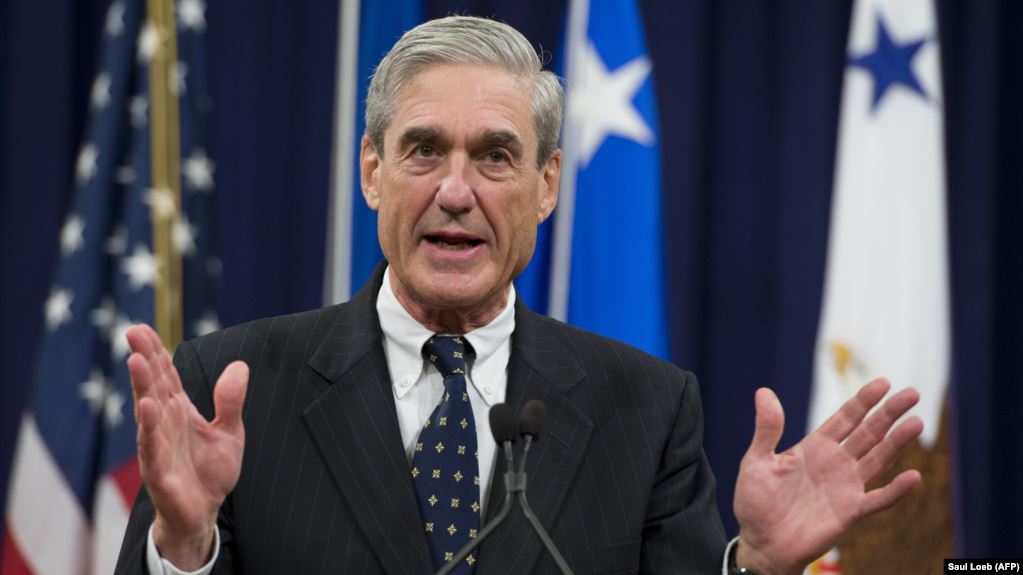
Photo: Special Counsel Robert Mueller. Credit: rferl.org

Why Barr’s investigation is important and should be encouraged.

By Stephen F. Cohen

June 7, 2019

It cannot be emphasized too often: Russiagate – allegations that the American president has been compromised by the Kremlin, which may even have helped to put him in the White House – is the worst and (considering the lack of actual evidence) most fraudulent political scandal in American history.

We have yet to calculate the damage Russiagate has inflicted on America’s democratic institutions, including the presidency and the electoral process, and on domestic and foreign perceptions of American democracy, or on US-Russian relations at a critical moment when both sides, having “modernized” their nuclear weapons, are embarking on a new, more dangerous, and largely unreported arms race.

Originally published by The Nation

Rational (if politically innocent) observers may have thought that when the Mueller report found no “collusion” or other conspiracy between Trump and Vladimir Putin’s Kremlin, only possible “obstruction” by Trump – nothing Mueller said in his May 29 press statement altered that conclusion – Russiagate would fade away.

If so, they were badly mistaken. Evidently infuriated that Mueller did not liberate the White House from Trump, Russiagate promoters—liberal Democrats and progressives foremost among them—have only redoubled their unverified collusion allegations, even in once-respectable media outlets. Whether out of political ambition or impassioned faith, the damage wrought by these Russiagaters continues to mount, with no end in sight.

One way to end Russiagate might be to discover how it actually began. Considering what we have learned, or been told, since the allegations became public nearly three years ago, in mid-2016, there seem to be at least three hypothetical possibilities:

1. One is the orthodox Russiagate explanation: Early on, sharp-eyed top officials of President Obama’s intelligence agencies, particularly the CIA and FBI, detected truly suspicious “contacts” between Trump’s presidential campaign and Russians “linked to the Kremlin” (whatever that may mean, considering that the presidential administration employs hundreds of people), and this discovery legitimately led to the full-scale “counterintelligence investigation” initiated in July 2016.

Indeed, Mueller documented various foreigners who contacted, or who sought to contact, the Trump campaign. The problem here is that Mueller does not tell us, and we do not know, if the number of them was unusual.

Many foreigners seek “contacts” with US presidential campaigns and have done so for decades. In this case, we do not know, for the sake of comparison, how many such foreigners had or sought contacts with the rival Clinton campaign, directly or through the Clinton Foundation, in 2016. (Certainly, there were quite a few contacts with anti-Trump Ukrainians, for example.) If the number was roughly comparable, why didn’t US intelligence initiate a counterintelligence investigation of the Clinton campaign?

If readers think the answer is because the foreigners around the Trump campaign included Russians, consider this: In 1986, when Senator Gary Hart was the leading candidate for the Democratic presidential nomination, he went to Russia—still Communist Soviet Russia—to make contacts in preparation for his anticipated presidency, including meeting with Soviet leader Mikhail Gorbachev.

US media coverage of Hart’s visit was generally favorable. (I accompanied Senator Hart and do not recall much, if any, adverse US media reaction.)

2. The second explanation – currently, and oddly, favored by non-comprehending pro-Trump commentators at Fox News and elsewhere – is that “Putin’s Kremlin” pumped anti-Trump “disinformation” into the American media, primarily through what became known as the Steele Dossier.

As I pointed out nearly a year and a half ago, this makes no sense factually or logically. Nothing in the dossier suggests that any of its contents necessarily came from high-level Kremlin sources, as Steele claimed.

Moreover, if Kremlin leader Putin so favored Trump, as a Russiagate premise insists, is it really plausible that underlings in the Kremlin would have risked Putin’s ire by furnishing Steele with anti-Trump “information”? On the other hand, there is plenty of evidence that “researchers” in the United States (some, like Christopher Steele, paid by the Clinton campaign) were supplying him with the fruits of their research.

3. The third possible explanation—one I have termed “Intelgate,” and that I explore in my recent book War With Russia?: From Putin & Ukraine to Trump & Russiagate—is that US intelligence agencies undertook an operation to damage, if not destroy, first the candidacy and then the presidency of Donald Trump.

More evidence of “Intelgate” has since appeared. For example, the intelligence community has said it began its investigation in April 2016 because of a few innocuous remarks by a young, lowly Trump foreign-policy adviser, George Papadopoulos.

The relatively obscure Papadopoulos suddenly found himself befriended by apparently influential people he had not previously known, among them Stefan Halper, Joseph Mifsud, Alexander Downer, and a woman calling herself Azra Turk. What we now know—and what Papadopoulos did not know at the time—is that all of them had ties to US and/or UK and Western European intelligence agencies.

US Attorney General William Barr now proposes to investigate the origins of Russiagate. He has appointed yet another special prosecutor, John Durham, to do so, but the power to decide the range and focus of the investigation will remain with Barr.

The important news is Barr’s expressed intention to investigate the role of other US intelligence agencies, not just the FBI, which obviously means the CIA when it was headed by John Brennan and Brennan’s partner at the time, James Clapper, then director of national intelligence.

As I argued in The Nation, Brennan, not Obama’s hapless FBI Director James Comey, was the godfather of Russiagate, a thesis for which more evidence has since appeared.

We should hope that Barr intends to exclude nothing, including the two foundational texts of the deceitful Russiagate narrative: the Steele Dossier and, directly related, the contrived but equally ramifying Intelligence Community Assessment of January 2017. (Not coincidentally, they were made public at virtually the same time, inflating Russiagate into an obsessive national scandal.)

Thus far, Barr has been cautious in his public statements. He has acknowledged there was “spying,” or surveillance, on the Trump campaign, which can be legal, but he surely knows that in the case of Papadopoulos (and possibly of General Michael Flynn), what happened was more akin to entrapment, which is never legal.

Barr no doubt also recalls, and will likely keep in mind, the astonishing warning Senator Charles Schumer issued to President-elect Trump in January 2017: “Let me tell you, you take on the intelligence community, they have six ways from Sunday at getting back at you.” (Indeed, Barr might ask Schumer what he meant and why he felt the need to be the menacing messenger of intel agencies, wittingly or not.)

But Barr’s thorniest problem may be understanding the woeful role of mainstream media in Russiagate. As Lee Smith, who contributed important investigative reporting, has written: “The press is part of the operation, the indispensable part. None of it would have been possible…had the media not linked arms with spies, cops, and lawyers to relay a story first spun by Clinton operatives.”

The media

How does Barr explore this “indispensable” complicity of the media in originating and perpetuating the Russiagate fraud without impermissibly infringing on the freedom of the press?

Ideally, mainstream media – print and broadcast – would now themselves report on how and why they permitted intelligence officials, through leaks and anonymous sources, and as “opinion” commentators, to use their pages and programming to promote Russiagate for so long, and why they so excluded well-informed, nonpartisan alternative opinions.

Instead, they have almost unanimously reported and broadcast negatively, even antagonistically, about Barr’s investigation, and indeed about Barr personally. (The Washington Post even found a way to print this: “William Barr looks like a toad…”) Such is the seeming panic of the Russiagate media over Barr’s investigation, which promises to declassify related documents, that The New York Times again trotted out its easily debunked fiction that public disclosures will endanger a purported US informant, a Kremlin mole, at Putin’s side.

Finally, but most crucially, what was the real reason US intelligence agencies launched a discrediting operation against Trump? Was it because, as seems likely, they intensely disliked his campaign talk of “cooperation with Russia,” which seemed to mean the prospect of a new US-Russian détente?

Even fervent political and media opponents of Trump should want to know who is making foreign policy in Washington. The next intel target might be their preferred candidate or president, or a foreign policy they favor.

Nor, it seems clear, did the CIA stop. In March 2018, the current director, Gina Haspel, flatly lied to President Trump about an incident in the UK in order to persuade him to escalate measures against Moscow, which he then reluctantly did.

Several non–mainstream media outlets have reported the true story. Typically, The New York Times, on April 17 of this year, reported it without correcting Haspel’s falsehood.

We are left, then, with this paradox, formulated in a tweet on May 24 by the British journalist John O’Sullivan: “Spygate is the first American scandal in which the government wants the facts published transparently but the media want to cover them up.”

Originally published by The Nation

About the author:

Stephen F. Cohen is a professor emeritus of Russian studies and politics at New York University and Princeton University. A Nation contributing editor, his new book War With Russia? From Putin & Ukraine to Trump & Russiagate is available in paperback and in an ebook edition.


One Response

  1. 3 is correct James Brennan Director of FBI (a Communist appointed by Obama) and James Clapper Director of NSA conspired together to destroy Trump and remove him from office. The two are still at work, commenting and spreading lies each day. Clapper is well known for his lying and lawlessness.

Related Posts

PART 2 — Diplomacy, Law and Nonviolent Power By Jan ObergTFF co-founder and director January 26, 2026 This is the second of four TFF-created idea portfolios designed to curb the global reach of the United States and, in both the short and long term, help catalyse a worldwide nonviolent resistance to what many observers describe as the Trump administration’s uniquely confrontational, destructive and world-threatening policies. These portfolios outline what governments and citizens across the world can do through dynamic diplomacy, creative initiatives, and strictly nonviolent means. They are typical TFF works in that we do not only tell what the problem is and how bad it will go – as 90+% of all commentators, experts and scholars do – we tell what we think can be done, inviting you to think of what you think you can do. It seems painfully clear to me that the current political dynamics in Washington increasingly resemble the most dangerous...
PART 1 — Media, Culture and Information Sovereignty By Jan ObergTFF co-founder and director January 20, 2026 This is the first of four TFF-created idea portfolios designed to curb the global reach of the United States and, in both the short and long term, help catalyse a worldwide nonviolent resistance to what many observers describe as the Trump administration’s uniquely confrontational, destructive and world-threatening policies. These portfolios outline what governments and citizens across the world can do through dynamic diplomacy, creative initiatives, and strictly nonviolent means. They are typical TFF works in that we do not only tell what the problem is and how bad it will go – as 90+% of all commentators, experts and scholars do – we tell what we think can be done, inviting you to think of what you think you can do. It seems painfully clear to me that the current political dynamics in Washington increasingly resemble the most...
Introduction to TFF’s forthcoming four Idea Portfolios of Diplomatic and Nonviolent Resistance By TFF’s Board & FoundersPascal Lottaz, Biljana Vankovska, Annette Schiffmann, Christina Spannar & Jan Oberg January 19, 2026 “America, you are too arrogant.” — Martin Luther King Jr. Over the course of Trump’s first term and now a year into his second, the world has witnessed a consistent pattern of actions that challenge the basic long-standing norms of international cooperation, weaken multilateral institutions, and ignore the global norms and legal frameworks established by the UN Charter. During these years, we have witnessed military operations in Iran, Syria and Ukraine without UN authorisation; the killing of Iranian General Qassem Soleimani; repeated strikes across the Middle East; and the launch of tariff wars against allies and competitors alike. We have seen a renewed emphasis on nuclearism and zero interest in arms control and disarmament negotiations. Pentagon is now The Department...

Recent Articles

Tony Robinson October 4, 2026 Violence is easy to recognise when someone is being beaten, shot or killed. It becomes more difficult when nobody is holding a weapon. Poverty, discrimination, exploitation and repression can restrict a human life just as effectively, although they do so in very different ways and with very different consequences. Simply adding more categories to an ever-growing list of forms of violence does not really solve the problem. The more interesting question is what all these different situations have in common and why it makes sense to describe them using the same word. Human beings do not simply react to what happens around them. They remember the past, imagine things that do not yet exist, make plans and undertake projects. Workers organise because they imagine different working conditions; people migrate because they imagine another life somewhere else; social movements emerge because people refuse to accept the...
It’s a matter of principles, courage, vision and pulling together – while the militarist world is falling apart… Peter Langille October 3, 2026 “Here, then, is the problem which we present to you, stark and dreadful and inescapable: Shall we put an end to the human race; or shall mankind renounce war?”The Bertrand Russell—Albert Einstein Manifesto, July 9, 1955 ⁕ The forecast for what’s ahead is worrisome. The sharp rise in armed conflicts over the past three years is adding to what was already the highest level in over seventy years. Genocides, which should be prevented are supported. A shared climate emergency that jeopardises survival is ignored. Diverse polls now suggest that people are war-weary, worried and interested in a more effective United Nations. And, there are viable policy options for a more secure world! Yet governments are doubling-down, betting on more war and investing heavily. If current trends persist,...
Johan Galtung 1930-2024October 2015 Published here on October 3, 2026 Let us focus on Civilization for conflict analysis and remedies. Major forms of disorder use violence; war is state organized violence. The most belligerent states are the United States of America and Israel, both with civilization roots. National Evangelism, the US Protestant Christian civilization– more national than evangelical–justifies US warfare as exceptionalism of a people chosen by God, with a manifest destiny to run the world. Orthodox Judaism justifies Israeli warfare to conquer and expand from Nile to Euphrates as a religious right and duty to the Eternal One. The third most belligerent country, the UK, no longer believes it is God-chosen but chosen by the USA; not quite the same but something. But the root cause of global disorder lies in the Occident–with Islam–seeing itself as the single, universal civilization valid for all at all times, all others being...

TFF on Substack

Discover and subscribe to more peace materials on TFF Substack

Most Popular

Tony Robinson October 4, 2026 Violence is easy to recognise when someone is being beaten, shot or killed. It becomes more difficult when nobody is holding a weapon. Poverty, discrimination, exploitation and repression can restrict a human life just as effectively, although they do so in very different ways and with very different consequences. Simply adding more categories to an ever-growing list of forms of violence does not really solve the problem. The more interesting question is what all these different situations have in common and why it makes sense to describe them using the same word. Human beings do not simply react to what happens around them. They remember the past, imagine things that do not yet exist, make plans and undertake projects. Workers organise because they imagine different working conditions; people migrate because they imagine another life somewhere else; social movements emerge because people refuse to accept the...
It’s a matter of principles, courage, vision and pulling together – while the militarist world is falling apart… Peter Langille October 3, 2026 “Here, then, is the problem which we present to you, stark and dreadful and inescapable: Shall we put an end to the human race; or shall mankind renounce war?”The Bertrand Russell—Albert Einstein Manifesto, July 9, 1955 ⁕ The forecast for what’s ahead is worrisome. The sharp rise in armed conflicts over the past three years is adding to what was already the highest level in over seventy years. Genocides, which should be prevented are supported. A shared climate emergency that jeopardises survival is ignored. Diverse polls now suggest that people are war-weary, worried and interested in a more effective United Nations. And, there are viable policy options for a more secure world! Yet governments are doubling-down, betting on more war and investing heavily. If current trends persist,...
Johan Galtung 1930-2024October 2015 Published here on October 3, 2026 Let us focus on Civilization for conflict analysis and remedies. Major forms of disorder use violence; war is state organized violence. The most belligerent states are the United States of America and Israel, both with civilization roots. National Evangelism, the US Protestant Christian civilization– more national than evangelical–justifies US warfare as exceptionalism of a people chosen by God, with a manifest destiny to run the world. Orthodox Judaism justifies Israeli warfare to conquer and expand from Nile to Euphrates as a religious right and duty to the Eternal One. The third most belligerent country, the UK, no longer believes it is God-chosen but chosen by the USA; not quite the same but something. But the root cause of global disorder lies in the Occident–with Islam–seeing itself as the single, universal civilization valid for all at all times, all others being...
Read More
Living-Peace-Sign-Budapest-copy
Tony Robinson October 4, 2026 Violence is easy to recognise when someone is being beaten, shot or killed. It becomes more difficult when nobody is holding a weapon. Poverty, discrimination, exploitation and repression can restrict a human life just as effectively, although they do so in very different ways and with very different consequences. Simply adding more categories to an ever-growing list of forms of violence does not really solve the problem. The more interesting question is what all these different situations have in common and why it makes sense to describe them using the same word. Human beings do not simply react to what happens around them. They remember the past, imagine things that do not yet exist, make plans and undertake projects. Workers organise because they imagine different working conditions; people migrate because they imagine another life somewhere else; social movements emerge because people refuse to accept the...
b54a1f10-8c65-4f0b-9dd5-4abc0a7d04cc_2659x2659
It’s a matter of principles, courage, vision and pulling together – while the militarist world is falling apart… Peter Langille October 3, 2026 “Here, then, is the problem which we present to you, stark and dreadful and inescapable: Shall we put an end to the human race; or shall mankind renounce war?”The Bertrand Russell—Albert Einstein Manifesto, July 9, 1955 ⁕ The forecast for what’s ahead is worrisome. The sharp rise in armed conflicts over the past three years is adding to what was already the highest level in over seventy years. Genocides, which should be prevented are supported. A shared climate emergency that jeopardises survival is ignored. Diverse polls now suggest that people are war-weary, worried and interested in a more effective United Nations. And, there are viable policy options for a more secure world! Yet governments are doubling-down, betting on more war and investing heavily. If current trends persist,...
010
Johan Galtung 1930-2024October 2015 Published here on October 3, 2026 Let us focus on Civilization for conflict analysis and remedies. Major forms of disorder use violence; war is state organized violence. The most belligerent states are the United States of America and Israel, both with civilization roots. National Evangelism, the US Protestant Christian civilization– more national than evangelical–justifies US warfare as exceptionalism of a people chosen by God, with a manifest destiny to run the world. Orthodox Judaism justifies Israeli warfare to conquer and expand from Nile to Euphrates as a religious right and duty to the Eternal One. The third most belligerent country, the UK, no longer believes it is God-chosen but chosen by the USA; not quite the same but something. But the root cause of global disorder lies in the Occident–with Islam–seeing itself as the single, universal civilization valid for all at all times, all others being...
Screenshot 2026-10-02 011738
Jan ObergPhD, director, The Transnational Foundation for Peace and Future Research, TFFLund, Sweden October 2, 2026 This is my full original manuscript. The Chinese Academy of Social Science, CASS, makes two publications out if it. 1. China’s Five-year plan emphasized the capabilities of basic research and original innovation. It is regarded as the goal of the future social development, which, as required, should be significantly enhanced. Can you comment on the importance of original innovation in research and academic study? I believe it is easier to define “original innovation” in the natural sciences than in social sciences. The breaking points of what constitutes something new, or innovative, are not quite as sharp in the latter. But in both fields it is about opening up something that was closed, unseen, unexplored before – making manifest what was earlier latent. Innovations come in many forms and shapes – naming something that was not...
arctic-circle-map
The agreement is catastrophic both because of what it says and what it doesn’t mention. It reduces further the major asset of security policies: Freedom of action. Jan Oberg TFF director September 25, 2026 A couple of hours before the agreement was signed on September 22, 2026, I published the following 13 hypotheses about what it would most likely contain on TFF Substack (in English). I was wrong on only the first point. Contrary to what Trump had written on his Truth Social platform, it does not appear to come into force immediately. In fact, it turned out to be worse than even I had anticipated. After these hypotheses now come a number of reflections in light of what the agreement actually contains, and does not contain, as well as the way in which it has generally been presented by major media outlets and by the public-service broadcaster DR. My...
girl-5894831_1280
Below are TFF-related media mentions, comments, videos and social media posts published elsewhere but not on this homepage. We happen to catch and list only a fraction. Regarding video comments and debates, we recommend that you go to the TFF Video Channel on Substack where many of them are reproduced. Jan Oberg is a contributor to China Daily – 52 million daily clicks – and Global Times, CGTN and CCTV (the national television), China Investment, Xinhua News Agency and several others. Articles and videos on these media very often multiply into countless Chinese (and Western media) that re-post them from these main media. Thanks to The China Academy, his analyses, interviews and comments are frequently posted on YouTube channels such as Thinkers Forum and Wave Media. These videos are often re-posted on Bilibili (China’s YouTube), the China Content Center on TikTok, and on the Chinese edition of TikTok, Douyin.com. This means reaching hundreds of millions of viewers worldwide over a year. While there are too many to catch on all these...



