
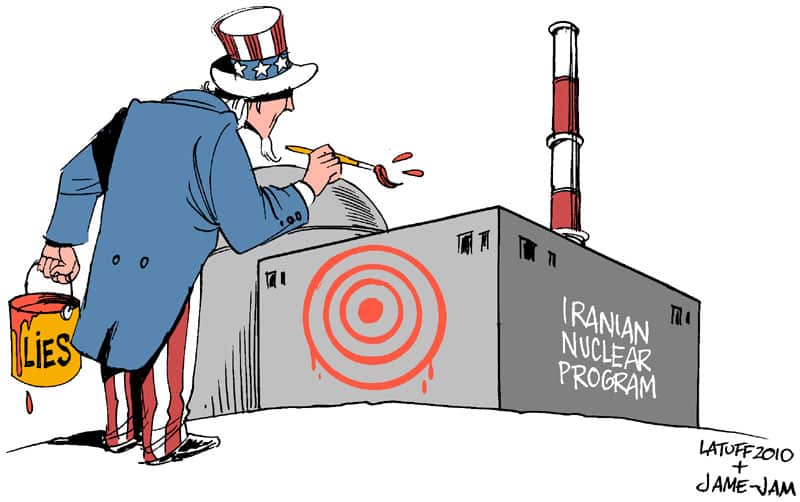
What lies behind the race toward war with Iran?

William R. Polk

June 5, 2019

Despite appearances of random, off-the-cuff decisions, rendered on tweets and without, or even in opposition to, the advice of foreign policy specialists, I am going to posit a rationale behind the warlike actions and pronouncements of Messrs. Trump, Bolton and Pompeo. To do so, I will try to put all the scattered and sometimes conflicting pieces together.

I begin by acknowledging the issue that has attracted most attention. That is the nuclear danger. While it figures in all the media accounts, I put it aside for two reasons:

First, Iran has no nuclear weapons as every reasonably well-informed person in government and among the general population knows. To acquire them in the foreseeable future, Iran would have to buy them from an existing nuclear power.

Nuclear-capable powers have not been known to put their weapons on the market. But, as threats of invasion grow, Iran will probably be willing to pay almost anything to get them, so conceivably a deal could be made sometime in the future. However, with the possible exceptions of Pakistan and (even less likely) North Korea, Iran has no currently identifiable source of supply.

Even if it could acquire a source, Iran would have to ship the devices or components from their current location. Such a move would certainly be monitored. Moreover, physical possession of a single weapon or several is only the first step in a very complex process of readying it or them for possible use.

This transitional period, which would last for months if not years, would offer various means of prevention. Clear and present danger is not where we are today nor will be in the foreseeable future.

Second, Iran has been constrained by the 2015 Joint Comprehensive Plan of Action (JCPOA) deal worked out by John Kerry and Javad Zarif. Not only has Iran made no further progress toward fabrication of a nuclear device, but it has dismantled much of its organization and has given up some of the materials it would need to fabricate a weapon.

Nonetheless, in government use of propaganda, raising the nuclear issue has proven a powerful public relations gambit. It focuses attention on the confrontation in terms readily understandable to and believed by the general public.

Three dangers

Focusing attention on the nuclear danger poses three dangers:

First, whether the worry is sincere or whether is just used by key officials to play to the emotions of the less informed, and so to win praise, kudos, or elections, raising the nuclear danger fans emotions. From still-raw personal experience, I deeply fear nuclear war. Any sensible person should. It would be truly an end-game for both sides – and possibly for everyone else.

However, despite rivers of ink describing the horrific results, few people seem to have worried about the preliminary steps toward war or fully absorbed the consequences. Governments, however, have spent considerable time and treasure developing alternatives to nuclear war and creating a bureaucracy charged with preventing accidents. But…

Second, flirting with the nuclear danger creates space for mistakes. A close reading of the short history of the nuclear age tells us that what we were doing certainly did not safeguard us from misjudgments, equipment failures or managerial incompetence.

In the study I made after my very disturbing experience in the Cuban Missile Crisis, I discovered scores of near-misses. In situation after situation, we were saved by dumb luck.

Calibrating the boundary between defense and offense, reaction and provocation and the allowable and the forbidden is not a strategic call as some “big bomb” theorists like Albert Wohlstetter have argued or even a mathematical science like Thomas Schelling has proclaimed. Safety lies less in judgment than in avoidance of the creation of conditions in which weapons might be used. And…

Third, charging a rival with possession of weapons is open-ended: no government can prove that it does not have and does not intend to acquire nuclear weapons. Consequently, those who wish to pursue a policy of conflict always have the scope to do so.

Indeed, the logical results of continued threats of invasion, devastation and, indeed, annihilation make acquisition of such weapons appear imperative to those so threatened.

So what did Iran do?

In May 2003, Iran called for a “grand bargain” in which it offered not to develop nuclear weapons, and meetings were set up to ventilate a possible deal. However, the Bush administration decided not to attend the meetings. (As New York Times columnist Nicholas Kristof lampooned the American reaction, it was a case of “Hang Up. Tehran is Calling.”)

It was in continuation of the 2003 offer and its amplification that Javad Zarif was allowed to negotiate with John Kerry the 2015 JCPOA nuclear arms limitation deal. JCPOA had the effect of changing the context in which the nuclear issue could be handled and of making Iranian acquisition of nuclear weapons virtually impossible.

But, with advent of the Trump administration, America returned to the Bush administration policy and backed out of the agreement. Why did it do so?

Consider, first, the American opponents of a deal:

American hardliners, the core of Trump’s constituency, believe that the context of American-Iranian relations must be changed, but only along lines dictated by America: they argue that America must “regime change” Iran. And, generally, they have accepted that this could be done only after America had destroyed Iran’s armed forces and, inevitably, killed, wounded, impoverished or driven away from their homes much of its population.

Senator John McCain led the chorus in singing to a popular tune, “Bomb bomb bomb, bomb bomb, Iran,” government-subsidized think tanks organized wargames and the military acted out their scenarios in “Operation TIRANNT” to show how McCain’s ditty could be played.

We did not then have the cold, hard and continuous lessons of Libya, Syria, Iraq and Afghanistan so clearly before us, but now we know what the results would have been and still could be.

Messrs. Trump, Bolton and Pompeo cannot avoid seeing them. But, they and other hardliners are undeterred by what they see, and what Mr. Kerry achieved is now regarded by many Americans as a sell-out of national security.

Now consider the Iranian opponents of a deal:

Iranian hardliners in Iran also fault their government for agreeing to Zarif’s deal. They accuse Zarif personally and the current Iranian leadership of virtual treason. When he was still the ambassador to the UN, Zarif told me that his position had become untenable. The “Hard Right” succeeded in 2007 in ousting him from government service.

As he met with even presumably reasonably well-informed Americans, many of whom were acutely aware of the pressure of the Far Right in America, Zarif was surprised to find that most did not know that many influential and determined Iranians were opposed to any form of accommodation with America.

Indeed, as he and others have pointed out, Iranian hardliners could back up their case against nuclear disengagement by pointing to the fate of those leaders who succumbed to American pressure to give up their nuclear arms programs: Saddam Husain and Muamar Qaddafi would probably be alive today if they had not done so. Presumably, Kim Jong-un ponders their fate while he keeps or increases his counterstrike capability.

So far at least, Iran does not have this option. But, ironically it was on the way to acquiring nuclear weapons — with American assistance and approval — under the Shah.

Had the 1979 revolution not taken place, Iran would today be a nuclear power, like its neighbours Israel and Pakistan, but the revolutionary leader, Ayatollah Ruhollah Khomeini, renounced the program, saying it was sacrilege in Islam.

Completely devastating consequences of military action

In place of this ultimate means of defense, Iran has built “unconventional conventional” forces. I have written extensively about them elsewhere (in my little book Understanding Iran and in recent essays on the web). They include creating and training of a potential guerrilla force (the Sazeman-e Basijis) that could number a million fighters with millions more potentially in reserve; stockpiling supplies and equipment throughout a country the size of America’s Great Plains states; organizing a survivable – because decentralized – command and control structure; and prepositioning weapons suitable for guerrilla warfare both on land and at sea.

With the examples of Vietnam and Afghanistan before us, I predict that an invasion of Iran, having begun with overwhelming aerial bombing and multiple airborne and infantry forces, would wipe out the standing army (the Pasdaran-e Enghelab). But that would be only round one.

The conflict would then turn into a guerrilla war, lasting far into the future, with results worse even than Afghanistan, costing huge casualties and causing great suffering.

In the course of perhaps twenty years of fighting, Iran would be driven down to something like the condition of Haiti. The costs to America would not be so great as those to Iran, but I predict that it would cost us about four or five times as much as the Iraq-Afghan war, say $20 trillion. Casualties would be heavy and every American neighborhood would have a share of the “walking wounded.”

Even worse might be the impact on our increasingly brittle social-political-legal system. Finally, so severe would be the dislocation to the international system that it is at least possible that warfare in Iran would give rise to other conflicts.

If only a portion of my estimates is likely, the question arises: why would rational, informed and experienced men, even those who may be emotionally deranged, risk such a policy?

Why take such huge risks?

The most strident answer that has at least publicly been given is that Iran poses a grave if not existential danger to America. This answer would be laughable if it were not asserted by our decision-makers. America is the strongest nation on earth while Iran is a poor, weak society with almost no means of projecting force outside of its neighborhood.

The more considered answer is that Iran threaten American interests in its neighbourhood. That is to say, it has the power of disruption. It is “exporting terrorism.”

In truth, like America, Britain, France, Turkey, Russia and Israel, Iran has military forces in Syria and Iraq, and like those countries it supplies weapons to its friends and allies. Also like those countries it encourages its friends and allies to support its policies. And, like them, it almost certainly engages in “dirty tricks.”

These policies are all unsavory, destructive and painful. They are one of the causes of the conversion of whole nations into refugees and they have destroyed decades of hard work on development.

However, they have become standard operating procedure in relations among states. Iran did not invent them and hardly stands alone creating a potential for disruption.

Potential for disruption? Iraq, Syria, Saudi Arabia, Israel/Palestine, Afghanistan, Libya, Somalia and Yemen hardly need any stimulus from Iran. In more stable, politically acceptable conditions, Iranian intervention would be irrelevant.

The simple fact is that much of Asia and Africa has been conditioned by experience over generations, as I have laid out in my 2018 Yale University Press book Crusade and Jihad, to be politically, socially and psychologically violence-prone.

The unfortunate heirs to tragedies of the past live in a world suffering from what I have called the post-imperial syndrome. No amount of military force can suppress that memory or cure its lasting ills.

Indeed, the employment of military force, with the concomitant breakdown of such civic order as imperialism left behind, has created new opportunities for “warlordism,” as we see today in Afghanistan. Anarchy has both provided arms and created a demand for them.

The whole Middle East is awash with arms. Today, on weapons, as my fellow Texans used to say, “the horse is out of the barn.” Indeed, we helped open the gate.

But, as we should long ago have learned in Greece, Vietnam, Iraq, Afghanistan, Somalia and Libya, however easy they are to get, arms are not the key element in terrorism, guerrilla warfare and other forms of conflict.

The Mau Mau taught the British that effective guns can be made from water pipes and door bolts. Bombs are even simpler to acquire and use. Whatever else one may say of it, the National Rifle Association is correct in proclaiming that shooters, not guns, kill people. If a cause is believed to be just, anger is great and no means of accommodation exists, sticks and stones will do the job.

So, bottom line: Crudely put, Iran is a small part of our bigger problem with the world or even more crudely put, little, isolated and distant Iran cannot justify the horrible costs of a war.

It follows that even a disarmed and regime-changed Iran will not calm desperate, starving or enraged guerrillas anywhere. Certainly not in a bombed out, displaced and bitter Iran.

From this, I conclude that as so often in the beginning of wars, the dominant power – in this case President Trump’s administration – does not believe war will actually happen, that force will not be necessary because, faced with destruction, the weaker power will be realistic and surrender.

Unfortunately, history does not bear out this belief.

Drawing the line between what the adversary will accept and what he cannot accept can never be clear because in national affairs a negotiated surrender, unlike a business deal, does not hinge on adding up the numbers of profit and loss.

Emotions, ideologies, personalities and guesses play destabilizing, sometimes irrational and often unpredictable roles: I learned this not only as a historian but witnessed it first hand in a vain attempt I made to find a way to head off the invasion of Iraq.

What was true in Iraq was later played out in Libya. Saddam and Qaddafi could not surrender or even compromise; once the process of regime change began, they had to be killed and in the process their nation-states had to be destroyed.

Threat is almost never enough and surrender is seldom possible.

The real issue is ... China

So what, we must ask, is fueling the American drive toward the brink of war with Iran?

The question is difficult to answer, as I wrote at the beginning of this essay because it is embedded and largely obscured by what appear to be random, off-the-cuff decisions, rendered on tweets and without or in opposition to the advice of foreign policy specialists.

Given these constraints, I will hazard an answer by imposing a logical system where neither logic nor system is immediately apparent. With these provisos, let me try to peek into Mr. Trump’s emotions and – perhaps, as he claims – his shrewdness.

The following are my readings and hunches:

As he constantly asserts his mindset as a businessman, I imagine that Mr. Trump realizes that the cost-benefit ratio makes actual war with Iran unattractive. Indeed, my hunch is that he is not really interested in Iran as such or even in the much-proclaimed Iranian export of terrorism.

He uses Bolton as the “bad cop” to try to bully Iran. That plays well to his constituency and keeps all the cards in his hands. He can do what he did in North Korea – threaten, badger and coo almost in one breath. He risks little or nothing. If Bolton’s antics fail, he – like all the other henchmen – is expendable.

And, by allowing Boston to demand the impossible Trump may get what he really wants.

So what does Mr. Trump really want?

Linking each of Mr. Trump’s actions and pronouncements is China. China is the crucial but veiled part of what may be his conscious but certainly is his de facto strategic program. Where Iran is small and weak, China is huge and increasingly strong.

Iran does not rival America in any dimension, but China is the only serious rival to America.

Russia is still a great power – with a huge but unusable and unproductive nuclear arsenal (like ours) – but as a nation-state it is now fractured, as a society it is increasingly divided and it rests on a sort of “rust-belt” economy.

India has been and may again be a great power, but it is trapped by myriad divergences, is embroiled in a never-ending replay of the trauma of partition and lives or languishes according to the uncontrollable monsoon rains.

I don’t think Mr. Trump regards Britain or the European Union as more than adjuncts to the American system.

China alone has the mass, the determination and the skill to challenge America. Not today, not tomorrow perhaps but almost certainly, if it is undeterred, in the foreseeable future Mr. Trump apparently believes it could pose, an existential threat.

Mr. Trump’s reactions, whether or not well articulated or even personally fully understood, I believe, form a strategic pattern.

Consider these aspects of what he is doing:

First, he wants to prevent Americans from supporting Chinese growth by buying disproportionate amounts of Chinese goods. Since the Chinese have benefitted from cheap labor, cheap money and American consumer demand, its competitive advantage, he argues, must be undercut by duties on its produce.

Second, China has benefitted from American intellectual openness and from American (and European) business practice to acquire the “know-how,” to refine our inventions and to build our wares in China. He wants to put in place means to stop pilfering of “intellectual property” and to control or prevent the movement of manufacturing to China.

Third, he wants to put in place ways to slow the pace of Chinese growth. Growth in recent years has been explosive and previous American and Western attempts to slow it by, for example, trying to force a revaluation of the Chinese currency, the renminbi, have generally failed.

Just as Germany in the 1930s surged ahead by devaluing its currency, so Chinese industry has been stimulated by what some economists believe to be a 25% exchange incentive. Trump did not start the demand for revaluation, but he has pushed it.

Fourth, the highly favorable (to America) military balance has slipped. Our bastion in Taiwan remains but the Taiwanese obviously no longer believe in it. Nearly a million Taiwanese have moved to the mainland. Britain’s Hong Kong is no more.

The Chinese have reached out into the previously American-dominated South Pacific. And China has taken the lead position in several Asian and African economies. Its “Silk Road” is becoming an artery connecting China to the heart of Europe. Its military-industrial complex is growing. China now builds competitive military aircraft and has just begun construction of its second aircraft carrier.

It is a significant nuclear power; indeed, after a small number, perhaps 50 or so, nuclear weapons are an economic drain rather than a military asset. China is thought to have more than 250 warheads; it does not need more.

Its labor force is large, disciplined and increasingly trained. Suppression of dissidence is severe and, to us, very unattractive, but there is little sign of effective resistance even from such minority groups as the Tibetans and the Uyghurs. And the leadership appears to be unified.

In short, while the Chinese leadership has proclaimed that it is satisfied to be the junior hegemon and will not challenge America’s status as the world’s superpower, its moves convince many Americans, including I believe, Mr. Trump, that such a self-effacing policy for a proud and ancient world power can be only temporary.

So, without elaborate intelligence appreciations and strategic advice, Mr. Trump presumably asks, as he proclaims he would of a business rival, where is China vulnerable?

The answer, according to the Chairman of Energy Intelligence, my close friend Raja Sidawi, who is arguably the world’s number one expert in his field, is energy.

China is largely dependent on oil from the Gulf – Saudi Arabia, the UAE, Qatar, Kuwait, Iraq and Iran. All of those countries, except for Iran are now in various ways and to various extents guided by America.

So, as Mr. Sidawi has argued in our exchanges, if America could bring about the inclusion of Iran in the American consortium, it could monopolize the flow of and thus would “be able to dictate the pace of Chinese economic growth.”

In his actions, if not in coherent or at least articulated thought, Mr. Trump has reversed the 1904 strategic doctrine of Halford MacKinder.

3 Responses

  1. It is a thoughtful and insightful article by an eminent scholar with vast experience of geopolitical issues. However, even if we can credit the neocon members of the Trump administration with such a vision and strategy, I believe that the outcome will be quite the opposite of what they desire. As Professor Polk rightly argues, a war with Iran will not be a cakewalk and will involve the United States in a multi-decade unconventional and destructive war that will cost trillions of dollars. As a result, far from isolating China, it will weaken America and will further strengthen China. Would China remain still if USA tries to block her access to sources of energy? What about Russia? Would she also boycott China? There are other and less costly ways of containing China. For a start, US officials should realise that the period of unipolar world when the United States acted as the only global hegemon is over. The way to deal with other great powers and potential rivals is not to try to set the clock back and engage in fanciful policies, but to engage in dialogue and create a multipolar world with various countries acting as equal partners working for the common good, rather than starting a global confrontation. Such policies are the foolish dreams of neocons who really should be put back in their boxes, and adopt more intelligent policies fit for the 21st rather than the 19th century.

  2. A relevant question is: Who desires the destruction of Iran and its people? Who has been pushing for US action against Iran for many years now? Who was intimately involved in the Stuxnet cyber attack on Iran in the period 2007 – 2009? Answer to all of the above: Israel.

  3. Couldn’t agree more. By isolating itself, the US/NATO/EU miss the opportunity to engage in the building of a new, better multi-polar world. The opportunities are there – such as the Belt and Road Initiative (BRI) but the West is in selfie mode, tendentially autistic – look at the Western media: How much do we hear about the world outside our own? These very days, Xi Jinping and Putin meet before the St Petersburg International Economic Forum (SPIEF) – not a word about it… There will be tough wake-up after fake and omission…

Related Posts

A friendly quarrel while we agree that the US sanctions are a weapon of mass destruction and kill more people than wars do. And that we must talk much more about sanctions than we have so far. Jan Oberg, TFF director March 16, 2026 John Mearsheimer recently stated that U.S. sanctions murdered around 38 million people between 1971 and 2021 – see the video below. It is a dramatic figure, and it has spread quickly because it captures, in one sentence, the enormous human cost of modern sanctions. I share his concern about the destructive effects of economic coercion. But the specific number he cites — and the way he attributes it — deserves a friendly academic clarification. The figure comes from a 2023 Lancet Global Health article estimating the mortality effects of unilateral U.S. and EU sanctions over the past half‑century. This is the first point where Mearsheimer’s shorthand diverges from the text: the study...
This is not another geopolitical commentary on the Arctic. It is a visionary peace proposal that can save the region from militarised rivalry and ecological ruin. A blueprint for shared security, sustainable development, and human dignity — benefitting Greenland, the Arctic, and the rest of us. Jan Oberg TFF director Lund, Sweden, February 17, 2026 I. Four Principles for a New Arctic Vision The Arctic is often framed as a cold arena of rivalry — a place where great powers test each other’s resolve. But this worldview is outdated, unimaginative, and ultimately self‑defeating. The Arctic is not a vacuum waiting to be militarised; it is a living region, a climate stabiliser, and a cultural homeland whose future will shape the future of humanity. If we begin from that understanding, a far more rational Arctic order becomes possible — one that is peaceful, cooperative, and centred on the people who actually live there. This vision rests...
PART 2 — Diplomacy, Law and Nonviolent Power By Jan ObergTFF co-founder and director January 26, 2026 This is the second of four TFF-created idea portfolios designed to curb the global reach of the United States and, in both the short and long term, help catalyse a worldwide nonviolent resistance to what many observers describe as the Trump administration’s uniquely confrontational, destructive and world-threatening policies. These portfolios outline what governments and citizens across the world can do through dynamic diplomacy, creative initiatives, and strictly nonviolent means. They are typical TFF works in that we do not only tell what the problem is and how bad it will go – as 90+% of all commentators, experts and scholars do – we tell what we think can be done, inviting you to think of what you think you can do. It seems painfully clear to me that the current political dynamics in Washington increasingly resemble the most dangerous...

Recent Articles

Tony Robinson October 4, 2026 Violence is easy to recognise when someone is being beaten, shot or killed. It becomes more difficult when nobody is holding a weapon. Poverty, discrimination, exploitation and repression can restrict a human life just as effectively, although they do so in very different ways and with very different consequences. Simply adding more categories to an ever-growing list of forms of violence does not really solve the problem. The more interesting question is what all these different situations have in common and why it makes sense to describe them using the same word. Human beings do not simply react to what happens around them. They remember the past, imagine things that do not yet exist, make plans and undertake projects. Workers organise because they imagine different working conditions; people migrate because they imagine another life somewhere else; social movements emerge because people refuse to accept the...
It’s a matter of principles, courage, vision and pulling together – while the militarist world is falling apart… Peter Langille October 3, 2026 “Here, then, is the problem which we present to you, stark and dreadful and inescapable: Shall we put an end to the human race; or shall mankind renounce war?”The Bertrand Russell—Albert Einstein Manifesto, July 9, 1955 ⁕ The forecast for what’s ahead is worrisome. The sharp rise in armed conflicts over the past three years is adding to what was already the highest level in over seventy years. Genocides, which should be prevented are supported. A shared climate emergency that jeopardises survival is ignored. Diverse polls now suggest that people are war-weary, worried and interested in a more effective United Nations. And, there are viable policy options for a more secure world! Yet governments are doubling-down, betting on more war and investing heavily. If current trends persist,...
Johan Galtung 1930-2024October 2015 Published here on October 3, 2026 Let us focus on Civilization for conflict analysis and remedies. Major forms of disorder use violence; war is state organized violence. The most belligerent states are the United States of America and Israel, both with civilization roots. National Evangelism, the US Protestant Christian civilization– more national than evangelical–justifies US warfare as exceptionalism of a people chosen by God, with a manifest destiny to run the world. Orthodox Judaism justifies Israeli warfare to conquer and expand from Nile to Euphrates as a religious right and duty to the Eternal One. The third most belligerent country, the UK, no longer believes it is God-chosen but chosen by the USA; not quite the same but something. But the root cause of global disorder lies in the Occident–with Islam–seeing itself as the single, universal civilization valid for all at all times, all others being...

TFF on Substack

Discover and subscribe to more peace materials on TFF Substack

Most Popular

Tony Robinson October 4, 2026 Violence is easy to recognise when someone is being beaten, shot or killed. It becomes more difficult when nobody is holding a weapon. Poverty, discrimination, exploitation and repression can restrict a human life just as effectively, although they do so in very different ways and with very different consequences. Simply adding more categories to an ever-growing list of forms of violence does not really solve the problem. The more interesting question is what all these different situations have in common and why it makes sense to describe them using the same word. Human beings do not simply react to what happens around them. They remember the past, imagine things that do not yet exist, make plans and undertake projects. Workers organise because they imagine different working conditions; people migrate because they imagine another life somewhere else; social movements emerge because people refuse to accept the...
It’s a matter of principles, courage, vision and pulling together – while the militarist world is falling apart… Peter Langille October 3, 2026 “Here, then, is the problem which we present to you, stark and dreadful and inescapable: Shall we put an end to the human race; or shall mankind renounce war?”The Bertrand Russell—Albert Einstein Manifesto, July 9, 1955 ⁕ The forecast for what’s ahead is worrisome. The sharp rise in armed conflicts over the past three years is adding to what was already the highest level in over seventy years. Genocides, which should be prevented are supported. A shared climate emergency that jeopardises survival is ignored. Diverse polls now suggest that people are war-weary, worried and interested in a more effective United Nations. And, there are viable policy options for a more secure world! Yet governments are doubling-down, betting on more war and investing heavily. If current trends persist,...
Johan Galtung 1930-2024October 2015 Published here on October 3, 2026 Let us focus on Civilization for conflict analysis and remedies. Major forms of disorder use violence; war is state organized violence. The most belligerent states are the United States of America and Israel, both with civilization roots. National Evangelism, the US Protestant Christian civilization– more national than evangelical–justifies US warfare as exceptionalism of a people chosen by God, with a manifest destiny to run the world. Orthodox Judaism justifies Israeli warfare to conquer and expand from Nile to Euphrates as a religious right and duty to the Eternal One. The third most belligerent country, the UK, no longer believes it is God-chosen but chosen by the USA; not quite the same but something. But the root cause of global disorder lies in the Occident–with Islam–seeing itself as the single, universal civilization valid for all at all times, all others being...
Read More
Living-Peace-Sign-Budapest-copy
Tony Robinson October 4, 2026 Violence is easy to recognise when someone is being beaten, shot or killed. It becomes more difficult when nobody is holding a weapon. Poverty, discrimination, exploitation and repression can restrict a human life just as effectively, although they do so in very different ways and with very different consequences. Simply adding more categories to an ever-growing list of forms of violence does not really solve the problem. The more interesting question is what all these different situations have in common and why it makes sense to describe them using the same word. Human beings do not simply react to what happens around them. They remember the past, imagine things that do not yet exist, make plans and undertake projects. Workers organise because they imagine different working conditions; people migrate because they imagine another life somewhere else; social movements emerge because people refuse to accept the...
b54a1f10-8c65-4f0b-9dd5-4abc0a7d04cc_2659x2659
It’s a matter of principles, courage, vision and pulling together – while the militarist world is falling apart… Peter Langille October 3, 2026 “Here, then, is the problem which we present to you, stark and dreadful and inescapable: Shall we put an end to the human race; or shall mankind renounce war?”The Bertrand Russell—Albert Einstein Manifesto, July 9, 1955 ⁕ The forecast for what’s ahead is worrisome. The sharp rise in armed conflicts over the past three years is adding to what was already the highest level in over seventy years. Genocides, which should be prevented are supported. A shared climate emergency that jeopardises survival is ignored. Diverse polls now suggest that people are war-weary, worried and interested in a more effective United Nations. And, there are viable policy options for a more secure world! Yet governments are doubling-down, betting on more war and investing heavily. If current trends persist,...
010
Johan Galtung 1930-2024October 2015 Published here on October 3, 2026 Let us focus on Civilization for conflict analysis and remedies. Major forms of disorder use violence; war is state organized violence. The most belligerent states are the United States of America and Israel, both with civilization roots. National Evangelism, the US Protestant Christian civilization– more national than evangelical–justifies US warfare as exceptionalism of a people chosen by God, with a manifest destiny to run the world. Orthodox Judaism justifies Israeli warfare to conquer and expand from Nile to Euphrates as a religious right and duty to the Eternal One. The third most belligerent country, the UK, no longer believes it is God-chosen but chosen by the USA; not quite the same but something. But the root cause of global disorder lies in the Occident–with Islam–seeing itself as the single, universal civilization valid for all at all times, all others being...
Screenshot 2026-10-02 011738
Jan ObergPhD, director, The Transnational Foundation for Peace and Future Research, TFFLund, Sweden October 2, 2026 This is my full original manuscript. The Chinese Academy of Social Science, CASS, makes two publications out if it. 1. China’s Five-year plan emphasized the capabilities of basic research and original innovation. It is regarded as the goal of the future social development, which, as required, should be significantly enhanced. Can you comment on the importance of original innovation in research and academic study? I believe it is easier to define “original innovation” in the natural sciences than in social sciences. The breaking points of what constitutes something new, or innovative, are not quite as sharp in the latter. But in both fields it is about opening up something that was closed, unseen, unexplored before – making manifest what was earlier latent. Innovations come in many forms and shapes – naming something that was not...
arctic-circle-map
The agreement is catastrophic both because of what it says and what it doesn’t mention. It reduces further the major asset of security policies: Freedom of action. Jan Oberg TFF director September 25, 2026 A couple of hours before the agreement was signed on September 22, 2026, I published the following 13 hypotheses about what it would most likely contain on TFF Substack (in English). I was wrong on only the first point. Contrary to what Trump had written on his Truth Social platform, it does not appear to come into force immediately. In fact, it turned out to be worse than even I had anticipated. After these hypotheses now come a number of reflections in light of what the agreement actually contains, and does not contain, as well as the way in which it has generally been presented by major media outlets and by the public-service broadcaster DR. My...
girl-5894831_1280
Below are TFF-related media mentions, comments, videos and social media posts published elsewhere but not on this homepage. We happen to catch and list only a fraction. Regarding video comments and debates, we recommend that you go to the TFF Video Channel on Substack where many of them are reproduced. Jan Oberg is a contributor to China Daily – 52 million daily clicks – and Global Times, CGTN and CCTV (the national television), China Investment, Xinhua News Agency and several others. Articles and videos on these media very often multiply into countless Chinese (and Western media) that re-post them from these main media. Thanks to The China Academy, his analyses, interviews and comments are frequently posted on YouTube channels such as Thinkers Forum and Wave Media. These videos are often re-posted on Bilibili (China’s YouTube), the China Content Center on TikTok, and on the Chinese edition of TikTok, Douyin.com. This means reaching hundreds of millions of viewers worldwide over a year. While there are too many to catch on all these...




