
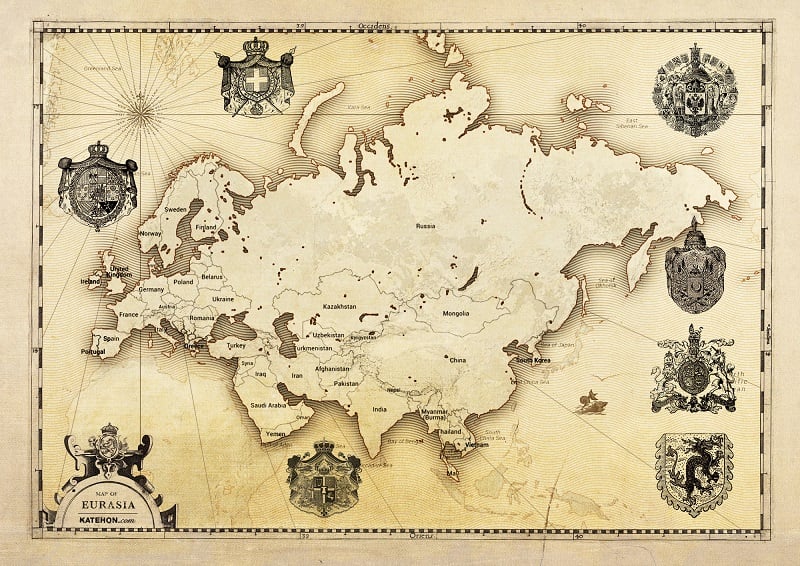
How the New Silk Roads are merging into Greater Eurasia

By Pepe Escobar

April 16, 2019

Russia is keen to push economic integration with parts of Asia and this fits in with China’s Belt and Road Initiative

The concept of Greater Eurasia has been discussed at the highest levels of Russian academia and policy-making for some time. This week the policy was presented at the Council of Ministers and looks set to be enshrined, without fanfare, as the main guideline of Russian foreign policy for the foreseeable future.

President Putin is unconditionally engaged to make it a success. Already at the St Petersburg International Economic Forum in 2016, Putin referred to an emerging “Eurasian partnership”.

Originally published at eurasia-news-online.com

I was privileged over the past week to engage in excellent discussions in Moscow with some of the top Russian analysts and policymakers involved in advancing Greater Eurasia.

Three particularly stand out: Yaroslav Lissovolik, program director of the Valdai Discussion Club and an expert on the politics and economics of the Global South; Glenn Diesen, author of the seminal Russia’s Geoeconomic Strategy for a Greater Eurasia; and the legendary Professor Sergey Karaganov, dean of the Faculty of World Economy and International Affairs at the National Research University Higher School of Economics and honorary chairman of the Presidium of the Council on Foreign and Defense Policy, who received me in his office for an off-the-record conversation.

The framework for Great Eurasia has been dissected in detail by the indispensable Valdai Discussion Club, particularly on Rediscovering the Identity, the sixth part of a series called Toward the Great Ocean, published last September, and authored by an academic who’s who on the Russian Far East, led by Leonid Blyakher of the Pacific National University in Khabarovsk and coordinated by Karaganov, director of the project.

The conceptual heart of Greater Eurasia is Russia’s Turn to the East, or pivot to Asia, home of the economic and technological markets of the future. This implies Greater Eurasia proceeding in symbiosis with China’s New Silk Roads, or Belt and Road Initiative (BRI).

And yet this advanced stage of the Russia-China strategic partnership does not mean Moscow will neglect its myriad close ties to Europe.

Russian Far East experts are very much aware of the “Eurocentrism of a considerable portion of Russian elites.” They know how almost the entire economic, demographic and ideological environment in Russia has been closely intertwined with Europe for three centuries.

They recognize that Russia has borrowed Europe’s high culture and its system of military organization. But now, they argue, it’s time, as a great Eurasian power, to profit from “an original and self-sustained fusion of many civilizations”; Russia not just as a trade or connectivity point, but as a “civilizational bridge”.

Legacy of Genghis Khan 

What my conversations, especially with Lissovolik, Diesen and Karaganov, have revealed is something absolutely groundbreaking – and virtually ignored across the West; Russia is aiming to establish a new paradigm not only in geopolitics and geoeconomics, but also on a cultural and ideological level.

Conditions are certainly ripe for it. Northeast Asia is immersed in a power vacuum. The Trump administration’s priority – as well as the US National Security Strategy’s – is containment of China. Both Japan and South Korea, slowly but surely, are getting closer to Russia.

Culturally, retracing Russia’s past, Greater Eurasia analysts may puzzle misinformed Western eyes. ‘Towards the Great Ocean’, the Valdai report supervised by Karaganov, notes the influence of Byzantium, which “preserved classical culture and made it embrace the best of the Orient culture at a time when Europe was sinking into the Dark Ages.” Byzantium inspired Russia to adopt Orthodox Christianity.

It also stresses the role of the Mongols over Russia’s political system. “The political traditions of most Asian countries are based on the legacy of the Mongols. Arguably, both Russia and China are rooted in Genghis Khan’s empire,” it says.

If the current Russian political system may be deemed authoritarian – or, as claimed in Paris and Berlin, an exponent of “illiberalism” – top Russian academics argue that a market economy protected by lean, mean military power performs way more efficiently than crisis-ridden Western liberal democracy.

As China heads West in myriad forms, Greater Eurasia and the Belt and Road Initiative are bound to merge. Eurasia is crisscrossed by mighty mountain ranges such as the Pamirs and deserts like the Taklamakan and the Karakum.

The best ground route runs via Russia or via Kazakhstan to Russia. In crucial soft power terms, Russian remains the lingua franca in Mongolia, Central Asia and the Caucasus.

And that leads us to the utmost importance of an upgraded Trans-Siberian railway – Eurasia’s current connectivity core. In parallel, the transportation systems of the Central Asian “stans” are closely integrated with the Russian network of roads; all that is bound to be enhanced in the near future by Chinese-built high-speed rail.

Iran and Turkey are conducting their own versions of a pivot to Asia. A free-trade agreement between Iran and the Eurasia Economic Union (EAEU) was approved in early December. Iran and India are also bound to strike a free-trade agreement.

Iran is a big player in the International North-South Transport Corridor (INSTC), which is essential in driving closer economic integration between Russia and India.

The Caspian Sea, after a recent deal between its five littoral states, is re-emerging as a major trading post in Central Eurasia. Russia and Iran are involved in a joint project to build a gas pipeline to India.

Kazakhstan shows how Greater Eurasia and BRI are complementary; Astana is both a member of BRI and the EAEU. The same applies to gateway Vladivostok, Eurasia’s entry point for both South Korea and Japan, as well as Russia’s entry point to Northeast Asia.

Ultimately, Russia’s regional aim is to connect China’s northern provinces with Eurasia via the Trans-Siberian and the Chinese Eastern Railway – with Chita in China and Khabarovsk in Russia totally inter-connected.

And all across the spectrum, Moscow aims at maximizing return on the crown jewels of the Russian Far East; agriculture, water resources, minerals, lumber, oil and gas. Construction of liquefied natural gas (LNG) plants in Yamal vastly benefits China, Japan and South Korea.

Community spirit

Eurasianism, as initially conceptualized in the early 20th century by the geographer PN Savitsky, the geopolitician GV Vernadsky and the cultural historian VN Ilyn, among others, regarded Russian culture as a unique, complex combination of East and West, and the Russian people as belonging to “a fully original Eurasian community”.

That certainly still applies. But as Valdai Club analysts argue, the upgraded concept of Greater Eurasia “is not targeted against Europe or the West”; it aims to include at least a significant part of the EU.

The Chinese leadership describes BRI not only as connectivity corridors, but also as a “community”. Russians use a similar term applied to Greater Eurasia; sobornost (“community spirit”).

As Alexander Lukin of the Higher School of Economics and an expert on the SCO has constantly stressed, including in his book China and Russia: The New Rapprochement, this is all about the interconnection of Greater Eurasia, BRI, EAEU, SCO, INSTC, BRICS, BRICS Plus and ASEAN.

The cream of the crop of Russian intellectuals – at the Valdai Club and the Higher School of Economics – as well as top Chinese analysts, are in sync. Karaganov himself constantly reiterates that the concept of Greater Eurasia was arrived at, “jointly and officially”, by the Russia-China partnership; “a common space for economic, logistic and information cooperation, peace and security from Shanghai to Lisbon and New Delhi to Murmansk”.

The concept of Greater Eurasia is, of course, a work in progress. What my conversations in Moscow revealed is its extraordinary ambition; positioning Russia as a key geoeconomic and geopolitical crossroads linking the economic systems of North Eurasia, Central and Southwest Asia.

As Diesen notes, Russia and China have become inevitable allies because of their “shared objective of restructuring global value-chains and developing a multipolar world”.

It’s no wonder Beijing’s drive to develop state-of-the-art national technological platforms is provoking so much anger in Washington.

And in terms of the big picture, it makes perfect sense for BRI to be harmonized with Russia’s economic connectivity drive for Greater Eurasia.

That’s irreversible. The dogs of demonization, containment, sanctions and even war may bark all they want, but the Eurasia integration caravan keeps moving along.

Originally published at eurasia-news-online.com

Photo credit: eurasia-news-online.com

One Response

  1. Another factor to be aware of is that more of these countries want to break free from the US dollar hegemony in international commerce.

Related Posts

PART 2 — Diplomacy, Law and Nonviolent Power By Jan ObergTFF co-founder and director January 26, 2026 This is the second of four TFF-created idea portfolios designed to curb the global reach of the United States and, in both the short and long term, help catalyse a worldwide nonviolent resistance to what many observers describe as the Trump administration’s uniquely confrontational, destructive and world-threatening policies. These portfolios outline what governments and citizens across the world can do through dynamic diplomacy, creative initiatives, and strictly nonviolent means. They are typical TFF works in that we do not only tell what the problem is and how bad it will go – as 90+% of all commentators, experts and scholars do – we tell what we think can be done, inviting you to think of what you think you can do. It seems painfully clear to me that the current political dynamics in Washington increasingly resemble the most dangerous...
TFF’s comprehensive proposal for dialogue about true peace in Ukraine is due in a day or two Jan Oberg November 20, 2025 What is being whispered through diplomatic corridors today is not peace, but quackery. The alleged 28‑point plan drafted in Washington and Moscow is mentioned as a solution to the Ukraine war. It is being negotiated by US businessman, real estate developer and Trump ally, Steve Witkoff, and by Kirill Dmitriev, who is CEO of the Russian Direct Investment Fund and a close ally of Putin, according to India’s Economic Times. For presumably good reasons, their education, qualifications and experience in international conflict analysis and peace-making remain untold. They look like surgeons who have never opened a medical textbook. It is nothing more than a mirage: a framework of concessions imposed on Ukraine’s citizens, negotiated without Kyiv, and excluding Europe. Like Gaza, it promises “peace” while institutionalising injustice. If half of what is available about...
Professor Zhang Weiwei is a highly respected Chinese intellectual and professor at Fudan University in Shanghai. He is the director of its China Institute and also runs a series of conversations with many different people around the world. Here is what came out of their meetings there and in Skopje, Macedonia in October 2024: & As you can see, also at the end of the second one, we both enjoy win-win exchanges like these about world order issues. Zhang Weiwei is known for using videos and social media to reach a large audience in China and worldwide. We suggest you see many more of Zhang Weiwei’s conversations – like recently with Professor Jeffrey Sachs – on the Thinkers’ Forum on YouTube. PSTFF posts hundreds of videos, its own and those of others, in our Video Collections on TFF Substack – including those that appear on YouTube. However, TFF has been cancelled by Google-owned...

Recent Articles

Tony Robinson October 4, 2026 Violence is easy to recognise when someone is being beaten, shot or killed. It becomes more difficult when nobody is holding a weapon. Poverty, discrimination, exploitation and repression can restrict a human life just as effectively, although they do so in very different ways and with very different consequences. Simply adding more categories to an ever-growing list of forms of violence does not really solve the problem. The more interesting question is what all these different situations have in common and why it makes sense to describe them using the same word. Human beings do not simply react to what happens around them. They remember the past, imagine things that do not yet exist, make plans and undertake projects. Workers organise because they imagine different working conditions; people migrate because they imagine another life somewhere else; social movements emerge because people refuse to accept the...
It’s a matter of principles, courage, vision and pulling together – while the militarist world is falling apart… Peter Langille October 3, 2026 “Here, then, is the problem which we present to you, stark and dreadful and inescapable: Shall we put an end to the human race; or shall mankind renounce war?”The Bertrand Russell—Albert Einstein Manifesto, July 9, 1955 ⁕ The forecast for what’s ahead is worrisome. The sharp rise in armed conflicts over the past three years is adding to what was already the highest level in over seventy years. Genocides, which should be prevented are supported. A shared climate emergency that jeopardises survival is ignored. Diverse polls now suggest that people are war-weary, worried and interested in a more effective United Nations. And, there are viable policy options for a more secure world! Yet governments are doubling-down, betting on more war and investing heavily. If current trends persist,...
Johan Galtung 1930-2024October 2015 Published here on October 3, 2026 Let us focus on Civilization for conflict analysis and remedies. Major forms of disorder use violence; war is state organized violence. The most belligerent states are the United States of America and Israel, both with civilization roots. National Evangelism, the US Protestant Christian civilization– more national than evangelical–justifies US warfare as exceptionalism of a people chosen by God, with a manifest destiny to run the world. Orthodox Judaism justifies Israeli warfare to conquer and expand from Nile to Euphrates as a religious right and duty to the Eternal One. The third most belligerent country, the UK, no longer believes it is God-chosen but chosen by the USA; not quite the same but something. But the root cause of global disorder lies in the Occident–with Islam–seeing itself as the single, universal civilization valid for all at all times, all others being...

TFF on Substack

Discover and subscribe to more peace materials on TFF Substack

Most Popular

Tony Robinson October 4, 2026 Violence is easy to recognise when someone is being beaten, shot or killed. It becomes more difficult when nobody is holding a weapon. Poverty, discrimination, exploitation and repression can restrict a human life just as effectively, although they do so in very different ways and with very different consequences. Simply adding more categories to an ever-growing list of forms of violence does not really solve the problem. The more interesting question is what all these different situations have in common and why it makes sense to describe them using the same word. Human beings do not simply react to what happens around them. They remember the past, imagine things that do not yet exist, make plans and undertake projects. Workers organise because they imagine different working conditions; people migrate because they imagine another life somewhere else; social movements emerge because people refuse to accept the...
It’s a matter of principles, courage, vision and pulling together – while the militarist world is falling apart… Peter Langille October 3, 2026 “Here, then, is the problem which we present to you, stark and dreadful and inescapable: Shall we put an end to the human race; or shall mankind renounce war?”The Bertrand Russell—Albert Einstein Manifesto, July 9, 1955 ⁕ The forecast for what’s ahead is worrisome. The sharp rise in armed conflicts over the past three years is adding to what was already the highest level in over seventy years. Genocides, which should be prevented are supported. A shared climate emergency that jeopardises survival is ignored. Diverse polls now suggest that people are war-weary, worried and interested in a more effective United Nations. And, there are viable policy options for a more secure world! Yet governments are doubling-down, betting on more war and investing heavily. If current trends persist,...
Johan Galtung 1930-2024October 2015 Published here on October 3, 2026 Let us focus on Civilization for conflict analysis and remedies. Major forms of disorder use violence; war is state organized violence. The most belligerent states are the United States of America and Israel, both with civilization roots. National Evangelism, the US Protestant Christian civilization– more national than evangelical–justifies US warfare as exceptionalism of a people chosen by God, with a manifest destiny to run the world. Orthodox Judaism justifies Israeli warfare to conquer and expand from Nile to Euphrates as a religious right and duty to the Eternal One. The third most belligerent country, the UK, no longer believes it is God-chosen but chosen by the USA; not quite the same but something. But the root cause of global disorder lies in the Occident–with Islam–seeing itself as the single, universal civilization valid for all at all times, all others being...
Read More
Living-Peace-Sign-Budapest-copy
Tony Robinson October 4, 2026 Violence is easy to recognise when someone is being beaten, shot or killed. It becomes more difficult when nobody is holding a weapon. Poverty, discrimination, exploitation and repression can restrict a human life just as effectively, although they do so in very different ways and with very different consequences. Simply adding more categories to an ever-growing list of forms of violence does not really solve the problem. The more interesting question is what all these different situations have in common and why it makes sense to describe them using the same word. Human beings do not simply react to what happens around them. They remember the past, imagine things that do not yet exist, make plans and undertake projects. Workers organise because they imagine different working conditions; people migrate because they imagine another life somewhere else; social movements emerge because people refuse to accept the...
b54a1f10-8c65-4f0b-9dd5-4abc0a7d04cc_2659x2659
It’s a matter of principles, courage, vision and pulling together – while the militarist world is falling apart… Peter Langille October 3, 2026 “Here, then, is the problem which we present to you, stark and dreadful and inescapable: Shall we put an end to the human race; or shall mankind renounce war?”The Bertrand Russell—Albert Einstein Manifesto, July 9, 1955 ⁕ The forecast for what’s ahead is worrisome. The sharp rise in armed conflicts over the past three years is adding to what was already the highest level in over seventy years. Genocides, which should be prevented are supported. A shared climate emergency that jeopardises survival is ignored. Diverse polls now suggest that people are war-weary, worried and interested in a more effective United Nations. And, there are viable policy options for a more secure world! Yet governments are doubling-down, betting on more war and investing heavily. If current trends persist,...
010
Johan Galtung 1930-2024October 2015 Published here on October 3, 2026 Let us focus on Civilization for conflict analysis and remedies. Major forms of disorder use violence; war is state organized violence. The most belligerent states are the United States of America and Israel, both with civilization roots. National Evangelism, the US Protestant Christian civilization– more national than evangelical–justifies US warfare as exceptionalism of a people chosen by God, with a manifest destiny to run the world. Orthodox Judaism justifies Israeli warfare to conquer and expand from Nile to Euphrates as a religious right and duty to the Eternal One. The third most belligerent country, the UK, no longer believes it is God-chosen but chosen by the USA; not quite the same but something. But the root cause of global disorder lies in the Occident–with Islam–seeing itself as the single, universal civilization valid for all at all times, all others being...
Screenshot 2026-10-02 011738
Jan ObergPhD, director, The Transnational Foundation for Peace and Future Research, TFFLund, Sweden October 2, 2026 This is my full original manuscript. The Chinese Academy of Social Science, CASS, makes two publications out if it. 1. China’s Five-year plan emphasized the capabilities of basic research and original innovation. It is regarded as the goal of the future social development, which, as required, should be significantly enhanced. Can you comment on the importance of original innovation in research and academic study? I believe it is easier to define “original innovation” in the natural sciences than in social sciences. The breaking points of what constitutes something new, or innovative, are not quite as sharp in the latter. But in both fields it is about opening up something that was closed, unseen, unexplored before – making manifest what was earlier latent. Innovations come in many forms and shapes – naming something that was not...
arctic-circle-map
The agreement is catastrophic both because of what it says and what it doesn’t mention. It reduces further the major asset of security policies: Freedom of action. Jan Oberg TFF director September 25, 2026 A couple of hours before the agreement was signed on September 22, 2026, I published the following 13 hypotheses about what it would most likely contain on TFF Substack (in English). I was wrong on only the first point. Contrary to what Trump had written on his Truth Social platform, it does not appear to come into force immediately. In fact, it turned out to be worse than even I had anticipated. After these hypotheses now come a number of reflections in light of what the agreement actually contains, and does not contain, as well as the way in which it has generally been presented by major media outlets and by the public-service broadcaster DR. My...
girl-5894831_1280
Below are TFF-related media mentions, comments, videos and social media posts published elsewhere but not on this homepage. We happen to catch and list only a fraction. Regarding video comments and debates, we recommend that you go to the TFF Video Channel on Substack where many of them are reproduced. Jan Oberg is a contributor to China Daily – 52 million daily clicks – and Global Times, CGTN and CCTV (the national television), China Investment, Xinhua News Agency and several others. Articles and videos on these media very often multiply into countless Chinese (and Western media) that re-post them from these main media. Thanks to The China Academy, his analyses, interviews and comments are frequently posted on YouTube channels such as Thinkers Forum and Wave Media. These videos are often re-posted on Bilibili (China’s YouTube), the China Content Center on TikTok, and on the Chinese edition of TikTok, Douyin.com. This means reaching hundreds of millions of viewers worldwide over a year. While there are too many to catch on all these...




