
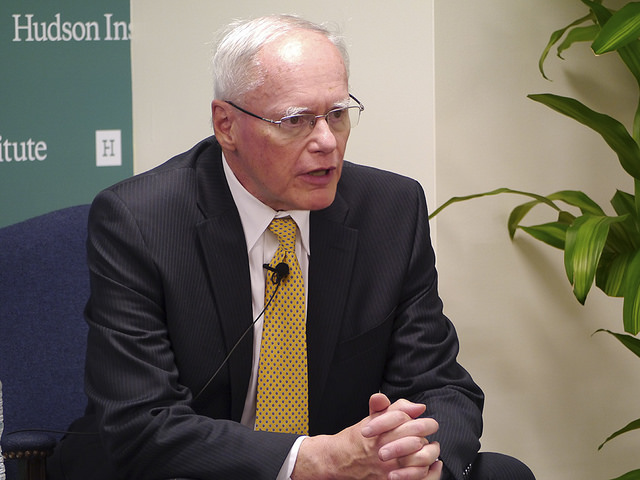
Photo: James Jeffrey – Special Representative for Syria Engagement in the United States (Hudson Institute via Flickr)


By Paul R. Pillar

September 19, 2018

Amid a week of attention-grabbing drama about the dysfunction of Donald Trump’s presidency, it almost escaped notice that his administration is putting U.S. troops in harm’s way in a foreign war for a new purpose—a purpose that does not entail countering a threat to the United States.

Newly appointed special envoy for Syria, James Jeffrey stated that under a “new policy” on Syria, the United States is “no longer pulling out by the end of the year.”

This policy goes against what Trump had been saying not only in the presidential campaign about wanting less U.S. involvement in Middle Eastern wars but also, more recently and more specifically, about wanting to withdraw the 2,200 U.S. soldiers now in Syria.

Those troops have been in the northeastern part of the country, hitherto focused on aiding the fight against the so-called Islamic State (ISIS or IS).

But now, according to Jeffrey, besides mopping up the remnants of IS’s former mini-state in eastern Syria, U.S. troops are to stay in Syria indefinitely with the objective of ejecting from the country all troops of Syria’s ally Iran.

Administration officials say that a motivation for the new policy is growing doubt that Russia will be either able or willing to assist in such an ejection.


Originally published at lobelog.com

The new policy is an entirely new war aim, not an extension or corollary of the prior declared purpose of combating IS. In fact, Iran’s presence in Syria, aimed at supporting the Bashar al-Assad regime, has been on the opposite side of the Syrian civil war from IS, which has aimed to overthrow that regime.

Hawks in the administration have been talking for some time, of course, about confronting and opposing Iran anyway and anywhere they can, but Jeffrey’s statement marks an official departure from what had been a U.S. war objective in Syria exclusively focused on IS.


An Unscrutinized War Aim

That shift warrants much more scrutiny and debate than it is getting. U.S. service members are being dispatched to a foreign war for the purpose of somehow getting one Middle Eastern state that has had a longstanding security relationship with another Middle Eastern state to remove its personnel from that second state.

Exactly how are U.S. interests supposedly affected by whether those personnel stay or go?

The only Americans who might be harmed under one scenario but not the other are the very soldiers who are being dispatched. The Syrian-Iranian alliance has existed for decades, going back to when the two states shared an adversary in the form of Saddam Hussein’s regime in Iraq.

The issue is not only whether U.S. interests are affected but whether they are affected enough to justify the participation of the U.S. military in a foreign war—which should entail a higher standard.

Suppose that Article I, Section 8 of the U.S. Constitution were observed, as it ought to be but generally is not, and that a congressional declaration of war preceded involvement of the U.S. military in any foreign war.

Suppose further that when an already deployed U.S. force is given an entirely different mission, that this mission and the deployment intended to serve it are given a thorough zero-based review—which it ought to be but generally is not.

Would the elected representatives of the American people vote to send U.S. soldiers into a war for the purpose of getting a Middle Eastern state to move some of its own troops from point A to point B (troops that had gone to point A not as invaders but instead to assist the incumbent government)?

Probably not, despite years of rhetoric depicting Iran as evil incarnate.

To be fair, withdrawing an already deployed U.S. expeditionary force is not entirely the same as deploying one afresh, whether or not the mission has changed.

When Richard Nixon and Henry Kissinger inherited the Vietnam War in 1969, their task was not centered on the question of whether the war had been a good or a bad idea in the first place but instead on how to extract a half-million-man army in a way that could plausibly be presented as “peace with honor.”

But the scale of extraction and of the associated emotions and politics involving sunk costs are vastly different with the small U.S. force in Syria. Any legitimate issues about extraction there should focus on the previously established mission of mopping up IS.


No Good Solutions

The Syrian war always has been, and still is, a problem with no good solutions as far as U.S. policy is concerned. Robert Malley, who coordinated Middle Eastern policy in the Obama White House, describes Syria as a “failure” for the administration in which he worked.
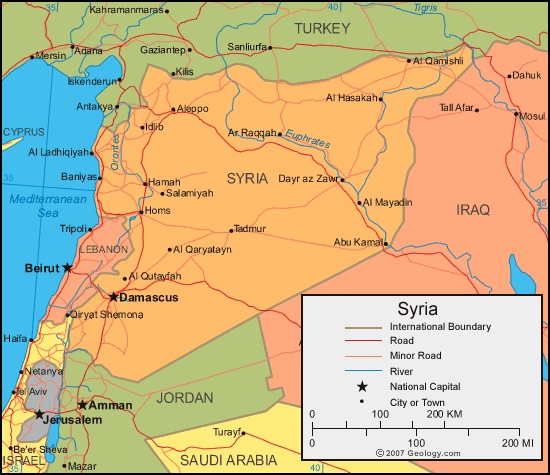
Map of Syria. Photo credit: danmark-land.blogspot.com

The agonizing over Syria is likely to accelerate in the coming days as the Syrian regime attempts to capture Idlib province, the last major remaining redoubt of rebel forces, and one to which many fighters ousted from other rebel enclaves had earlier repaired.

Ignoring uncomfortable truths about the Syria conflict keeps getting in the way of sober policy-making. The regime, aided by its Russian and Iranian allies, already has recaptured most rebel-held territory.

Probably the shortest route to mitigating further suffering from this war — in which upwards of a half million people have died and millions more have been displaced — is for government forces to complete the victory that they are well on the way to achieving.

But the brutal and disagreeable nature of the Assad regime has made that prospect a nonstarter as a basis for (openly avowed) U.S. policy-making, even if the “Assad must go” slogan has quietly been retired.

Idlib presents more uncomfortable truths. Although Syria, Russia, and Iran routinely describe all Syrian rebels as “terrorists” in their propaganda, the label fits to a large degree in Idlib.

The strongest armed group in Idlib, and the de facto ruler over most of the province, is Hei’at Tahrir al-Sham (HTS), which is the latest name of the al-Qaeda affiliate in Syria.

A regime offensive in Idlib may indeed bring about the grievous casualties and displacements about which many commentators are currently warning. But a successful offensive also would end the inhumane local rule of HTS, which has featured mass arrests, secret prisons, and torture.

Finding the least bad solution must involve multilateral diplomacy, given the number of external actors involved in the conflict.

The most important players in that diplomacy have been Russia, Iran, and Turkey, although the presidents of those three countries failed to achieve any breakthrough agreement on Syria in a summit meeting they just held in Tehran. All three have stronger interests in Syria than does the United States.

For both Russia and Iran, Syria represents the single biggest, longest, and friendliest relationship either regime has enjoyed in the Arab world. For Turkey, Syria presents a host of immediate problems, including more than three million Syrian refugees already on its soil, the prospect of still more from fighting in Idlib, border security issues, and the Kurdish question.

The U.S. fixation on opposing and isolating Iran at every opportunity makes the difficult task of finding the least bad solution to the Syrian war even more difficult. The fixation was impeding Syria-related diplomacy even before the Trump administration took office.

It was not until October 2015, three months after the multilateral agreement restricting Iran’s nuclear program was signed, that the Obama administration ended the longstanding U.S. objection to Iranian participation in Syrian peace talks sponsored by the United Nations.

Jeffrey and other Trump administration officials have not explained how keeping those U.S. troops in Syria will help achieve a withdrawal of Iranian personnel.

Conceivably they could function as a bargaining chip, with a hope of achieving some agreement about withdrawal of all foreign forces from Syria. But two can play that game.

Iranian President Hassan Rouhani said at the summit meeting in Tehran not only that “fighting terrorism in Idlib is an unavoidable part of the mission of restoring peace and stability to Syria” but also that “we have to force the United States to leave” Syria.

In that game, Iran, as noted above, has a stronger incentive to keep playing than does the United States.

The principal effect of keeping those American soldiers in Syria indefinitely, with opposing Iran as their new mission, is to increase the chance of a direct U.S.-Iranian military clash, possibly escalating into a major war. That’s not good, even though it might be what some in power want.


Originally published at lobelog.com

Paul R. Pillar is Non-resident Senior Fellow at the Center for Security Studies of Georgetown University and an Associate Fellow of the Geneva Center for Security Policy. He retired in 2005 from a 28-year career in the U.S. intelligence community. His senior positions included National Intelligence Officer for the Near East and South Asia, Deputy Chief of the DCI Counterterrorist Center, and Executive Assistant to the Director of Central Intelligence. He is a Vietnam War veteran and a retired officer in the U.S. Army Reserve. Dr. Pillar’s degrees are from Dartmouth College, Oxford University, and Princeton University. His books include Negotiating Peace (1983), Terrorism and U.S. Foreign Policy (2001), Intelligence and U.S. Foreign Policy (2011), and Why America Misunderstands the World (2016).


Related Posts

PART 2 — Diplomacy, Law and Nonviolent Power By Jan ObergTFF co-founder and director January 26, 2026 This is the second of four TFF-created idea portfolios designed to curb the global reach of the United States and, in both the short and long term, help catalyse a worldwide nonviolent resistance to what many observers describe as the Trump administration’s uniquely confrontational, destructive and world-threatening policies. These portfolios outline what governments and citizens across the world can do through dynamic diplomacy, creative initiatives, and strictly nonviolent means. They are typical TFF works in that we do not only tell what the problem is and how bad it will go – as 90+% of all commentators, experts and scholars do – we tell what we think can be done, inviting you to think of what you think you can do. It seems painfully clear to me that the current political dynamics in Washington increasingly resemble the most dangerous...
PART 1 — Media, Culture and Information Sovereignty By Jan ObergTFF co-founder and director January 20, 2026 This is the first of four TFF-created idea portfolios designed to curb the global reach of the United States and, in both the short and long term, help catalyse a worldwide nonviolent resistance to what many observers describe as the Trump administration’s uniquely confrontational, destructive and world-threatening policies. These portfolios outline what governments and citizens across the world can do through dynamic diplomacy, creative initiatives, and strictly nonviolent means. They are typical TFF works in that we do not only tell what the problem is and how bad it will go – as 90+% of all commentators, experts and scholars do – we tell what we think can be done, inviting you to think of what you think you can do. It seems painfully clear to me that the current political dynamics in Washington increasingly resemble the most...
Introduction to TFF’s forthcoming four Idea Portfolios of Diplomatic and Nonviolent Resistance By TFF’s Board & FoundersPascal Lottaz, Biljana Vankovska, Annette Schiffmann, Christina Spannar & Jan Oberg January 19, 2026 “America, you are too arrogant.” — Martin Luther King Jr. Over the course of Trump’s first term and now a year into his second, the world has witnessed a consistent pattern of actions that challenge the basic long-standing norms of international cooperation, weaken multilateral institutions, and ignore the global norms and legal frameworks established by the UN Charter. During these years, we have witnessed military operations in Iran, Syria and Ukraine without UN authorisation; the killing of Iranian General Qassem Soleimani; repeated strikes across the Middle East; and the launch of tariff wars against allies and competitors alike. We have seen a renewed emphasis on nuclearism and zero interest in arms control and disarmament negotiations. Pentagon is now The Department...

Recent Articles

Tony Robinson October 4, 2026 Violence is easy to recognise when someone is being beaten, shot or killed. It becomes more difficult when nobody is holding a weapon. Poverty, discrimination, exploitation and repression can restrict a human life just as effectively, although they do so in very different ways and with very different consequences. Simply adding more categories to an ever-growing list of forms of violence does not really solve the problem. The more interesting question is what all these different situations have in common and why it makes sense to describe them using the same word. Human beings do not simply react to what happens around them. They remember the past, imagine things that do not yet exist, make plans and undertake projects. Workers organise because they imagine different working conditions; people migrate because they imagine another life somewhere else; social movements emerge because people refuse to accept the...
It’s a matter of principles, courage, vision and pulling together – while the militarist world is falling apart… Peter Langille October 3, 2026 “Here, then, is the problem which we present to you, stark and dreadful and inescapable: Shall we put an end to the human race; or shall mankind renounce war?”The Bertrand Russell—Albert Einstein Manifesto, July 9, 1955 ⁕ The forecast for what’s ahead is worrisome. The sharp rise in armed conflicts over the past three years is adding to what was already the highest level in over seventy years. Genocides, which should be prevented are supported. A shared climate emergency that jeopardises survival is ignored. Diverse polls now suggest that people are war-weary, worried and interested in a more effective United Nations. And, there are viable policy options for a more secure world! Yet governments are doubling-down, betting on more war and investing heavily. If current trends persist,...
Johan Galtung 1930-2024October 2015 Published here on October 3, 2026 Let us focus on Civilization for conflict analysis and remedies. Major forms of disorder use violence; war is state organized violence. The most belligerent states are the United States of America and Israel, both with civilization roots. National Evangelism, the US Protestant Christian civilization– more national than evangelical–justifies US warfare as exceptionalism of a people chosen by God, with a manifest destiny to run the world. Orthodox Judaism justifies Israeli warfare to conquer and expand from Nile to Euphrates as a religious right and duty to the Eternal One. The third most belligerent country, the UK, no longer believes it is God-chosen but chosen by the USA; not quite the same but something. But the root cause of global disorder lies in the Occident–with Islam–seeing itself as the single, universal civilization valid for all at all times, all others being...

TFF on Substack

Discover and subscribe to more peace materials on TFF Substack

Most Popular

Tony Robinson October 4, 2026 Violence is easy to recognise when someone is being beaten, shot or killed. It becomes more difficult when nobody is holding a weapon. Poverty, discrimination, exploitation and repression can restrict a human life just as effectively, although they do so in very different ways and with very different consequences. Simply adding more categories to an ever-growing list of forms of violence does not really solve the problem. The more interesting question is what all these different situations have in common and why it makes sense to describe them using the same word. Human beings do not simply react to what happens around them. They remember the past, imagine things that do not yet exist, make plans and undertake projects. Workers organise because they imagine different working conditions; people migrate because they imagine another life somewhere else; social movements emerge because people refuse to accept the...
It’s a matter of principles, courage, vision and pulling together – while the militarist world is falling apart… Peter Langille October 3, 2026 “Here, then, is the problem which we present to you, stark and dreadful and inescapable: Shall we put an end to the human race; or shall mankind renounce war?”The Bertrand Russell—Albert Einstein Manifesto, July 9, 1955 ⁕ The forecast for what’s ahead is worrisome. The sharp rise in armed conflicts over the past three years is adding to what was already the highest level in over seventy years. Genocides, which should be prevented are supported. A shared climate emergency that jeopardises survival is ignored. Diverse polls now suggest that people are war-weary, worried and interested in a more effective United Nations. And, there are viable policy options for a more secure world! Yet governments are doubling-down, betting on more war and investing heavily. If current trends persist,...
Johan Galtung 1930-2024October 2015 Published here on October 3, 2026 Let us focus on Civilization for conflict analysis and remedies. Major forms of disorder use violence; war is state organized violence. The most belligerent states are the United States of America and Israel, both with civilization roots. National Evangelism, the US Protestant Christian civilization– more national than evangelical–justifies US warfare as exceptionalism of a people chosen by God, with a manifest destiny to run the world. Orthodox Judaism justifies Israeli warfare to conquer and expand from Nile to Euphrates as a religious right and duty to the Eternal One. The third most belligerent country, the UK, no longer believes it is God-chosen but chosen by the USA; not quite the same but something. But the root cause of global disorder lies in the Occident–with Islam–seeing itself as the single, universal civilization valid for all at all times, all others being...
Read More
Living-Peace-Sign-Budapest-copy
Tony Robinson October 4, 2026 Violence is easy to recognise when someone is being beaten, shot or killed. It becomes more difficult when nobody is holding a weapon. Poverty, discrimination, exploitation and repression can restrict a human life just as effectively, although they do so in very different ways and with very different consequences. Simply adding more categories to an ever-growing list of forms of violence does not really solve the problem. The more interesting question is what all these different situations have in common and why it makes sense to describe them using the same word. Human beings do not simply react to what happens around them. They remember the past, imagine things that do not yet exist, make plans and undertake projects. Workers organise because they imagine different working conditions; people migrate because they imagine another life somewhere else; social movements emerge because people refuse to accept the...
b54a1f10-8c65-4f0b-9dd5-4abc0a7d04cc_2659x2659
It’s a matter of principles, courage, vision and pulling together – while the militarist world is falling apart… Peter Langille October 3, 2026 “Here, then, is the problem which we present to you, stark and dreadful and inescapable: Shall we put an end to the human race; or shall mankind renounce war?”The Bertrand Russell—Albert Einstein Manifesto, July 9, 1955 ⁕ The forecast for what’s ahead is worrisome. The sharp rise in armed conflicts over the past three years is adding to what was already the highest level in over seventy years. Genocides, which should be prevented are supported. A shared climate emergency that jeopardises survival is ignored. Diverse polls now suggest that people are war-weary, worried and interested in a more effective United Nations. And, there are viable policy options for a more secure world! Yet governments are doubling-down, betting on more war and investing heavily. If current trends persist,...
010
Johan Galtung 1930-2024October 2015 Published here on October 3, 2026 Let us focus on Civilization for conflict analysis and remedies. Major forms of disorder use violence; war is state organized violence. The most belligerent states are the United States of America and Israel, both with civilization roots. National Evangelism, the US Protestant Christian civilization– more national than evangelical–justifies US warfare as exceptionalism of a people chosen by God, with a manifest destiny to run the world. Orthodox Judaism justifies Israeli warfare to conquer and expand from Nile to Euphrates as a religious right and duty to the Eternal One. The third most belligerent country, the UK, no longer believes it is God-chosen but chosen by the USA; not quite the same but something. But the root cause of global disorder lies in the Occident–with Islam–seeing itself as the single, universal civilization valid for all at all times, all others being...
Screenshot 2026-10-02 011738
Jan ObergPhD, director, The Transnational Foundation for Peace and Future Research, TFFLund, Sweden October 2, 2026 This is my full original manuscript. The Chinese Academy of Social Science, CASS, makes two publications out if it. 1. China’s Five-year plan emphasized the capabilities of basic research and original innovation. It is regarded as the goal of the future social development, which, as required, should be significantly enhanced. Can you comment on the importance of original innovation in research and academic study? I believe it is easier to define “original innovation” in the natural sciences than in social sciences. The breaking points of what constitutes something new, or innovative, are not quite as sharp in the latter. But in both fields it is about opening up something that was closed, unseen, unexplored before – making manifest what was earlier latent. Innovations come in many forms and shapes – naming something that was not...
arctic-circle-map
The agreement is catastrophic both because of what it says and what it doesn’t mention. It reduces further the major asset of security policies: Freedom of action. Jan Oberg TFF director September 25, 2026 A couple of hours before the agreement was signed on September 22, 2026, I published the following 13 hypotheses about what it would most likely contain on TFF Substack (in English). I was wrong on only the first point. Contrary to what Trump had written on his Truth Social platform, it does not appear to come into force immediately. In fact, it turned out to be worse than even I had anticipated. After these hypotheses now come a number of reflections in light of what the agreement actually contains, and does not contain, as well as the way in which it has generally been presented by major media outlets and by the public-service broadcaster DR. My...
girl-5894831_1280
Below are TFF-related media mentions, comments, videos and social media posts published elsewhere but not on this homepage. We happen to catch and list only a fraction. Regarding video comments and debates, we recommend that you go to the TFF Video Channel on Substack where many of them are reproduced. Jan Oberg is a contributor to China Daily – 52 million daily clicks – and Global Times, CGTN and CCTV (the national television), China Investment, Xinhua News Agency and several others. Articles and videos on these media very often multiply into countless Chinese (and Western media) that re-post them from these main media. Thanks to The China Academy, his analyses, interviews and comments are frequently posted on YouTube channels such as Thinkers Forum and Wave Media. These videos are often re-posted on Bilibili (China’s YouTube), the China Content Center on TikTok, and on the Chinese edition of TikTok, Douyin.com. This means reaching hundreds of millions of viewers worldwide over a year. While there are too many to catch on all these...



