
Why the Experience of Ahed Tamimi Matters So Much


By Richard Falk

March 14, 2018


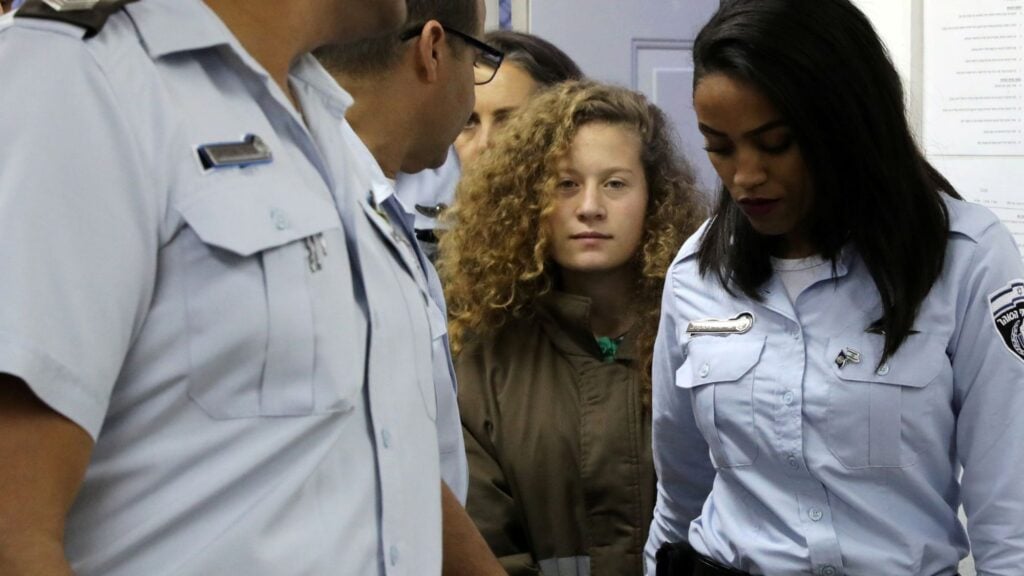
It is now known by virtually everyone who follows the Palestinian struggle that a 16 year old girl, now 17, named Ahed Tamimi, confronted Israeli soldiers on her family’s land shortly after her cousin, Mohammed, was shot in the face with a rubber bullet, causing a coma.

The video of her actions has gone viral, showing the world a courageous young woman engaging in nonviolent acts of resistance, and then a day later in the middle of the night being arrested in her home and then charged with a series of crimes; as is standard Israeli practice in the arrest of children, Aden was hauled off to an Israeli prison facility out of reach of her family and then denied bail.

As has been widely noted, Ahed Tamimi is a heroic victim for those in Palestine and elsewhere who approve of the Palestinian national struggle, and commend such symbolic acts of nonviolent resistance.

Ahed has also been often called ‘iconic’ because her story, now and before, is so emblematic of the extraordinary perseverance of the Palestinian people who having endured fifty years of occupation, and seventy years since the mass dispossession of 1948 known to Palestinians as the Nakba.

This prolonged ordeal continues to unfold without a decent ending in sight. The fact that Ahed is a child and a girl reinforces the double image of courage, stubborn resistance, and victimization.

It is also notable that as early as 2013 Ahed gained prominence when given The Handala Courage Award by a Turkish municipality in Istanbul, an occurrence given great attention due to a breakfast in her honor arranged by then Prime Minister Recep Tayyip Erdoğan. While only 13, Ahed opened an art exhibit in Istanbul aptly titled “Being a Child in Palestine.”

• • •
 

Richard Falk

The Israeli reaction, as might be expected, was as negative and denigrating as the Palestinian response was affirmative, maybe more so.

Israel’s Minister of Culture, no less, Mira Regev referred to Ahed this way: “She is not a little girl, she is a terrorist. It about time they will understand that people like her have to be in jail and not allowed to incite racism and subversion against the state of Israel.”

The internationally known Minister of Education, Naftali Bennett, was more precise in describing the punishment that fit Ahed’s supposed crime: “Ahed Tamimi should serve a life sentence for her crime.”

More luridly, Ben Caspit, a prominent journalist, made a rather shocking assertion of how Ahed’s type of defiant behavior shockingly deserves to be addressed outside the framework of law: “In the case of girls, we should exact a price at some other opportunity, in the dark without witnesses or cameras.”

Some critics have read this statement as advocacy of sexual abuse, even rape, but whatever its intention, the fact that such language can be used openly at the higher levels of Israeli discourse, without arousing an Israeli backlash is suggestive of a terroristic style of governance relied upon to break the will of Palestinian resistance.

• • •


Mira Regev’s reaction to the Tamimi video clip situates the Israeli reaction to Ahed Tamimi’s in ways that seem to reflect the dominant mood in the country that perversely reverses the realities of oppressor and oppressed, victimizers and victims: “When I watched that, I felt humiliated. I felt crushed,” finding the incident “damaging to the honor of the military and the state of Israel.”

It is this strange sense that it is Israelis, not Palestinians, that experience humiliation in the current situation, despite Israel being in total control of every aspect of the Palestinian life experience, which for Palestinians involves a daily encounter with oppressive policies designed to frighten, humiliate, and subjugate.

In contrast, Israelis enjoy the benefit of urban freedom and prosperity in an atmosphere of normalcy with relatively high levels of security in recent years that has greatly diminished the security threat, and in the process, effectively erased Palestinian grievances and aspirations from public consciousness.

When Palestinians are noticed, as in this incident, it tends to be with derision, and expressions of a domineering Israeli political will that considers it entirely fitting to impose punishments on Palestinian children of a severity totally disproportionate to the gravity of the supposed crime.

It is this disparity between the reality of Palestinian resistance and the rhetoric of Israeli oppressive options that gives Ahed Tamimi’s story such symbolic poignancy.

• • •


Of course, there are more sophisticated Israeli responses to Ahed’s challenge. Some commentators claim that what is disproportionate is the global attention devoted to the incident, even suggesting that it was a cynical ploy meant to distract world public opinion due to the failure of Hamas to deliver on its call for a third intifada in response to Trump’s decision to recognize Jerusalem as the capital of Israel and so move the U.S. Embassy.

Other critics insist that the incident was staged by the Palestinians, with cameras at the ready, and not as spontaneous as the video wants us to believe. Such a contention seems irrelevant, even if correct, as Ahed’s defiance was prompted by the shooting and wounding of her cousin a short time before, which was certainly not staged, but rather a reflection of oppressive and violent Israeli responses to Palestinian demonstrations of resistance.

To belittle her acts as instruments of ‘infowar’ is also to ignore the uncertainty she faced when so strongly confronting Israeli soldiers and challenging their authority.

She could not have known that these soldiers would not violently retaliate, as indeed some Israelis wished had happened to avoid ‘humiliation’ on the Israeli side.

Ahed’s bravery and dignified reaction seem to be authentic given the wider context, as does the resistance of the Tamimi family in the town of Nabi Saleh that undoubtedly socialized Ahed into a culture of nonviolent practice.

• • •


I think these polarized responses to the incident offer a defining metaphor for the current phase of Israel/Palestine relations.

The metaphor is given a special vividness because Ahed Tamimi as a child epitomizes the mentality and tactics of an oppressive state. The prospect of Ahed’s case being heard by a military court that finds that more than 99% of defendants are guilty of the crimes of which they are accused.

This is reminiscent of South African administration of criminal justice at the height of apartheid racism.

Beyond the legal fate of Ahed’s case is the unspeakable inhumanity of holding a civilian population captive generation after generation.


TFF recommends these media concerning Ahed Tamimi and her struggle

Ahed Tamimi on Wikipedia

BBC background

AlJazeera background

Amnesty’s urgent appeal for Ahed’s release


Her lawyer said – ”

And on March 21, 2018, Ahed Tamimi got 8 months in please deal. Her lawyer, Ms Lasky said: “When they decided to keep her trial behind closed doors, we knew that we were not going to get a fair trial.”

Professor Falk became an adviser to TFF when it was established in 1985.

One Response

  1. Yes and well written. The young age of her only makes the action stronger. This tells that it comes from a simple heart – as should all reactions. Simple in the sense nobody can steal other people’s lives. No matter what. And the fact that the Israeli government just continues is very bad for all human beings.

Related Posts

This is not another geopolitical commentary on the Arctic. It is a visionary peace proposal that can save the region from militarised rivalry and ecological ruin. A blueprint for shared security, sustainable development, and human dignity — benefitting Greenland, the Arctic, and the rest of us. Jan Oberg TFF director Lund, Sweden, February 17, 2026 I. Four Principles for a New Arctic Vision The Arctic is often framed as a cold arena of rivalry — a place where great powers test each other’s resolve. But this worldview is outdated, unimaginative, and ultimately self‑defeating. The Arctic is not a vacuum waiting to be militarised; it is a living region, a climate stabiliser, and a cultural homeland whose future will shape the future of humanity. If we begin from that understanding, a far more rational Arctic order becomes possible — one that is peaceful, cooperative, and centred on the people who actually live there. This vision rests...
PART 2 — Diplomacy, Law and Nonviolent Power By Jan ObergTFF co-founder and director January 26, 2026 This is the second of four TFF-created idea portfolios designed to curb the global reach of the United States and, in both the short and long term, help catalyse a worldwide nonviolent resistance to what many observers describe as the Trump administration’s uniquely confrontational, destructive and world-threatening policies. These portfolios outline what governments and citizens across the world can do through dynamic diplomacy, creative initiatives, and strictly nonviolent means. They are typical TFF works in that we do not only tell what the problem is and how bad it will go – as 90+% of all commentators, experts and scholars do – we tell what we think can be done, inviting you to think of what you think you can do. It seems painfully clear to me that the current political dynamics in Washington increasingly resemble the most dangerous...
TFF’s comprehensive proposal for dialogue about true peace in Ukraine is due in a day or two Jan Oberg November 20, 2025 What is being whispered through diplomatic corridors today is not peace, but quackery. The alleged 28‑point plan drafted in Washington and Moscow is mentioned as a solution to the Ukraine war. It is being negotiated by US businessman, real estate developer and Trump ally, Steve Witkoff, and by Kirill Dmitriev, who is CEO of the Russian Direct Investment Fund and a close ally of Putin, according to India’s Economic Times. For presumably good reasons, their education, qualifications and experience in international conflict analysis and peace-making remain untold. They look like surgeons who have never opened a medical textbook. It is nothing more than a mirage: a framework of concessions imposed on Ukraine’s citizens, negotiated without Kyiv, and excluding Europe. Like Gaza, it promises “peace” while institutionalising injustice. If half of what is available about...

Recent Articles

Tony Robinson October 4, 2026 Violence is easy to recognise when someone is being beaten, shot or killed. It becomes more difficult when nobody is holding a weapon. Poverty, discrimination, exploitation and repression can restrict a human life just as effectively, although they do so in very different ways and with very different consequences. Simply adding more categories to an ever-growing list of forms of violence does not really solve the problem. The more interesting question is what all these different situations have in common and why it makes sense to describe them using the same word. Human beings do not simply react to what happens around them. They remember the past, imagine things that do not yet exist, make plans and undertake projects. Workers organise because they imagine different working conditions; people migrate because they imagine another life somewhere else; social movements emerge because people refuse to accept the...
It’s a matter of principles, courage, vision and pulling together – while the militarist world is falling apart… Peter Langille October 3, 2026 “Here, then, is the problem which we present to you, stark and dreadful and inescapable: Shall we put an end to the human race; or shall mankind renounce war?”The Bertrand Russell—Albert Einstein Manifesto, July 9, 1955 ⁕ The forecast for what’s ahead is worrisome. The sharp rise in armed conflicts over the past three years is adding to what was already the highest level in over seventy years. Genocides, which should be prevented are supported. A shared climate emergency that jeopardises survival is ignored. Diverse polls now suggest that people are war-weary, worried and interested in a more effective United Nations. And, there are viable policy options for a more secure world! Yet governments are doubling-down, betting on more war and investing heavily. If current trends persist,...
Johan Galtung 1930-2024October 2015 Published here on October 3, 2026 Let us focus on Civilization for conflict analysis and remedies. Major forms of disorder use violence; war is state organized violence. The most belligerent states are the United States of America and Israel, both with civilization roots. National Evangelism, the US Protestant Christian civilization– more national than evangelical–justifies US warfare as exceptionalism of a people chosen by God, with a manifest destiny to run the world. Orthodox Judaism justifies Israeli warfare to conquer and expand from Nile to Euphrates as a religious right and duty to the Eternal One. The third most belligerent country, the UK, no longer believes it is God-chosen but chosen by the USA; not quite the same but something. But the root cause of global disorder lies in the Occident–with Islam–seeing itself as the single, universal civilization valid for all at all times, all others being...

TFF on Substack

Discover and subscribe to more peace materials on TFF Substack

Most Popular

Tony Robinson October 4, 2026 Violence is easy to recognise when someone is being beaten, shot or killed. It becomes more difficult when nobody is holding a weapon. Poverty, discrimination, exploitation and repression can restrict a human life just as effectively, although they do so in very different ways and with very different consequences. Simply adding more categories to an ever-growing list of forms of violence does not really solve the problem. The more interesting question is what all these different situations have in common and why it makes sense to describe them using the same word. Human beings do not simply react to what happens around them. They remember the past, imagine things that do not yet exist, make plans and undertake projects. Workers organise because they imagine different working conditions; people migrate because they imagine another life somewhere else; social movements emerge because people refuse to accept the...
It’s a matter of principles, courage, vision and pulling together – while the militarist world is falling apart… Peter Langille October 3, 2026 “Here, then, is the problem which we present to you, stark and dreadful and inescapable: Shall we put an end to the human race; or shall mankind renounce war?”The Bertrand Russell—Albert Einstein Manifesto, July 9, 1955 ⁕ The forecast for what’s ahead is worrisome. The sharp rise in armed conflicts over the past three years is adding to what was already the highest level in over seventy years. Genocides, which should be prevented are supported. A shared climate emergency that jeopardises survival is ignored. Diverse polls now suggest that people are war-weary, worried and interested in a more effective United Nations. And, there are viable policy options for a more secure world! Yet governments are doubling-down, betting on more war and investing heavily. If current trends persist,...
Johan Galtung 1930-2024October 2015 Published here on October 3, 2026 Let us focus on Civilization for conflict analysis and remedies. Major forms of disorder use violence; war is state organized violence. The most belligerent states are the United States of America and Israel, both with civilization roots. National Evangelism, the US Protestant Christian civilization– more national than evangelical–justifies US warfare as exceptionalism of a people chosen by God, with a manifest destiny to run the world. Orthodox Judaism justifies Israeli warfare to conquer and expand from Nile to Euphrates as a religious right and duty to the Eternal One. The third most belligerent country, the UK, no longer believes it is God-chosen but chosen by the USA; not quite the same but something. But the root cause of global disorder lies in the Occident–with Islam–seeing itself as the single, universal civilization valid for all at all times, all others being...
Read More
Living-Peace-Sign-Budapest-copy
Tony Robinson October 4, 2026 Violence is easy to recognise when someone is being beaten, shot or killed. It becomes more difficult when nobody is holding a weapon. Poverty, discrimination, exploitation and repression can restrict a human life just as effectively, although they do so in very different ways and with very different consequences. Simply adding more categories to an ever-growing list of forms of violence does not really solve the problem. The more interesting question is what all these different situations have in common and why it makes sense to describe them using the same word. Human beings do not simply react to what happens around them. They remember the past, imagine things that do not yet exist, make plans and undertake projects. Workers organise because they imagine different working conditions; people migrate because they imagine another life somewhere else; social movements emerge because people refuse to accept the...
b54a1f10-8c65-4f0b-9dd5-4abc0a7d04cc_2659x2659
It’s a matter of principles, courage, vision and pulling together – while the militarist world is falling apart… Peter Langille October 3, 2026 “Here, then, is the problem which we present to you, stark and dreadful and inescapable: Shall we put an end to the human race; or shall mankind renounce war?”The Bertrand Russell—Albert Einstein Manifesto, July 9, 1955 ⁕ The forecast for what’s ahead is worrisome. The sharp rise in armed conflicts over the past three years is adding to what was already the highest level in over seventy years. Genocides, which should be prevented are supported. A shared climate emergency that jeopardises survival is ignored. Diverse polls now suggest that people are war-weary, worried and interested in a more effective United Nations. And, there are viable policy options for a more secure world! Yet governments are doubling-down, betting on more war and investing heavily. If current trends persist,...
010
Johan Galtung 1930-2024October 2015 Published here on October 3, 2026 Let us focus on Civilization for conflict analysis and remedies. Major forms of disorder use violence; war is state organized violence. The most belligerent states are the United States of America and Israel, both with civilization roots. National Evangelism, the US Protestant Christian civilization– more national than evangelical–justifies US warfare as exceptionalism of a people chosen by God, with a manifest destiny to run the world. Orthodox Judaism justifies Israeli warfare to conquer and expand from Nile to Euphrates as a religious right and duty to the Eternal One. The third most belligerent country, the UK, no longer believes it is God-chosen but chosen by the USA; not quite the same but something. But the root cause of global disorder lies in the Occident–with Islam–seeing itself as the single, universal civilization valid for all at all times, all others being...
Screenshot 2026-10-02 011738
Jan ObergPhD, director, The Transnational Foundation for Peace and Future Research, TFFLund, Sweden October 2, 2026 This is my full original manuscript. The Chinese Academy of Social Science, CASS, makes two publications out if it. 1. China’s Five-year plan emphasized the capabilities of basic research and original innovation. It is regarded as the goal of the future social development, which, as required, should be significantly enhanced. Can you comment on the importance of original innovation in research and academic study? I believe it is easier to define “original innovation” in the natural sciences than in social sciences. The breaking points of what constitutes something new, or innovative, are not quite as sharp in the latter. But in both fields it is about opening up something that was closed, unseen, unexplored before – making manifest what was earlier latent. Innovations come in many forms and shapes – naming something that was not...
arctic-circle-map
The agreement is catastrophic both because of what it says and what it doesn’t mention. It reduces further the major asset of security policies: Freedom of action. Jan Oberg TFF director September 25, 2026 A couple of hours before the agreement was signed on September 22, 2026, I published the following 13 hypotheses about what it would most likely contain on TFF Substack (in English). I was wrong on only the first point. Contrary to what Trump had written on his Truth Social platform, it does not appear to come into force immediately. In fact, it turned out to be worse than even I had anticipated. After these hypotheses now come a number of reflections in light of what the agreement actually contains, and does not contain, as well as the way in which it has generally been presented by major media outlets and by the public-service broadcaster DR. My...
girl-5894831_1280
Below are TFF-related media mentions, comments, videos and social media posts published elsewhere but not on this homepage. We happen to catch and list only a fraction. Regarding video comments and debates, we recommend that you go to the TFF Video Channel on Substack where many of them are reproduced. Jan Oberg is a contributor to China Daily – 52 million daily clicks – and Global Times, CGTN and CCTV (the national television), China Investment, Xinhua News Agency and several others. Articles and videos on these media very often multiply into countless Chinese (and Western media) that re-post them from these main media. Thanks to The China Academy, his analyses, interviews and comments are frequently posted on YouTube channels such as Thinkers Forum and Wave Media. These videos are often re-posted on Bilibili (China’s YouTube), the China Content Center on TikTok, and on the Chinese edition of TikTok, Douyin.com. This means reaching hundreds of millions of viewers worldwide over a year. While there are too many to catch on all these...




