
The U.S. foreign policy elite still wants the Middle East for its oil and its strategic location.
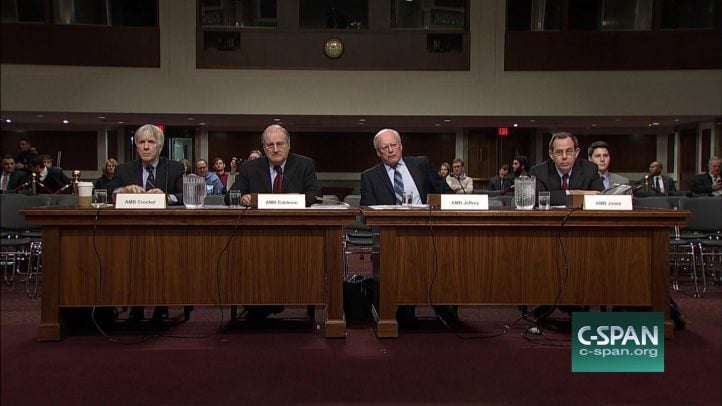
• In recent testimony before the Senate Armed Services Committee, four former U.S. diplomats provided remarkably candid commentary on recent U.S. involvement in the Middle East, revealing a number of the most closely guarded secrets of U.S. diplomacy.
The four former diplomats emphasized the importance of the region’s oil, spoke critically about the weaknesses of U.S. strategy, made a number of crude comments about U.S. partners, displayed little concern about ongoing violence, and called for more “discipline” throughout the region.
One of the former diplomats, James Jeffrey, criticized the Obama administration for withdrawing U.S. forces from Iraq in 2011 rather than going through with a secret deal to maintain a secret network of military bases in the country. Even today, Jeffrey said, officials in Washington must not “melt down” and retrench when U.S. forces get killed. Officials must accept that there could always be “new Benghazis and new Nigers,” he said, referring to incidents in which U.S. agents have been killed.
The four former diplomats also lambasted U.S. partners in the region. They criticized many of their closest allies for poor governance, a lack of democracy, and an inability to coordinate on shared strategic objectives.
Jeffrey made some of the strongest criticisms, charging Kurdish leaders in Iraqi Kurdistan with making their region into “another basket case” in the Middle East. He also complained that U.S. officials had to deal “with a lot of bitching” from the Turkish government over U.S. support for the Kurdish fighters confronting the Islamic State (ISIS or IS) in Syria.
In addition to Jeffrey, who once held high-level positions in the George W. Bush administration, the group of former diplomats included Ryan Crocker, Eric Edelman, and Stuart Jones. Crocker has been the U.S. ambassador to six different countries in the Middle East. Edelman and Jones, who have both been diplomats in the Middle East, have held senior positions in numerous administrations.
Over the past few decades, all four men have played significant roles in crafting and implementing U.S. policies in the region. They were “giants” who had “walked the earth,” according to Edelman.
Together, these four former diplomats called on the Trump administration to play a more assertive role in the Middle East. Although they largely agreed that IS has been significantly weakened over the last two and a half years, removing a significant challenge to U.S. power, they saw ongoing challenges from Iran and Russia and growing problems between the U.S. and its allies. They wanted to ensure that the United States remained well positioned to call the shots in the region and maintain a U.S.-led system of regional order.
“Clarity on U.S. plans and goals and particularly success against Iran will help mobilize allies, but the U.S. must discipline the system and overwatch partners constantly,” Jeffrey said.
The Strategic Concerns
Some of the more astounding revelations concern the basic reason why U.S. officials remain so focused on the Middle East. Although U.S. officials typically emphasize the problems of terrorism and security, a number of the former diplomats indicated that the major concerns have always been the region’s oil, location, and function in the global economy.
Former diplomat Eric Edelman made the clearest statement on the matter, explaining in his prepared statement that geostrategic calculations have been central factors in U.S. policy since the end of World War II. “U.S. policymakers have considered access to the region’s energy resources vital for U.S. allies in Europe, and ultimately for the United States itself,” he wrote. “Moreover, the region’s strategic location—linking Europe and Asia—made it particularly important from a geopolitical point of view.”
Edelman went on to suggest that U.S. actions in the region have been consistently based on these geostrategic factors. He cited the Carter Doctrine of 1980, which identified the Persian Gulf as a region so vital to U.S. interests that the U.S. would militarily intervene in the region to expel outside forces. He also cited the first Gulf War against Iraq, in which the U.S. militarily intervened to expel Iraqi forces from Kuwait.
“The geostrategic and economic factors that made the Middle East so important to our national security in the past are just as potent today,” Edelman said. Even with recent increases in U.S. energy production as a result of the fracking revolution, “real or even potential disruptions to the flow of oil anywhere would have serious negative effects on our economy.”
With his remarks, Edelman made it clear that U.S. officials continue to value the Middle East for its oil. The region “contains half of global proven oil reserves, accounts for one-third of oil production and exports, and is home to three of the world’s four biggest oil transit chokepoints,” he explained.
When Edelman raised these points during the hearing, nobody disagreed with him. Neither his colleagues nor the committee members challenged his observations about why the region was so important. His remarks were considered so uncontroversial that they never came up for debate.
Instead, the current and former officials focused their discussion on what they thought were the main challenges to U.S. access to the area. Their primary concern was that Russia and Iran were working together to challenge the U.S.-led system of regional order with the hopes of creating some alternative system.
“In reality, both Russia and Iran want to roll back U.S. influence even further in the region, and each depends on the other to help it do so,” Edelman warned in his prepared statement.
During the hearing, Jeffrey made a similar point, saying that “Russia and Iran and, to some degree, Syria want to change the mix of the Middle East.” The U.S. and its allies, he continued, must maintain the current system and “at the end of the day we just have to push back.”
In these ways, the former diplomats provided some remarkable insights into the most basic reasons behind U.S. actions in the Middle East. They revealed that basic U.S. policy was to maintain a U.S.-led system of regional order so that the U.S. government could influence how all parts of the world gained access to the region’s oil.
Frictions
Throughout the hearing, the four former diplomats also made a number of unusually blunt criticisms of U.S. strategy. They felt that their superiors in Washington and their many partners throughout the region kept taking steps that were creating more problems in the area.
Jeffrey was especially critical of the Obama administration, which he blamed for failures in the second Gulf War against Iraq. Jeffrey, who was the Obama administration’s ambassador to Iraq during the period when U.S. forces withdrew from the country in 2011, said that the administration should have accepted a secret plan to keep U.S. forces in the country. Jeffrey explained that administration officials had arranged a secret plan with Iraqi Prime Minister Nouri al-Maliki “to cheat, with Maliki’s acknowledgement,” on the final agreement to withdraw U.S. forces from the country. “We had Black SOF, White SOF,” he said, seemingly referring to different kinds of Special Operations Forces. “We had drones, we had all kinds of things,” he added.
Jeffrey was reluctant to provide more details, but he insisted that the secret plan could have worked if his superiors in the Obama administration had tried it. He did not express any concern about the fact that an estimated 100,000 people had already died in the war.
“It was a very big package, including a $14 billion FMS program,” Jeffrey said, referring to a program of military sales. “We had bases all over the country that were disguised bases that the U.S. military was running.”
Although the other former diplomats on the panel largely agreed that the Obama administration should not have withdrawn U.S. forces from Iraq in 2011, they were convinced that U.S. partners shared much of the blame for ongoing violence in the area. The former diplomats accused many of their closest partners and allies of acting in ways that were creating problems.
Sometimes, “they will do things in a way that we think makes things worse rather than better,” Edelman said.
Jeffrey agreed with his colleagues, saying it was simply the price of operating in the Middle East. To maintain access to the region, he explained, “we have to rely on five countries—Israel, Saudi Arabia, Turkey, Pakistan, and Egypt.” Each of them, he said, came with significant problems, all of which made it difficult to operate in the area. “We wouldn’t pick these allies if we were coming up with a different Middle East, but we have to deal with the Middle East we have,” he said.
Jeffrey was especially critical of Turkey, a NATO ally. He said that “the things they do are toxic.”
Since a putsch attempt against the Turkish government in July 2016, Turkish leaders have accused the U.S. government of involvement. As part of the government’s subsequent crackdown on its domestic opponents, an estimated 150,000 Turks have been fired from their jobs, 60,000 have been arrested, 1,500 civil society organizations have been disbanded, and more than 100 media outlets have been closed.
The crackdown came amid a period of growing tensions between the U.S. and Turkish governments. Differences over how to deal with the war in Syria and relations with Russia have added to the tensions in the relationship.
“It’s unpleasant, it’s transactional, it’s ugly,” Jeffrey said.
Edelman, who believed that the U.S. bore “a little bit of the blame here for this deterioration in relations,” still called for a tougher approach. “I don’t think we can tolerate some of the behavior that our Turkish allies are showing,” he said.
Ryan Crocker reminded the committee members that the United States still relied on Turkey to maintain access to the region. He said that it would be necessary to continue working with the country’s repressive leadership, despite its troubling behavior.
“They are a NATO partner in a region where we don’t have a choice between democracy and autocracy,” Crocker said. “That’s not on the table.”
Jeffrey provided one of the most telling comments on the situation when he acknowledged that the Turkish government continued to tolerate U.S. support for the Kurdish fighters who were fighting IS in Syria. The Kurdish fighters, he explained, were an offshoot of the Kurdistan Worker’s Party (PKK), a group that both the U.S. and Turkish governments consider to be a terrorist organization.
“The Turks are allowing us to support the PKK offshoot Kurds in Syria every day—reluctantly, with a lot of bitching, but they do it,” Jeffrey said.
The U.S. decision to support the Kurdish fighters created additional controversy because of Kurdish aspirations to create their own state. The governments of countries with significant Kurdish populations, including Iran, Iraq, Syria, and Turkey, all opposed the idea.
When Iraqi Kurds living in the autonomous region of Iraqi Kurdistan voted last September to explore the possibility of independence, they faced a significant backlash. Weeks after the vote, the Iraqi government sent its military forces into the region, reclaiming the oil-rich area of Kirkuk while weakening the independence movement.
The former diplomats signaled their support for the Iraqi government’s military operations, despite the fact that the Iraqi Kurds were playing a significant role in the war against IS.
Jeffrey argued that Iraq must hold together because of its potential to produce so much oil. He said that Iraq could eventually enter “into the Saudi Arabia category,” meaning that it could become a major player in the global oil market. “That’s a very important trump card, so to speak, in the Middle East, and we don’t want to just break it up,” he said.
Jeffrey was especially critical of the Iraqi Kurds for pursuing independence, saying that “they have gone in three months from one of the best good-news stories in the region to another basket case.”
If they keep crossing “red lines,” Ryan Crocker said, “we’re probably not going to be around to back them up when the going gets rough.”
“It’s the same as, sadly, with the Christian communities,” Crocker added, referring to Iraqi Christians who were facing their own challenges.
In these ways, the former diplomats made it clear that they were willing to ignore the plight of their partners and other marginalized groups if they could not find any strategic reasons to support them. The challenges facing the Kurds and Christians, they indicated, were minor factors compared to the strategic factors at play.
Taken together, their comments indicated that geostrategic calculations remained paramount. The four former diplomats may not have liked all of their partners, but they all believed that they had to accept these trade-offs if they were going to achieve their plans for the region.
“We can’t be going at each other, scratching each other because of these secondary sins when the real sinning in the region is done by Islamic terrorists and Iran,” Jeffrey said. “So we have to get a better hold of our allies.”
The Final Outlook
In spite of the rather complex strategic landscape, the four former diplomats still acknowledged that the United States maintained tremendous influence throughout the Middle East. They largely agreed that the United States remained the dominant power in the region with no comparable rival.
In his prepared statement, Edelman acknowledged that U.S. naval and air power in the Persian Gulf “outmatches Iran’s.”
Jeffrey agreed, explaining that the U.S. maintained “significant assets” throughout the Middle East. “Most of the states in the region are our security partners, with a huge conventional superiority, along with CENTCOM, over Iran, even with Russian support,” Jeffrey explained.
CENTCOM, short for U.S. Central Command, hosts about 80,000 U.S. military forces at numerous bases and offshore sites throughout the region. Over the past two-and-a-half years, CENTCOM has put its power on display in the war against IS. Since August 2014, coalition forces have conducted nearly 25,000 airstrikes in Iraq and Syria. As of April 2017, they had killed as many as 70,000 ISIS fighters, according to their own estimates.
As part of the campaign, U.S. forces have gained a major new foothold in Syria. “We have a lot of assets in Syria even though it doesn’t look that way,” Jeffrey said. “We and the Turks between us hold about a third of the country and have a lot of local allies.”
U.S. forces have also reestablished a powerful military presence in Iraq, now basing more than 5,000 U.S. forces in the country.
Currently, all signs indicate the United States is increasing its hold over the Middle East.
The only problem, according to the former diplomats, is that the United States continues to face significant resistance. Although the U.S. has constructed a kind of informal American empire, they believe that U.S. actions and polices are creating blowback that is bringing more conflict and violence to the region.
“Anything we do to contain Iran, to push back, will bring with it great risks to us and to people in the region,” Jeffrey said. These were the lessons of history, he explained, citing “the chaos we deliberately created” to confront past challengers in Afghanistan, Iraq, and Iran.
Moving forward, Jeffrey believed it would be better to conduct what he called “economy-of-force, light-footprint operations with our allies.” He suggested that these types of operations would be more effective, even if they resulted in additional violence.
“That will produce new Benghazis and new Nigers,” Jeffrey said. But “we have to be able to move on and not melt down when these things happen because this is the right way to approach it.”
Indeed, Jeffrey insisted that it would be necessary to accept more death and violence if the United States was going to achieve its strategic objectives. This kind of trade-off, he believed, was simply how things worked in the area. Citing recent retaliatory actions by the Israeli and Saudi government against missile attacks, Jeffrey said that the high civilians death tolls that resulted from such operations had simply become one of the costs of military engagement in the region.
“Ten thousand more dead civilians in the Middle East, in a region that’s seen 1 million in the last 30 years, by my count… are not going to deter the Saudis and the Israelis from acting against this threat,” he said.






2 Responses
Mr. Jeffrey quite bluntly states that “We have a lot of assets in Syria even though it doesn´t look that way. We and the Turks between us hold about a third of the country and have a lot of local allies.” Well worth noticing.
Thank you, Vagn – indeed it is worth noticing – as are other quite frank statements. And of course we have seen no raised eyebrows in the Western mainstream media.