What Africa taught the Rev. Martin Luther King, Jr.

By Juan Cole

January 15, 2018 – Informed Comment

In 1957 Martin Luther King and his wife Coretta went to Ghana in connection with its independence from Britain. The British had grabbed the fabled West African Gold Coast in the nineteenth century in order to profit from its gold and other resources (after having profited in the 18th century from slaving in the region). As late as the 1940s and 1950s British colonial troops treated the local population with brutality.

Originally published on Informed Comment

Despite the myth that European colonial empires did volunteer development work for peoples of the global south, mostly they invested almost nothing in industry and any infrastructure they put in was for their armies, administrators, primary product exports and settlers. Lord Cromer actually refused to spread education in Egypt, e.g. In the British Gold Coast/ Ghana, what little education and literacy the colonialists introduced was for the formation of a small collaborating bureaucratic class or for missionary work. In the Gold Coast/ Ghana the British developed a colonial export economy in the early twentieth century based on cocoa. You never get rich off of agriculture; it was industry that made a country wealthy. And even in export agriculture you need to keep all your profits to get ahead, whereas the British took their cut. Then in the Great Depression the bottom fell out of the export market anyway. Despite all the disappointments of postcolonial government since 1957, poverty has been reduced by independent Ghana from 50% to 25% of the population and literacy has been raised to 71% from almost nothing under the British. Ghana has been a functioning democracy for some time now.

There is a sense in which African-American populations in the South were under a sort of colonial rule with Jim Crow, as well.

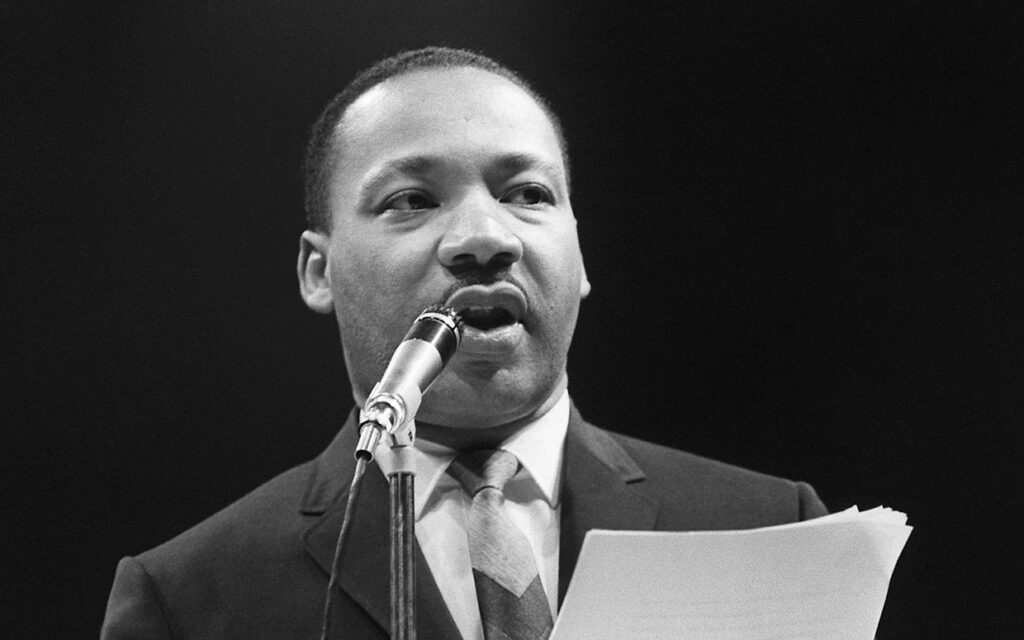
In his sermon on the Birth of a Nation,, King addressed a church congregation in Montgomery, Alabama.

King remarked,

“You also know that for years and for centuries, Africa has been one of the most exploited continents in the history of the world. It’s been the “Dark Continent.” It’s been the continent that has suffered all of the pain and the affliction that could be mustered up by other nations. And it is that continent which has experienced slavery, which has experienced all of the lowest standards that we can think about, and its been brought into being by the exploitation inflicted upon it by other nations. ”

That European colonial nations raped Africa of its resources and reduced its populations from free peoples to colonial subjects goes without saying. Belgium is alleged to have polished off about half the population of the Congo in the course of its rapine. Now, in the 1950s and 1960s that era of direct foreign rule was coming to an end.

He detailed the competition for the resources of the Gold Coast and added,

“Finally, in 1850, Britain won out, and she gained possession of the total territorial expansion of the Gold Coast. From 1850 to 1957, March sixth, the Gold Coast was a colony of the British Empire. And as a colony she suffered all of the injustices, all of the exploitation, all of the humiliation that comes as a result of colonialism. But like all slavery, like all domination, like all exploitation, it came to the point that the people got tired of it.

And that seems to be the long story of history. There seems to be a throbbing desire, there seems to be an internal desire for freedom within the soul of every man. And it’s there — it might not break forth in the beginning, but eventually it breaks out.”

What King took away from the sordid story of colonial oppression and brutal extraction of resources was the universal human yearning to be free. And he was proud that Ghana’s independence leader, Kwame Nkrumah (1909-1972), had been educated at the University of Pennsylvania.

He also firmly believed that nonviolent methods were the best, perhaps only path to true liberation:

“It says to us another thing. It reminds us of the fact that a nation or a people can break aloose from oppression without violence. Nkrumah says in the first two pages of his autobiography, which was published on the sixth of March — a great book which you ought to read — he said that he had studied the social systems of social philosophers and he started studying the life of Gandhi and his techniques. And he said that in the beginning he could not see how they could ever get aloose from colonialism without armed revolt, without armies and ammunition, rising up. Then he says after he continued to study Gandhi and continued to study this technique, he came to see that the only way was through nonviolent positive action. And he called his program “positive action.” ”

It wasn’t only that nonviolence is a useful, utilitarian tool of social mobilization. In King’s view its beauty is the promise it lays out for peaceful post-conflict reconciliation:

“The aftermath of nonviolence is the creation of the beloved community. The aftermath of nonviolence is redemption. The aftermath of nonviolence is reconciliation. The aftermath of violence however, are emptiness and bitterness. This is the thing I’m concerned about. Let us fight passionately and unrelentingly for the goals of justice and peace, but let’s be sure that our hands are clean in this struggle. Let us never fight with falsehood and violence and hate and malice, but always fight with love, so that, when the day comes that the walls of segregation have completely crumbled in Montgomery. that we will be able to live with people as their brothers and sisters.”

King was exuberant about independence but was anything but naive. He was well aware of the severe economic and other challenges facing newly independent countries in Africa:

“Now it will confront its wilderness. Like any breaking aloose from Egypt, there is a wilderness ahead. There is a problem of adjustment. Nkrumah realizes that. There is always this wilderness standing before him. For instance, it’s a one-crop country, cocoa mainly. Sixty percent of the cocoa of the world comes from the Gold Coast, or from Ghana. And, in order to make the economic system more stable, it will be necessary to industrialize. Cocoa is too fluctuating to base a whole economy on that…”

Colonialism made economies in the global South “lopsided” in the term of the great economic historian of the Middle East, Charles Issawi.

King was thinking analogically. What the system of racial injustice in the United States does, as the Ferguson investigation revealed, is to transfer resources (through fines and jailing for minor or trumped up “offenses”) from African-American communities to white elites. He saw clearly that racial hierarchy and domination has a powerful economic dimension. In fact, despite the legislative victories of the Civil Rights movement, which were inspired so powerfully by African decolonization, the big failure of race relations in the past fifty years is that the per capita wealth holdings of African-Americans have remained tiny compared to those of the whites, and African-Americans have been excluded from the economic growth of these last five decades (though to be fair it is mainly the top 10% or 30 million mostly upper middle class and wealthy whites who have grabbed most of this increase).

To the extent that at least in the surface law the shameful episode of some Americans treating others as pariahs, with laws on the books against racial intermarriage, joint schooling, even using the same bathrooms and water fountains, has ended–to that extent our nation owes an enormous debt to African freedom fighters of the 1940s and 1950s who inspired Americans to begin addressing their internal colonialism.

As Dr. King so memorably said, it is not the color of your skin that matters (nor the poverty of your neighborhood) but the content of your character.

Originally published on Informed Comment


Related video:

Martin Luther King Jr After his Journey to Africa

Related Posts

By Jan ObergTFF co-founder and director February 11, 2026 PART 3 — ECONOMICS, TRADE & FINANCIAL SOVEREIGNTY A. Trade Measures & Market Signaling Economic pressure can be applied instantly and scaled without violence. Immediate Measures (within a week) Government boycott US goods and services  A very powerful signal which over time will be felt. Targeted tariffs on selected U.S. goods Symbolic but high-visibility sectors send a clear message. Suspend trade facilitation talks A peaceful pause that signals deep concern. Freeze U.S. participation in public procurement – military procurement in particular A nonviolent way to reduce influence. Competition law review of U.S. corporations A legal tool to scrutinise market dominance. Longer-Term Measures EU–Asia–Africa trade corridors Reducing reliance on U.S. markets. European supply chains for critical minerals Strategic autonomy in resource access. European Strategic Trade Authority Monitoring coercive practices globally. Euro-denominated commodity markets Weakening the dollar’s pricing monopoly. The EU must resume contacts and negotiations with Russia, focusing on energy cooperation To...
PART 2 — Diplomacy, Law and Nonviolent Power By Jan ObergTFF co-founder and director January 26, 2026 This is the second of four TFF-created idea portfolios designed to curb the global reach of the United States and, in both the short and long term, help catalyse a worldwide nonviolent resistance to what many observers describe as the Trump administration’s uniquely confrontational, destructive and world-threatening policies. These portfolios outline what governments and citizens across the world can do through dynamic diplomacy, creative initiatives, and strictly nonviolent means. They are typical TFF works in that we do not only tell what the problem is and how bad it will go – as 90+% of all commentators, experts and scholars do – we tell what we think can be done, inviting you to think of what you think you can do. It seems painfully clear to me that the current political dynamics in Washington increasingly resemble the most dangerous...
Introduction to TFF’s forthcoming four Idea Portfolios of Diplomatic and Nonviolent Resistance By TFF’s Board & FoundersPascal Lottaz, Biljana Vankovska, Annette Schiffmann, Christina Spannar & Jan Oberg January 19, 2026 “America, you are too arrogant.” — Martin Luther King Jr. Over the course of Trump’s first term and now a year into his second, the world has witnessed a consistent pattern of actions that challenge the basic long-standing norms of international cooperation, weaken multilateral institutions, and ignore the global norms and legal frameworks established by the UN Charter. During these years, we have witnessed military operations in Iran, Syria and Ukraine without UN authorisation; the killing of Iranian General Qassem Soleimani; repeated strikes across the Middle East; and the launch of tariff wars against allies and competitors alike. We have seen a renewed emphasis on nuclearism and zero interest in arms control and disarmament negotiations. Pentagon is now The Department...

Recent Articles

What the West Borrowed from Asia and What It Left Behind Jan Krikke October 8, 2026 The article was originally published here In the late 1960s, the musical Hair announced that the Age of Aquarius was dawning. Its opening anthem promised a transformation of human consciousness: an era of peace, harmony and understanding. Half a century later, a familiar echo of that promise is a meditation app offered by your employer. You can find it in the same list of benefits as the pension plan and the gym discount. How did a spiritual revolution become an employee benefit? The answer lies in the history of the movement known as New Age: where it came from, what it borrowed from Asia, and why the meaning of what it borrowed changed in the process. Two definitions will help. New Age is a loose label for a wide range of spiritual practices and...
Small and different + among the 10% most active + 9,000 texts + 150 Associates + 60 000 a day — and a stubborn belief that peace is smarter and must be secured by peaceful means. In 2026, the Transnational Foundation for Peace and Future Research (TFF) turns 40. On Monday, October 5, 2026, a new TFF homepage will go live — a new gateway to more than 9,000 articles, analyses, research papers and other contributions produced over four decades of independent peace research. But this is not simply a new website. For four decades, TFF has worked from a simple conviction: peace is smarter than militarism and can be brought about by peaceful means. This is not merely an aspiration. It is the principle expressed in the UN Charter and the Gandhian tradition that has guided our work from the beginning. TFF is a research-based, independent and people-financed foundation....
Tony Robinson October 4, 2026 Violence is easy to recognise when someone is being beaten, shot or killed. It becomes more difficult when nobody is holding a weapon. Poverty, discrimination, exploitation and repression can restrict a human life just as effectively, although they do so in very different ways and with very different consequences. Simply adding more categories to an ever-growing list of forms of violence does not really solve the problem. The more interesting question is what all these different situations have in common and why it makes sense to describe them using the same word. Human beings do not simply react to what happens around them. They remember the past, imagine things that do not yet exist, make plans and undertake projects. Workers organise because they imagine different working conditions; people migrate because they imagine another life somewhere else; social movements emerge because people refuse to accept the...

TFF on Substack

Discover and subscribe to more peace materials on TFF Substack

Most Popular

What the West Borrowed from Asia and What It Left Behind Jan Krikke October 8, 2026 The article was originally published here In the late 1960s, the musical Hair announced that the Age of Aquarius was dawning. Its opening anthem promised a transformation of human consciousness: an era of peace, harmony and understanding. Half a century later, a familiar echo of that promise is a meditation app offered by your employer. You can find it in the same list of benefits as the pension plan and the gym discount. How did a spiritual revolution become an employee benefit? The answer lies in the history of the movement known as New Age: where it came from, what it borrowed from Asia, and why the meaning of what it borrowed changed in the process. Two definitions will help. New Age is a loose label for a wide range of spiritual practices and...
Small and different + among the 10% most active + 9,000 texts + 150 Associates + 60 000 a day — and a stubborn belief that peace is smarter and must be secured by peaceful means. In 2026, the Transnational Foundation for Peace and Future Research (TFF) turns 40. On Monday, October 5, 2026, a new TFF homepage will go live — a new gateway to more than 9,000 articles, analyses, research papers and other contributions produced over four decades of independent peace research. But this is not simply a new website. For four decades, TFF has worked from a simple conviction: peace is smarter than militarism and can be brought about by peaceful means. This is not merely an aspiration. It is the principle expressed in the UN Charter and the Gandhian tradition that has guided our work from the beginning. TFF is a research-based, independent and people-financed foundation....
Tony Robinson October 4, 2026 Violence is easy to recognise when someone is being beaten, shot or killed. It becomes more difficult when nobody is holding a weapon. Poverty, discrimination, exploitation and repression can restrict a human life just as effectively, although they do so in very different ways and with very different consequences. Simply adding more categories to an ever-growing list of forms of violence does not really solve the problem. The more interesting question is what all these different situations have in common and why it makes sense to describe them using the same word. Human beings do not simply react to what happens around them. They remember the past, imagine things that do not yet exist, make plans and undertake projects. Workers organise because they imagine different working conditions; people migrate because they imagine another life somewhere else; social movements emerge because people refuse to accept the...
Read More
8824b09f-33a5-43f9-9fd0-550f28cda24d_1536x1024
What the West Borrowed from Asia and What It Left Behind Jan Krikke October 8, 2026 The article was originally published here In the late 1960s, the musical Hair announced that the Age of Aquarius was dawning. Its opening anthem promised a transformation of human consciousness: an era of peace, harmony and understanding. Half a century later, a familiar echo of that promise is a meditation app offered by your employer. You can find it in the same list of benefits as the pension plan and the gym discount. How did a spiritual revolution become an employee benefit? The answer lies in the history of the movement known as New Age: where it came from, what it borrowed from Asia, and why the meaning of what it borrowed changed in the process. Two definitions will help. New Age is a loose label for a wide range of spiritual practices and...
Screenshot 2026-10-04 210142
Small and different + among the 10% most active + 9,000 texts + 150 Associates + 60 000 a day — and a stubborn belief that peace is smarter and must be secured by peaceful means. In 2026, the Transnational Foundation for Peace and Future Research (TFF) turns 40. On Monday, October 5, 2026, a new TFF homepage will go live — a new gateway to more than 9,000 articles, analyses, research papers and other contributions produced over four decades of independent peace research. But this is not simply a new website. For four decades, TFF has worked from a simple conviction: peace is smarter than militarism and can be brought about by peaceful means. This is not merely an aspiration. It is the principle expressed in the UN Charter and the Gandhian tradition that has guided our work from the beginning. TFF is a research-based, independent and people-financed foundation....
Living-Peace-Sign-Budapest-copy
Tony Robinson October 4, 2026 Violence is easy to recognise when someone is being beaten, shot or killed. It becomes more difficult when nobody is holding a weapon. Poverty, discrimination, exploitation and repression can restrict a human life just as effectively, although they do so in very different ways and with very different consequences. Simply adding more categories to an ever-growing list of forms of violence does not really solve the problem. The more interesting question is what all these different situations have in common and why it makes sense to describe them using the same word. Human beings do not simply react to what happens around them. They remember the past, imagine things that do not yet exist, make plans and undertake projects. Workers organise because they imagine different working conditions; people migrate because they imagine another life somewhere else; social movements emerge because people refuse to accept the...
b54a1f10-8c65-4f0b-9dd5-4abc0a7d04cc_2659x2659
It’s a matter of principles, courage, vision and pulling together – while the militarist world is falling apart… Peter Langille October 3, 2026 “Here, then, is the problem which we present to you, stark and dreadful and inescapable: Shall we put an end to the human race; or shall mankind renounce war?”The Bertrand Russell—Albert Einstein Manifesto, July 9, 1955 ⁕ The forecast for what’s ahead is worrisome. The sharp rise in armed conflicts over the past three years is adding to what was already the highest level in over seventy years. Genocides, which should be prevented are supported. A shared climate emergency that jeopardises survival is ignored. Diverse polls now suggest that people are war-weary, worried and interested in a more effective United Nations. And, there are viable policy options for a more secure world! Yet governments are doubling-down, betting on more war and investing heavily. If current trends persist,...
010
Johan Galtung 1930-2024October 2015 Published here on October 3, 2026 Let us focus on Civilization for conflict analysis and remedies. Major forms of disorder use violence; war is state organized violence. The most belligerent states are the United States of America and Israel, both with civilization roots. National Evangelism, the US Protestant Christian civilization– more national than evangelical–justifies US warfare as exceptionalism of a people chosen by God, with a manifest destiny to run the world. Orthodox Judaism justifies Israeli warfare to conquer and expand from Nile to Euphrates as a religious right and duty to the Eternal One. The third most belligerent country, the UK, no longer believes it is God-chosen but chosen by the USA; not quite the same but something. But the root cause of global disorder lies in the Occident–with Islam–seeing itself as the single, universal civilization valid for all at all times, all others being...
Screenshot 2026-10-02 011738
Jan Oberg PhD, director, The Transnational Foundation for Peace and Future Research, TFFLund, Sweden October 2, 2026 This is my full original manuscript. The Chinese Academy of Social Science, CASS, makes two publications out if it. 1. China’s Five-year plan emphasized the capabilities of basic research and original innovation. It is regarded as the goal of the future social development, which, as required, should be significantly enhanced. Can you comment on the importance of original innovation in research and academic study? I believe it is easier to define “original innovation” in the natural sciences than in social sciences. The breaking points of what constitutes something new, or innovative, are not quite as sharp in the latter. But in both fields it is about opening up something that was closed, unseen, unexplored before – making manifest what was earlier latent. Innovations come in many forms and shapes – naming something that was...