How Governments and Citizens Can Stop the Trump Regime’s World-Threatening Designs

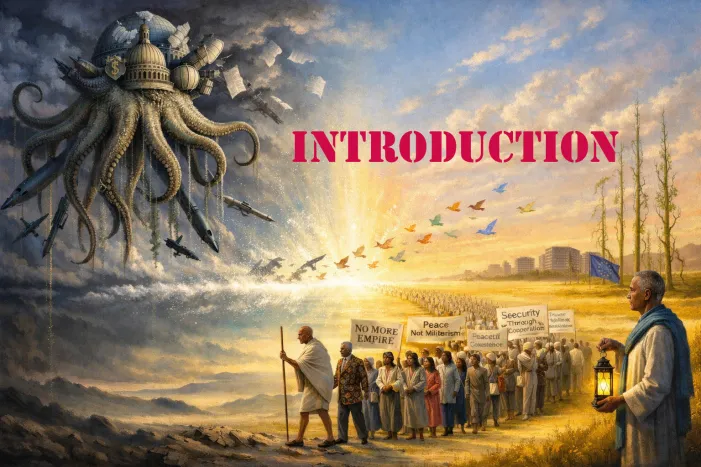
AI created illustration after an idea by Jan Oberg – the EU flag in the right background

Introduction to TFF’s forthcoming four Idea Portfolios of Diplomatic and Nonviolent Resistance

By TFF’s Board & Founders
Pascal Lottaz, Biljana Vankovska, Annette Schiffmann, Christina Spannar & Jan Oberg

January 19, 2026

“America, you are too arrogant.”

— Martin Luther King Jr.

Over the course of Trump’s first term and now a year into his second, the world has witnessed a consistent pattern of actions that challenge the basic long-standing norms of international cooperation, weaken multilateral institutions, and ignore the global norms and legal frameworks established by the UN Charter.

During these years, we have witnessed military operations in Iran, Syria and Ukraine without UN authorisation; the killing of Iranian General Qassem Soleimani; repeated strikes across the Middle East; and the launch of tariff wars against allies and competitors alike. We have seen a renewed emphasis on nuclearism and zero interest in arms control and disarmament negotiations. Pentagon is now The Department of War.

We have seen travel bans targeting entire nationalities; visa denials for diplomats meant to attend UN meetings; and threats to withdraw from NATO while demanding that allies spend 5% of their GDP on the military without any shared threat analysis. We have also witnessed systematically confrontational policies and orchestrated and well-financed media campaigns directed against China and other actors.

U.S. policies have involved unwavering support for Israel’s devastating genocidal military campaign in Gaza; recognition of Juan Guaidó as “president” of Venezuela and the kidnapping of Nicolas Maduro with spouse as well as taking control over Venezuelan state assets; hard pressure on Ukraine to de facto let go of its natural resources; withdrawal from the JCPOA with Iran; and public statements about acquiring territories such as Canada, Mexico, Cuba, and Greenland — the latter being an integral part of Denmark, a loyal U.S. ally since 1948.

The rhetoric surrounding these actions has been confrontational, personalised as arrogant or vulgar, and consistently dismissive of international law. Domestically, Trump has dismissed officials, centralised executive power, and pursued a “law and order” agenda that cannot help but raise profound concerns about democratic norms within the United States. It is not only warfare on most of the world; it is also a domestic war.

The speed, surprise, and scale of these actions — combined with the near absence of meaningful international countermeasures — is likely to create the dangerous illusion within the Trump Regime circles: that such behaviour carries no cost, that it can continue indefinitely, and that the world will simply adjust to whatever it does next. Most likely, Trump thinks to himself – I can obviously get away with doing what I want – and I will.

Europe – fragmented, submissive, and visionless – has shown little willingness or ability to respond beyond words, and more words. Instead of developing a creative alternative West, European leaders travel physically or mentally to sit at the feet of the Emperor.

Military confrontation is neither realistic nor desirable, yet eminently productive tools such as diplomacy, conflict resolution, and concrete nonviolent measures have barely been considered. The result is paralysis — and paralysis invites escalation.

We believe this moment demands something different. Not passivity. Not fear. Not the old reflex of waiting for a “better” post-Trump America.

We demand – and propose – diplomatic and other nonviolent resistance — principled, lawful, creative, and global with the aim of stopping the Trump Regime from doing more harm to humanity.

What will follow this introduction, therefore, is four portfolios of immediate and long-term measures that governments, institutions, and citizens can take to signal boundaries, impose costs, and demonstrate that even the most militarily powerful state operates within limits.

None of these proposals is military, coercive, or vengeful. They are grounded in international law, civic mobilisation, economic sovereignty, and the collective strength of global civil society. But, yes, they require civil courage and a will to do some new thinking. The situation seems to make both imperative.

TFF’s four idea portfolios would imply the most far-reaching nonviolent resistance to U.S. policy since 1945.

It is necessary because the belief that the United States is inherently a force for good in our world — or that Trump is an aberration — has become a dangerous illusion. The elites inside the US Military-Industrial-Media-Academic Complex, MIMAC, feed him so that he can serve them.

Likewise, it is delusional to hope for the ‘good old America’ to return after Trump’s second (or third) term. His destruction of the US will be beyond repair. Furthermore, his personal style is indeed special, but he operates fully within the parameters of the US Empire and how an empire behaves when its decline and fall become more and more clear to itself and the rest of the world.

The world cannot rely on nostalgia or wishful thinking. One may paraphrase a thinker reflecting on the Second World War: those who sleep in times of peace and democracy may well wake up in a dictatorship at war.

TFF insists that better paths exist — grounded in creativity, nonviolence, and international law. We insist that there is a huge spectrum of possible actions between fighting the US militarily and doing nothing.

We therefore publish these Four Idea Portfolios of Resistance, followed by a vision for transforming the Arctic into a Zone of Cooperation that benefits local communities, the region, and the world.

Please look out for these five TFF documents in the near future.

If you find them useful and necessary, please share them widely so that we can build critical nonviolent mass for resistance and thereby promote a future with much more justice, peace and respect for global norms and laws.

The implementation of at least some of these ideas will also enable the world to again dialogue about solutions to humanity’s real and very urgent problems and reduce the attention to destructive Trumped-up militarism and imperial narratives.

The world must act now. The window of action may soon close.

◆

Introduction: How Governments and Citizens Can Stop the Trump Regime’s World-Threatening Designs

Part 1 – Media, Culture and Information Sovereignty

Part 2 – Diplomacy, Law and Nonviolent Power

Part 3 – Economics, trade and financial sovereignty

Related Posts

What the West Borrowed from Asia and What It Left Behind Jan Krikke October 8, 2026 The article was originally published here In the late 1960s, the musical Hair announced that the Age of Aquarius was dawning. Its opening anthem promised a transformation of human consciousness: an era of peace, harmony and understanding. Half a century later, a familiar echo of that promise is a meditation app offered by your employer. You can find it in the same list of benefits as the pension plan and the gym discount. How did a spiritual revolution become an employee benefit? The answer lies in the history of the movement known as New Age: where it came from, what it borrowed from Asia, and why the meaning of what it borrowed changed in the process. Two definitions will help. New Age is a loose label for a wide range of spiritual practices and...
Small and different + among the 10% most active + 9,000 texts + 150 Associates + 60 000 a day — and a stubborn belief that peace is smarter and must be secured by peaceful means. In 2026, the Transnational Foundation for Peace and Future Research (TFF) turns 40. On Monday, October 5, 2026, a new TFF homepage will go live — a new gateway to more than 9,000 articles, analyses, research papers and other contributions produced over four decades of independent peace research. But this is not simply a new website. For four decades, TFF has worked from a simple conviction: peace is smarter than militarism and can be brought about by peaceful means. This is not merely an aspiration. It is the principle expressed in the UN Charter and the Gandhian tradition that has guided our work from the beginning. TFF is a research-based, independent and people-financed foundation....
Tony Robinson October 4, 2026 Violence is easy to recognise when someone is being beaten, shot or killed. It becomes more difficult when nobody is holding a weapon. Poverty, discrimination, exploitation and repression can restrict a human life just as effectively, although they do so in very different ways and with very different consequences. Simply adding more categories to an ever-growing list of forms of violence does not really solve the problem. The more interesting question is what all these different situations have in common and why it makes sense to describe them using the same word. Human beings do not simply react to what happens around them. They remember the past, imagine things that do not yet exist, make plans and undertake projects. Workers organise because they imagine different working conditions; people migrate because they imagine another life somewhere else; social movements emerge because people refuse to accept the...

Recent Articles

What the West Borrowed from Asia and What It Left Behind Jan Krikke October 8, 2026 The article was originally published here In the late 1960s, the musical Hair announced that the Age of Aquarius was dawning. Its opening anthem promised a transformation of human consciousness: an era of peace, harmony and understanding. Half a century later, a familiar echo of that promise is a meditation app offered by your employer. You can find it in the same list of benefits as the pension plan and the gym discount. How did a spiritual revolution become an employee benefit? The answer lies in the history of the movement known as New Age: where it came from, what it borrowed from Asia, and why the meaning of what it borrowed changed in the process. Two definitions will help. New Age is a loose label for a wide range of spiritual practices and...
Small and different + among the 10% most active + 9,000 texts + 150 Associates + 60 000 a day — and a stubborn belief that peace is smarter and must be secured by peaceful means. In 2026, the Transnational Foundation for Peace and Future Research (TFF) turns 40. On Monday, October 5, 2026, a new TFF homepage will go live — a new gateway to more than 9,000 articles, analyses, research papers and other contributions produced over four decades of independent peace research. But this is not simply a new website. For four decades, TFF has worked from a simple conviction: peace is smarter than militarism and can be brought about by peaceful means. This is not merely an aspiration. It is the principle expressed in the UN Charter and the Gandhian tradition that has guided our work from the beginning. TFF is a research-based, independent and people-financed foundation....
Tony Robinson October 4, 2026 Violence is easy to recognise when someone is being beaten, shot or killed. It becomes more difficult when nobody is holding a weapon. Poverty, discrimination, exploitation and repression can restrict a human life just as effectively, although they do so in very different ways and with very different consequences. Simply adding more categories to an ever-growing list of forms of violence does not really solve the problem. The more interesting question is what all these different situations have in common and why it makes sense to describe them using the same word. Human beings do not simply react to what happens around them. They remember the past, imagine things that do not yet exist, make plans and undertake projects. Workers organise because they imagine different working conditions; people migrate because they imagine another life somewhere else; social movements emerge because people refuse to accept the...

TFF on Substack

Discover and subscribe to more peace materials on TFF Substack

Most Popular

What the West Borrowed from Asia and What It Left Behind Jan Krikke October 8, 2026 The article was originally published here In the late 1960s, the musical Hair announced that the Age of Aquarius was dawning. Its opening anthem promised a transformation of human consciousness: an era of peace, harmony and understanding. Half a century later, a familiar echo of that promise is a meditation app offered by your employer. You can find it in the same list of benefits as the pension plan and the gym discount. How did a spiritual revolution become an employee benefit? The answer lies in the history of the movement known as New Age: where it came from, what it borrowed from Asia, and why the meaning of what it borrowed changed in the process. Two definitions will help. New Age is a loose label for a wide range of spiritual practices and...
Small and different + among the 10% most active + 9,000 texts + 150 Associates + 60 000 a day — and a stubborn belief that peace is smarter and must be secured by peaceful means. In 2026, the Transnational Foundation for Peace and Future Research (TFF) turns 40. On Monday, October 5, 2026, a new TFF homepage will go live — a new gateway to more than 9,000 articles, analyses, research papers and other contributions produced over four decades of independent peace research. But this is not simply a new website. For four decades, TFF has worked from a simple conviction: peace is smarter than militarism and can be brought about by peaceful means. This is not merely an aspiration. It is the principle expressed in the UN Charter and the Gandhian tradition that has guided our work from the beginning. TFF is a research-based, independent and people-financed foundation....
Tony Robinson October 4, 2026 Violence is easy to recognise when someone is being beaten, shot or killed. It becomes more difficult when nobody is holding a weapon. Poverty, discrimination, exploitation and repression can restrict a human life just as effectively, although they do so in very different ways and with very different consequences. Simply adding more categories to an ever-growing list of forms of violence does not really solve the problem. The more interesting question is what all these different situations have in common and why it makes sense to describe them using the same word. Human beings do not simply react to what happens around them. They remember the past, imagine things that do not yet exist, make plans and undertake projects. Workers organise because they imagine different working conditions; people migrate because they imagine another life somewhere else; social movements emerge because people refuse to accept the...
Read More
8824b09f-33a5-43f9-9fd0-550f28cda24d_1536x1024
What the West Borrowed from Asia and What It Left Behind Jan Krikke October 8, 2026 The article was originally published here In the late 1960s, the musical Hair announced that the Age of Aquarius was dawning. Its opening anthem promised a transformation of human consciousness: an era of peace, harmony and understanding. Half a century later, a familiar echo of that promise is a meditation app offered by your employer. You can find it in the same list of benefits as the pension plan and the gym discount. How did a spiritual revolution become an employee benefit? The answer lies in the history of the movement known as New Age: where it came from, what it borrowed from Asia, and why the meaning of what it borrowed changed in the process. Two definitions will help. New Age is a loose label for a wide range of spiritual practices and...
Screenshot 2026-10-04 210142
Small and different + among the 10% most active + 9,000 texts + 150 Associates + 60 000 a day — and a stubborn belief that peace is smarter and must be secured by peaceful means. In 2026, the Transnational Foundation for Peace and Future Research (TFF) turns 40. On Monday, October 5, 2026, a new TFF homepage will go live — a new gateway to more than 9,000 articles, analyses, research papers and other contributions produced over four decades of independent peace research. But this is not simply a new website. For four decades, TFF has worked from a simple conviction: peace is smarter than militarism and can be brought about by peaceful means. This is not merely an aspiration. It is the principle expressed in the UN Charter and the Gandhian tradition that has guided our work from the beginning. TFF is a research-based, independent and people-financed foundation....
Living-Peace-Sign-Budapest-copy
Tony Robinson October 4, 2026 Violence is easy to recognise when someone is being beaten, shot or killed. It becomes more difficult when nobody is holding a weapon. Poverty, discrimination, exploitation and repression can restrict a human life just as effectively, although they do so in very different ways and with very different consequences. Simply adding more categories to an ever-growing list of forms of violence does not really solve the problem. The more interesting question is what all these different situations have in common and why it makes sense to describe them using the same word. Human beings do not simply react to what happens around them. They remember the past, imagine things that do not yet exist, make plans and undertake projects. Workers organise because they imagine different working conditions; people migrate because they imagine another life somewhere else; social movements emerge because people refuse to accept the...
b54a1f10-8c65-4f0b-9dd5-4abc0a7d04cc_2659x2659
It’s a matter of principles, courage, vision and pulling together – while the militarist world is falling apart… Peter Langille October 3, 2026 “Here, then, is the problem which we present to you, stark and dreadful and inescapable: Shall we put an end to the human race; or shall mankind renounce war?”The Bertrand Russell—Albert Einstein Manifesto, July 9, 1955 ⁕ The forecast for what’s ahead is worrisome. The sharp rise in armed conflicts over the past three years is adding to what was already the highest level in over seventy years. Genocides, which should be prevented are supported. A shared climate emergency that jeopardises survival is ignored. Diverse polls now suggest that people are war-weary, worried and interested in a more effective United Nations. And, there are viable policy options for a more secure world! Yet governments are doubling-down, betting on more war and investing heavily. If current trends persist,...
010
Johan Galtung 1930-2024October 2015 Published here on October 3, 2026 Let us focus on Civilization for conflict analysis and remedies. Major forms of disorder use violence; war is state organized violence. The most belligerent states are the United States of America and Israel, both with civilization roots. National Evangelism, the US Protestant Christian civilization– more national than evangelical–justifies US warfare as exceptionalism of a people chosen by God, with a manifest destiny to run the world. Orthodox Judaism justifies Israeli warfare to conquer and expand from Nile to Euphrates as a religious right and duty to the Eternal One. The third most belligerent country, the UK, no longer believes it is God-chosen but chosen by the USA; not quite the same but something. But the root cause of global disorder lies in the Occident–with Islam–seeing itself as the single, universal civilization valid for all at all times, all others being...
Screenshot 2026-10-02 011738
Jan Oberg PhD, director, The Transnational Foundation for Peace and Future Research, TFFLund, Sweden October 2, 2026 This is my full original manuscript. The Chinese Academy of Social Science, CASS, makes two publications out if it. 1. China’s Five-year plan emphasized the capabilities of basic research and original innovation. It is regarded as the goal of the future social development, which, as required, should be significantly enhanced. Can you comment on the importance of original innovation in research and academic study? I believe it is easier to define “original innovation” in the natural sciences than in social sciences. The breaking points of what constitutes something new, or innovative, are not quite as sharp in the latter. But in both fields it is about opening up something that was closed, unseen, unexplored before – making manifest what was earlier latent. Innovations come in many forms and shapes – naming something that was...