
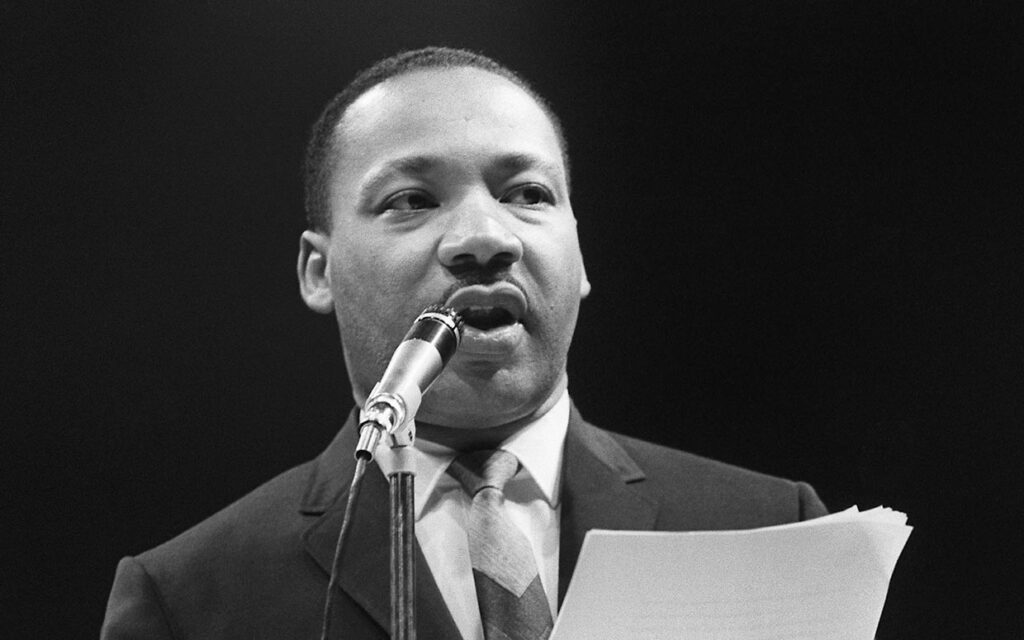
What Africa taught the Rev. Martin Luther King, Jr.

By Juan Cole

January 15, 2018 – Informed Comment

In 1957 Martin Luther King and his wife Coretta went to Ghana in connection with its independence from Britain. The British had grabbed the fabled West African Gold Coast in the nineteenth century in order to profit from its gold and other resources (after having profited in the 18th century from slaving in the region). As late as the 1940s and 1950s British colonial troops treated the local population with brutality.

Originally published on Informed Comment

Despite the myth that European colonial empires did volunteer development work for peoples of the global south, mostly they invested almost nothing in industry and any infrastructure they put in was for their armies, administrators, primary product exports and settlers. Lord Cromer actually refused to spread education in Egypt, e.g. In the British Gold Coast/ Ghana, what little education and literacy the colonialists introduced was for the formation of a small collaborating bureaucratic class or for missionary work. In the Gold Coast/ Ghana the British developed a colonial export economy in the early twentieth century based on cocoa. You never get rich off of agriculture; it was industry that made a country wealthy. And even in export agriculture you need to keep all your profits to get ahead, whereas the British took their cut. Then in the Great Depression the bottom fell out of the export market anyway. Despite all the disappointments of postcolonial government since 1957, poverty has been reduced by independent Ghana from 50% to 25% of the population and literacy has been raised to 71% from almost nothing under the British. Ghana has been a functioning democracy for some time now.

There is a sense in which African-American populations in the South were under a sort of colonial rule with Jim Crow, as well.

In his sermon on the Birth of a Nation,, King addressed a church congregation in Montgomery, Alabama.

King remarked,

“You also know that for years and for centuries, Africa has been one of the most exploited continents in the history of the world. It’s been the “Dark Continent.” It’s been the continent that has suffered all of the pain and the affliction that could be mustered up by other nations. And it is that continent which has experienced slavery, which has experienced all of the lowest standards that we can think about, and its been brought into being by the exploitation inflicted upon it by other nations. ”

That European colonial nations raped Africa of its resources and reduced its populations from free peoples to colonial subjects goes without saying. Belgium is alleged to have polished off about half the population of the Congo in the course of its rapine. Now, in the 1950s and 1960s that era of direct foreign rule was coming to an end.

He detailed the competition for the resources of the Gold Coast and added,

“Finally, in 1850, Britain won out, and she gained possession of the total territorial expansion of the Gold Coast. From 1850 to 1957, March sixth, the Gold Coast was a colony of the British Empire. And as a colony she suffered all of the injustices, all of the exploitation, all of the humiliation that comes as a result of colonialism. But like all slavery, like all domination, like all exploitation, it came to the point that the people got tired of it.

And that seems to be the long story of history. There seems to be a throbbing desire, there seems to be an internal desire for freedom within the soul of every man. And it’s there — it might not break forth in the beginning, but eventually it breaks out.”

What King took away from the sordid story of colonial oppression and brutal extraction of resources was the universal human yearning to be free. And he was proud that Ghana’s independence leader, Kwame Nkrumah (1909-1972), had been educated at the University of Pennsylvania.

He also firmly believed that nonviolent methods were the best, perhaps only path to true liberation:

“It says to us another thing. It reminds us of the fact that a nation or a people can break aloose from oppression without violence. Nkrumah says in the first two pages of his autobiography, which was published on the sixth of March — a great book which you ought to read — he said that he had studied the social systems of social philosophers and he started studying the life of Gandhi and his techniques. And he said that in the beginning he could not see how they could ever get aloose from colonialism without armed revolt, without armies and ammunition, rising up. Then he says after he continued to study Gandhi and continued to study this technique, he came to see that the only way was through nonviolent positive action. And he called his program “positive action.” ”

It wasn’t only that nonviolence is a useful, utilitarian tool of social mobilization. In King’s view its beauty is the promise it lays out for peaceful post-conflict reconciliation:

“The aftermath of nonviolence is the creation of the beloved community. The aftermath of nonviolence is redemption. The aftermath of nonviolence is reconciliation. The aftermath of violence however, are emptiness and bitterness. This is the thing I’m concerned about. Let us fight passionately and unrelentingly for the goals of justice and peace, but let’s be sure that our hands are clean in this struggle. Let us never fight with falsehood and violence and hate and malice, but always fight with love, so that, when the day comes that the walls of segregation have completely crumbled in Montgomery. that we will be able to live with people as their brothers and sisters.”

King was exuberant about independence but was anything but naive. He was well aware of the severe economic and other challenges facing newly independent countries in Africa:

“Now it will confront its wilderness. Like any breaking aloose from Egypt, there is a wilderness ahead. There is a problem of adjustment. Nkrumah realizes that. There is always this wilderness standing before him. For instance, it’s a one-crop country, cocoa mainly. Sixty percent of the cocoa of the world comes from the Gold Coast, or from Ghana. And, in order to make the economic system more stable, it will be necessary to industrialize. Cocoa is too fluctuating to base a whole economy on that…”

Colonialism made economies in the global South “lopsided” in the term of the great economic historian of the Middle East, Charles Issawi.

King was thinking analogically. What the system of racial injustice in the United States does, as the Ferguson investigation revealed, is to transfer resources (through fines and jailing for minor or trumped up “offenses”) from African-American communities to white elites. He saw clearly that racial hierarchy and domination has a powerful economic dimension. In fact, despite the legislative victories of the Civil Rights movement, which were inspired so powerfully by African decolonization, the big failure of race relations in the past fifty years is that the per capita wealth holdings of African-Americans have remained tiny compared to those of the whites, and African-Americans have been excluded from the economic growth of these last five decades (though to be fair it is mainly the top 10% or 30 million mostly upper middle class and wealthy whites who have grabbed most of this increase).

To the extent that at least in the surface law the shameful episode of some Americans treating others as pariahs, with laws on the books against racial intermarriage, joint schooling, even using the same bathrooms and water fountains, has ended–to that extent our nation owes an enormous debt to African freedom fighters of the 1940s and 1950s who inspired Americans to begin addressing their internal colonialism.

As Dr. King so memorably said, it is not the color of your skin that matters (nor the poverty of your neighborhood) but the content of your character.

Originally published on Informed Comment


Related video:

Martin Luther King Jr After his Journey to Africa

Related Posts

By Jan ObergTFF co-founder and director February 11, 2026 PART 3 — ECONOMICS, TRADE & FINANCIAL SOVEREIGNTY A. Trade Measures & Market Signaling Economic pressure can be applied instantly and scaled without violence. Immediate Measures (within a week) Government boycott US goods and services  A very powerful signal which over time will be felt. Targeted tariffs on selected U.S. goods Symbolic but high-visibility sectors send a clear message. Suspend trade facilitation talks A peaceful pause that signals deep concern. Freeze U.S. participation in public procurement – military procurement in particular A nonviolent way to reduce influence. Competition law review of U.S. corporations A legal tool to scrutinise market dominance. Longer-Term Measures EU–Asia–Africa trade corridors Reducing reliance on U.S. markets. European supply chains for critical minerals Strategic autonomy in resource access. European Strategic Trade Authority Monitoring coercive practices globally. Euro-denominated commodity markets Weakening the dollar’s pricing monopoly. The EU must resume contacts and negotiations with Russia, focusing on energy cooperation To...
PART 2 — Diplomacy, Law and Nonviolent Power By Jan ObergTFF co-founder and director January 26, 2026 This is the second of four TFF-created idea portfolios designed to curb the global reach of the United States and, in both the short and long term, help catalyse a worldwide nonviolent resistance to what many observers describe as the Trump administration’s uniquely confrontational, destructive and world-threatening policies. These portfolios outline what governments and citizens across the world can do through dynamic diplomacy, creative initiatives, and strictly nonviolent means. They are typical TFF works in that we do not only tell what the problem is and how bad it will go – as 90+% of all commentators, experts and scholars do – we tell what we think can be done, inviting you to think of what you think you can do. It seems painfully clear to me that the current political dynamics in Washington increasingly resemble the most dangerous...
Introduction to TFF’s forthcoming four Idea Portfolios of Diplomatic and Nonviolent Resistance By TFF’s Board & FoundersPascal Lottaz, Biljana Vankovska, Annette Schiffmann, Christina Spannar & Jan Oberg January 19, 2026 “America, you are too arrogant.” — Martin Luther King Jr. Over the course of Trump’s first term and now a year into his second, the world has witnessed a consistent pattern of actions that challenge the basic long-standing norms of international cooperation, weaken multilateral institutions, and ignore the global norms and legal frameworks established by the UN Charter. During these years, we have witnessed military operations in Iran, Syria and Ukraine without UN authorisation; the killing of Iranian General Qassem Soleimani; repeated strikes across the Middle East; and the launch of tariff wars against allies and competitors alike. We have seen a renewed emphasis on nuclearism and zero interest in arms control and disarmament negotiations. Pentagon is now The Department...

Recent Articles

Jan Oberg TFF director October 28, 2026 Exactly one month has now passed since I published my criticism of the introduction to the special issue on Johan Galtung published by the Journal of Global Security Studies, JoGSS, and of Tor Egil Førland’s chapter about Galtung which serves as a preview to his forthcoming biography of Galtung to be published by PRIO. See the original on The Transnational here and the same article on TFF Substack with many general and critical comments and, in particular, the people who decided to withdraw from the biography project in protest. The special issue itself was extraordinary. It was devoted to the intellectual legacy of one of the founders of peace research and contained a number of strong assessments of his personality, scholarship, intellectual trajectory, and public role. Such assessments are, of course, entirely legitimate. No scholar is beyond criticism, and neither was Johan Galtung....
An aspect of Iran’s culture and civilisation you’ve probably never heard about. Don’t be surprised if the US and Israel also try to bomb them. Jan ObergTFF director October 26, 2026 Today – under the “USraeli” threat of new “annihilating” bombings – opens the 7th International Conference on Peace and Conflict Resolution at Tehran’s University. As far as I can tell, this is the only permanent, advanced peace research institution in West Asia/the Middle East. Perhaps more countries in that region could be inspired? I mean, how many military “security” institutes and military academies do they have? Many peace research institutes and university departments have been established since the 1950s in the West. They are now all under attack; some have closed down, some have gone mainstream, yet others kept the name but do nothing to research peace and disseminate results or advice; instead, they cooperate with militarism’s platforms such...
Let’s discuss using AI to create peace – in contrast to boring geopolitics devoid of creative healing and visions. Jan Oberg TFF director October 15, 2026 I asked VEED to create a short video exemplifying how peace is preferable to war, then chose the lady as a template. Simple as that. In less than a minute, it produced this video, which any peace-loving person would appreciate. The only problem is that human intelligence (HI), at least the one that exists among Western decision-makers, isn’t half as moral or smart as AI. I have used AI to dialogue about peace and peace plans, creative conflict resolution and visions of a better future for humankind. It so happens that I am having more stimulating, intelligent, creative and moral discussions with AI than I could possibly have with any EU or NATO leader today. Yes, AI has very problematic and dangerous aspects; used...

TFF on Substack

Discover and subscribe to more peace materials on TFF Substack

Most Popular

Jan Oberg TFF director October 28, 2026 Exactly one month has now passed since I published my criticism of the introduction to the special issue on Johan Galtung published by the Journal of Global Security Studies, JoGSS, and of Tor Egil Førland’s chapter about Galtung which serves as a preview to his forthcoming biography of Galtung to be published by PRIO. See the original on The Transnational here and the same article on TFF Substack with many general and critical comments and, in particular, the people who decided to withdraw from the biography project in protest. The special issue itself was extraordinary. It was devoted to the intellectual legacy of one of the founders of peace research and contained a number of strong assessments of his personality, scholarship, intellectual trajectory, and public role. Such assessments are, of course, entirely legitimate. No scholar is beyond criticism, and neither was Johan Galtung....
An aspect of Iran’s culture and civilisation you’ve probably never heard about. Don’t be surprised if the US and Israel also try to bomb them. Jan ObergTFF director October 26, 2026 Today – under the “USraeli” threat of new “annihilating” bombings – opens the 7th International Conference on Peace and Conflict Resolution at Tehran’s University. As far as I can tell, this is the only permanent, advanced peace research institution in West Asia/the Middle East. Perhaps more countries in that region could be inspired? I mean, how many military “security” institutes and military academies do they have? Many peace research institutes and university departments have been established since the 1950s in the West. They are now all under attack; some have closed down, some have gone mainstream, yet others kept the name but do nothing to research peace and disseminate results or advice; instead, they cooperate with militarism’s platforms such...
Let’s discuss using AI to create peace – in contrast to boring geopolitics devoid of creative healing and visions. Jan Oberg TFF director October 15, 2026 I asked VEED to create a short video exemplifying how peace is preferable to war, then chose the lady as a template. Simple as that. In less than a minute, it produced this video, which any peace-loving person would appreciate. The only problem is that human intelligence (HI), at least the one that exists among Western decision-makers, isn’t half as moral or smart as AI. I have used AI to dialogue about peace and peace plans, creative conflict resolution and visions of a better future for humankind. It so happens that I am having more stimulating, intelligent, creative and moral discussions with AI than I could possibly have with any EU or NATO leader today. Yes, AI has very problematic and dangerous aspects; used...
Read More
JoGSS-Silent
Jan Oberg TFF director October 28, 2026 Exactly one month has now passed since I published my criticism of the introduction to the special issue on Johan Galtung published by the Journal of Global Security Studies, JoGSS, and of Tor Egil Førland’s chapter about Galtung which serves as a preview to his forthcoming biography of Galtung to be published by PRIO. See the original on The Transnational here and the same article on TFF Substack with many general and critical comments and, in particular, the people who decided to withdraw from the biography project in protest. The special issue itself was extraordinary. It was devoted to the intellectual legacy of one of the founders of peace research and contained a number of strong assessments of his personality, scholarship, intellectual trajectory, and public role. Such assessments are, of course, entirely legitimate. No scholar is beyond criticism, and neither was Johan Galtung....
Screenshot 2026-10-26 115647
An aspect of Iran’s culture and civilisation you’ve probably never heard about. Don’t be surprised if the US and Israel also try to bomb them. Jan ObergTFF director October 26, 2026 Today – under the “USraeli” threat of new “annihilating” bombings – opens the 7th International Conference on Peace and Conflict Resolution at Tehran’s University. As far as I can tell, this is the only permanent, advanced peace research institution in West Asia/the Middle East. Perhaps more countries in that region could be inspired? I mean, how many military “security” institutes and military academies do they have? Many peace research institutes and university departments have been established since the 1950s in the West. They are now all under attack; some have closed down, some have gone mainstream, yet others kept the name but do nothing to research peace and disseminate results or advice; instead, they cooperate with militarism’s platforms such...
Screenshot 2026-10-15 141837
Let’s discuss using AI to create peace – in contrast to boring geopolitics devoid of creative healing and visions. Jan Oberg TFF director October 15, 2026 I asked VEED to create a short video exemplifying how peace is preferable to war, then chose the lady as a template. Simple as that. In less than a minute, it produced this video, which any peace-loving person would appreciate. The only problem is that human intelligence (HI), at least the one that exists among Western decision-makers, isn’t half as moral or smart as AI. I have used AI to dialogue about peace and peace plans, creative conflict resolution and visions of a better future for humankind. It so happens that I am having more stimulating, intelligent, creative and moral discussions with AI than I could possibly have with any EU or NATO leader today. Yes, AI has very problematic and dangerous aspects; used...
girl-5894831_1280
Below are TFF-related media mentions, comments, videos and social media posts published elsewhere but not on this homepage. We happen to catch and list only a fraction. Regarding video comments and debates, we recommend that you go to the TFF Video Channel on Substack where many of them are reproduced. Jan Oberg is a contributor to China Daily – 52 million daily clicks – and Global Times, CGTN and CCTV (the national television), China Investment, Xinhua News Agency and several others. Articles and videos on these media very often multiply into countless Chinese (and Western media) that re-post them from these main media. Thanks to The China Academy, his analyses, interviews and comments are frequently posted on YouTube channels such as Thinkers Forum and Wave Media. These videos are often re-posted on Bilibili (China’s YouTube), the China Content Center on TikTok, and on the Chinese edition of TikTok, Douyin.com. This means reaching hundreds of millions of viewers worldwide over a year. While there are too many to catch on all these...
Nobel-Prize-Plaque
Jan Oberg TFF director October 13, 2026 According to Alfred Nobel’s will, the Nobel Peace Prize shall be awarded: ”to the person who has done the most or best to advance fellowship among nations, the abolition or reduction of standing armies, and the establishment and promotion of peace congresses.” Further down, he also expresses how the prize for the “champions of peace” shall be decided: “that for champions of peace by a committee of five persons to be selected by the Norwegian Storting. Alfred Nobel’s will is remarkably short and clear. But few seem to have read it. Nobel did not say that the committee itself should consist of members of parliament. He entrusted the Storting with appointing five persons. In principle, it could have selected diplomats, mediators, peace researchers, conflict-resolution specialists, or other individuals with recognised expertise in matters of peace from around the world. Instead, the Storting gradually...
law-419057_1280
The Quest for Humane Survival Richard Falk Professor emeritus, Princeton UniversityTFF Associate since 1986October 12, 2026 After decades of teaching and writing about international law in academic frameworks that were not institutionally situated within law school environments—at Princeton and the University of California, Santa Barbara—I found myself most receptive to the TWAIL outlook. It has been especially illuminating in clarifying the extent to which international law evolved as a dialogical critique of Europe’s efforts to legitimize its colonial undertakings. In particular, TWAIL has exposed how international law has functioned to legalize the subjugation of Third World peoples, securing conditions for exploitative investment and trade relations, the coercive enforcement of public debts, and an ideology of cultural superiority. TWAIL’s exposure of these economic legacies of colonialism has influenced my understanding of the history and development of international law, broadly conceived, as an ideological project of the Western sub-system of the world...




