Vijay Prashad: The West must stop blocking negotiations between Ukraine and Russia

Vijay Prashad

December 5th, 2022

Ukrainians have been paying a terrible price for the failure of ensuring sensible and reasonable negotiations from 2014 to February 2022 – which could have prevented the invasion by Russia in the first place, and once the war started, could have led to the end of this war.

Originally posted on People’s Dispatch homepage on October 25th 2022, here

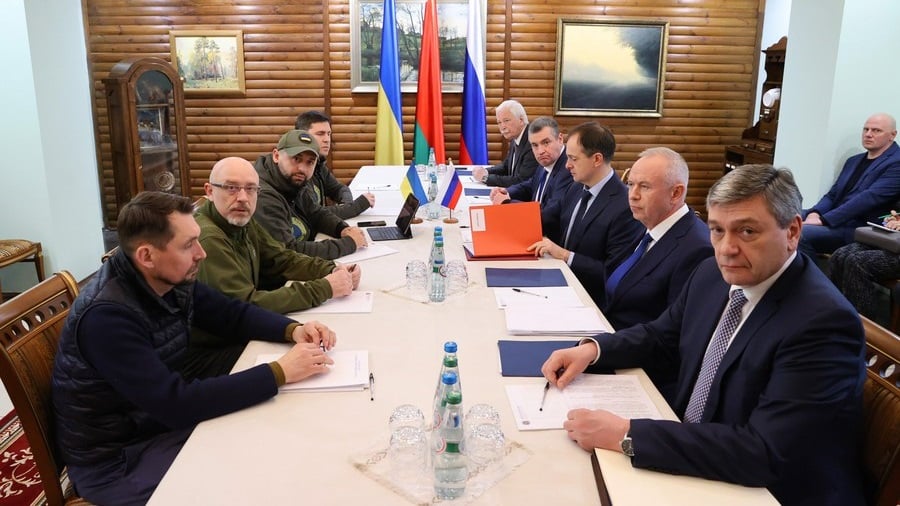
Russia invaded Ukraine on February 24, 2022. This war has been horrendous, though it does not compare with the terrible destruction wrought by the US bombardment of Iraq (“shock and awe”) in 2003. In the Gomel region of Belarus that borders Ukraine, Russian and Ukrainian diplomats met on February 28 to begin negotiations toward a ceasefire. These talks fell apart.

Then, in early March, the two sides met again in Belarus to hold a second and third round of talks. On March 10, the foreign ministers of Ukraine and Russia met in Antalya, Turkey, and finally, at the end of March, senior officials from Ukraine and Russia met in Istanbul, Turkey, thanks to the initiative of Turkey’s President Recep Tayyip Erdoğan.

On March 29, Turkey’s Foreign Minister Mevlüt Çavuşoğlu said, “We are pleased to see that the rapprochement between the parties has increased at every stage. Consensus and common understanding were reached on some issues.” By April, an agreement regarding a tentative interim deal was reached between Russia and Ukraine, according to an article in Foreign Affairs.

In early April, Russian forces began to withdraw from Ukraine’s northern Chernihiv Oblast, which meant that Russia halted military operations around Kyiv, Ukraine’s capital. The United States and the United Kingdom claimed that this withdrawal was a consequence of military failure, while the Russians said it was due to the interim deal. It is impossible to ascertain, with the available facts, which of these two views was correct.

Before the deal could go forward, then-UK Prime Minister Boris Johnson arrived in Kyiv on April 9. A Ukrainian media outlet – Ukrainska Pravda – reported that Johnson carried two messages to Ukraine’s President Volodymyr Zelensky: first, that Russian President Vladimir Putin “should be pressured, not negotiated with,” and second, that even if Ukraine signed agreements with the Kremlin, the West was not ready to do so. According to Ukrainska Pravda, soon after Johnson’s visit, “the bilateral negotiation process was paused.”

A few weeks later, US Secretary of State Antony Blinken and US Secretary of Defense Lloyd Austin visited Kyiv, and following the trip, Austin spoke at a news conference at an undisclosed location in Poland and said, “We want to see Russia weakened.” There is no direct evidence that Johnson, Blinken, and Austin directly pressured Zelensky to withdraw from the interim negotiations, but there is sufficient circumstantial evidence to suggest that this was the case.

The lack of willingness to allow Ukraine to negotiate with Russia predates these visits and was summarized in a March 10, 2022, article in the Washington Post where senior officials in US President Joe Biden’s administration stated that the current US strategy “is to ensure that the economic costs for Russia are severe and sustainable, as well as to continue supporting Ukraine militarily in its effort to inflict as many defeats on Russia as possible.”

Long before the Russian invasion of Ukraine, since 2014, the United States has – through the Ukraine Security Assistance Initiative of the US Department of Defense – spent more than $19 billion in providing training and equipment to the Ukrainian military ($17.6 billion since Russia invaded Ukraine on February 24, 2022). The total annual budget of the United Nations for 2022 is $3.12 billion, far less than the amount spent by the US on Ukraine today. The arming of Ukraine, the statements about weakening Russia by senior officials of the US government, and the refusal to initiate any kind of arms control negotiations prolong a war that is ugly and unnecessary.

Ukraine is not in Iowa

Ukraine and Russia are neighbors. You cannot change the geographical location of Ukraine and move it to Iowa in the United States. This means that Ukraine and Russia have to come to an agreement and find a solution to end the conflict between them. In 2019, Volodymyr Zelensky won by a landslide (73%) in the Ukrainian presidential election against Petro Poroshenko, the preferred candidate of the West. “We will not be able to avoid negotiations between Russia and Ukraine,” Zelensky said on a TV panel, “Pravo Na Vladu,” TSN news service reported, before he became president. In December 2019, Zelensky and Putin met in Paris, alongside then-Chancellor of Germany Angela Merkel and France’s President Emmanuel Macron (known as the “Normandy Four”). This initiative was driven by Macron and Merkel. As early as 2019, France’s President Emmanuel Macron argued that it was time for Europe to “rethink… our relationship with Russia” because “pushing Russia away from Europe is a profound strategic error.”

In March 2020, Zelensky said that he and Putin could work out an agreement within a year based on the Minsk II agreements of February 2015. “There are points in Minsk. If we move them around a bit, then what bad can that lead to? As soon as there are no people with weapons, the shooting will stop. That’s important,” Zelensky told the Guardian. In a December 2019 press conference, Putin said, “there is nothing more important than the Minsk Agreements.” At this point, Putin said that all he expected was that the Donbas region would be given special status in the Ukrainian constitution, and during the time of the expected Ukraine-Russia April 2020 meeting, the troops on both sides would have pulled back and agreed to “disengagement along the entire contact line.”

Role of Macron

It was clear to Macron by 2020 that the point of the negotiations was about more than just Minsk and Ukraine; it was about the creation of a “new security architecture” that did not isolate Russia – and was also not subservient to Washington. Macron developed these points in February 2021 in two directions and spoke about them during his interview with the Atlantic Council (a US think tank).

First, he said that NATO has “pushed our borders as far as possible to the eastern side,” but NATO’s expansion has “not succeeded in reducing the conflicts and threats there.” NATO’s eastward expansion, he made clear, was not going to increase Europe’s security. Second, Macron said that the US unilateral withdrawal from the Intermediate-Range Nuclear Forces Treaty in 2019 – and Russia’s mirroring that – leaves Europe unprotected “against these Russian missiles.”

He further said, “As a European, I want to open a discussion between the European Union and Russia.” Such a discussion would pioneer a post-Cold War understanding of security, which would leave the United States out of the conversation with Russia. None of these proposals from Macron could advance, not only because of hesitancy in Russia but also principally because they were not seen favorably by Washington.

Confusion existed about whether US President Joe Biden would be welcomed into the Normandy Four. In late 2020, Zelensky said he wanted Biden at the table, but a year later it became clear that Russia was not interested in having the United States be part of the Normandy Four. Putin said that the Normandy Four was “self-sufficient.”

Biden, meanwhile, chose to intensify threats and sanctions against Russia based on the claims of Kremlin interference in the United States 2016 and 2018 elections. By December 2021, there was no proper reciprocal dialogue between Biden and Putin. Putin told Finnish President Sauli Niinistö that there was a “need to immediately launch negotiations with the United States and NATO” on security guarantees. In a video call between Biden and Putin on December 7, 2021, the Kremlin told the US president that “Russia is seriously interested in obtaining reliable, legally fixed guarantees that rule out NATO expansion eastward and the deployment of offensive strike weapons systems in states adjacent to Russia.” No such guarantee was forthcoming from Washington. The talks fizzled out.

The record shows that Washington rejected Macron’s initiatives as well as entreaties from Putin and Zelensky to resolve issues through diplomatic dialogue. Up to four days before the Russian invasion, Macron continued his efforts to prevent an escalation of the conflict. By then, the appetite in Moscow for negotiations had dwindled, and Putin rejected Macron’s efforts.

An independent European foreign policy was simply not possible (as Macron had suggested and as the former leader of the Soviet Union Mikhail Gorbachev had proposed in 1989 while talking about his vision for a “common European home” that would stretch from northern Asia to Europe). Nor was an agreement with Russia feasible if it meant that Russian concerns were to be taken seriously by the West.

Ukrainians have been paying a terrible price for the failure of ensuring sensible and reasonable negotiations from 2014 to February 2022 – which could have prevented the invasion by Russia in the first place, and once the war started, could have led to the end of this war. All wars end in negotiations, but these negotiations to end wars should be permitted to restart.

This article was produced by Globetrotter.

Support TFF
Please support TFF’s work for peace through research and public education. We are all-volunteer, people-financed and do not accept money from governments or corporations. In other words, one of the very last free research think tanks in this world – and for a noble purpose: Peace by peaceful – intelligent – means. It is fast, easy and secure. Click here. Thanks!

Vijay Prashad is an Indian historian, editor, and journalist. He is a writing fellow and chief correspondent at Globetrotter. He is an editor of LeftWord Books and the director of Tricontinental: Institute for Social Research. He is a senior non-resident fellow at Chongyang Institute for Financial Studies, Renmin University of China. He has written more than 20 books, including The Darker Nations and The Poorer Nations. His latest books are Struggle Makes Us Human: Learning from Movements for Socialism and (with Noam Chomsky) The Withdrawal: Iraq, Libya, Afghanistan, and the Fragility of U.S. Power.

Related Posts

TFF’s comprehensive proposal for dialogue about true peace in Ukraine is due in a day or two Jan Oberg November 20, 2025 What is being whispered through diplomatic corridors today is not peace, but quackery. The alleged 28‑point plan drafted in Washington and Moscow is mentioned as a solution to the Ukraine war. It is being negotiated by US businessman, real estate developer and Trump ally, Steve Witkoff, and by Kirill Dmitriev, who is CEO of the Russian Direct Investment Fund and a close ally of Putin, according to India’s Economic Times. For presumably good reasons, their education, qualifications and experience in international conflict analysis and peace-making remain untold. They look like surgeons who have never opened a medical textbook. It is nothing more than a mirage: a framework of concessions imposed on Ukraine’s citizens, negotiated without Kyiv, and excluding Europe. Like Gaza, it promises “peace” while institutionalising injustice. If half of what is available about...
Drones over Nordic airports. No damage. No trace. No answers. Most assume Russia—but what if that’s not so? Why is there so much we are not told? This article explores the strategic ambiguity behind recent drone incursions and asks: Who else might benefit from sending drones into NATO airspace? From Ukraine’s surprising drone supremacy to Russia’s possible signalling, the silence itself may be the loudest message. These are the kinds of questions decent, intelligent investigative journalists and commentators could easily research. Why don’t they? Jan Oberg September 29, 2025 Did you, dear reader, know or think of this? That the most powerful weapon in today’s conflicts might be the one that leaves no trace – and no answers. Just enough fear to justify the next move? Recently, drones have repeatedly appeared over Nordic airports and near some military facilities. They cause no damage – for which reason the designation “hybrid attack” is...
This is the third appeal from TFF. The first and the second here. On August 22, 2025, the UN officially declared famine in Gaza. The world’s top authority on food security called for help and said starvation will spread further within the Strip unless fighting stops and much more aid is allowed in. More than half a million people in the Gaza Strip are facing catastrophic hunger conditions, while more than a million more are in a food emergency phase, the report states. This man-made catastrophic famine could have been prevented by a steady flow of humanitarian aid into the enclave, relief chief Tom Fletcher pointed out. “Yet food stacks up at borders because of systematic obstruction by Israel,” Mr. Fletcher said. “It is a famine within a few 100 meters of food in a fertile land.” The UN’s top aid official underscored that the famine in Gaza is “caused by cruelty, justified...

Recent Articles

Tony Robinson October 4, 2026 Violence is easy to recognise when someone is being beaten, shot or killed. It becomes more difficult when nobody is holding a weapon. Poverty, discrimination, exploitation and repression can restrict a human life just as effectively, although they do so in very different ways and with very different consequences. Simply adding more categories to an ever-growing list of forms of violence does not really solve the problem. The more interesting question is what all these different situations have in common and why it makes sense to describe them using the same word. Human beings do not simply react to what happens around them. They remember the past, imagine things that do not yet exist, make plans and undertake projects. Workers organise because they imagine different working conditions; people migrate because they imagine another life somewhere else; social movements emerge because people refuse to accept the...
It’s a matter of principles, courage, vision and pulling together – while the militarist world is falling apart… Peter Langille October 3, 2026 “Here, then, is the problem which we present to you, stark and dreadful and inescapable: Shall we put an end to the human race; or shall mankind renounce war?”The Bertrand Russell—Albert Einstein Manifesto, July 9, 1955 ⁕ The forecast for what’s ahead is worrisome. The sharp rise in armed conflicts over the past three years is adding to what was already the highest level in over seventy years. Genocides, which should be prevented are supported. A shared climate emergency that jeopardises survival is ignored. Diverse polls now suggest that people are war-weary, worried and interested in a more effective United Nations. And, there are viable policy options for a more secure world! Yet governments are doubling-down, betting on more war and investing heavily. If current trends persist,...
Johan Galtung 1930-2024October 2015 Published here on October 3, 2026 Let us focus on Civilization for conflict analysis and remedies. Major forms of disorder use violence; war is state organized violence. The most belligerent states are the United States of America and Israel, both with civilization roots. National Evangelism, the US Protestant Christian civilization– more national than evangelical–justifies US warfare as exceptionalism of a people chosen by God, with a manifest destiny to run the world. Orthodox Judaism justifies Israeli warfare to conquer and expand from Nile to Euphrates as a religious right and duty to the Eternal One. The third most belligerent country, the UK, no longer believes it is God-chosen but chosen by the USA; not quite the same but something. But the root cause of global disorder lies in the Occident–with Islam–seeing itself as the single, universal civilization valid for all at all times, all others being...

TFF on Substack

Discover and subscribe to more peace materials on TFF Substack

Most Popular

Tony Robinson October 4, 2026 Violence is easy to recognise when someone is being beaten, shot or killed. It becomes more difficult when nobody is holding a weapon. Poverty, discrimination, exploitation and repression can restrict a human life just as effectively, although they do so in very different ways and with very different consequences. Simply adding more categories to an ever-growing list of forms of violence does not really solve the problem. The more interesting question is what all these different situations have in common and why it makes sense to describe them using the same word. Human beings do not simply react to what happens around them. They remember the past, imagine things that do not yet exist, make plans and undertake projects. Workers organise because they imagine different working conditions; people migrate because they imagine another life somewhere else; social movements emerge because people refuse to accept the...
It’s a matter of principles, courage, vision and pulling together – while the militarist world is falling apart… Peter Langille October 3, 2026 “Here, then, is the problem which we present to you, stark and dreadful and inescapable: Shall we put an end to the human race; or shall mankind renounce war?”The Bertrand Russell—Albert Einstein Manifesto, July 9, 1955 ⁕ The forecast for what’s ahead is worrisome. The sharp rise in armed conflicts over the past three years is adding to what was already the highest level in over seventy years. Genocides, which should be prevented are supported. A shared climate emergency that jeopardises survival is ignored. Diverse polls now suggest that people are war-weary, worried and interested in a more effective United Nations. And, there are viable policy options for a more secure world! Yet governments are doubling-down, betting on more war and investing heavily. If current trends persist,...
Johan Galtung 1930-2024October 2015 Published here on October 3, 2026 Let us focus on Civilization for conflict analysis and remedies. Major forms of disorder use violence; war is state organized violence. The most belligerent states are the United States of America and Israel, both with civilization roots. National Evangelism, the US Protestant Christian civilization– more national than evangelical–justifies US warfare as exceptionalism of a people chosen by God, with a manifest destiny to run the world. Orthodox Judaism justifies Israeli warfare to conquer and expand from Nile to Euphrates as a religious right and duty to the Eternal One. The third most belligerent country, the UK, no longer believes it is God-chosen but chosen by the USA; not quite the same but something. But the root cause of global disorder lies in the Occident–with Islam–seeing itself as the single, universal civilization valid for all at all times, all others being...
Read More
Living-Peace-Sign-Budapest-copy
Tony Robinson October 4, 2026 Violence is easy to recognise when someone is being beaten, shot or killed. It becomes more difficult when nobody is holding a weapon. Poverty, discrimination, exploitation and repression can restrict a human life just as effectively, although they do so in very different ways and with very different consequences. Simply adding more categories to an ever-growing list of forms of violence does not really solve the problem. The more interesting question is what all these different situations have in common and why it makes sense to describe them using the same word. Human beings do not simply react to what happens around them. They remember the past, imagine things that do not yet exist, make plans and undertake projects. Workers organise because they imagine different working conditions; people migrate because they imagine another life somewhere else; social movements emerge because people refuse to accept the...
b54a1f10-8c65-4f0b-9dd5-4abc0a7d04cc_2659x2659
It’s a matter of principles, courage, vision and pulling together – while the militarist world is falling apart… Peter Langille October 3, 2026 “Here, then, is the problem which we present to you, stark and dreadful and inescapable: Shall we put an end to the human race; or shall mankind renounce war?”The Bertrand Russell—Albert Einstein Manifesto, July 9, 1955 ⁕ The forecast for what’s ahead is worrisome. The sharp rise in armed conflicts over the past three years is adding to what was already the highest level in over seventy years. Genocides, which should be prevented are supported. A shared climate emergency that jeopardises survival is ignored. Diverse polls now suggest that people are war-weary, worried and interested in a more effective United Nations. And, there are viable policy options for a more secure world! Yet governments are doubling-down, betting on more war and investing heavily. If current trends persist,...
010
Johan Galtung 1930-2024October 2015 Published here on October 3, 2026 Let us focus on Civilization for conflict analysis and remedies. Major forms of disorder use violence; war is state organized violence. The most belligerent states are the United States of America and Israel, both with civilization roots. National Evangelism, the US Protestant Christian civilization– more national than evangelical–justifies US warfare as exceptionalism of a people chosen by God, with a manifest destiny to run the world. Orthodox Judaism justifies Israeli warfare to conquer and expand from Nile to Euphrates as a religious right and duty to the Eternal One. The third most belligerent country, the UK, no longer believes it is God-chosen but chosen by the USA; not quite the same but something. But the root cause of global disorder lies in the Occident–with Islam–seeing itself as the single, universal civilization valid for all at all times, all others being...
Screenshot 2026-10-02 011738
Jan ObergPhD, director, The Transnational Foundation for Peace and Future Research, TFFLund, Sweden October 2, 2026 This is my full original manuscript. The Chinese Academy of Social Science, CASS, makes two publications out if it. 1. China’s Five-year plan emphasized the capabilities of basic research and original innovation. It is regarded as the goal of the future social development, which, as required, should be significantly enhanced. Can you comment on the importance of original innovation in research and academic study? I believe it is easier to define “original innovation” in the natural sciences than in social sciences. The breaking points of what constitutes something new, or innovative, are not quite as sharp in the latter. But in both fields it is about opening up something that was closed, unseen, unexplored before – making manifest what was earlier latent. Innovations come in many forms and shapes – naming something that was not...
arctic-circle-map
The agreement is catastrophic both because of what it says and what it doesn’t mention. It reduces further the major asset of security policies: Freedom of action. Jan Oberg TFF director September 25, 2026 A couple of hours before the agreement was signed on September 22, 2026, I published the following 13 hypotheses about what it would most likely contain on TFF Substack (in English). I was wrong on only the first point. Contrary to what Trump had written on his Truth Social platform, it does not appear to come into force immediately. In fact, it turned out to be worse than even I had anticipated. After these hypotheses now come a number of reflections in light of what the agreement actually contains, and does not contain, as well as the way in which it has generally been presented by major media outlets and by the public-service broadcaster DR. My...
girl-5894831_1280
Below are TFF-related media mentions, comments, videos and social media posts published elsewhere but not on this homepage. We happen to catch and list only a fraction. Regarding video comments and debates, we recommend that you go to the TFF Video Channel on Substack where many of them are reproduced. Jan Oberg is a contributor to China Daily – 52 million daily clicks – and Global Times, CGTN and CCTV (the national television), China Investment, Xinhua News Agency and several others. Articles and videos on these media very often multiply into countless Chinese (and Western media) that re-post them from these main media. Thanks to The China Academy, his analyses, interviews and comments are frequently posted on YouTube channels such as Thinkers Forum and Wave Media. These videos are often re-posted on Bilibili (China’s YouTube), the China Content Center on TikTok, and on the Chinese edition of TikTok, Douyin.com. This means reaching hundreds of millions of viewers worldwide over a year. While there are too many to catch on all these...