Ukraine crisis: Time for some peace diplomacy, visions of a better future

Jan Oberg

March 3, 2022

I am happy to inform you about my latest column in China’s leading Global Times – with the title above. Read it here and when you are anyhow there, look around: Many different subjects from the Western media and many different angles from a country we all need to know more about. Not the least now when the pluralism and scope have been reduced ad absurdum in the Western mainstream media (MSM).

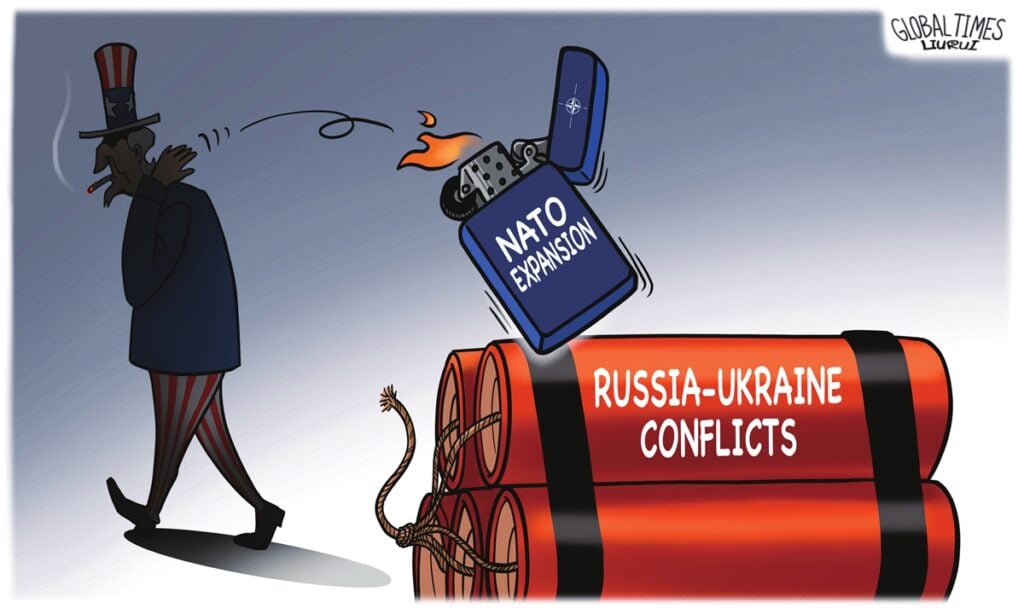
The illustration is, in my view, spot-on – and thus matches my spot-on points 😜

Peace & future researcher + ‌Art Photographer

2 Responses

  1. Der Graben – (in English, The Grave) …..was written by a German poet in 1926, 8 years after the first world war and 13 years before the second world war. Both of these wars were devastating disasters, where millions of people were killed. The song is from the theater play “Die Mutter” (The Mother) by Bertolt Brecht. It tells a story about a German mother and her young boys and beg the sons not to join the war. They are asked to cherish their life, make peace with the French and English soldiers, also just boys, join hands with them across the horrible mass graves and stop the war, which none of them want. Once again we hear the terrible war drums of Europe; again we are on the brink of a new world war, a new disaster; it might be the last war there will ever be. Listen to the song, think about everything you love and cherish, think about our beautiful Planet and all the World’s people and how to protect them. Let’s refuse to destroy our world, let’s refuse to fight – with words as well as bombs. It is high time, we join our hands across all borders and build a better world in peace. To avoid a third world war, twelve of Asia’s countries with almost half of the world’s population try to seek peace instead of endless war: The ASEAN, ten countries in South East Asia with 622 million people, India with 1.3 billion people and China with 1.4 billion people. I know that many people in the West also favor negotiations and not war. Ukraine and Russia have already started negotiations in Belarus, and will now continue in Turkey. They need all the support they can get, no more weapons and fighter jets! https://www.youtube.com/watch?v=U9eQ38d9iZ4 DER GRABEN Aus “Die Mutter”, Bertolt Brecht Komposition: Hanns Eisler Text: Kurt Tucholsky Mutter, wozu hast Du Deinen aufgezogen, Hast Dich zwanzig Jahr’ mit ihm gequält? Wozu ist er Dir in Deinen Arm geflogen, Und Du hast ihm leise was erzählt? Bis sie ihn Dir weggenommen haben Für den Graben, Mutter, für den Graben! Junge, kannst Du noch an Vater denken? Vater nahm Dich oft auf seinen Arm, Und er wollt’ Dir einen Groschen schenken, Und er spielte mit Dir Räuber und Gendarm Bis sie ihn Dir weggenommen haben Für den Graben, Junge, für den Graben! Drüben die französischen Genossen lagen dicht bei Englands Arbeitsmann. Alle haben sie ihr Blut vergossen und zerschossen ruht heut Mann bei Mann. Alte Leute, Männer mancher Knabe in dem einen großen Massengrabe. Seid nicht stolz auf Orden und Geklunker. Seid nicht stolz auf Narben und die Zeit. In die Gräben schickten euch die Junker, Staatswahn und der Fabrikantenneid. Ihr wart gut genug zum Fraß für Raben, für das Grab, Kameraden, für den Graben. Werft die Fahnen fort! Die Militärkapellen spielen auf zu Eurem Todestanz! Seid Ihr hin? – Ein Kranz von Immortellen, Das ist dann der Dank des Vaterlands! Denkt an Todesröcheln und Gestöhne! Drüben stehen Väter, Mütter, Söhne, Schuften schwer, wie ihr, um’s bißchen Leben. Wollt Ihr denen nicht die Hände geben? Reicht die Bruderhand als schönste aller Gaben Über’n Graben, Leute, über’n Graben! THE TRENCHES (An English translation; the word “trenches” should be substituted by “graves”) Mother, for what did you raise your son? Why did you struggle with him twenty years? Why was it to you he would always run And quietly he’d whisper in your ear? Till the day they came and took him away… For the trenches, mother, for the trenches. For the trenches, mother, for the trenches. Young man, can you still remember Dad? How he’d take you on his shoulder for a ride? How he’d always have a penny for his lad And count to ninety-nine while you would hide? Till the day they came and took him away… For the trenches, young man, for the trenches. For the trenches, young man, for the trenches. See those French and English workers yonder? Side by side they sacrificed their lives. Shot to pieces, every life was squandered, For a place a metre deep in mud. All the young men, even boys, who gave, Their lives for a lonely mass grave, Their lives for a lonely mass grave. Don’t be so proud of your scars and medals, Don’t be proud about glory days gone by. You were sent to the trenches by the ogres, The envy of industry, the madness of the state. You were good enough as carrion for the crows, For the trenches, comrades, for the trenches. For the trenches, comrades, for the trenches. Think of the moans and the rattle of the guns, Yonder are fathers’, mothers’ sons. Making ends meet with the daily grind, Don’t you want to shake hands with your own kind? Reach out your hands and greet your fellow men, Across the trenches, people, across the trenches. Across the trenches, people, across the trenches.

  2. Thank you so much dear Gitte. What a thought-provoking reply- Brecht on how meaningless war is – then in the trenches, now all over: on the ground, in the deep ocean and in the sky, in space. Still, it’s done by human beings who refuse to see the larger picture of militarist culture which they are a small point. Like you, I share hope when it comes to the non-Western/Occidental ways of thinking and cultures of the East/Orient. And YES, no weapons to Ukraine but a peace-intrvention in support also of the peace people inside Ukraine. We never hear about them. My best; Jan

Related Posts

Below are TFF-related media mentions, comments, videos and social media posts published elsewhere but not on this homepage. We happen to catch and list only a fraction. Regarding video comments and debates, we recommend that you go to the TFF Video Channel on Substack where many of them are reproduced. Jan Oberg is a contributor to China Daily – 52 million daily clicks – and Global Times, CGTN and CCTV (the national television), China Investment, Xinhua News Agency and several others. Articles and videos on these media very often multiply into countless Chinese (and Western media) that re-post them from these main media. Thanks to The China Academy, his analyses, interviews and comments are frequently posted on YouTube channels such as Thinkers Forum and Wave Media. These videos are often re-posted on Bilibili (China’s YouTube), the China Content Center on TikTok, and on the Chinese edition of TikTok, Douyin.com. This means reaching hundreds of millions of viewers worldwide over a year. While there are too many to catch on all these...

Jan Oberg TFF director October 13, 2026 According to Alfred Nobel’s will, the Nobel Peace Prize shall be awarded: ”to the person who has done the most or best to advance fellowship among nations, the abolition or reduction of standing armies, and the establishment and promotion of peace congresses.” Further down, he also expresses how the prize for the “champions of peace” shall be decided: “that for champions of peace by a committee of five persons to be selected by the Norwegian Storting. Alfred Nobel’s will is remarkably short and clear. But few seem to have read it. Nobel did not say that the committee itself should consist of members of parliament. He entrusted the Storting with appointing five persons. In principle, it could have selected diplomats, mediators, peace researchers, conflict-resolution specialists, or other individuals with recognised expertise in matters of peace from around the world. Instead, the Storting gradually...
The Quest for Humane Survival Richard Falk Professor emeritus, Princeton UniversityTFF Associate since 1986October 12, 2026 After decades of teaching and writing about international law in academic frameworks that were not institutionally situated within law school environments—at Princeton and the University of California, Santa Barbara—I found myself most receptive to the TWAIL outlook. It has been especially illuminating in clarifying the extent to which international law evolved as a dialogical critique of Europe’s efforts to legitimize its colonial undertakings. In particular, TWAIL has exposed how international law has functioned to legalize the subjugation of Third World peoples, securing conditions for exploitative investment and trade relations, the coercive enforcement of public debts, and an ideology of cultural superiority. TWAIL’s exposure of these economic legacies of colonialism has influenced my understanding of the history and development of international law, broadly conceived, as an ideological project of the Western sub-system of the world...

Recent Articles

Below are TFF-related media mentions, comments, videos and social media posts published elsewhere but not on this homepage. We happen to catch and list only a fraction. Regarding video comments and debates, we recommend that you go to the TFF Video Channel on Substack where many of them are reproduced. Jan Oberg is a contributor to China Daily – 52 million daily clicks – and Global Times, CGTN and CCTV (the national television), China Investment, Xinhua News Agency and several others. Articles and videos on these media very often multiply into countless Chinese (and Western media) that re-post them from these main media. Thanks to The China Academy, his analyses, interviews and comments are frequently posted on YouTube channels such as Thinkers Forum and Wave Media. These videos are often re-posted on Bilibili (China’s YouTube), the China Content Center on TikTok, and on the Chinese edition of TikTok, Douyin.com. This means reaching hundreds of millions of viewers worldwide over a year. While there are too many to catch on all these...
Jan Oberg TFF director October 13, 2026 According to Alfred Nobel’s will, the Nobel Peace Prize shall be awarded: ”to the person who has done the most or best to advance fellowship among nations, the abolition or reduction of standing armies, and the establishment and promotion of peace congresses.” Further down, he also expresses how the prize for the “champions of peace” shall be decided: “that for champions of peace by a committee of five persons to be selected by the Norwegian Storting. Alfred Nobel’s will is remarkably short and clear. But few seem to have read it. Nobel did not say that the committee itself should consist of members of parliament. He entrusted the Storting with appointing five persons. In principle, it could have selected diplomats, mediators, peace researchers, conflict-resolution specialists, or other individuals with recognised expertise in matters of peace from around the world. Instead, the Storting gradually...
The Quest for Humane Survival Richard Falk Professor emeritus, Princeton UniversityTFF Associate since 1986October 12, 2026 After decades of teaching and writing about international law in academic frameworks that were not institutionally situated within law school environments—at Princeton and the University of California, Santa Barbara—I found myself most receptive to the TWAIL outlook. It has been especially illuminating in clarifying the extent to which international law evolved as a dialogical critique of Europe’s efforts to legitimize its colonial undertakings. In particular, TWAIL has exposed how international law has functioned to legalize the subjugation of Third World peoples, securing conditions for exploitative investment and trade relations, the coercive enforcement of public debts, and an ideology of cultural superiority. TWAIL’s exposure of these economic legacies of colonialism has influenced my understanding of the history and development of international law, broadly conceived, as an ideological project of the Western sub-system of the world...

TFF on Substack

Discover and subscribe to more peace materials on TFF Substack

Most Popular

Below are TFF-related media mentions, comments, videos and social media posts published elsewhere but not on this homepage. We happen to catch and list only a fraction. Regarding video comments and debates, we recommend that you go to the TFF Video Channel on Substack where many of them are reproduced. Jan Oberg is a contributor to China Daily – 52 million daily clicks – and Global Times, CGTN and CCTV (the national television), China Investment, Xinhua News Agency and several others. Articles and videos on these media very often multiply into countless Chinese (and Western media) that re-post them from these main media. Thanks to The China Academy, his analyses, interviews and comments are frequently posted on YouTube channels such as Thinkers Forum and Wave Media. These videos are often re-posted on Bilibili (China’s YouTube), the China Content Center on TikTok, and on the Chinese edition of TikTok, Douyin.com. This means reaching hundreds of millions of viewers worldwide over a year. While there are too many to catch on all these...

Jan Oberg TFF director October 13, 2026 According to Alfred Nobel’s will, the Nobel Peace Prize shall be awarded: ”to the person who has done the most or best to advance fellowship among nations, the abolition or reduction of standing armies, and the establishment and promotion of peace congresses.” Further down, he also expresses how the prize for the “champions of peace” shall be decided: “that for champions of peace by a committee of five persons to be selected by the Norwegian Storting. Alfred Nobel’s will is remarkably short and clear. But few seem to have read it. Nobel did not say that the committee itself should consist of members of parliament. He entrusted the Storting with appointing five persons. In principle, it could have selected diplomats, mediators, peace researchers, conflict-resolution specialists, or other individuals with recognised expertise in matters of peace from around the world. Instead, the Storting gradually...
The Quest for Humane Survival Richard Falk Professor emeritus, Princeton UniversityTFF Associate since 1986October 12, 2026 After decades of teaching and writing about international law in academic frameworks that were not institutionally situated within law school environments—at Princeton and the University of California, Santa Barbara—I found myself most receptive to the TWAIL outlook. It has been especially illuminating in clarifying the extent to which international law evolved as a dialogical critique of Europe’s efforts to legitimize its colonial undertakings. In particular, TWAIL has exposed how international law has functioned to legalize the subjugation of Third World peoples, securing conditions for exploitative investment and trade relations, the coercive enforcement of public debts, and an ideology of cultural superiority. TWAIL’s exposure of these economic legacies of colonialism has influenced my understanding of the history and development of international law, broadly conceived, as an ideological project of the Western sub-system of the world...
Read More
girl-5894831_1280
Below are TFF-related media mentions, comments, videos and social media posts published elsewhere but not on this homepage. We happen to catch and list only a fraction. Regarding video comments and debates, we recommend that you go to the TFF Video Channel on Substack where many of them are reproduced. Jan Oberg is a contributor to China Daily – 52 million daily clicks – and Global Times, CGTN and CCTV (the national television), China Investment, Xinhua News Agency and several others. Articles and videos on these media very often multiply into countless Chinese (and Western media) that re-post them from these main media. Thanks to The China Academy, his analyses, interviews and comments are frequently posted on YouTube channels such as Thinkers Forum and Wave Media. These videos are often re-posted on Bilibili (China’s YouTube), the China Content Center on TikTok, and on the Chinese edition of TikTok, Douyin.com. This means reaching hundreds of millions of viewers worldwide over a year. While there are too many to catch on all these...

Nobel-Prize-Plaque
Jan Oberg TFF director October 13, 2026 According to Alfred Nobel’s will, the Nobel Peace Prize shall be awarded: ”to the person who has done the most or best to advance fellowship among nations, the abolition or reduction of standing armies, and the establishment and promotion of peace congresses.” Further down, he also expresses how the prize for the “champions of peace” shall be decided: “that for champions of peace by a committee of five persons to be selected by the Norwegian Storting. Alfred Nobel’s will is remarkably short and clear. But few seem to have read it. Nobel did not say that the committee itself should consist of members of parliament. He entrusted the Storting with appointing five persons. In principle, it could have selected diplomats, mediators, peace researchers, conflict-resolution specialists, or other individuals with recognised expertise in matters of peace from around the world. Instead, the Storting gradually...
law-419057_1280
The Quest for Humane Survival Richard Falk Professor emeritus, Princeton UniversityTFF Associate since 1986October 12, 2026 After decades of teaching and writing about international law in academic frameworks that were not institutionally situated within law school environments—at Princeton and the University of California, Santa Barbara—I found myself most receptive to the TWAIL outlook. It has been especially illuminating in clarifying the extent to which international law evolved as a dialogical critique of Europe’s efforts to legitimize its colonial undertakings. In particular, TWAIL has exposed how international law has functioned to legalize the subjugation of Third World peoples, securing conditions for exploitative investment and trade relations, the coercive enforcement of public debts, and an ideology of cultural superiority. TWAIL’s exposure of these economic legacies of colonialism has influenced my understanding of the history and development of international law, broadly conceived, as an ideological project of the Western sub-system of the world...
images-2
Advocates of nuclear disarmament are regularly dismissed by the champions of nuclear deterrence as naïve and unrealistic, utopian or even irresponsible. Yet this ‘doctrine’ of deterrence, regarded by France as the ‘cornerstone’ of its national security, is based on quasi-religious beliefs, a theory that cannot be proven, risky gambles and fragile assumptions. So much so that one might legitimately ask which side the ‘Care Bears’ are on. Marc FinaudVice-President of Initiatives for Nuclear Disarmament (IDN) October 9, 2026 This article was originally published on Pressenza When it comes to these things being treated as religious concepts, look here. Idealists and realists It was Hubert Védrine, François Mitterrand’s former Foreign Minister, who repeatedly coined the phrase: ‘Europeans are a sort of Care Bears who don’t realise they’re living in Jurassic Park’. He applies this reference to the cartoon for well-behaved children not only to what he regards as weakness or idealism...
8824b09f-33a5-43f9-9fd0-550f28cda24d_1536x1024
What the West Borrowed from Asia and What It Left Behind Jan Krikke October 8, 2026 The article was originally published here In the late 1960s, the musical Hair announced that the Age of Aquarius was dawning. Its opening anthem promised a transformation of human consciousness: an era of peace, harmony and understanding. Half a century later, a familiar echo of that promise is a meditation app offered by your employer. You can find it in the same list of benefits as the pension plan and the gym discount. How did a spiritual revolution become an employee benefit? The answer lies in the history of the movement known as New Age: where it came from, what it borrowed from Asia, and why the meaning of what it borrowed changed in the process. Two definitions will help. New Age is a loose label for a wide range of spiritual practices and...
Screenshot 2026-10-04 210142
Small and different + among the 10% most active + 9,000 texts + 150 Associates + 60 000 a day — and a stubborn belief that peace is smarter and must be secured by peaceful means. In 2026, the Transnational Foundation for Peace and Future Research (TFF) turns 40. On Monday, October 5, 2026, a new TFF homepage will go live — a new gateway to more than 9,000 articles, analyses, research papers and other contributions produced over four decades of independent peace research. But this is not simply a new website. For four decades, TFF has worked from a simple conviction: peace is smarter than militarism and can be brought about by peaceful means. This is not merely an aspiration. It is the principle expressed in the UN Charter and the Gandhian tradition that has guided our work from the beginning. TFF is a research-based, independent and people-financed foundation....




