
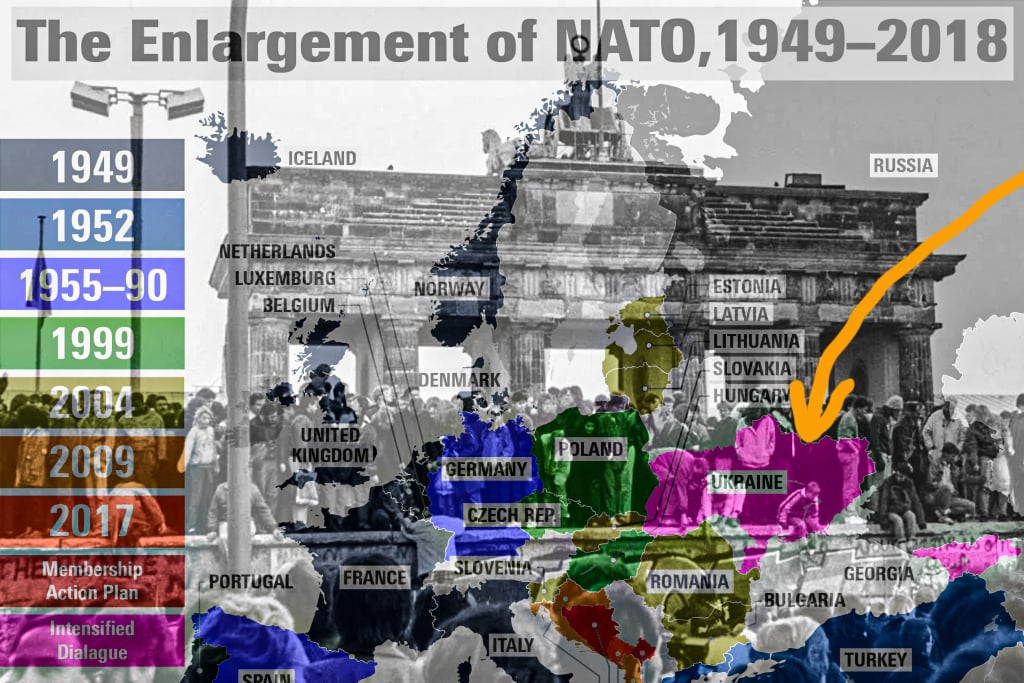
Beyond Russia, NATO/EU policies will prove morally wrong, unrealistic, dangerous and self-destructive.
February 23, 2023
Introduction: 1 year of violence on top of 30 years of conflict: Too much wrong thinking
The world’s focus is on the war. On February 24, it is one year since Russia launched its so-called special military operation. Much more important is to focus on the underlying conflicts – because there exists no war or other violence without root causes.
The focus on war, by definition, won’t lead to a solution or wider, sustainable peace – like feeling the pain in a patient without diagnosing where it comes from can never lead to healing.
Unless you ask: What is the problem, the conflict, that stands between the conflicting parties – NATO and Russia – it will end with escalation until one of the sides feel that the nuclear button is the only way out.
International politics is still so immature that the simple distinction between the violence and the conflict seem too intellectually demanding for the decision-makers, the media and most researchers.
However, understanding it would help save humanity’s future.
But the Military-Industrial-Media-Academic Complex, MIMAC, of course, thrives on the focus on war, weapons and ever more – blind – militarist thinking.
The conflict is about 30 years old, and the war is one year.
Whatever the reader may think about Putin, Russia, the invasion, Ukraine etc., the infantile blaming, demonisation and the projection of all guilt on one side in such a complex, multi-party and history-based conflict should stop. It’s emotionalist and stands in the way of rational and prudent policy-making.
Moreover, it is dangerous in its consequences. Therefore, it’s time for the West – US/NATO and the EU – to do some soul-searching and stop living in denial about its complicity in the conflict and this terrible war.
The overarching fallacy is to think and believe that because Russia did something wrong, everything NATO/EU did and do is right.
Contrary to good academic practice and my other writings, this article merely states points and conclusions, while my arguments can be found in the 200-300 pages of analyses I have written since 2014. Much of it can be found here and here.
I focus here on NATO/EU policies and why they are wrong and won’t succeed; that does not mean that I find Russia’s policies right and successful. But before you accuse others, take a look at yourself. The day after the invasion, I distanced myself from it and also made six – correct, as it turned out – predictions.
The basic psycho-political elements of the West’s policy vis-a-vis Russia
The building blocks of the West’s – NATO/EU – policies vis-a-vis Russia can be characterised by the following psycho-political concepts:
Immaturity and banalisation – in blaming everything on Russia in general and Putin in particular (it can be said that Putin also blames everything on the West, but that won’t help the EU and NATO – just make ‘us’ as stupid as ‘we’ think he is).
Psycho-political projections – what Russia does, NATO/EU countries have done themselves and in some respects much worse; and Putin is hysteric when he feels threatened by us, whereas we are justified – always were – that Russia is a huge threat and that Ukraine is only the first of a series of future aggressions. In other words, comparative studies and media mention of NATO countries’ aggression and violations of international law are prohibited.
Just one example: President Joe Biden, the leader of today’s only global empire with over 600 bases in more than 130 countries and the most war-fighting and mass-killing country since 1945, stated on February 24, 2022, that “This was … always about naked aggression, about Putin’s desire for empire by any means necessary.”
Untruthful innocence – NATO, by constitution, never did and doesn’t do anything wrong; it is innocent. NATO’s S-G Stoltenberg has repeatedly stated that ‘NATO is not a party to the conflict’ (but also, inconsequently, that Putin must not win because, then, ‘we’ shall have lost). The homepages of NATO and the EU state untruthfully that the extremely well-documented promises made to Gorbachev about not expanding NATO ‘one inch’ were never given.
The same untruthful innocence produces the lie that it all began with Russia’s annexation of Crimea or the full-scale invasion of Ukraine and that it was ‘unprovoked.’ The word reveals with abundant clarity that NATO knows it behaved in a provocative way. The only relevant history is the history of the conflict – which began at the end of the First Cold War in 1989-90. The rest is make-believe, opportunistic ignorance and pure propaganda.
An example of symbol politics and “sending messages”

European Commission President Ursula von der Leyen delivers a speech during a debate on ‘The State of the European Union’ at the European Parliament in Strasbourg, France, 14 September 2022. EPA/CHRISTOPHE PETIT TESSON
Groupthink – which implies that a group of elite decision-makers constantly and over time confirm each other in being fundamentally right and cannot be on the wrong track; they meet (latest in Munich) and confirm each other; their ministries, presumed analytical institutions and think tanks as well as the mainstream media hardly ever raise questions or criticise; every interpretation and information not identical with this groupthink is repelled, the world is interpreted selectively to fit the group’s worldview – and eventually, it is totally convinced that it cannot be wrong and that it’s decisions are smart and productive and will lead to the goal.
In this case, the US/NATO stated goal is to weaken Russia militarily and damage its economy to such an extent that it can never do such a thing again – a punishment for what it has done. Groupthink is dangerous because it defies reality checks, leads to hubris, to fatally wrong decisions, and invariably ends up as lemmings running to doom.
Hubris – or arrogance: In reality, ‘we’ are omnipotent. As former NATO S-G, Anders Fogh-Rasmussen has stated: Putin knows that “NATO spends ten times more on the military than he does and that we can beat the crap out of him.” Yet, paradoxically, no Western leader seems to be even thinking of aligning the idea that NATO shall win this war with NATO’s consistent propaganda to its citizens that Russia was a formidable threat which NATO had to defend itself against.
That was done by NATO having actually 12 times higher military expenditures before the war the war anyhow happened, and its ‘deterrence’ failed. And NATO has moved into the largest-ever re-armament to ‘defend’ with goals like 2-4% of the GNP spent/wasted on ‘warfare planning, ‘security’ and ‘defence.’ (As if that was a serious way to determine thow to meet perceived threats).
Militarism – every’ solution’ mentioned is about military actions. We shall win on the battlefield. Nobody in NATO/EU circles knows how to pronounce words such as peace, conflict-resolution, mediation, peacemaking, peace-keeping, reconciliation, dialogue, talks…
Of course, it is implicitly understood that President Putin is at such a low intellectual and moral level that the only thing he understands is that we – the bigger boys in the schoolyard – beat that crap out of him.
Sadly, the only thing that today keeps the Western world together is militarism, winning over Russia together. No other or more positive cause has had the same solidifying function. Militarism has become a religion, NATO its church – and only infidels question that faith and God’s existence. And they know that God is always on’ our’ side.
With warfare, people come together and, in enigmatic ways, their lives may acquire a new meaning that replaces a sense of meaninglessness, and fills an existential void.
Omnipotence – the EU/NATO world has no sense of limitations. It can fight economic crises, recover after the Corona years, handle refugees, solve climate change, alleviate poverty – you name it – and it can re-arm for billions upon billions of dollars. It – the US in particular – can wage a Cold War on everything China – an industry of non-documented accusations – and it can print any amount of greenbacks and repay debts, fix all the infrastructure and other problems of the US society, compete and win in the fields of advanced technology.
The EU – which hasn’t gotten its acts together and built a modern transport infrastructure based on an all-Europe high-speed train network – believes it can always do that later.
All these countries can install sanctions ad libitum – the disease I call ‘sanctionitis’ – believing that they will not be hurt themselves by them. And we shall, of course, re-build Ukraine after we have contributed to destroying it, now it has fought so nobly for ‘our’ values.
We are second to none, and we can do everything simultaneously. No need to prioritise. Significantly, all decisions are made knee-jerk: Sanctions, cancelling of Russia in all other fields, Finland’s and Sweden’s NATO member decisions without analyses of the short, mid-and long-term consequences.
All major decision-makers will be retired or dead, leaving it our children and grandchildren to pay the price by living in a Cold War-impoverished, de-developed and unhappy Europe and US – the more so, the longer the war lasts.
Lacking world awareness – 80-85% of humanity lives in countries whose governments do not side with the NATO/EU world. If the NATO/EU world thought about global attitudes before they made their decisions in response to Russia’s invasion, they made a Himalayan miscalculation – or thought they could later bully everybody into lining up behind them.
This is interesting also because NATO does not only have 30 members, it has 42 partners – some on all continents – and it tries very clearly to move towards becoming a global rather than transatlantic organisation.
This dimension is brilliantly summarised by the High Rep of the EU Foreign and Security Policy (and Spanish Socialist Workers’ Party member), Josef Borell’s racist statement from late 2022: “Europe is a garden. We have built a garden. Everything works. It is the best combination of political freedom, economic prosperity and social cohesion that the humankind has been able to build – the three things together. The rest of the world,” he went on, “is not exactly a garden. Most of the rest of the world is a jungle, and the jungle could invade the garden.” (Stated when opening the European Diplomatic (!) Academy in Bruges).
This leads to:
Intellectual poverty – EU/NATO policies now operate on simplifying Twitter-like statements, assertions, non-documented accusations, self-legitimising marketing language, slogans, empty promises and symbolic blue-yellow emblems, ties, dresses – instead of on analyses, arguments and complex understanding.
Following these things every day is utterly boring, predictable and – filled with repetition. Mr Stoltenberg could easily enter Guiness World Records in Banality Repetition. The awareness or focus of politics, media and research is on weapons, war reporting, media war, more weapons fast into Ukraine – and ‘we shall win’ and ‘Russia must not win.’
The obvious questions never asked are: And then what? At what cost to whom? And what will Europe and the world look like afterwards – if it exists? These groupthinkers don’t seem to bother. The idea of asking: If war, what are the underlying conflicts? What are the real, tangible problems – a conflict is an unsolved problem – that stand between NATO and Russia and seriously contributed to the latter blowing up – is prohibited.
The intellectual poverty also comes through in believing, as it seems, that the word ‘Putin’ explains everything. So, this enormously complex conflict accumulating and deepening since the Berlin Wall came down and the Soviet Union and the Warsaw Pact dissolved, is reduced to Mr Putin – The (D)Evil – his personality, childhood, or his being physically or mentally ill, a man you shall not listen to who runs a country whose people we punish collectively (against international law, but who cares?).
Furthermore, it comes through in cancelling all critical voices and calling people who ar capable of seeing two sides in a conflict ‘Putinists’ or ‘Putin Versteher’ – the poor trick of framing, of attacking the messenger instead of saying something intellectually qualified.
So, nine psycho-political building blocks in synergy.
Reality checks are very unlikely – at least until the crisis is on the verge of complete breakdown. These building blocks alone guarantee, in my view, that this is not going to go well, and that the NATO/EU leaders are likely to make ever larger miscalculations and live on delusions. Wars tend to narrow down people’s minds. There is no space or time for reflection, for stopping to think.

2. What does it mean to win?
The usual, again intellectually deficient, argument is that’ we’ must and will, therefore, win, ‘they’ shall lose. And, implicitly, we win because they lose, we win over them. That could turn out to be wrong because ‘they’ might win and ‘we’ might lose.
But it is actually a fourfold table; apart from these two outcomes, both could somehow win, and both could lose.
But even this is a fallacy – because there are not two but many parties: Russia (government and people), Ukraine (government and people), NATO with 30 member states (governments and people) and the US as the leader (government and people). And there is the rest of the world and how the conflict and war impact the global system as time passes.
But let’s stick to the winning idea. What does it mean? Winning militarily, of course – but also winning politically, morally, economically and culturally? Who will be stronger in which respects when the war ends?
The most likely scenario I see on this first anniversary of the war, is a long struggle rather than a quick end to it. The longer it lasts, the more difficult it will be to solve the underlying conflicts – because of the immense accumulated hatred, traumas, devastations, death and wounded, the destroyed economies, etc.


Although the human and material destruction in Ukraine is, so far, rather limited in comparison with, say, Afghanistan, Iraq, Libya, Syria, Yemen etc. – it is already as huge as it is heartbreaking. Therefore, the slogan “This war must stop now!” – is the most powerful and truthful – but it is unlikely that the parties will listen anytime soon. They are all in a blind chicken game.
Apart from arms-producing companies and major energy corporations, I see none among the many conflict parties mentioned above who will be better off after this war than before 2014 (the US-instigated and financed regime change in Kyiv and the Russian annexation afterwards of Crimea) or before February 24, 2022.
Instead, everyone – you and me, too – will pay various types of prices. This applies to the immediate after, but also to decades ahead. Healing this conflict and the wounds of this war, building trust as well as a new security system, will take several decades.
In summary, this war cannot be won in any reasonable sense of the word. The ad nauseam repeated NATO/EU slogan “We shall win, stand with Ukraine as long as it takes,” is ill-considered, intellectually poor and delusional.
And it is dangerously irresponsible also because it means killing even more Ukrainian citizens who – in any thinkable scenario – will be the main losers.
Regrettably, this does not prevent those who say it from believing their own words. It’s just that they have never thought through what they mean – because of the 9 psycho-political points above.
3. All basic NATO/EU assumptions are either plain wrong, unrealistic or unsustainable.
1 • Putin wanted to split NATO, but we stand united.
The first is plain wrong. If NATO is not a party to the conflict, why is Russia’s invasion of a non-NATO country an attempt to split the alliance? Ten former Warsaw Pact countries have become members of NATO despite the well-documented promises all important Western leaders gave Gorbachev over 30 years ago that, if they got united Germany into NATO, the alliance would not expand “one inch” to the East? Why did Russia not split that expanded NATO earlier – and why did it intervene in the case of Ukraine?
It is true, however, true that the only thing the West stands united around is hatred, demonisation and re-armament – winning the war on Ukraine’s territory. Western cohesion has much to thank Putin for – for as long as it lasts.
2 • Putin is out to conquer one country after the other.
Well, so far, it’s not gone that well in Ukraine, and why did he not do that over the last 20 years during which he has been president? Does Russia – with 8% of NATO’s military expenditures and falling – really have the capacity to invade one country after the other, occupy and administer a series of NATO members? Some people say, look at the Russian invasion of Georgia in 2008. Well again, that was not what it really was – but the repeated propaganda works.
3 • Russia/Putin threatens Finland and Sweden and may even make an isolated attack on the Swedish island of Gotland – therefore, Sweden must join NATO.
Well, what about a shred of evidence of such an intention? Any assessment of the ‘correlation of forces’? Goodhearted people seem to believe that Sweden would have to fight it alone but – no – the US would come to its rescue even if Sweden wasn’t a member of NATO. That was already agreed upon and planned.
Sweden will instead now be drawn early into warfare and have to accept US and perhaps other bases/weapons prepositioning on its territory and thereby ensure that Russian missiles will target Sweden. It has said goodbye to 200 years of beneficial non-alignment, an independent foreign policy, options of being a mediator and an advocate of common security and the UN goal of general and complete disarmament.
The Swedish PM Kristersson has – without any mandate – promised full loyalty even with NATO’s nuclear doctrine. The Swedes will now live much more dangerously – with sharp, confrontational borderlines instead of neutral buffers. And with much less diversity and freely stated opinions in a more militarist security debate.
4 • Russia will fall apart economically.
Yes, of course, there are economic problems and they may likely increase year by year – but Russia is far from falling apart – for at least four reasons. Furthermore, the Russians know how to suffer – 27 million dead in WW2 – whereas Westerners don’t know much about suffering for their principles and stated ideals.
Ukraine is an existential issue for Russia and many Russians, but absolutely not for the US/NATO – except for the fact that NATO’s only raison d’etre is expansion for the sake of expansion and to keep the conflict with Russia as a-symmetrical as possible and weaken Russia.
Moreover, Russia has the world’s by far largest territory and deposits of natural resources – it is certainly able to slowly but surely turn its back on the EU and NATO countries and cooperate, instead, much more closely with China, India, Iran, the Middle East and the rest of the world, also in the China-driven Belt And Road Initiative, BRI.
Out there, they may not love Russia, but they unite with it because they are sick and tired of the West in general and the US Empire’s operations in particular. And because the Global South has been hard hit by both global economic crisis, the fallout from the Corona and now the West’s response to the invasion.


5 • We can win this war by letting the Ukrainians fight it for us.
We’ve all heard it repeatedly: Ukraine’s cause is our cause. Ukraine is fighting for our liberal values, for us, for Europe. Ukraine struggles impressively for freedom, democracy, human rights – and therefore, we have a duty to support it with weapons and humanitarian aid.
This idealised, or glossy, Western media image of ‘our’ Ukraine has a political purpose and should be discussed. Understandably, a country fighting for its survival may have to compromise on some of those fine values; the relevant question is what Ukraine might look like – given parts of its history and the de-moralising effects of multi-year warfighting.
Additionally, do the Ukrainians have the military, political, economic and psychological strength to carry the West’s burden on its shoulders, fight for years against NATO’s allegedly formidable nuclear enemy? For a time, yes, but hardly for much longer.
We should not be surprised if more and more Ukrainians begin to wonder: How much of our country and our future must be destroyed to – perhaps – become a NATO member? Is our president doing what is best for Ukraine or is he actually more loyal to the US/NATO than to his citizens? What about internal conflicts, power struggles, coup d’etat attempts and war fatique if this war drags on and, for years, doesn’t lead to anything that can be called victory?
And will Europe take more millions of Ukrainian refugees who have to run away or see no future there?
What we see is the tyranny of the small steps – incremental NATO de facto involvement “for as long as it takes.” It means both fighter aircraft, long-range missiles, and substantial depletion of NATO’s military arsenals. It won’t be for Ukraine’s sake – the country could well be pulverised – but because ‘we’ need to win this war.
6 • The ethics is abominable.
Is Ukraine really important enough for the US and NATO to risk major war, perhaps nuclear war? Do NATO countries have real ideals, and do they want to show that deeds are more important than words? Does NATO really want to win and pay victory’s price?
Today’s leaders would say ‘Yes.’ Then the moral dilemma can be formulated in this way: Why not put in 300 000 – 400 000 NATO troops and conduct the war you have developed plans for since decades back – make it your war, not a proxy war in which the Ukrainian people shall pay the price for the – predictable – consequences of NATO’s expansion (Remember that before the invasion, there was only a minority of all Ukrainians who were in favour of NATO membership and 2/3 of the people who wanted the question decided by a referendum – they never got. NATO and President Poroshenko made the decision).
So, how much are the Ukrainians willing to sacrifice for ‘our’ goals? And for how long?
7 • Peace will emerge from the victory on the battlefields of Ukraine.
It won’t. It never has. Militarism and being drunk on weapons exclude every thought of peacemaking – the words mentioned above under militarism. When you allocate all your resources to the arsenals of war, you deplete the arsenals of peace.
The NATO/EU countries have, in contrast to Putin in 2014, never proposed that the UN come in as a mediator, disarmer and dialogue facilitator. The Minsk process was nothing but a way to buy time for Ukraine to be armed as much as possible before the great battle for ‘our values’ and the killing of 14 000 Russian-leaning Ukrainian citizens. Ukraine is not a country without internal conflicts – that may blow up when the present war ends.
The incredible conflict and peace illiterate assumption seems to be that the NATO/EU countries can be both a fighting party and, later, a mediator. Or that there will be no need for any mediation and reconciliation with Russia: A new Iron Curtain, just tighter, in the making.
8 • The people of Europe will put up with all this because we tell them it is an existential fight.
I do not think they will. There are already doubts and demonstrations against the US/NATO/EU media narrative. It will dawn among the EU’s 420 million citizens that the skyrocketing prices are not “Putin’s prices” but of their own politicians’ making.
It may dawn upon them that Nord Stream’s destruction was an act of economic terrorism against friends and allies, a deep humiliation of Germany and Chancellor Scholz personall – a hitherto unseen US arrogance that will not be forgotten even with the media avoiding it as much as they can – a 9/26 as a European 9/11?
According to this survey published by Euronews, people’s attention is shifting from Ukraine’s battlefield to the wider-felt impacts, including supply-chain disruption, energy price spikes and rising inflation. Time will exert its influence on what can be done by whom and for how long.
9 • We can make Ukraine a NATO member and ignore Russia’s concerns, protests and anger.
Well, not exactly prudent but, rather, a result of the above 9 psycho-political mechanisms. That’s is why NATO’s expansion cannot be discussed and the narrative has it that Putin acted out of the blue.
Generally, people who feel ignored will, as time passes and their frustration builds, force others to listen to them.
In my online book, The TFF Abolish NATO Catalogue, I have analysed this expansion process and dealt with essentially important and trustworthy analyses. And Ted Snider writes in his article “We all knew the dangers of NATO expansion” that:
“In 2008, William Burns, who is now Biden’s director of the CIA but was then ambassador to Russia, warned that “Ukrainian entry into NATO is the brightest of all redlines for the Russian elite (not just Putin).” He warned Secretary of State Condoleezza Rice that “I have yet to find anyone who views Ukraine in NATO as anything other than a direct challenge to Russian interests.” Short even of expansion into Ukraine, Burns called NATO expansion into Eastern Europe “premature at best, and needlessly provocative at worst.” If it came to Ukraine, Burns warned, “There could be no doubt that Putin would fight back hard.”
This is one of numerous facts that you are prevented systematically by our politicians and media to know and discuss.
The list of intellectuals – Realpolitik as well as peace experts – who have warned that Ukraine was a No Go place for full NATO membership is long and most mentioned in my book. NATO, the hubris alliance, did not believe it had to listen or take serious what they – and every Russian president – have stated the last 30 years and CIA’s Burns expressed so well in the same year as NATO decided that Ukraine should become a NATO member (without ever asking the Ukrainian people).
10 • The West will come out stronger and keep its role as a world leader.
It won’t, it will be weakened. If it wants to outcompete China, the Belt and Road Initiative as well as other big powers, it would be wiser to sleep out the militarist hangover and get up early in the morning. If anything, this extremely resource-consuming war for a non-important, non-NATO country will weaken the West more than it will weaken Russia, which will join the emerging new multi-polar world order.
It will instead accelerate the decline of the US global empire and cause it to fall sooner rather than later. Which is what I predict, for instance, in the article “The Occident is now militarising itself to death for a second time.”
Instead of conclusions
• We are where we are now for a series of reasons. We did not have to be here. This could all have been avoided.
• The – superior – NATO/EU world is in denial, and its policies have no chance of succeeding because they are intellectually and morally deficient.
• This is true irrespective of what you feel about Putin and Russia. If you or the West think he is stupid or evil, don’t believe that anything you do is wise and good. It hasn’t been. And don’t ever reciprocate in kind – tit-for-tat – because that makes you a mirror image of Putin. (Read your Gandhi).
• Each and every person who says that ‘we’ shall win this war and ‘they’ shall lose should get out of the sandbox and recognise that s/he becomes co-responsible for the limitless suffering of the innocent Ukrainian citizens, perhaps in the millions.
• This war must stop and stop now. We must begin to think and get out of the emotionalist, self-glorifying autopilot straitjacket.
• Or we shall all lose.
• Knowledge-based and intelligent civil conflict resolution is the only road to peace, cooperation and coexistence in the future.
• Peace is still possible.
• And peacemaking is the only chance for the US and Europe to play a positive role in tomorrow’s new and very different world.







3 Responses
I like it all, but especially “– a 9/26 as a European 9/11?”
Thank you very much for the comprehensive analyses. I hope that many, many readers will be wiser. By following some people on social media that I did not know of before, I sense a shift in the attitudes towards this conflict and the terrible developments since February 2022. The arguments here provides definitely more fuel to the intellectual and moral fight, which is adamant!
Thank you so much. We sense that change too – hopefully, it will be fast enough.