
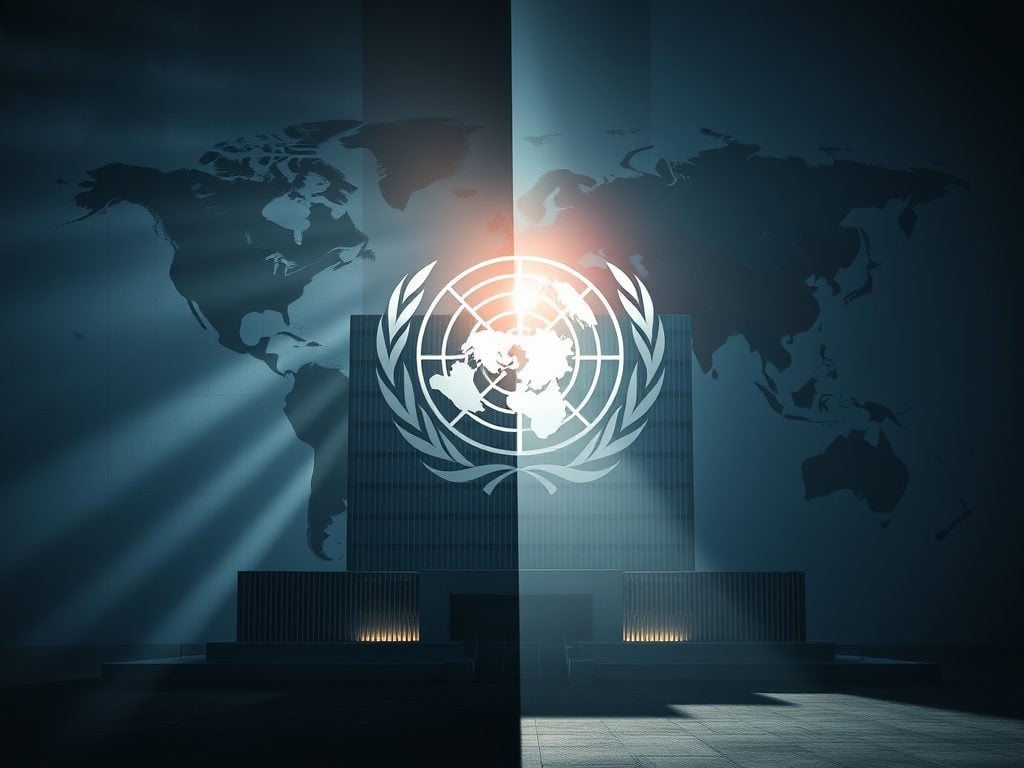
The UN at 80: Still humanity’s most important organisation but member states deliberately destroy it

Editorial for Transcend Media Service, TMS, and published in an edited Q & A version by the China Social Science Network-China Social Science News.

See also this follow-up, “Condemn all UN member states: They spend 100 times more on militarism than on the entire UN system.”

The UN has been extremely important over the last 80 years in terms of, for instance, global dialogue, multi-dimensional development, international law, peace-keeping, normativity, violence condemnation, and ethics. It has been the place to hold member states accountable.

The UN Charter is the most Gandhian document ever signed by the world’s governments. If the great majority of member states lived up to their obligations in accordance with the UN Charter and including the resolutions they have signed up to, the world would be a much more peaceful, just, democratic, and lawful place.

Regrettably, there are several reasons why the world is not in accordance with those fine Charter norms and provisions:
a) The majority of states are nationalistic and do not accept supra-national bodies that could limit their ‘national interests,’
b) the general member state conceptualisation of defence and security is based on offensive deterrence, which prioritizes offensive weapons and unavoidably create the classical ‘security dilemma’ which leads to ever higher armament levels and risks of violence instead of true peace. Additionally, weapons of mass destruction are incompatible with several provisions, the clearest being the Charter’s Article 1 – that peace shall be established by peaceful means and the Treaty on the Prohibition of Nuclear Weapons (2017).

One may mention two other reasons, namely:

c) Civilian conflict-resolution, mediation, reconciliation and similar concepts and policies are by and large ignored because most governments are woefully lacking in knowledge about these matters. Security means preparing for war, not preparing for cooperation, dialogue, mediation and negotiated solutions. And then:

d) Member states spend a total of 300-400 times more on their military than on what the United Nations and all its family organizations do.

As if this were not bad enough, here is what the UN itself points out, namely that “according to information provided by the UN Controller to the General Assembly’s Fifth Committee (Administrative and Budgetary), only $1.8 billion has been received against the $3.5 billion regular budget assessments for 2025 – a shortfall of around 50 per cent.”

It should be obvious that the world’s government priorities militate against every idea about a less violent and war-ridden world. In 2024, the world spent US$ 2700 billion on the military.

There are other reasons, but these are enough to make the point that the main fault is with the member states and their behaviour rather than with the United Nations as a global institution.

If the member states wanted it to be what its founding intellectuals wanted it to be, it would be completely different from today’s UN.

•


Most international organizations have preambles that make peace their overriding norms and goal, often with explicit reference to the UN Charter. One example is the EU, another NATO. NATO’s treaty is pretty much a copy of the UN Charter expanded with Article 5 about mutual military assistance in case of an attack on a NATO member. It also states that all conflicts shall be referred to the UN.

However, since NATO bombed Yugoslavia in 1999 in its first ‘out of area’ operation and lacking a UN mandate, it has operated principles, concepts and policies that can be summarized as a 24/7 violation of its own treaty.

In today’s dark militarist times, the word ‘peace’ is nothing but window dressing. Virtually no government has any capacity to solve conflicts through diplomacy and other civilian means – to make peace by peaceful means. I have argued elsewhere that the world is more conflict and peace illiterate than ever.

/the-wests-self-destructive-peace-and-conflict-illiteracy/


Since peace considerations have been de facto cancelled in Western politics, media and research, it can safely be predicted that the fact that the UN – humanity’s most important organization – turns 80, will cause very little attention celebration among the 12% of humanity who live in the West. Western media is likely to pay much more attention to NATO’s 80th anniversary in 2029. However, the UN will be celebrated by many in the non-Western parts of the world.

•


For decades, a lot of research, dialogues and civil society activism has produced brilliant proposals for UN reforms and, related to them, discussed what the future world needs in terms of global governance and cooperation. For someone who has followed them all for equally many decades, there is only one conclusion to be drawn: The West does not have any vision for the future in general or for the UN’s future in particular, does not want to share power with others through a reformed UN and wants to keep on dominating the world. It seems blind to the fact that it is in rapid decline and bound to fall in terms of ethics, economics, politics, legitimacy, culture, technology, education, research and in terms of respect for international law and even it’s own civilisational values.

Thus, the last the US/West would like to see is a shared global future with a strong United Nations. At what point – and how – it will recognise that its struggle for global one-polar dominance is hopeless and that ‘if you can’t beat them, join them’ remains to be seen. But it is not going to be a cosy tea party.

What reform are mentioned in UN circles?  

The “UN80 Initiative” centers on three priorities: enhancing operational efficiency, assessing how mandates – or key tasks – from Member States are implemented, and exploring structural reforms across the UN system. Of course, these are important issues and the UN certainly needs to be updated, made more efficient and pursue better management.

However, such priorities apply to lots of other international organisations too, but the UN is both the one singled out as “outdated” or “bureaucratic” and also the one that has to survive on woefully inadequate funds given its extremely complex global mandate.

Compare with NATO which does not even discuss reform and rests on a manifestly outdated offensive military ‘defence’ and a right to First Use of nuclear weapons, a gigantic bureaucracy that, when it has a summit, is basically a stage-set theatre performance with fashion, cosy family smiles, jokes, staged press conferences and other meetings where each actors has been instructed beforehand about exactly what to say and not to say – and they all state the same banalities as if Russia had already started its tanks rolling towards the Eifel Tower and Brussels. The final summit declaration is written before the meeting, it is brief and only states that the Alliance has decided to increase its military expenditures to 5% of GNP – a measure I believe I am still the only one to have fundamentally criticized as the intellectual nonsense it is:
https://thetransnational.substack.com/p/natos-5-of-gdp-military-expenditures 

This happens while the UN must move to cheaper location worldwide, perhaps abandoning partly or in whole its second HQ in Geneva. In passing I would suggest that the UN HQ in New York is moved out of the US that no longer deserves to be the host of it.

The 80th UN Anniversary would better be celebrated by launching various elements of a new vision for the UN in the future world and by the UN leadership requiring much more solidarity and increased funding from its members as well as simple respect for the norms, values and articles of the Charter.

But that would, among many other things, require a UN Secretary-General more like Dag Hammarskjöld or Kofi Annan than the present, very decent and soft-spoken António Guterres who would hardly activate the Charter’s Articles 99 and 100 about the power he actually has and demand of member states that they enable him and his secretariat to perform all the tasks they demand that the UN shall do and achieve almost against all odds created by the self-same members. They instead submit blurred mandates and shamelessly small funds.

The UN is in need of many reforms and updating; anybody turning 80 is. But the UN’s first S-G, Norwegian Trygve Lie, was absolutely correct in pointing out that the UN will only be as strong, efficient and world-improving as the member states want it to be.

The US and other Western members have not only marginalised the UN systematically for decades, they have also conducted policies which amount to a total violation of everything the UN stands for and seeks to achieve. The US/West has even introduced its own “rules-based international order” and – with Israel – considers itself “exceptionalist” in not being bound by international law as we know it in general and the UN Charter in particular. The Gaza Genocide and the Israeli and US aggression on Iran speaks volumes of the rogue contempt for the UN and international law.

It is well-known that the Security Council must be reformed, the General Assembly invigorated, perhaps a new peoples’ Assembly – so the UN could become more “We, the peoples” and not only “We, the – unelected – government representatives,” and that security also includes the environment, etc.

There is an obvious need for a much stronger UN Peace-Keeping Organisation and an Intervention Force under UN – not NATO – command in accordance with Chapter 7 – when every civilian step has been tried and found in vain.

We are not revealing a secret by saying that it is various member states who oppose all these common-sense ideas that would be eminently possible if member states were members for the UN and not only of or against it.

In my view, China is the only large and important power that speaks up and conducts policies with fundamental respect for the UN Charter. One only has to point to China’s adherence to the brilliant Five Principles of Peaceful Co-Existence (embedded in its constitution) and its visionary Initiatives for A Shared Future, Civilisation, Development and Security.

That said, it is, however, also almost US$ 600 million behind with this year’s funding pledges and is only the 8th largest contributor to UN Peace-Keeping.

Furthermore, it can also safely be argued that projects such as the Belt and Road Initiative, BRI, is in fine alignment with the basic UN principles; cooperation for mutual and equal benefit is highly likely to contribute to violence- and war-prevention and, in the longer perspective, become perhaps the most important single peace project in the new multi-polar world humanity is longing to see come about.     
    

Peace & future researcher + ‌Art Photographer

2 Responses

  1. Obviously China is now in the same situation as the US was when it sponsored the UN – a country that is beginning to be so important that it may use the UN as a tool. Countries that see their economic future in a positive light don’t need to be violent – while those who see their economies as threatened may use violence to keep the threats away.

Related Posts

It’s a matter of principles, courage, vision and pulling together – while the militarist world is falling apart… Peter Langille October 3, 2026 “Here, then, is the problem which we present to you, stark and dreadful and inescapable: Shall we put an end to the human race; or shall mankind renounce war?”The Bertrand Russell—Albert Einstein Manifesto, July 9, 1955 ⁕ The forecast for what’s ahead is worrisome. The sharp rise in armed conflicts over the past three years is adding to what was already the highest level in over seventy years. Genocides, which should be prevented are supported. A shared climate emergency that jeopardises survival is ignored. Diverse polls now suggest that people are war-weary, worried and interested in a more effective United Nations. And, there are viable policy options for a more secure world! Yet governments are doubling-down, betting on more war and investing heavily. If current trends persist,...
Johan Galtung 1930-2024October 2015 Published here on October 3, 2026 Let us focus on Civilization for conflict analysis and remedies. Major forms of disorder use violence; war is state organized violence. The most belligerent states are the United States of America and Israel, both with civilization roots. National Evangelism, the US Protestant Christian civilization– more national than evangelical–justifies US warfare as exceptionalism of a people chosen by God, with a manifest destiny to run the world. Orthodox Judaism justifies Israeli warfare to conquer and expand from Nile to Euphrates as a religious right and duty to the Eternal One. The third most belligerent country, the UK, no longer believes it is God-chosen but chosen by the USA; not quite the same but something. But the root cause of global disorder lies in the Occident–with Islam–seeing itself as the single, universal civilization valid for all at all times, all others being...
Jan ObergPhD, director, The Transnational Foundation for Peace and Future Research, TFFLund, Sweden October 2, 2026 This is my full original manuscript. The Chinese Academy of Social Science, CASS, makes two publications out if it. 1. China’s Five-year plan emphasized the capabilities of basic research and original innovation. It is regarded as the goal of the future social development, which, as required, should be significantly enhanced. Can you comment on the importance of original innovation in research and academic study? I believe it is easier to define “original innovation” in the natural sciences than in social sciences. The breaking points of what constitutes something new, or innovative, are not quite as sharp in the latter. But in both fields it is about opening up something that was closed, unseen, unexplored before – making manifest what was earlier latent. Innovations come in many forms and shapes – naming something that was not...

Recent Articles

Tony Robinson October 4, 2026 Violence is easy to recognise when someone is being beaten, shot or killed. It becomes more difficult when nobody is holding a weapon. Poverty, discrimination, exploitation and repression can restrict a human life just as effectively, although they do so in very different ways and with very different consequences. Simply adding more categories to an ever-growing list of forms of violence does not really solve the problem. The more interesting question is what all these different situations have in common and why it makes sense to describe them using the same word. Human beings do not simply react to what happens around them. They remember the past, imagine things that do not yet exist, make plans and undertake projects. Workers organise because they imagine different working conditions; people migrate because they imagine another life somewhere else; social movements emerge because people refuse to accept the...
It’s a matter of principles, courage, vision and pulling together – while the militarist world is falling apart… Peter Langille October 3, 2026 “Here, then, is the problem which we present to you, stark and dreadful and inescapable: Shall we put an end to the human race; or shall mankind renounce war?”The Bertrand Russell—Albert Einstein Manifesto, July 9, 1955 ⁕ The forecast for what’s ahead is worrisome. The sharp rise in armed conflicts over the past three years is adding to what was already the highest level in over seventy years. Genocides, which should be prevented are supported. A shared climate emergency that jeopardises survival is ignored. Diverse polls now suggest that people are war-weary, worried and interested in a more effective United Nations. And, there are viable policy options for a more secure world! Yet governments are doubling-down, betting on more war and investing heavily. If current trends persist,...
Johan Galtung 1930-2024October 2015 Published here on October 3, 2026 Let us focus on Civilization for conflict analysis and remedies. Major forms of disorder use violence; war is state organized violence. The most belligerent states are the United States of America and Israel, both with civilization roots. National Evangelism, the US Protestant Christian civilization– more national than evangelical–justifies US warfare as exceptionalism of a people chosen by God, with a manifest destiny to run the world. Orthodox Judaism justifies Israeli warfare to conquer and expand from Nile to Euphrates as a religious right and duty to the Eternal One. The third most belligerent country, the UK, no longer believes it is God-chosen but chosen by the USA; not quite the same but something. But the root cause of global disorder lies in the Occident–with Islam–seeing itself as the single, universal civilization valid for all at all times, all others being...

TFF on Substack

Discover and subscribe to more peace materials on TFF Substack

Most Popular

Tony Robinson October 4, 2026 Violence is easy to recognise when someone is being beaten, shot or killed. It becomes more difficult when nobody is holding a weapon. Poverty, discrimination, exploitation and repression can restrict a human life just as effectively, although they do so in very different ways and with very different consequences. Simply adding more categories to an ever-growing list of forms of violence does not really solve the problem. The more interesting question is what all these different situations have in common and why it makes sense to describe them using the same word. Human beings do not simply react to what happens around them. They remember the past, imagine things that do not yet exist, make plans and undertake projects. Workers organise because they imagine different working conditions; people migrate because they imagine another life somewhere else; social movements emerge because people refuse to accept the...
It’s a matter of principles, courage, vision and pulling together – while the militarist world is falling apart… Peter Langille October 3, 2026 “Here, then, is the problem which we present to you, stark and dreadful and inescapable: Shall we put an end to the human race; or shall mankind renounce war?”The Bertrand Russell—Albert Einstein Manifesto, July 9, 1955 ⁕ The forecast for what’s ahead is worrisome. The sharp rise in armed conflicts over the past three years is adding to what was already the highest level in over seventy years. Genocides, which should be prevented are supported. A shared climate emergency that jeopardises survival is ignored. Diverse polls now suggest that people are war-weary, worried and interested in a more effective United Nations. And, there are viable policy options for a more secure world! Yet governments are doubling-down, betting on more war and investing heavily. If current trends persist,...
Johan Galtung 1930-2024October 2015 Published here on October 3, 2026 Let us focus on Civilization for conflict analysis and remedies. Major forms of disorder use violence; war is state organized violence. The most belligerent states are the United States of America and Israel, both with civilization roots. National Evangelism, the US Protestant Christian civilization– more national than evangelical–justifies US warfare as exceptionalism of a people chosen by God, with a manifest destiny to run the world. Orthodox Judaism justifies Israeli warfare to conquer and expand from Nile to Euphrates as a religious right and duty to the Eternal One. The third most belligerent country, the UK, no longer believes it is God-chosen but chosen by the USA; not quite the same but something. But the root cause of global disorder lies in the Occident–with Islam–seeing itself as the single, universal civilization valid for all at all times, all others being...
Read More
Living-Peace-Sign-Budapest-copy
Tony Robinson October 4, 2026 Violence is easy to recognise when someone is being beaten, shot or killed. It becomes more difficult when nobody is holding a weapon. Poverty, discrimination, exploitation and repression can restrict a human life just as effectively, although they do so in very different ways and with very different consequences. Simply adding more categories to an ever-growing list of forms of violence does not really solve the problem. The more interesting question is what all these different situations have in common and why it makes sense to describe them using the same word. Human beings do not simply react to what happens around them. They remember the past, imagine things that do not yet exist, make plans and undertake projects. Workers organise because they imagine different working conditions; people migrate because they imagine another life somewhere else; social movements emerge because people refuse to accept the...
b54a1f10-8c65-4f0b-9dd5-4abc0a7d04cc_2659x2659
It’s a matter of principles, courage, vision and pulling together – while the militarist world is falling apart… Peter Langille October 3, 2026 “Here, then, is the problem which we present to you, stark and dreadful and inescapable: Shall we put an end to the human race; or shall mankind renounce war?”The Bertrand Russell—Albert Einstein Manifesto, July 9, 1955 ⁕ The forecast for what’s ahead is worrisome. The sharp rise in armed conflicts over the past three years is adding to what was already the highest level in over seventy years. Genocides, which should be prevented are supported. A shared climate emergency that jeopardises survival is ignored. Diverse polls now suggest that people are war-weary, worried and interested in a more effective United Nations. And, there are viable policy options for a more secure world! Yet governments are doubling-down, betting on more war and investing heavily. If current trends persist,...
010
Johan Galtung 1930-2024October 2015 Published here on October 3, 2026 Let us focus on Civilization for conflict analysis and remedies. Major forms of disorder use violence; war is state organized violence. The most belligerent states are the United States of America and Israel, both with civilization roots. National Evangelism, the US Protestant Christian civilization– more national than evangelical–justifies US warfare as exceptionalism of a people chosen by God, with a manifest destiny to run the world. Orthodox Judaism justifies Israeli warfare to conquer and expand from Nile to Euphrates as a religious right and duty to the Eternal One. The third most belligerent country, the UK, no longer believes it is God-chosen but chosen by the USA; not quite the same but something. But the root cause of global disorder lies in the Occident–with Islam–seeing itself as the single, universal civilization valid for all at all times, all others being...
Screenshot 2026-10-02 011738
Jan ObergPhD, director, The Transnational Foundation for Peace and Future Research, TFFLund, Sweden October 2, 2026 This is my full original manuscript. The Chinese Academy of Social Science, CASS, makes two publications out if it. 1. China’s Five-year plan emphasized the capabilities of basic research and original innovation. It is regarded as the goal of the future social development, which, as required, should be significantly enhanced. Can you comment on the importance of original innovation in research and academic study? I believe it is easier to define “original innovation” in the natural sciences than in social sciences. The breaking points of what constitutes something new, or innovative, are not quite as sharp in the latter. But in both fields it is about opening up something that was closed, unseen, unexplored before – making manifest what was earlier latent. Innovations come in many forms and shapes – naming something that was not...
arctic-circle-map
The agreement is catastrophic both because of what it says and what it doesn’t mention. It reduces further the major asset of security policies: Freedom of action. Jan Oberg TFF director September 25, 2026 A couple of hours before the agreement was signed on September 22, 2026, I published the following 13 hypotheses about what it would most likely contain on TFF Substack (in English). I was wrong on only the first point. Contrary to what Trump had written on his Truth Social platform, it does not appear to come into force immediately. In fact, it turned out to be worse than even I had anticipated. After these hypotheses now come a number of reflections in light of what the agreement actually contains, and does not contain, as well as the way in which it has generally been presented by major media outlets and by the public-service broadcaster DR. My...
girl-5894831_1280
Below are TFF-related media mentions, comments, videos and social media posts published elsewhere but not on this homepage. We happen to catch and list only a fraction. Regarding video comments and debates, we recommend that you go to the TFF Video Channel on Substack where many of them are reproduced. Jan Oberg is a contributor to China Daily – 52 million daily clicks – and Global Times, CGTN and CCTV (the national television), China Investment, Xinhua News Agency and several others. Articles and videos on these media very often multiply into countless Chinese (and Western media) that re-post them from these main media. Thanks to The China Academy, his analyses, interviews and comments are frequently posted on YouTube channels such as Thinkers Forum and Wave Media. These videos are often re-posted on Bilibili (China’s YouTube), the China Content Center on TikTok, and on the Chinese edition of TikTok, Douyin.com. This means reaching hundreds of millions of viewers worldwide over a year. While there are too many to catch on all these...





