
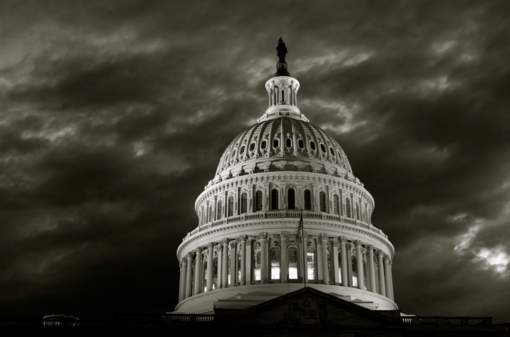
Photo by Daniel Huizinga | CC BY 2.0

March 16, 2021
One of the most steadfast beliefs regarding the United States is that it is a democracy. Whenever this conviction waivers slightly, it is almost always to point out detrimental exceptions to core American values or foundational principles.
For instance, aspiring critics frequently bemoan a “loss of democracy” due to the election of clownish autocrats, draconian measures on the part of the state, the revelation of extraordinary malfeasance or corruption, deadly foreign interventions, or other such activities that are considered undemocratic exceptions.
The same is true for those whose critical framework consists in always juxtaposing the actions of the U.S. government to its founding principles, highlighting the contradiction between the two and clearly placing hope in its potential resolution.
Originally published at Counterpunch
The problem, however, is that there is no contradiction or supposed loss of democracy because the United States simply never was one. This is a difficult reality for many people to confront, and they are likely more inclined to immediately dismiss such a claim as preposterous rather than take the time to scrutinize the material historical record in order to see for themselves.
Such a dismissive reaction is due in large part to what is perhaps the most successful public relations campaign in modern history.
What will be seen, however, if this record is soberly and methodically inspected, is that a country founded on elite, colonial rule based on the power of wealth—a plutocratic colonial oligarchy, in short—has succeeded not only in buying the label of “democracy” to market itself to the masses, but in having its citizenry, and many others, so socially and psychologically invested in its nationalist origin myth that they refuse to hear lucid and well-documented arguments to the contrary.
To begin to peel the scales from our eyes, let us outline in the restricted space of this article, five patent reasons why the United States has never been a democracy (a more sustained and developed argument is available in my book, Counter-History of the Present).
To begin with, British colonial expansion into the Americas did not occur in the name of the freedom and equality of the general population, or the conferral of power to the people. Those who settled on the shores of the “new world,” with few exceptions, did not respect the fact that it was a very old world indeed, and that a vast indigenous population had been living there for centuries.
As soon as Columbus set foot, Europeans began robbing, enslaving and killing the native inhabitants. The trans-Atlantic slave trade commenced almost immediately thereafter, adding a countless number of Africans to the ongoing genocidal assault against the indigenous population.
Moreover, it is estimated that over half of the colonists who came to North America from Europe during the colonial period were poor indentured servants, and women were generally trapped in roles of domestic servitude. Rather than the land of the free and equal, then, European colonial expansion to the Americas imposed a land of the colonizer and the colonized, the master and the slave, the rich and the poor, the free and the un-free.
The former constituted, moreover, an infinitesimally small minority of the population, whereas the overwhelming majority, meaning “the people,” was subjected to death, slavery, servitude, and unremitting socio-economic oppression.
Second, when the elite colonial ruling class decided to sever ties from their homeland and establish an independent state for themselves, they did not found it as a democracy. On the contrary, they were fervently and explicitly opposed to democracy, like the vast majority of European Enlightenment thinkers. They understood it to be a dangerous and chaotic form of uneducated mob rule.
For the so-called “founding fathers,” the masses were not only incapable of ruling, but they were considered a threat to the hierarchical social structures purportedly necessary for good governance.
In the words of John Adams, to take but one telling example, if the majority were given real power, they would redistribute wealth and dissolve the “subordination” so necessary for politics.
When the eminent members of the landowning class met in 1787 to draw up a constitution, they regularly insisted in their debates on the need to establish a republic that kept at bay vile democracy, which was judged worse than “the filth of the common sewers” by the pro-Federalist editor William Cobbett.
The new constitution provided for popular elections only in the House of Representatives, but in most states the right to vote was based on being a property owner, and women, the indigenous and slaves—meaning the overwhelming majority of the population—were simply excluded from the franchise.
Senators were elected by state legislators, the President by electors chosen by the state legislators, and the Supreme Court was appointed by the President. It is in this context that Patrick Henry flatly proclaimed the most lucid of judgments: “it is not a democracy.” George Mason further clarified the situation by describing the newly independent country as “a despotic aristocracy.”
When the American republic slowly came to be relabeled as a “democracy,” there were no significant institutional modifications to justify the change in name. In other words, and this is the third point, the use of the term “democracy” to refer to an oligarchic republic simply meant that a different word was being used to describe the same basic phenomenon.
This began around the time of “Indian killer” Andrew Jackson’s presidential campaign in the 1830s. Presenting himself as a ‘democrat,’ he put forth an image of himself as an average man of the people who was going to put a halt to the long reign of patricians from Virginia and Massachusetts.
Slowly but surely, the term “democracy” came to be used as a public relations term to re-brand a plutocratic oligarchy as an electoral regime that serves the interest of the people or demos. Meanwhile, the American holocaust continued unabated, along with chattel slavery, colonial expansion and top-down class warfare.
In spite of certain minor changes over time, the U.S. republic has doggedly preserved its oligarchic structure, and this is readily apparent in the two major selling points of its contemporary “democratic” publicity campaign. The Establishment and its propagandists regularly insist that a structural aristocracy is a “democracy” because the latter is defined by the guarantee of certain fundamental rights (legal definition) and the holding of regular elections (procedural definition).
This is, of course, a purely formal, abstract and largely negative understanding of democracy, which says nothing whatsoever about people having real, sustained power over the governing of their lives.
However, even this hollow definition dissimulates the extent to which, to begin with, the supposed equality before the law in the United States presupposes an inequality before the law by excluding major sectors of the population: those judged not to have the right to rights, and those considered to have lost their right to rights (Native Americans, African-Americans and women for most of the country’s history, and still today in certain aspects, as well as immigrants, “criminals,” minors, the “clinically insane,” political dissidents, and so forth).
Regarding elections, they are run in the United States as long, multi-million dollar advertising campaigns in which the candidates and issues are pre-selected by the corporate and party elite. The general population, the majority of whom do not have the right to vote or decide not to exercise it, are given the “choice”—overseen by an undemocratic electoral college and embedded in a non-proportional representation scheme—regarding which member of the aristocratic elite they would like to have rule over and oppress them for the next four years.
“Multivariate analysis indicates,” according to an important recent study by Martin Gilens and Benjamin I. Page, “that economic elites and organized groups representing business interests have substantial independent impacts on U.S. government policy, while average citizens and mass-based interest groups have little or no independent influence. The results provide substantial support for theories of Economic-Elite Domination […], but not for theories of Majoritarian Electoral Democracy.”
To take but a final example of the myriad ways in which the U.S. is not, and has never been, a democracy, it is worth highlighting its consistent assault on movements of people power. Since WWII, it has endeavored to overthrow some 50 foreign governments, most of which were democratically elected.
It has also, according the meticulous calculations by William Blum in America’s Deadliest Export: Democracy, grossly interfered in the elections of at least 30 countries, attempted to assassinate more than 50 foreign leaders, dropped bombs on more than 30 countries, and attempted to suppress populist movements in 20 countries.
The record on the home front is just as brutal. To take but one significant parallel example, there is ample evidence that the FBI has been invested in a covert war against democracy. Beginning at least in the 1960s, and likely continuing up to the present, the Bureau “extended its earlier clandestine operations against the Communist party, committing its resources to undermining the Puerto Rico independence movement, the Socialist Workers party, the civil rights movement, Black nationalist movements, the Ku Klux Klan, segments of the peace movement, the student movement, and the ‘New Left’ in general” (Cointelpro: The FBI’s Secret War on Political Freedom, p. 22-23).
Consider, for instance, Judi Bari’s summary of its assault on the Socialist Workers Party: “From 1943-63, the federal civil rights case Socialist Workers Party v. Attorney General documents decades of illegal FBI break-ins and 10 million pages of surveillance records. The FBI paid an estimated 1,600 informants $1,680,592 and used 20,000 days of wiretaps to undermine legitimate political organizing.”
In the case of the Black Panther Party and the American Indian Movement (AIM)—which were both important attempts to mobilize people power to dismantle the structural oppression of white supremacy and top-down class warfare—the FBI not only infiltrated them and launched hideous smear and destabilization campaigns against them, but they assassinated 27 Black Panthers and 69 members of AIM (and subjected countless others to the slow death of incarceration).
If it be abroad or on the home front, the American secret police has been extremely proactive in beating down the movements of people rising up, thereby protecting and preserving the main pillars of white supremacist, capitalist aristocracy.
Rather than blindly believing in a golden age of democracy in order to remain at all costs within the gilded cage of an ideology produced specifically for us by the well-paid spin-doctors of a plutocratic oligarchy, we should unlock the gates of history and meticulously scrutinize the founding and evolution of the American imperial republic.
This will not only allow us to take leave of its jingoist and self-congratulatory origin myths, but it will also provide us with the opportunity to resuscitate and reactivate so much of what they have sought to obliterate.
In particular, there is a radical America just below the surface of these nationalist narratives, an America in which the population autonomously organizes itself in indigenous and ecological activism, black radical resistance, anti-capitalist mobilization, anti-patriarchal struggles, and so forth.
It is this America that the corporate republic has sought to eradicate, while simultaneously investing in an expansive public relations campaign to cover over its crimes with the fig leaf of “democracy” (which has sometimes required integrating a few token individuals, who appear to be from below, into the elite ruling class in order to perpetuate the all-powerful myth of meritocracy).
If we are astute and perspicacious enough to recognize that the U.S. is undemocratic today, let us not be so indolent or ill-informed that we let ourselves be lulled to sleep by lullabies praising its halcyon past.
Indeed, if the United States is not a democracy today, it is in large part due to the fact that it never was one.
Far from being a pessimistic conclusion, however, it is precisely by cracking open the hard shell of ideological encasement that we can tap into the radical forces that have been suppressed by it.
These forces — not those that have been deployed to destroy them — should be the ultimate source of our pride in the power of the people.
Originally published at Counterpunch
Gabriel Rockhill is a Franco-American philosopher, cultural critic and activist. He the founding Director of the Critical Theory Workshop and Professor of Philosophy at Villanova University. His books include Counter-History of the Present: Untimely Interrogations into Globalization, Technology, Democracy (2017), Interventions in Contemporary Thought: History, Politics, Aesthetics (2016), Radical History & the Politics of Art (2014) and Logique de l’histoire (2010). In addition to his scholarly work, he has been actively engaged in extra-academic activities in the art and activist worlds, as well as a regular contributor to public intellectual debate. Follow on twitter: @GabrielRockhill
Please help TFF remain truly independent by contributing if you benefited from this article





