
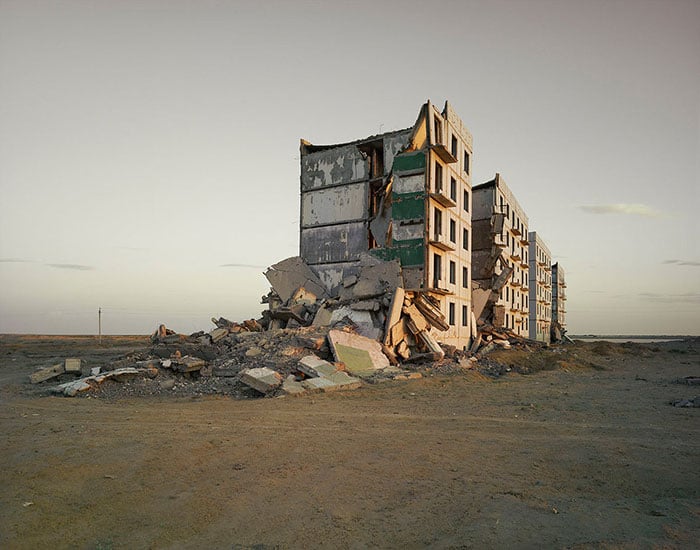
The story of how Kazakhstan became nuclear-free

Photo by Nadav Kander


By Marzhan Nurzhan

The CTBTO Youth Group (CYG) holds its second international conference in Kazakh capital city Astana from August 28-30, 2018. The author is a CYG member from Kazakhstan, a convener of Abolition 2000 Youth Network and a PNND Coordinator for CIS countries. This article first appeared in The Astana Times on May 29, 2018 with the title ‘Kazakhstan’s Nuclear Legacy and Importance of CTBTO’. It is being reproduced with the author’s permission. – The Editor.


PRAGUE (IDN) – I am coming from Kazakhstan, the country which inherited around 1,500 nuclear weapons from the Soviet Union making it the 4th biggest nuclear arsenal in the world at the time.

For almost half a century, from 1949 until 1989, the Soviet Union conducted 456 nuclear tests above and underground at the Semipalatinsk Nuclear Test Site, known also as Semey polygon, in the eastern part of Kazakhstan. The energy of the tests released in turn was roughly equal to the capacity of 2,500 Hiroshima atomic bombs.

The radioactive fallout from the nuclear explosions has resulted in widespread contamination of the Semey area causing catastrophic humanitarian and environmental consequences. Almost 2 million people have been already affected suffering from severe health problems, cancer, birth deformities and death which will continue for many generations to come.

Therefore, I believe that role of the Vienna-based Comprehensive Nuclear Test Ban Treaty Organization (CTBTO) is vital and instrumental in banning nuclear tests everywhere in this world forever, in order to prevent further damage to human health and the environment.

Originally published also on IPS, InDepthNews, here


From nuclear victim to disarmament champion

The horrific experience of being victim of the Soviet nuclear tests stimulated strong public opposition to nuclear weapons in Kazakhstan, supported by Kazakh leaders. A civil society movement ‘Nevada-Semipalatinsk’ (Nevada-Semey) guided by Olzhas Suleimenov led to the closure of nuclear test site on August 29, 1991 – preventing any further nuclear tests in Kazakhstan.

Following independence in December 1991, the new government of Kazakhstan, led by the President, made the historic decision to relinquish nearly 1,500 nuclear weapons they had inherited when the Soviet Union dissolved, and join the Non-Proliferation Treaty as a non-nuclear-weapon state.

Since then, Kazakhstan has continued to play a key role for global nuclear non-proliferation and disarmament. In addition to supporting and promoting the CTBT, Kazakhstan played a leading role in establishing the Central Asian Nuclear Weapon Free Zone. The CANWFZ treaty includes an obligation of all five member states to adhere to the CTBT.

Other key initiatives of Kazakhstan include proposing a Universal Declaration for a Nuclear-Weapons-Free World which was adopted by the UN General Assembly, launching the ATOM Project which highlights the humanitarian impact of nuclear tests through the voices of victims and survivors such as Karipbek Kuyukov, and organizing a special session in January 2018 of the UN Security Council focused on confidence building and nuclear disarmament.


International Day against Nuclear Tests

Given its experience as the most affected country in the world by nuclear test explosions, Kazakhstan successfully moved the United Nations General Assembly to establish the International Day against Nuclear Tests on August 29, which has a special significance due to the symbolic date that coincides with the first nuclear test conducted in Kazakhstan and also the date of the closure of the Semey polygon in 1991.

The experience of Kazakhstan and other countries that have suffered from nuclear tests can be used to encourage CTBT Annex 2 states of the humanitarian and security benefits of joining the CTBT. The International Day against Nuclear Tests on August 29 is a good opportunity to publicise this.

Kazakhstan commemorates the day annually, often through international conferences hosted in Astana and field trips to ground zero in Semey. In 2016, I had the opportunity to help organize the conference “Building a nuclear-weapon-free world” in Astana, co-hosted by Parliamentarians for Nuclear Non-Proliferation and Disarmament (PNND).

Our visit to ground zero was particularly poignant for me and for other conference participants.


Second CYG Astana Conference. Trip to ground zero

This year CTBTO Youth Group (CYG) will hold its second international conference in Kazakhstan. This will provide a great opportunity for CTBTO youth to build a deeper understanding of the impact of nuclear tests and the imperative for nuclear disarmament.

The role of young people in peace and security is important, particularly participation and involvement in the area of nuclear issues. Youth and future generations are impacted by the legacy of nuclear tests and the threat from nuclear weapons policies, and so their voice must be included. This is rightly highlighted by the CTBTO Youth Group. Thus, I was honoured to participate in the First CYG Moscow conference from October 18-20, 2017, where I had an opportunity to contribute to the initiative of youth diplomacy pledge.

However, youth also need to learn from our elders who have experience, knowledge and skills that can be transferred. There currently appears to be an intergenerational gap, a lack of communication between youth and seniors, which must be filled and bridged with a common ground, interest and interaction. Therefore, we as youth must use the platform provided by the upcoming conference in Astana on August 28-30.

This international meeting between the CTBTO Group of Eminent Persons (GEM) and CYG members will be a place to collaborate and learn from each other, especially drawing from the experience, expertise and knowledge of seniors with regards to nuclear-related issues. The conference will include a unique opportunity for participants to visit the former Semipalatinsk test site in order to witness first-hand the risks of nuclear testing and reflect upon it.

These efforts of Kazakhstan will have a positive impact on present generation to work on building a world free of nuclear weapons and contribute to the entry into force of the CTBT in the nearest future. [IDN-InDepthNews – 30 May 2018]

Photo: Group picture of participants of the CTBTO Youth Group Moscow Conference from 18-20 October 2017 in Moscow with the CTBTO Executive Secretary Lassina Zerbo in the centre. The next conference is scheduled from 28-20 August 2018 in Kazakh capital city Astana. Credit: CTBTO

IDN is flagship agency of the International Press Syndicate.


Recommended reading

Alex Smirnov
Semipalatinsk nuclear test site 20 years after the closure (with photos)

Harrison Jacobs, Business Insider
These Are The Secret Sites Where The Soviet Union Exploded Atomic Bombs And Tested Radiation On Unsuspecting Russians (with Nadav Kander’s photos)

The Guardian’s superb review of Jonathan Aitken’s very interesting 2009 book on President Nazabayev and his struggle to make Kazakhstan nuclear-free – “Nazabayev And The Making Of Kazakhstan”


Related Posts

Advocates of nuclear disarmament are regularly dismissed by the champions of nuclear deterrence as naïve and unrealistic, utopian or even irresponsible. Yet this ‘doctrine’ of deterrence, regarded by France as the ‘cornerstone’ of its national security, is based on quasi-religious beliefs, a theory that cannot be proven, risky gambles and fragile assumptions. So much so that one might legitimately ask which side the ‘Care Bears’ are on. Marc FinaudVice-President of Initiatives for Nuclear Disarmament (IDN) October 9, 2026 This article was originally published on Pressenza When it comes to these things being treated as religious concepts, look here. Idealists and realists It was Hubert Védrine, François Mitterrand’s former Foreign Minister, who repeatedly coined the phrase: ‘Europeans are a sort of Care Bears who don’t realise they’re living in Jurassic Park’. He applies this reference to the cartoon for well-behaved children not only to what he regards as weakness or idealism...
Tony Robinson October 4, 2026 Violence is easy to recognise when someone is being beaten, shot or killed. It becomes more difficult when nobody is holding a weapon. Poverty, discrimination, exploitation and repression can restrict a human life just as effectively, although they do so in very different ways and with very different consequences. Simply adding more categories to an ever-growing list of forms of violence does not really solve the problem. The more interesting question is what all these different situations have in common and why it makes sense to describe them using the same word. Human beings do not simply react to what happens around them. They remember the past, imagine things that do not yet exist, make plans and undertake projects. Workers organise because they imagine different working conditions; people migrate because they imagine another life somewhere else; social movements emerge because people refuse to accept the...
Lena Petrova of “World Affairs In Context” with more than half a million subscribers on YouTube wanted to explore what a peace researcher like me has to say about, among other things, the First and the Second Cold War and why eethics has disappeared from politics. I am particularly happy about this conversation that also yielded an amazing number of very appreciative comments on YouTube. No doubt, people are longing for alternatives, including peace perspectives.

Recent Articles

A Message from Jan Oberg November 6, 2026 Over the past fifty years, I have devoted roughly 175,000 hours to research and public education for a more peaceful world: thinking, researching, writing, organising, publishing, debating, maintaining websites, corresponding, reaching out, leading a foundation, work in conflict and war zones, professorships, teaching courses and giving public lectures and doing media work. In short, ten hours a day, seven days a week, for half a century. The focus was on international political peace – analysing and trying to stop wars, address underlying conflicts and making alternative peace plans – at the desk and on the ground. Important as that has been and remains, it is only one kind of peace and it is now in a tragic militarist state compared with what it could have been.  Lately, however, I have found myself thinking about a concept from economics as well as everyday...
Photo above: Carl Fredrik Reuterswärd’s Non-Violence outside UN Headquarters in New York. Kirill Levin, CC BY-NC-SA 2. Jan Oberg November 3, 2026 I am happy to be published in Horizons which is produced by the Center for International Relations and Sustainable Development, CIRSD, in Belgrade. My contribution brings out a radical re-thinking of what concepts such as defence, security, deterrence – and peace – may mean if we want to create a more peaceful world. It also summarises a few things I have been working with the last few decades. Please read it here Og her er den på dansk, takket være Johnny Baltzersens lynhurtige oversættelse
UNITE-tillid, DREAM-velstand og andre konstruktive komponenter Normally we publish articles in English here. But this is a translation of a very important TFF document that should reach as many as possible in Denmark since this country’s government has been one of the most hardline in Europe and, up till now at least, has refused to use diplomacy and, instead, spent tremendous sums on arming Ukraine with the express goal of defeating Russia. Thus this – unique – article is in Danish. Vi er Johnny Baltzersen og hans Fælles Sikkerhed – Fælles Fremtid på Substack overmåde taknemmelige for at have oversat og publiceret TFF’s 2025-portfølje for fredsidéer med henblik på Ukraines fremtid. Vi håber den nu kan nå mange flere danskere – som også vil sprede den og skabe debat – nu den danske regerings og folketingspartiernes politik på dette område siden 2022 står nu – forudsigeligt – ved vejs ende....

TFF on Substack

Discover and subscribe to more peace materials on TFF Substack

Most Popular

A Message from Jan Oberg November 6, 2026 Over the past fifty years, I have devoted roughly 175,000 hours to research and public education for a more peaceful world: thinking, researching, writing, organising, publishing, debating, maintaining websites, corresponding, reaching out, leading a foundation, work in conflict and war zones, professorships, teaching courses and giving public lectures and doing media work. In short, ten hours a day, seven days a week, for half a century. The focus was on international political peace – analysing and trying to stop wars, address underlying conflicts and making alternative peace plans – at the desk and on the ground. Important as that has been and remains, it is only one kind of peace and it is now in a tragic militarist state compared with what it could have been.  Lately, however, I have found myself thinking about a concept from economics as well as everyday...
Photo above: Carl Fredrik Reuterswärd’s Non-Violence outside UN Headquarters in New York. Kirill Levin, CC BY-NC-SA 2. Jan Oberg November 3, 2026 I am happy to be published in Horizons which is produced by the Center for International Relations and Sustainable Development, CIRSD, in Belgrade. My contribution brings out a radical re-thinking of what concepts such as defence, security, deterrence – and peace – may mean if we want to create a more peaceful world. It also summarises a few things I have been working with the last few decades. Please read it here Og her er den på dansk, takket være Johnny Baltzersens lynhurtige oversættelse
UNITE-tillid, DREAM-velstand og andre konstruktive komponenter Normally we publish articles in English here. But this is a translation of a very important TFF document that should reach as many as possible in Denmark since this country’s government has been one of the most hardline in Europe and, up till now at least, has refused to use diplomacy and, instead, spent tremendous sums on arming Ukraine with the express goal of defeating Russia. Thus this – unique – article is in Danish. Vi er Johnny Baltzersen og hans Fælles Sikkerhed – Fælles Fremtid på Substack overmåde taknemmelige for at have oversat og publiceret TFF’s 2025-portfølje for fredsidéer med henblik på Ukraines fremtid. Vi håber den nu kan nå mange flere danskere – som også vil sprede den og skabe debat – nu den danske regerings og folketingspartiernes politik på dette område siden 2022 står nu – forudsigeligt – ved vejs ende....
Read More
AbstractVision_2017_#1_800 (kopia)
A Message from Jan Oberg November 6, 2026 Over the past fifty years, I have devoted roughly 175,000 hours to research and public education for a more peaceful world: thinking, researching, writing, organising, publishing, debating, maintaining websites, corresponding, reaching out, leading a foundation, work in conflict and war zones, professorships, teaching courses and giving public lectures and doing media work. In short, ten hours a day, seven days a week, for half a century. The focus was on international political peace – analysing and trying to stop wars, address underlying conflicts and making alternative peace plans – at the desk and on the ground. Important as that has been and remains, it is only one kind of peace and it is now in a tragic militarist state compared with what it could have been.  Lately, however, I have found myself thinking about a concept from economics as well as everyday...
knotted gun
Photo above: Carl Fredrik Reuterswärd’s Non-Violence outside UN Headquarters in New York. Kirill Levin, CC BY-NC-SA 2. Jan Oberg November 3, 2026 I am happy to be published in Horizons which is produced by the Center for International Relations and Sustainable Development, CIRSD, in Belgrade. My contribution brings out a radical re-thinking of what concepts such as defence, security, deterrence – and peace – may mean if we want to create a more peaceful world. It also summarises a few things I have been working with the last few decades. Please read it here Og her er den på dansk, takket være Johnny Baltzersens lynhurtige oversættelse
TFFPortfolioVign
UNITE-tillid, DREAM-velstand og andre konstruktive komponenter Normally we publish articles in English here. But this is a translation of a very important TFF document that should reach as many as possible in Denmark since this country’s government has been one of the most hardline in Europe and, up till now at least, has refused to use diplomacy and, instead, spent tremendous sums on arming Ukraine with the express goal of defeating Russia. Thus this – unique – article is in Danish. Vi er Johnny Baltzersen og hans Fælles Sikkerhed – Fælles Fremtid på Substack overmåde taknemmelige for at have oversat og publiceret TFF’s 2025-portfølje for fredsidéer med henblik på Ukraines fremtid. Vi håber den nu kan nå mange flere danskere – som også vil sprede den og skabe debat – nu den danske regerings og folketingspartiernes politik på dette område siden 2022 står nu – forudsigeligt – ved vejs ende....
JoGSS-Silent
Jan Oberg TFF director October 28, 2026 Exactly one month has now passed since I published my criticism of the introduction to the special issue on Johan Galtung published by the Journal of Global Security Studies, JoGSS, and of Tor Egil Førland’s chapter about Galtung which serves as a preview to his forthcoming biography of Galtung to be published by PRIO. See the original on The Transnational here and the same article on TFF Substack with many general and critical comments and, in particular, the people who decided to withdraw from the biography project in protest. The special issue itself was extraordinary. It was devoted to the intellectual legacy of one of the founders of peace research and contained a number of strong assessments of his personality, scholarship, intellectual trajectory, and public role. Such assessments are, of course, entirely legitimate. No scholar is beyond criticism, and neither was Johan Galtung....
Screenshot 2026-10-26 115647
An aspect of Iran’s culture and civilisation you’ve probably never heard about. Don’t be surprised if the US and Israel also try to bomb them. Jan ObergTFF director October 26, 2026 Today – under the “USraeli” threat of new “annihilating” bombings – opens the 7th International Conference on Peace and Conflict Resolution at Tehran’s University. As far as I can tell, this is the only permanent, advanced peace research institution in West Asia/the Middle East. Perhaps more countries in that region could be inspired? I mean, how many military “security” institutes and military academies do they have? Many peace research institutes and university departments have been established since the 1950s in the West. They are now all under attack; some have closed down, some have gone mainstream, yet others kept the name but do nothing to research peace and disseminate results or advice; instead, they cooperate with militarism’s platforms such...
Screenshot 2026-10-15 141837
Let’s discuss using AI to create peace – in contrast to boring geopolitics devoid of creative healing and visions. Jan Oberg TFF director October 15, 2026 I asked VEED to create a short video exemplifying how peace is preferable to war, then chose the lady as a template. Simple as that. In less than a minute, it produced this video, which any peace-loving person would appreciate. The only problem is that human intelligence (HI), at least the one that exists among Western decision-makers, isn’t half as moral or smart as AI. I have used AI to dialogue about peace and peace plans, creative conflict resolution and visions of a better future for humankind. It so happens that I am having more stimulating, intelligent, creative and moral discussions with AI than I could possibly have with any EU or NATO leader today. Yes, AI has very problematic and dangerous aspects; used...



