
Peter Isackson
November 10, 2020
The chaos of this year’s election may well be enough to dispel all remaining illusions about American democracy.

A functioning democracy requires an educated, informed population that understands its role in the processes that define how the democratic nation is governed. Ordinary citizens have two opportunities for actively participating in those processes. They can run for office or help those who are running for office get elected. And they can vote. Most people settle for voting. Actually, in the best of years, only slightly more than the majority of eligible voters actually vote. American democracy has never fired on all its cylinders.
Originally posted on Fair Observer on October 14, 2020.
The failure of half of Americans to participate is surprising because America has sedulously made the effort to educate its future voters. From day one, every schoolchild in the United States learns not only that the form of government they live under is a democracy but also that it is a regime defined by its commitment to freedom. Teachers, seconded by the media and the politicians who appear in the media, relentlessly drill into them the idea that the US is uniquely free, in ways that no other nation can claim. Americans possess unbridled freedom to speak out and to act, even in socially eccentric ways. For some, it even includes the freedom to shoot.
Although democracy and freedom are not synonymous, every schoolchild is taught to believe that they are. This has created a curious phenomenon in US culture: the idea that what they have is less the freedom to speak out, act and influence their community than the freedom from interference by other people — and especially by the government. In other words, many Americans understand that the most fundamental freedom is the freedom to be left alone. Instead of defining the individual’s field of possible action and participation, in their minds, democracy defines the right to avoid all action and participation.
The Art of Democratic Identity
Children who enter first grade and learn for the first time that they live in a free country may be left wondering what an unfree country is. A literal-minded 6-year-old — such as this writer who entered first grade during the Cold War — may naively wonder why, in a country that our teacher insisted is free, we have to pay for the things we consume. After all, any child who had ever been to a restaurant, a movie theater or a hotdog stand could sense what Milton Friedman would later affirm: There’s no such thing as a free lunch.
My teacher’s message, of course, had nothing to do with the price of things. We would learn about price, cost and value later. Like our parents, one day we would have a job, a house and a dog and be saddled with the task of fending for ourselves in a competitive world. We weren’t quite prepared to understand that our teacher’s riffing on the fact that we were a “free country” was, at the time, simply about the fact that another country with nuclear capacity, the Soviet Union, wasn’t free. We children knew nothing about Russia, the Iron Curtain, communism, capitalism and everything else that was talked about on the news, mainly because we watched cartoons on television. Our exposure to Cold War propaganda was only just beginning.
On that first day of school, we began the task of memorizing the secular prayer that would kickstart the learning process every day of our schooling for the following 12 years: the pledge of allegiance. Its syntax was incomprehensible, but it sounded comfortingly patriotic. The abstract idea of allegiance was too much for our young minds to deal with. But the key words, beginning with “the flag,” offered something concrete and allowed us to begin to understand that our job was to learn to comply with a system we couldn’t yet begin to understand.
“The flag” had meaning because we could see it in front of us, whereas “the Republic for which it stands” remained a mystery. Even “one nation” failed to make much sense to any of us since we hadn’t yet studied the Civil War — a moment in history when there were briefly two — but clearly one seemed to be the right number of nations to belong to. “Under God” confirmed what most of our parents had already told us, though the idea of who that being was differed from family to family.
It was the last six words of the pledge that held some meaning and still resonate in people’s minds: “with liberty and justice for all.” That’s when we began to learn what it meant to be a democracy. This became reinforced later, when we began studying the salient facts of history, including the importance of the first three words of the Constitution: “We the people.” The picture of a democratic society where people, on the one hand, are free (both to vote and to be left alone) and, on the other, treated fairly and equally, combined with our belief in the goodness of the complete system, had begun to fall into place.
Every official text we would subsequently discover, starting with the Declaration of Independence’s proclamation that “all men are created equal,” delivered the message that we, the citizens (or at least those who could vote), collectively controlled the form of a government that would protect us from various kinds of evil forces. Among those evil forces were, historically speaking, the European monarchies to the east against whom we revolted, and the rampaging Native Americans to the west.
The first group, the European kings, defined the enemy in our battle for freedom in the 18th century. The second group, the Indians on horseback, defined the 19th-century enemy. Once those two had been neutralized, all that was left in the 20th century, following our victory over the Germans and Japanese in World War II, was the Soviet Union.
Things had now become remarkably simple. We were a democracy that thrived thanks to our freedom, and especially the freedom of our markets. The Soviet Union was a communist dictatorship with a five-year plan. We were consumers with the widest possible range of choice who knew we would be left alone to consume whatever we chose. Moreover, they were atheists, and we, despite our freedom to believe or not believe, were “under God.” They had the mission of spreading across the globe their elaborate system of government interference in every aspect of everyone’s lives. In contrast, we knew, as President Woodrow Wilson had clearly established decades earlier, that our mission was to “make the world safe for democracy.”
Reconciling Democracy and Predestined Greatness
Unlike the Soviets, we had the power to elect our leaders. They had a single party, the Communist Party. We had two, a consumer’s choice. We understood the principles of democracy. The first of those principles consists of having a constitution with a bill of rights. The second is to have regularly planned elections permitting to choose which of the two parties we wanted to be governed by. Any wonderful and wild idea was possible, so long as one of the two parties embraced that idea.
Communism, of course, or its twin sister, socialism, represented impossible ideas, not only because they made no sense in a consumer society, but because neither of the parties would embrace such ideas. Nevertheless, some feared that the Democrats might be tempted by socialism or even communism. And so, enterprising politicians committed to the idea of democratic choice invented the House of Un-American Activities, making it clear to political consumers — i.e. voters — that some choices, deemed political heresy, would not be available in the political marketplace. Heresy can, after all, happen in a free country that is also “under God.”

Throughout our schooling, our teachers and textbooks led us to assume that the nation’s founders, like Woodrow Wilson more than a century later, had one mission in mind, though with a more local focus: making North America safe for democracy. According to the narrative we received, it was in the name of democracy that the Founding Fathers decided to break away from the despotism of the British monarchy. This created the enduring belief that the founders were visionaries intent on creating what would later become known as the “world’s greatest democracy.”
It’s a trope US politicians today never tire of repeating. The Democrat, President Harry Truman, may have been the first when he uttered the phrase in 1952, just as the Cold War was picking up steam. He cited America’s “responsibilities as the greatest nation in the history of the world.” Like George W. Bush, Mitt Romney and any Republican, President Donald Trump deems the US to be not only “the single greatest nation in the history of the world” but also “the greatest economy in the history of the world.” In contrast, this year’s Democratic candidate for the presidency, former Vice President Joe Biden, more modestly characterizes it as merely “the greatest nation on earth.” Perhaps he hasn’t studied history as carefully as Truman and Trump have.
It isn’t clear whether Cassius Clay, before becoming Muhammad Ali — who famously boasted he was “the greatest” — was inspired by patriotic politicians at the time vaunting the economic power and military prowess of the nation or whether today’s politicians who keep insisting on greatness are inspired by Ali. Donald Trump is not the only American to resonate to the idea of greatness. In every domain, Americans seek to determine who is the GOAT, the Greatest of All Time. There must always be a winner, someone who is totally exceptional.
American exceptionalism is not just an idea. It has become a dogma that leaders must embrace. Violating it or even trying to nuance it can prove disastrous. At a press conference in Europe in April 2009, fielding a question from a Financial Times reporter, newly installed President Barack Obama tried to limit his patriotic hubris when he said, “I believe in American exceptionalism, just as I suspect that the Brits believe in British exceptionalism and the Greeks believe in Greek exceptionalism.” This was too much for many Americans, such as Republican Louisiana Governor Bobby Jindal and Fox News, who saw this as proof that Obama wasn’t a true believer in American exceptionalism. How could he dare to reduce the nation’s prestige to that of has-been countries like the UK and Greece?
The Historical Truth
At the nation’s very beginning, the founders sought and fought simply to create a nation that was no longer attached to Britain. It was a first step in the direction of just wanting to be left alone. They grappled first with the idea of how whatever emerged might define itself as a political entity. After that came the question of how it should be governed. Because of the diversity of the colonies, the founders could agree on the idea of dispersed authority, leading to the idea of a federation that could be thought of as a single federal state. They also, and nearly as emphatically, agreed that it was not about democracy.
In 1814, John Adams, a revolutionary leader and the second president of the United States, famously responded with this curt judgment to one of his critics who berated him for maligning democracy: “Democracy never lasts long.” Lambasting what he referred to as the “ideology” of democracy, Adams expressed his horror at “democratic rage and popular fury” and insisted that democracy “soon wastes exhausts and murders itself. There never was a Democracy Yet, that did not commit suicide.” The chaos of the French Revolution, which they considered an exercise in democracy, had left a bad impression on the minds of the Founding Fathers.
Alexander Hamilton, who died prematurely in a duel 10 years before Adams drafted his letter to John Tyler (but who miraculously came back to life on Broadway in a rap-based musical comedy exactly two hundred years later) emphatically agreed with Adams: “We are a Republican Government. Real liberty is never found in despotism or in the extremes of Democracy.” Both men had studied ancient history and witnessed the chaos of the French Revolution. Hamilton concluded: “The ancient democracies in which the people themselves deliberated never possessed one good feature of government. Their very character was tyranny; their figure deformity.”

The idea of democracy got off to a bad start in the young republic. And yet, most Americans today assume that US democracy was born with the drafting of the US Constitution. Even if the Founding Fathers clearly stated their preference for the idea of a republic ruled by a patrician elite and sought to define the young nation as fundamentally the opposite of a democracy, for generations, Americans have tended to believe that the Constitution embodied and validated democratic principles.
Obsessed by the attribute of greatness, Americans also continue to believe that the US deserves the title of “the world’s greatest democracy.” This is a notion that has the potential to irritate people who are not American. Last year, Dutch blogger Moshe-Mordechai Van Zuiden, writing for The Times of Israel, bitterly contested the insistence on American greatness. He lists 10 reasons why the US electoral system in no way reflects the ideal or even the messy reality of effective national democracies.
After excoriating a two-party system offering “only a choice between two people widely despised,” as happened in 2016 and may even be the case in 2020, he makes a more fundamental complaint: “Top Dog Wins is not democracy. It’s a dictatorship of the majority.” All of the 10 points made by this brash Dutchman are well taken. Despite their national pride, more and more Americans are ready to agree.
The Last Election
Americans are clearly unaware of the fact that the revered founders believed that if democracy were to take hold, it would lead to the collapse of a fragile nation. The president who successfully marketed the idea of democracy for the first time, changing the course of America’s political culture, was Andrew Jackson, the president Donald Trump most admires (after himself). It was during Jackson’s presidency that Alexis de Tocqueville wrote and published “Democracy in America.” Thanks to the French aristocrat’s writing and Jackson’s deeds, including displacing and sometimes massacring native tribes, the label stuck.
It subsequently became dogma that the United States not only is a democracy but exemplifies the ideal of what democracy should be. Abraham Lincoln went on to provide the concept of democracy with a permanent advertising slogan when he called it a “government of the people, by the people and for the people.” By the time of Lincoln and the imminent Emancipation Proclamation, the idea of “people” had taken on a much broader meaning than at the time of the drafting of the Constitution.
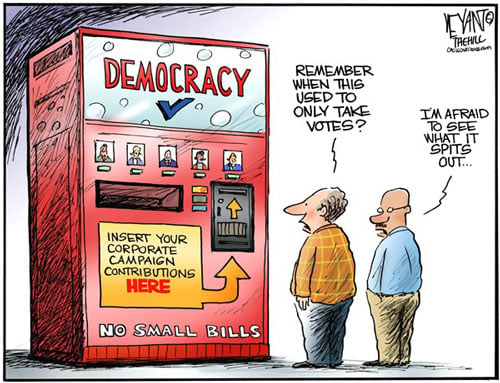
As Van Zuiden and others have pointed out, the electoral system in the US was never designed to function as a true democracy. Nevertheless, the belief was solidly instilled that democracy was in the nation’s DNA. It has withstood numerous assaults along the way and only recently begun to reveal some serious flaws that risk undermining Americans’ unquestioning belief in its virtues. For future observers of US history, the illusion of democracy as the basis of government may technically have expired in December 2000 when nine Supreme Court justices, and not the people or even the states, elected George W. Bush as president. At the time and amid such confusion, few had the courage to acknowledge that Bush’s election reflected a permanent change in their perception of democracy.
The chaos of this year’s election, characterized by the twin evils of a persistent pandemic and the personality of Donald Trump, may well be the election that dispels all remaining illusions. In 2021, a new approach to understanding the relationship between the people and the nation’s institutions will most likely begin to emerge. The rupture with past traditions has been too great for the old dogmas to survive intact.

It’s impossible to predict what form that seismic shift in the political culture will take. It now looks more than likely — though prudence is still required — that if democratic processes play out according to recognized rules, Joe Biden will by the 46th president of the United States. But there is no guarantee that democratic processes will play out in any recognizably legitimate way, partly because the COVID-19 pandemic has created a physical barrier to the already troublingly chaotic conduct of traditional elections whose results pass through the archaic Electoral College, and partly because President Donald Trump will be highly motivated to disturb, delay and possibly cancel whatever validated outcome emerges. But further complications and a practically infinite series of complementary risks are lying in the offing. The risk of uncontrollable civil unrest, if not civil war, is real.
Whatever the official result of the presidential election, whether it becomes known in the immediate aftermath of November 3 or sometime in January, it will be the object of contestation and possibly unpredictable forms of revolt by the citizens themselves. Like any episode of social upheaval, there is a strong chance that it will be quelled.
Biden’s Dilemma
But even if quashed and silenced, it certainly will not be resolved. The most favorable scenario for neutralizing the revolt of the Trumpian right would be a landslide victory for Biden, with the Democrats retaking control of the Senate while maintaining and increasing their majority in the House. But even so, the losers will certainly cry foul.
A resounding majority for Biden and the Democrats would nevertheless buttress what remains of the population’s belief in democracy, legitimizing Biden’s claim to govern the nation. But even in the best of scenarios, a landslide would still leave Biden in a fragile, if not precarious position. Biden has done next to nothing to unite his own party. A Democratic victory will incite the young progressives to contest his legitimate control over an aged and aging party establishment. Gallup reports that “Americans’ frustration with the parties is evident in the 57% of Americans saying a third party is needed.”
That figure has been stable for at least the past 10 years, but the level of frustration has been magnified by the presence of uninspiring candidates in both parties. As governing structures, both dominant parties have been seriously fragilized in the past two elections, the Republicans by Trump’s successful assault on their traditions and the Democrats by the nearly successful challenge of Bernie Sanders and the party establishment’s resistance to change.
If elected, Biden will be challenged on the right by the combined force of fanatical believers in Trump as the messiah and hordes of libertarians appalled by the prospect of more “big government.” He will be challenged on the left by the progressives who not only oppose his tepid policies but no longer believe in the integrity of the Democratic Party. If it was just a question of managing the personal rivalries within his party, as it was for Bill Clinton and Barack Obama, all might be fine. But with a prolonged pandemic, an out-of-control economic crisis, increasingly lucid and effective racial unrest and a growing anti-establishment sentiment across much of the right and the left, reinstalling the establishment that preceded Trump and restoring faith in its ability to govern will be a task logically beyond the capacity of 78-year-old Biden.
The End of an Era
And those issues only begin to define the challenges Biden will be facing. In an essay in The New Criterion earlier this year, James Pierson observed the very real potential for social collapse: “Yet today the United States seems headed in a different direction: toward pluralism without consensus — a nation-state without a national idea — and towards animus among racial, religious, regional, and national groups.” In his article, Pierson deftly summarizes the history of the nation from the convergence of disparate colonies into a “union” and its need for imperial expansion to maintain its unity. Historically speaking, both convergence and expansion are no longer what they used to be.
Pierson claims that before the Civil War and the victory of the Union forces, the US had not really decided what it was. He asks the question, “what was it: union, republic, or empire — or a combination of all three? Whatever it was, it was not yet a nation.” He claims it only became a nation-state “over a ninety-year period from 1860 to 1950, an era bookended by the Civil War and World War II, two great wars for liberal democracy, with World War I sandwiched in between.”

Pierson credits Abraham Lincoln with creating the democracy that eventually came to dominate the world in the 20th century. Although assassinated by John Wilkes Booth before he could begin to implement his plan, Lincoln effectively created a political culture or system of belief that has only begun to fray in the last few decades. Pierson describes Honest Abe’s ideological triumph. “Lincoln envisioned a nati





