

The New Yellow Peril: Sinophobia in the 21st Century

Tom Fowdy

May 11, 2021

Sinophobia is a fear or prejudice expressed towards China and its people. Similar to other varieties of racism, such as Islamophobia, Sinophobia embodies a series of beliefs and discourses that place emphasis on the apparent cultural inferiority and backwardness of “Chinese culture” to the western dynamic, which are used to argue that the “ways” of China pose an existential threat to the norms and values of a given society, or what was historically referred to as a “Yellow Peril”. The prejudice relies upon a series of cliches and representations regarding Chinese people and their way of life and in turn positions itself from a position of assumed western supremacy, of which owing to the legacy of colonialism treats China as “problem must be solved”.

Originally posted on Tom Fowdy’s homepage, April 13, 2020

What is China? The answer is not a simple one, but for many people it is. It is a vast country, one with many differences and variations inside it concerning the way people live, view the world and even speak. It is not easy to define a nation of 1.4 billion. Yet every human being of course perceives the world in terms of standout images, ideas and concepts carried by their society, which accumulative into a wider comprehension or “imagination” into how we believe things are. The subject of China is not surprisingly rife with such impressions, because it is something distant, huge and also something by which through experience few people understand very well.

When the western man thinks of China, he doesn’t give much insight into how everyday people may live but of course gravitates towards these given ideas, he may refer to the Great Wall of China, to Terracotta soldiers, calligraphy and other strong concepts. At the same time of course, he is likely to refer to negative imagery too: He may believe that it is excessively polluted, that it makes cheap and shoddy goods, or cruder cultural stereotypes (particularly in the midst of the coronavirus pandemic) that emphasis culinary habits which are perceived as backwards and barbaric, generalized to fit the population as a whole.

These generalizations however carry more significance than meets the eye, they are not just a matter of pure impression, but are actively transformed into an aspect of geopolitics rooted in how Western civilization perceives itself in relation to China. In a phenomenon described as “Orientalism” by Edward Said- the west has through the legacy of Imperialism and domination consolidated itself on a series of beliefs that it itself represents a universal and objective standard for “Normality” and “civilization” and in the process subsequently projects conceptions of “difference”, “exoticness” and “inferiority” onto their impression “non-western” nations, which they subsequently argue that they have a mission to “civilize” and “change” to accommodate to their vision of the world.

As a result, whilst racism, prejudice and misunderstandings are found everywhere, western generalizations of the non-west are exceptional because they are the beneficiary of geopolitical inequality and social power which masquerades the assumption of civilizational superiority as an unassailable and divine truth. The west has to power to define, subjugate and characterize the East to its own designs and interests, no matter how prejudiced, misinformed and even outright misleading their claims may be. In turn, such a mindset also means that the western public tend to follow suit and believe such mistruths, their vested belief in “enlightenment” subsequently misrendering their prejudices as a truth. What is perceived to be “Knowledge” is in fact not equal.

Herein lies the foundations of modern era Sinophobia. Beginning with the 19th century whereby European empires sought to subjugate China, from a position of western superiority, Sinophobic discourse iconifies China as a backwards, inferior and uncivilized country on which is the obligation is placed to confirm itself to an occidental vision, of which if it is not willing to do so it must be brought down accordingly. Fear is repeatedly expressed over its size and geopolitical significance, thus producing a mindset that if not conquered itself, China will thus through its massive size and population conquer and thus impose its “backwardness” on the west.

In doing so, China is characterized not as a nation or people capable of its own voice or legitimate perspective, but in the light of a “moral problem to be solved” by the superior hands and minds of an altruistic west who must “show it the way” and thus “save it from itself”. The discourse examines China as if it were a specimen in the zoo, to be studied, observed and tamed, than an entity in its own right. Relentless obsession with the country’s ruling Communist Party provides an acceptable facade for this mindset, morphing Sinophobic ideas and the apprehension of China with Cold War cliches and imagery which further propel the belief that China’s acceptance must hinge on the terms which the west has set for it.

The 2020 coronavirus pandemic is a good place to start with this. The outbreak has saw a resurgence of anti-Chinese attitudes emerge around the world. Angry at the massive disruption, personal losses and economic costs brought about by the of the covid-19 virus which first emerged in the city of Wuhan, the epidemic has created an outpouring of disgruntlement against China which, floated on the criteria above, weaponizes the standpoint of superiority to advocate a politics of “Blame” and vengeance against Beijing, echoing a discourse that the “barbaric Chinese people must pay a price for harming our superior and civilized way of life in the west”. Although many will feel their anger is justified, the fundamental mode of thinking behind such claims are driven by Sinophobia and Orientalism:

First of all, some western countries have convinced themselves that a widespread disease outbreak cannot be their problem. The western mind conceives disease not as an inevitable and ever recurring ailment of human existence, but as something only experienced by “tropical”, “oriental” and “foreign” nations which do not live up to a given standard of civilization. Therefore the west believes it is to “observe” these things and “Help” as designated humanitarians, but ought not to “experience” them. Therefore, because the coronavirus “reached” these countries it is subsequently perceived not as a human struggle but a political injustice of which an inferior nation ought to be blamed and stigmatized for.

In doing so, in Britain outlets such as the Daily Mail have led the calls for indignation against China, using crude and misleading stereotypes of animal markets and sweeping generalizations of culinary practices in order to signify the generalization of Chinese people as a “backwards and savage” nation which ought to be “punished” for what it inflicted upon Britain. The government’s own failures to prepare against the epidemic owing to such complacency are ignored entirely.

Instead, China becomes a surrogate for the blame in the context of inferiority and emphasis is placed on exaggerating the scope of the disaster within the country out of opportunism to deflect from Western fault. The paper later stated a botched “study” claiming China owes Britain “£354 billion” in compensation, a figure of course so backed in western entitlement and self-righteousness that it dismisses the entire history of what London has inflicted on Beijing. Justice is interpreted as a one dimensional notion which rests exclusively to and only on behalf of the west.

Yet this rhetoric works, because the image of Chinese people as culturally and socially inferior is baked into the western ego. Popular media has long depicted China and Asian culture as a whole as suspect, dishonest, brutal and greedy. For example, one may look at the crude Chinese stereotype portrayed in the American TV sitcom Family Guy, Mr. Washee Washee. The specified link illustrates this character as stingy, cold, brutish and inherently violent, obsessed with saving money on an automated bell when the door opens.

The character is a conduit for many modern cultural stereotypes of the Chinese, especially in America, where it is mainstream thinking to portray China’s business practices as deceitful, shoddy and dishonest. The Trump administration has sought to justify its aggressive trade actions against China by repeatedly portraying Beijing as “cheating” the world rules at America’s expense. Not only is this a huge exaggeration, but it thrives upon Sinophobic ideas about unreliable business practices in Asia and misrenders the vast majority of US-China commerce into a cliche of stereotypes.

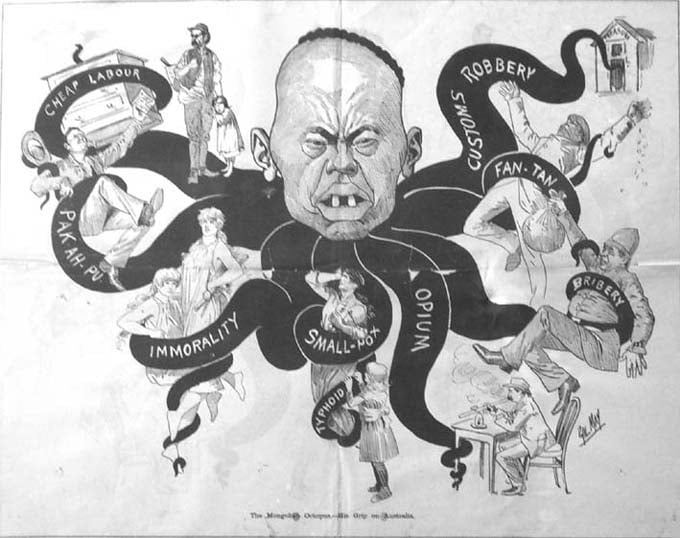
Although the Communist Party is again cited as the “true” source of blame, this is again a frontier to give it ideological acceptability which overlooks how the stereotype of the “deceitful Chinese” has in fact long pre-dated the age of the CCP from 1949 and draws upon it. The featured image in my post listed above is a racist Australian cartoon from 1886, known as the “Mongolian octopus” it embodies many crude generalizations of China in a threatening manner which strikingly enough are still relevant today, portraying Chinese culture as deceitful, disease ridden, makes “cheap goods”, “cheats at customs” and so on. It’s 134 years old, yet it could have been plucked out of a modern Trump speech.

The Simpsons also depicted these ideas in the 1994 episode “Marge in Chains“, although the specific episode is referring to Japan, not China, it nevertheless promulgates Asian centric cultural stereotypes which apply to Beijing by portraying a factory in Japan which makes cheap useless juice making machines for export to America (a common trait assumed with China trade). The work culture in the factory is portrayed also as brutal and dishonest (with the workers hiding their illnesses) which in turns leads to a “flu” being sent to Springfield, which as above sets out also reflects the belief that viruses are an “oriental” thing that do not truly have a “belonging” in the west.

We could go on and on with numerous more examples, but in essence Sinophobia certainly is rooted in a culturalist and western exceptionalist misrendering of China, of which perceives the white man’s burden as a “civilizer” and also portrays the essence of a large and booming China as an existential and uncivilized threat to the world. Whilst some will respond by pointing out this obviously does not invalidate all criticism of Communist Party rule, the notion nevertheless continues to wield powerful currency in how China is perceived, judged and thus approached from the western mind. The notion of Communism is not enough to invalidate the empirical evidence which shows that China is treated inherently unequally from the western point of view, a notion which has owing to size and scope, being exacerbated and repeatedly found legitimacy as an output of geopolitics, either in the 19th century or in the 21st.

We bring you high-quality analyses and documents like this on a permanent basis. Why not appreciate TFF’s true independence and productivity by contributing if you benefited from this article? Thanks.

Tom Fowdy comes from humble roots in Sunderland, North East England. He has an academic interest in the politics and affairs of East Asia, where he has primarily focused on China, North Korea & South Korea. He recently graduated from Oxford University’s China Studies Program. Previously, he has lived in Hong Kong, Shanghai, Beijing, Seoul and Australia.


Related Posts

PRESS RELEASE – 6 OCTOBER 2025 LAY DOWN YOUR ARMSPEACE PRIZE FOR 2025 is awarded Francesca Albanese The United Nations Special Rapporteur on the occupied Palestinian territories – as the person who, in accordance with Alfred Nobel’s will, has “done the most or the best work for fraternity between nations and for the abolition or reduction of standing armies as well as for the holding and promotion of peace congresses.” Francesca Albanese has forcefully and unwaveringly worked against Israel’s full-scale war on the occupied Palestinian territories, in particular Israel´s ongoing genocide against the Palestinian people. She has confronted Israel’s systematic war crimes and crimes against humanity in a truly global outreach. Further, she has brought governments, international organisations and people’s groups together to underline the responsibility of the world at large to act and to stop arming, enabling, and profiting from Israel’s ongoing criminal actions. But first of all, Albanese...
Professor Zhang Weiwei is a highly respected Chinese intellectual and professor at Fudan University in Shanghai. He is the director of its China Institute and also runs a series of conversations with many different people around the world. Here is what came out of their meetings there and in Skopje, Macedonia in October 2024: & As you can see, also at the end of the second one, we both enjoy win-win exchanges like these about world order issues. Zhang Weiwei is known for using videos and social media to reach a large audience in China and worldwide. We suggest you see many more of Zhang Weiwei’s conversations – like recently with Professor Jeffrey Sachs – on the Thinkers’ Forum on YouTube. PSTFF posts hundreds of videos, its own and those of others, in our Video Collections on TFF Substack – including those that appear on YouTube. However, TFF has been cancelled by Google-owned...
Joie De Vivre, 1946 by Pablo Picasso Not recognizing the magic of the present moment may just be a crime against our humanity. David Andersson August 5, 2025 TFF publishes this with particular joy because, while we have always been pro-peace, future-oriented and proposal-making, we need even more of that now: Peace is to be FOR something and go for it. In my recent article, From Personal Development to Human Development, I explored the imbalance between our inner growth and society’s relentless focus on external activity. One of the greatest obstacles to genuine human development today is the sheer level of negativity we encounter daily. As an editor, I regularly receive submissions from Western contributors. Many center on themes like political corruption—even among progressive leaders—technological control, cognitive warfare, genocide, alarming climate forecasts (“only three years left to avoid the worst”), and Europe’s persistent, deadly hypocrisy. The list continues, each entry more...

Recent Articles

Tony Robinson October 4, 2026 Violence is easy to recognise when someone is being beaten, shot or killed. It becomes more difficult when nobody is holding a weapon. Poverty, discrimination, exploitation and repression can restrict a human life just as effectively, although they do so in very different ways and with very different consequences. Simply adding more categories to an ever-growing list of forms of violence does not really solve the problem. The more interesting question is what all these different situations have in common and why it makes sense to describe them using the same word. Human beings do not simply react to what happens around them. They remember the past, imagine things that do not yet exist, make plans and undertake projects. Workers organise because they imagine different working conditions; people migrate because they imagine another life somewhere else; social movements emerge because people refuse to accept the...
It’s a matter of principles, courage, vision and pulling together – while the militarist world is falling apart… Peter Langille October 3, 2026 “Here, then, is the problem which we present to you, stark and dreadful and inescapable: Shall we put an end to the human race; or shall mankind renounce war?”The Bertrand Russell—Albert Einstein Manifesto, July 9, 1955 ⁕ The forecast for what’s ahead is worrisome. The sharp rise in armed conflicts over the past three years is adding to what was already the highest level in over seventy years. Genocides, which should be prevented are supported. A shared climate emergency that jeopardises survival is ignored. Diverse polls now suggest that people are war-weary, worried and interested in a more effective United Nations. And, there are viable policy options for a more secure world! Yet governments are doubling-down, betting on more war and investing heavily. If current trends persist,...
Johan Galtung 1930-2024October 2015 Published here on October 3, 2026 Let us focus on Civilization for conflict analysis and remedies. Major forms of disorder use violence; war is state organized violence. The most belligerent states are the United States of America and Israel, both with civilization roots. National Evangelism, the US Protestant Christian civilization– more national than evangelical–justifies US warfare as exceptionalism of a people chosen by God, with a manifest destiny to run the world. Orthodox Judaism justifies Israeli warfare to conquer and expand from Nile to Euphrates as a religious right and duty to the Eternal One. The third most belligerent country, the UK, no longer believes it is God-chosen but chosen by the USA; not quite the same but something. But the root cause of global disorder lies in the Occident–with Islam–seeing itself as the single, universal civilization valid for all at all times, all others being...

TFF on Substack

Discover and subscribe to more peace materials on TFF Substack

Most Popular

Tony Robinson October 4, 2026 Violence is easy to recognise when someone is being beaten, shot or killed. It becomes more difficult when nobody is holding a weapon. Poverty, discrimination, exploitation and repression can restrict a human life just as effectively, although they do so in very different ways and with very different consequences. Simply adding more categories to an ever-growing list of forms of violence does not really solve the problem. The more interesting question is what all these different situations have in common and why it makes sense to describe them using the same word. Human beings do not simply react to what happens around them. They remember the past, imagine things that do not yet exist, make plans and undertake projects. Workers organise because they imagine different working conditions; people migrate because they imagine another life somewhere else; social movements emerge because people refuse to accept the...
It’s a matter of principles, courage, vision and pulling together – while the militarist world is falling apart… Peter Langille October 3, 2026 “Here, then, is the problem which we present to you, stark and dreadful and inescapable: Shall we put an end to the human race; or shall mankind renounce war?”The Bertrand Russell—Albert Einstein Manifesto, July 9, 1955 ⁕ The forecast for what’s ahead is worrisome. The sharp rise in armed conflicts over the past three years is adding to what was already the highest level in over seventy years. Genocides, which should be prevented are supported. A shared climate emergency that jeopardises survival is ignored. Diverse polls now suggest that people are war-weary, worried and interested in a more effective United Nations. And, there are viable policy options for a more secure world! Yet governments are doubling-down, betting on more war and investing heavily. If current trends persist,...
Johan Galtung 1930-2024October 2015 Published here on October 3, 2026 Let us focus on Civilization for conflict analysis and remedies. Major forms of disorder use violence; war is state organized violence. The most belligerent states are the United States of America and Israel, both with civilization roots. National Evangelism, the US Protestant Christian civilization– more national than evangelical–justifies US warfare as exceptionalism of a people chosen by God, with a manifest destiny to run the world. Orthodox Judaism justifies Israeli warfare to conquer and expand from Nile to Euphrates as a religious right and duty to the Eternal One. The third most belligerent country, the UK, no longer believes it is God-chosen but chosen by the USA; not quite the same but something. But the root cause of global disorder lies in the Occident–with Islam–seeing itself as the single, universal civilization valid for all at all times, all others being...
Read More
Living-Peace-Sign-Budapest-copy
Tony Robinson October 4, 2026 Violence is easy to recognise when someone is being beaten, shot or killed. It becomes more difficult when nobody is holding a weapon. Poverty, discrimination, exploitation and repression can restrict a human life just as effectively, although they do so in very different ways and with very different consequences. Simply adding more categories to an ever-growing list of forms of violence does not really solve the problem. The more interesting question is what all these different situations have in common and why it makes sense to describe them using the same word. Human beings do not simply react to what happens around them. They remember the past, imagine things that do not yet exist, make plans and undertake projects. Workers organise because they imagine different working conditions; people migrate because they imagine another life somewhere else; social movements emerge because people refuse to accept the...
b54a1f10-8c65-4f0b-9dd5-4abc0a7d04cc_2659x2659
It’s a matter of principles, courage, vision and pulling together – while the militarist world is falling apart… Peter Langille October 3, 2026 “Here, then, is the problem which we present to you, stark and dreadful and inescapable: Shall we put an end to the human race; or shall mankind renounce war?”The Bertrand Russell—Albert Einstein Manifesto, July 9, 1955 ⁕ The forecast for what’s ahead is worrisome. The sharp rise in armed conflicts over the past three years is adding to what was already the highest level in over seventy years. Genocides, which should be prevented are supported. A shared climate emergency that jeopardises survival is ignored. Diverse polls now suggest that people are war-weary, worried and interested in a more effective United Nations. And, there are viable policy options for a more secure world! Yet governments are doubling-down, betting on more war and investing heavily. If current trends persist,...
010
Johan Galtung 1930-2024October 2015 Published here on October 3, 2026 Let us focus on Civilization for conflict analysis and remedies. Major forms of disorder use violence; war is state organized violence. The most belligerent states are the United States of America and Israel, both with civilization roots. National Evangelism, the US Protestant Christian civilization– more national than evangelical–justifies US warfare as exceptionalism of a people chosen by God, with a manifest destiny to run the world. Orthodox Judaism justifies Israeli warfare to conquer and expand from Nile to Euphrates as a religious right and duty to the Eternal One. The third most belligerent country, the UK, no longer believes it is God-chosen but chosen by the USA; not quite the same but something. But the root cause of global disorder lies in the Occident–with Islam–seeing itself as the single, universal civilization valid for all at all times, all others being...
Screenshot 2026-10-02 011738
Jan ObergPhD, director, The Transnational Foundation for Peace and Future Research, TFFLund, Sweden October 2, 2026 This is my full original manuscript. The Chinese Academy of Social Science, CASS, makes two publications out if it. 1. China’s Five-year plan emphasized the capabilities of basic research and original innovation. It is regarded as the goal of the future social development, which, as required, should be significantly enhanced. Can you comment on the importance of original innovation in research and academic study? I believe it is easier to define “original innovation” in the natural sciences than in social sciences. The breaking points of what constitutes something new, or innovative, are not quite as sharp in the latter. But in both fields it is about opening up something that was closed, unseen, unexplored before – making manifest what was earlier latent. Innovations come in many forms and shapes – naming something that was not...
arctic-circle-map
The agreement is catastrophic both because of what it says and what it doesn’t mention. It reduces further the major asset of security policies: Freedom of action. Jan Oberg TFF director September 25, 2026 A couple of hours before the agreement was signed on September 22, 2026, I published the following 13 hypotheses about what it would most likely contain on TFF Substack (in English). I was wrong on only the first point. Contrary to what Trump had written on his Truth Social platform, it does not appear to come into force immediately. In fact, it turned out to be worse than even I had anticipated. After these hypotheses now come a number of reflections in light of what the agreement actually contains, and does not contain, as well as the way in which it has generally been presented by major media outlets and by the public-service broadcaster DR. My...
girl-5894831_1280
Below are TFF-related media mentions, comments, videos and social media posts published elsewhere but not on this homepage. We happen to catch and list only a fraction. Regarding video comments and debates, we recommend that you go to the TFF Video Channel on Substack where many of them are reproduced. Jan Oberg is a contributor to China Daily – 52 million daily clicks – and Global Times, CGTN and CCTV (the national television), China Investment, Xinhua News Agency and several others. Articles and videos on these media very often multiply into countless Chinese (and Western media) that re-post them from these main media. Thanks to The China Academy, his analyses, interviews and comments are frequently posted on YouTube channels such as Thinkers Forum and Wave Media. These videos are often re-posted on Bilibili (China’s YouTube), the China Content Center on TikTok, and on the Chinese edition of TikTok, Douyin.com. This means reaching hundreds of millions of viewers worldwide over a year. While there are too many to catch on all these...



