

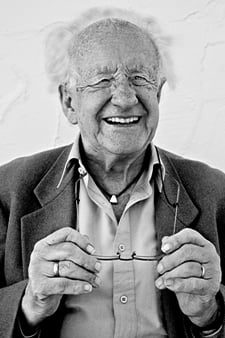
johangaltung

Sometimes a look at the basics is needed. They are reproduction of the nature on which we all depend, and reproduction of humans. Formulas like renewability and recycling, to avoid depletion and pollution, and well-being, meeting basic needs for all to avoid suffering and misery, are good guides. With them guaranteed, let us extract, produce, distribute, consume, and enjoy! Sounds rational.

But the basics are not guaranteed, not built into the system.

From the economy comes many products but also ecocrisis, misery, death, guided not by rationality but by the opposite. How come?

One more look at basics: the production factors, adding to nature, labor and capital, technology and decisions (management). These two were the basics for nobody less than Smith and Marx, but easily forgotten. To Smith, the driving force was not capital but decision: decide in favor of egoism, yourself, and the whole system will be at its best.

Marx observed that the system exploited labor into misery as long as they could reproduce themselves, meaning more labor, but not with wellbeing. And yet, to Marx the driving force was not misery below and greed above, not capital, but technology, the means of production, which would change the mode – social setting – of production. To Smith egoism was unchangeable, to be used; to Marx technology was autonomous with broad consequences, one being the socialization of means and mode. It seems never to have struck Marx to let a social mode of wellbeing for all determine the choice of technology.

Of course there is something to Smith’s decisionism and to Marx’ technologism. But we would have come further with a focus on the two basics above through primacy of naturism and laborism, not forgetting humans in general in favor of the workforce. And then there is indeed accumulation of capital as the driving force, built into profit and book-keeping for companies, and into growth and GNP-Gross National Product for states.

“Use capital to make more capital” also applies to nature, labor, technology and decisions. But there is one thing capital can do that the other four cannot: buying all the others. Capital buys nature, impeding reproduction of nature and humans; capital buys labor to abolish itself by rewarding higher productivity; capital buys technology to reproduce capital, not nature and humans; and capital buys decisions by buying the decision-makers in companies and states. In corporations processing nature the capital-owners were always well rewarded, less so in states processing decisions.

What have grown out of all proportions are companies processing capital – banks headed by “banksters”, through speculation. No scarce nature needed, no restless labor, only capital as resource and product and computer technology and egoistic decisions in favor of themselves. They can even practice socialism by distributing profit fairly to all working as bonuses. The big banks are known, not strange if smaller want to get into it. Nor is it strange that they fight – meaning buy – everybody who can limit their “freedom” to speculate: voters by buying candidates, campaigns and media, legislators, executives, judges.

Thus, compare the New York City sales tax of 4.5% with 0% on the stock exchange when buying and selling capital: only 0.5% tax would make $90 billion, twice the budget, available. And yet they are exempted. A cancer bribing other body tissues, and anti-bodies, for support.

How did it happen? By making capital dirty cheap with interest rates toward 0%, “quantitative easing”. Ivan J. Aziz of the Asian Development Bank (Development + Cooperation, 2013/12 pp. 479-81):

“Banks live from taking higher interest rates for the loans than the interest rates they pay on deposits. That is the way things normally are–but central banks in North America, Europe and Japan too have been implementing abnormal policies.–what does a bank do when money is cheap?–it obviously becomes more risk-taking–start handing out as much money in loans as they can, especially in property sector and consumption credit–this led to “bubbles”. At the same time, they start buying financial assets, shares, bonds, and so on which makes their balance sheets look more like those of institutional investors than–banks. Both result from cheap money and both are risky“.

One factor underlying this is the US existential fear of the US$ losing its status as world reserve currency if countries turn to the euro (Iraq under Saddam, Iran) or talks about a gold-backed dinar (Libya under Gaddafi). Added to low interest (guess who took the initiative) comes high killing, in Iraq and Libya, planned for Iran, and countries with state central banks (Lebanon-Syria-Sudan-Somalia).

As a result the planet is now hostage to unpayable debts: the Gross World Product is already lower than the combined world debt owed to banks. The debt is superior to the amount of money on the planet.

Added to this comes what Paul Krugman is arguing so well: use public budget stimulus to get the economy going, do not cut the public budget to reduce public debt through austerity. Austerity generates no growth; stimulus does, and will eventually lower the debt.

Added to this right-wing policy in the USA, now also in “left-wing” France comes USA-EU-Japan left inability to produce alternatives whether because they are bought, have mental deficits, or both.

Krugman and Kristof in International New York Times celebrate the 50-year old war on poverty as a success, rightly wanting more (but getting less). However, poverty and its extreme, the misery of suffering and death, is only one aspect of the scandal, the other is glaring inequality. But what can be done with banksters in control?

Not much; hence the bad outlook. The decision-makers in the leading corporations, the banks, will fight any control, not by killing but by bribing. The decision-makers in the leading states, Anglo-American, will fight any control by killing, bribing and spying.

The way out is a dirty road, not the highway of dirty cheap money. We have argued it many times in these editorials: people fending for themselves (Smith) with the social technology of cooperatives and self-employment (Marx). Worry less about capital and more about survival. Be prepared to struggle. “Jobs” simply do not exist.*

First published at Transcend Media Service.

* For much more see the author’s Peace Economics, TRANSCEND University Press-TUP 2012.

Related Posts

Jan Oberg PhD, director, The Transnational Foundation for Peace and Future Research, TFFLund, Sweden October 2, 2026 This is my full original manuscript. The Chinese Academy of Social Science, CASS, makes two publications out if it. 1. China’s Five-year plan emphasized the capabilities of basic research and original innovation. It is regarded as the goal of the future social development, which, as required, should be significantly enhanced. Can you comment on the importance of original innovation in research and academic study? I believe it is easier to define “original innovation” in the natural sciences than in social sciences. The breaking points of what constitutes something new, or innovative, are not quite as sharp in the latter. But in both fields it is about opening up something that was closed, unseen, unexplored before – making manifest what was earlier latent. Innovations come in many forms and shapes – naming something that was...
How Oxford University Press allowed a personality‑driven narrative to masquerade as scholarship. Jan Oberg, dr hc, TFF director This article has also been published on TFF Substack where more readers react and withdraw their interviews from the project. A Special Issue in a scholarly journal is not an ordinary publication. It is a collective, curated […]
A friendly quarrel while we agree that the US sanctions are a weapon of mass destruction and kill more people than wars do. And that we must talk much more about sanctions than we have so far. Jan Oberg, TFF director March 16, 2026 John Mearsheimer recently stated that U.S. sanctions murdered around 38 million people between 1971 and 2021 – see the video below. It is a dramatic figure, and it has spread quickly because it captures, in one sentence, the enormous human cost of modern sanctions. I share his concern about the destructive effects of economic coercion. But the specific number he cites — and the way he attributes it — deserves a friendly academic clarification. The figure comes from a 2023 Lancet Global Health article estimating the mortality effects of unilateral U.S. and EU sanctions over the past half‑century. This is the first point where Mearsheimer’s shorthand diverges from the text: the study...

Recent Articles

Photo above: Carl Fredrik Reuterswärd’s Non-Violence outside UN Headquarters in New York. Kirill Levin, CC BY-NC-SA 2. Jan Oberg November 3, 2026 I am happy to be published in Horizons which is produced by the Center for International Relations and Sustainable Development, CIRSD, in Belgrade. My contribution brings out a radical re-thinking of what concepts such as defence, security, deterrence – and peace – may mean if we want to create a more peaceful world. It also summarises a few things I have been working with the last few decades. Please read it here Og her er den på dansk, takket være Johnny Baltzersens lynhurtige oversættelse
UNITE-tillid, DREAM-velstand og andre konstruktive komponenter Normally we publish articles in English here. But this is a translation of a very important TFF document that should reach as many as possible in Denmark since this country’s government has been one of the most hardline in Europe and, up till now at least, has refused to use diplomacy and, instead, spent tremendous sums on arming Ukraine with the express goal of defeating Russia. Thus this – unique – article is in Danish. Vi er Johnny Baltzersen og hans Fælles Sikkerhed – Fælles Fremtid på Substack overmåde taknemmelige for at have oversat og publiceret TFF’s 2025-portfølje for fredsidéer med henblik på Ukraines fremtid. Vi håber den nu kan nå mange flere danskere – som også vil sprede den og skabe debat – nu den danske regerings og folketingspartiernes politik på dette område siden 2022 står nu – forudsigeligt – ved vejs ende....
Jan Oberg TFF director October 28, 2026 Exactly one month has now passed since I published my criticism of the introduction to the special issue on Johan Galtung published by the Journal of Global Security Studies, JoGSS, and of Tor Egil Førland’s chapter about Galtung which serves as a preview to his forthcoming biography of Galtung to be published by PRIO. See the original on The Transnational here and the same article on TFF Substack with many general and critical comments and, in particular, the people who decided to withdraw from the biography project in protest. The special issue itself was extraordinary. It was devoted to the intellectual legacy of one of the founders of peace research and contained a number of strong assessments of his personality, scholarship, intellectual trajectory, and public role. Such assessments are, of course, entirely legitimate. No scholar is beyond criticism, and neither was Johan Galtung....

TFF on Substack

Discover and subscribe to more peace materials on TFF Substack

Most Popular

Photo above: Carl Fredrik Reuterswärd’s Non-Violence outside UN Headquarters in New York. Kirill Levin, CC BY-NC-SA 2. Jan Oberg November 3, 2026 I am happy to be published in Horizons which is produced by the Center for International Relations and Sustainable Development, CIRSD, in Belgrade. My contribution brings out a radical re-thinking of what concepts such as defence, security, deterrence – and peace – may mean if we want to create a more peaceful world. It also summarises a few things I have been working with the last few decades. Please read it here Og her er den på dansk, takket være Johnny Baltzersens lynhurtige oversættelse
UNITE-tillid, DREAM-velstand og andre konstruktive komponenter Normally we publish articles in English here. But this is a translation of a very important TFF document that should reach as many as possible in Denmark since this country’s government has been one of the most hardline in Europe and, up till now at least, has refused to use diplomacy and, instead, spent tremendous sums on arming Ukraine with the express goal of defeating Russia. Thus this – unique – article is in Danish. Vi er Johnny Baltzersen og hans Fælles Sikkerhed – Fælles Fremtid på Substack overmåde taknemmelige for at have oversat og publiceret TFF’s 2025-portfølje for fredsidéer med henblik på Ukraines fremtid. Vi håber den nu kan nå mange flere danskere – som også vil sprede den og skabe debat – nu den danske regerings og folketingspartiernes politik på dette område siden 2022 står nu – forudsigeligt – ved vejs ende....
Jan Oberg TFF director October 28, 2026 Exactly one month has now passed since I published my criticism of the introduction to the special issue on Johan Galtung published by the Journal of Global Security Studies, JoGSS, and of Tor Egil Førland’s chapter about Galtung which serves as a preview to his forthcoming biography of Galtung to be published by PRIO. See the original on The Transnational here and the same article on TFF Substack with many general and critical comments and, in particular, the people who decided to withdraw from the biography project in protest. The special issue itself was extraordinary. It was devoted to the intellectual legacy of one of the founders of peace research and contained a number of strong assessments of his personality, scholarship, intellectual trajectory, and public role. Such assessments are, of course, entirely legitimate. No scholar is beyond criticism, and neither was Johan Galtung....
Read More
knotted gun
Photo above: Carl Fredrik Reuterswärd’s Non-Violence outside UN Headquarters in New York. Kirill Levin, CC BY-NC-SA 2. Jan Oberg November 3, 2026 I am happy to be published in Horizons which is produced by the Center for International Relations and Sustainable Development, CIRSD, in Belgrade. My contribution brings out a radical re-thinking of what concepts such as defence, security, deterrence – and peace – may mean if we want to create a more peaceful world. It also summarises a few things I have been working with the last few decades. Please read it here Og her er den på dansk, takket være Johnny Baltzersens lynhurtige oversættelse
TFFPortfolioVign
UNITE-tillid, DREAM-velstand og andre konstruktive komponenter Normally we publish articles in English here. But this is a translation of a very important TFF document that should reach as many as possible in Denmark since this country’s government has been one of the most hardline in Europe and, up till now at least, has refused to use diplomacy and, instead, spent tremendous sums on arming Ukraine with the express goal of defeating Russia. Thus this – unique – article is in Danish. Vi er Johnny Baltzersen og hans Fælles Sikkerhed – Fælles Fremtid på Substack overmåde taknemmelige for at have oversat og publiceret TFF’s 2025-portfølje for fredsidéer med henblik på Ukraines fremtid. Vi håber den nu kan nå mange flere danskere – som også vil sprede den og skabe debat – nu den danske regerings og folketingspartiernes politik på dette område siden 2022 står nu – forudsigeligt – ved vejs ende....
JoGSS-Silent
Jan Oberg TFF director October 28, 2026 Exactly one month has now passed since I published my criticism of the introduction to the special issue on Johan Galtung published by the Journal of Global Security Studies, JoGSS, and of Tor Egil Førland’s chapter about Galtung which serves as a preview to his forthcoming biography of Galtung to be published by PRIO. See the original on The Transnational here and the same article on TFF Substack with many general and critical comments and, in particular, the people who decided to withdraw from the biography project in protest. The special issue itself was extraordinary. It was devoted to the intellectual legacy of one of the founders of peace research and contained a number of strong assessments of his personality, scholarship, intellectual trajectory, and public role. Such assessments are, of course, entirely legitimate. No scholar is beyond criticism, and neither was Johan Galtung....
Screenshot 2026-10-26 115647
An aspect of Iran’s culture and civilisation you’ve probably never heard about. Don’t be surprised if the US and Israel also try to bomb them. Jan ObergTFF director October 26, 2026 Today – under the “USraeli” threat of new “annihilating” bombings – opens the 7th International Conference on Peace and Conflict Resolution at Tehran’s University. As far as I can tell, this is the only permanent, advanced peace research institution in West Asia/the Middle East. Perhaps more countries in that region could be inspired? I mean, how many military “security” institutes and military academies do they have? Many peace research institutes and university departments have been established since the 1950s in the West. They are now all under attack; some have closed down, some have gone mainstream, yet others kept the name but do nothing to research peace and disseminate results or advice; instead, they cooperate with militarism’s platforms such...
Screenshot 2026-10-15 141837
Let’s discuss using AI to create peace – in contrast to boring geopolitics devoid of creative healing and visions. Jan Oberg TFF director October 15, 2026 I asked VEED to create a short video exemplifying how peace is preferable to war, then chose the lady as a template. Simple as that. In less than a minute, it produced this video, which any peace-loving person would appreciate. The only problem is that human intelligence (HI), at least the one that exists among Western decision-makers, isn’t half as moral or smart as AI. I have used AI to dialogue about peace and peace plans, creative conflict resolution and visions of a better future for humankind. It so happens that I am having more stimulating, intelligent, creative and moral discussions with AI than I could possibly have with any EU or NATO leader today. Yes, AI has very problematic and dangerous aspects; used...
girl-5894831_1280
Below are TFF-related media mentions, comments, videos and social media posts published elsewhere but not on this homepage. We happen to catch and list only a fraction. Regarding video comments and debates, we recommend that you go to the TFF Video Channel on Substack where many of them are reproduced. Jan Oberg is a contributor to China Daily – 52 million daily clicks – and Global Times, CGTN and CCTV (the national television), China Investment, Xinhua News Agency and several others. Articles and videos on these media very often multiply into countless Chinese (and Western media) that re-post them from these main media. Thanks to The China Academy, his analyses, interviews and comments are frequently posted on YouTube channels such as Thinkers Forum and Wave Media. These videos are often re-posted on Bilibili (China’s YouTube), the China Content Center on TikTok, and on the Chinese edition of TikTok, Douyin.com. This means reaching hundreds of millions of viewers worldwide over a year. While there are too many to catch on all these...





