

TFF PressInfo # 292: Brisbane – A show of Western weakness

/10/janoberg.jpg”>[/caption]

No matter what you may think of Putin and Russia this is simply not the way international politics should be conducted, particularly not at the personal level. If it wasn’t an offence to children, one would aptly characterise it as childish behaviour.

Western leaders ignored a brilliant opportunity to meet face-to-face with Vladimir Putin and move forward towards mutual understanding instead of signalling that they want a new Cold War.

Western leaders tell us that Russia is a ”threat to the world”. That obviously serves other purposes because you don’t bully someone you genuinely fear.

The G20 Brisbane should be remembered for its show of Western leaders’ personal display of weakness and conflict illiteracy.

Pummelled Putin punching bag

CNN reports that, during the meeting, Putin took ”pummelling” and was treated as a ”punching bag” by Western leaders from he set foot on Australian soil where his Australian host had sent a deputy minister of defence to receive him.

The Guardian reports that the Russian president approached Canadian Prime Minister Harper with his hand outstretched. Harper reluctantly shook it, then said “Well I guess I’ll shake your hand, but I only have one thing to say to you: you need to get out of Ukraine.” ”Bold words” – media called it.

Footage shows Putin sitting alone at a lunch table – like a naughty school boy put in the corner as by his teachers.

President Obama said that we are ”opposing Russia’s aggression in Ukraine which is a threat to the world as we saw in the appalling shoot down in the MH-17”.

Well, if Russian mercenaries in Eastern Ukraine is enough for “aggression”, Western countries have a few more here and there. World threat? Not serious with a country that has 8% of the military expenditures of NATO and has lost its empire 25 year ago. And he knows, with sufficient hard evidence, that Russia shot that plane down?

Mockery of crisis management and diplomacy

Behaving like big boys ganging up and mobbing a smaller boy in the schoolyard – to the extent that he is leaving the place – is to make a mockery of the concept of diplomacy and professional politics.

Particularly in times of very very serious crisis where a new Cold War is very near.

It is unbecoming of statesmen, of world leaders we have a right to trust and expect know how to behave responsibly. Here they sank to the lowest gang behaviour, as arrogant as abject.

Media do their best to follow this banalisation of politics.

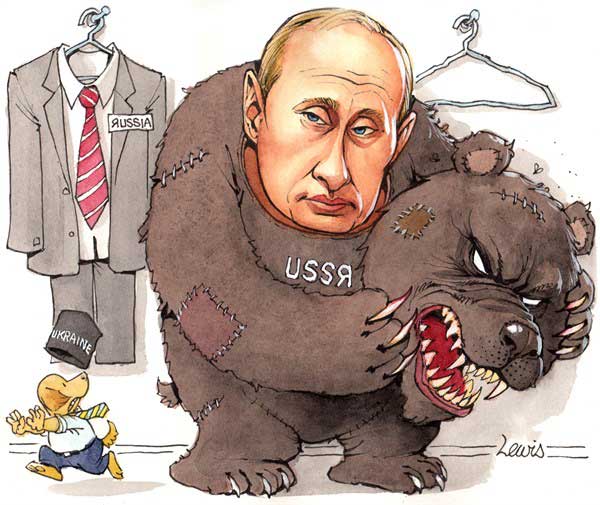
Cartoon by Australian Peter Lewis – “Vlad Putin’ on his bear costume”
Commentators, international affairs experts and others have found this OK – after all Putin is a bad guy, right?

Well, there other ways of seeing the West as displaying weakness rather than statesmanship in all this.

Psycho-political projection

Projection means transfer on someone else of what you know is bad/evil about yourself.

While NATO countries have ravaged or chopped up countries (e.g. Yugoslavia), one after the other – particularly civilisations like Iraq and Syria and bullying Iran – it must blow out of proportion the Russian annexation of Crimea.

Serbia was partly destroyed to create an independent Kosovo in which the U.S. immediately built the largest base since the war in Vietnam, Bondsteel. Thousands were killed and wounded, 800.000 fled right after the bombs began to fall and Serbs were rapidly cleansed out of Kosovo which is and will remain a failed state.

Compare that with the referendum in Crimea and compare the violations of international law in the two cases.

Or compare with the treatment of Iraq: About one million dead thanks to 13 years of sanctions, invasion, occupation and misadministration leading, as it seems now, to the division of that country (which will be blamed in the Iraqis themselves).

The West – foolishly, triumphantly – took advantage of Russia’s weakness and expanded NATO and did what could never have been done during the Soviet era – until Ukraine.

The West can’t live without enemies

One of Gorbachev’s closest associates said at the dissolution of the Soviet Union – We are going to do a terrible thing to you in the West: We are going to deprive you of your enemy.

Afterwards, Western leaders was at a loss finding scapegoats who could legitimate the continued existing of NATO after the Warsaw Pact dissolved and the biggest threat, the Soviet Union, had fallen apart.

For some time it was Mohamed Farah Aideed in Muqdishu, for some time Manuel Noriega (the U.S. invasion of Panama in 1989).

Saddam had to play the role of beloved dictator from August 1990 and in the early 1990s it became Slobodan Milosevic.

A classical pattern from 1989 to ISIS today: The West hates those the most that it once supported and called friends.

The Clinton administration bombed a little here and there – Madeleine Albright waking up every Monday discussing with her staff whom to appoint as favourite enemy this week.

Then came September 11, 2001 – and the war on terrorists (not terrorism) could begin – eventually appearing increasingly as Christian mission civilisatrice against Islamic culture.

Mainstream media and mainstream academia hardly ever ask whether there could be something wrong with Western culture or cosmology.

What is the reason that Western countries are by far the most bellicose states in post-1945 history with the largest military expenditures – or why the U.S. has 700 base facilities in 130 countries and permanently feels threatened – and compelled with a ”chosen people” syndrome to be The Saviour of humanity?

The U.S./NATO is today at constant war with the world – either militarily or economically or politically. Why?
Could it be that the US/NATO is not always 100% right or has a rights to lead and ‘save’ the world? – as we are being made to believe?

Divert the attention from domestic problems and Ukraine as a huge mistake?

Is the West in need perhaps of diverting the attention from its own steadily mounting domestic and regional problems? From its declining de facto global power? Does it need a lot of self-congratulatory chest-beating?

Everybody in the West seems conveniently to have forgotten that the Ukraine crisis did not start with an out-of-the-blue annexation of Crimea by Putin.

It was the US and the EU that caused it in the first place by masterminding and financing the regime change in Kiev and demanding that Ukraine choose between the EU and the Eurasian Union – to which Putin then re-acted.

Kissinger and Gorbachev – more experienced than any practising politician today – are not the only ones to see Ukraine and Western hubris as a huge mistake.

There is no doubt that the U.S. empire is getting weaker these years. No doubt that Europe is in deep crisis and lack visionary leadership. While the economic growth is around 0% there, the African continent grows with about 5% per year.

The only economic indicator that grows phenomenally is social unrest-producing economic inequality. And the peace dividend from 1989 has been squandered.

Neither can there be any doubt that others such as the BRICS countries are getting stronger – using neither Sword nor Bible.

The only power dimension on which the U.S./NATO world is still second to none is the military and, thus, that is the one mostly used.

On all other power scales – e.g. the economy (debt), culture, legitimacy, diplomacy and ability to serve as a benign, visionary model that inspires others – the arrow points down.

In summary, perhaps some of these factors were were displayed in the undignified body and verbal language in Brisbane. And the post-1989 boomerangs are coming back.

Why should BRICS and other new power centres in the emerging, regionalised and multipolar world be bothered by a grumpy ageing West whose time is running out?

And Putin, patiently putting up with the humiliation without losing his temper or dignity, surely slept well on his early plane home.

[ 1250 words ]

Peace & future researcher + ‌Art Photographer

Related Posts

Below are TFF-related media mentions, comments, videos and social media posts published elsewhere but not on this homepage. We happen to catch and list only a fraction. Regarding video comments and debates, we recommend that you go to the TFF Video Channel on Substack where many of them are reproduced. Jan Oberg is a contributor to China Daily – 52 million daily clicks – and Global Times, CGTN and CCTV (the national television), China Investment, Xinhua News Agency and several others. Articles and videos on these media very often multiply into countless Chinese (and Western media) that re-post them from these main media. Thanks to The China Academy, his analyses, interviews and comments are frequently posted on YouTube channels such as Thinkers Forum and Wave Media. These videos are often re-posted on Bilibili (China’s YouTube), the China Content Center on TikTok, and on the Chinese edition of TikTok, Douyin.com. This means reaching hundreds of millions of viewers worldwide over a year. While there are too many to catch on all these...
Jan Oberg TFF director October 13, 2026 According to Alfred Nobel’s will, the Nobel Peace Prize shall be awarded: ”to the person who has done the most or best to advance fellowship among nations, the abolition or reduction of standing armies, and the establishment and promotion of peace congresses.” Further down, he also expresses how the prize for the “champions of peace” shall be decided: “that for champions of peace by a committee of five persons to be selected by the Norwegian Storting. Alfred Nobel’s will is remarkably short and clear. But few seem to have read it. Nobel did not say that the committee itself should consist of members of parliament. He entrusted the Storting with appointing five persons. In principle, it could have selected diplomats, mediators, peace researchers, conflict-resolution specialists, or other individuals with recognised expertise in matters of peace from around the world. Instead, the Storting gradually...
The Quest for Humane Survival Richard Falk Professor emeritus, Princeton UniversityTFF Associate since 1986October 12, 2026 After decades of teaching and writing about international law in academic frameworks that were not institutionally situated within law school environments—at Princeton and the University of California, Santa Barbara—I found myself most receptive to the TWAIL outlook. It has been especially illuminating in clarifying the extent to which international law evolved as a dialogical critique of Europe’s efforts to legitimize its colonial undertakings. In particular, TWAIL has exposed how international law has functioned to legalize the subjugation of Third World peoples, securing conditions for exploitative investment and trade relations, the coercive enforcement of public debts, and an ideology of cultural superiority. TWAIL’s exposure of these economic legacies of colonialism has influenced my understanding of the history and development of international law, broadly conceived, as an ideological project of the Western sub-system of the world...

Recent Articles

Below are TFF-related media mentions, comments, videos and social media posts published elsewhere but not on this homepage. We happen to catch and list only a fraction. Regarding video comments and debates, we recommend that you go to the TFF Video Channel on Substack where many of them are reproduced. Jan Oberg is a contributor to China Daily – 52 million daily clicks – and Global Times, CGTN and CCTV (the national television), China Investment, Xinhua News Agency and several others. Articles and videos on these media very often multiply into countless Chinese (and Western media) that re-post them from these main media. Thanks to The China Academy, his analyses, interviews and comments are frequently posted on YouTube channels such as Thinkers Forum and Wave Media. These videos are often re-posted on Bilibili (China’s YouTube), the China Content Center on TikTok, and on the Chinese edition of TikTok, Douyin.com. This means reaching hundreds of millions of viewers worldwide over a year. While there are too many to catch on all these...
Jan Oberg TFF director October 13, 2026 According to Alfred Nobel’s will, the Nobel Peace Prize shall be awarded: ”to the person who has done the most or best to advance fellowship among nations, the abolition or reduction of standing armies, and the establishment and promotion of peace congresses.” Further down, he also expresses how the prize for the “champions of peace” shall be decided: “that for champions of peace by a committee of five persons to be selected by the Norwegian Storting. Alfred Nobel’s will is remarkably short and clear. But few seem to have read it. Nobel did not say that the committee itself should consist of members of parliament. He entrusted the Storting with appointing five persons. In principle, it could have selected diplomats, mediators, peace researchers, conflict-resolution specialists, or other individuals with recognised expertise in matters of peace from around the world. Instead, the Storting gradually...
The Quest for Humane Survival Richard Falk Professor emeritus, Princeton UniversityTFF Associate since 1986October 12, 2026 After decades of teaching and writing about international law in academic frameworks that were not institutionally situated within law school environments—at Princeton and the University of California, Santa Barbara—I found myself most receptive to the TWAIL outlook. It has been especially illuminating in clarifying the extent to which international law evolved as a dialogical critique of Europe’s efforts to legitimize its colonial undertakings. In particular, TWAIL has exposed how international law has functioned to legalize the subjugation of Third World peoples, securing conditions for exploitative investment and trade relations, the coercive enforcement of public debts, and an ideology of cultural superiority. TWAIL’s exposure of these economic legacies of colonialism has influenced my understanding of the history and development of international law, broadly conceived, as an ideological project of the Western sub-system of the world...

TFF on Substack

Discover and subscribe to more peace materials on TFF Substack

Most Popular

Below are TFF-related media mentions, comments, videos and social media posts published elsewhere but not on this homepage. We happen to catch and list only a fraction. Regarding video comments and debates, we recommend that you go to the TFF Video Channel on Substack where many of them are reproduced. Jan Oberg is a contributor to China Daily – 52 million daily clicks – and Global Times, CGTN and CCTV (the national television), China Investment, Xinhua News Agency and several others. Articles and videos on these media very often multiply into countless Chinese (and Western media) that re-post them from these main media. Thanks to The China Academy, his analyses, interviews and comments are frequently posted on YouTube channels such as Thinkers Forum and Wave Media. These videos are often re-posted on Bilibili (China’s YouTube), the China Content Center on TikTok, and on the Chinese edition of TikTok, Douyin.com. This means reaching hundreds of millions of viewers worldwide over a year. While there are too many to catch on all these...
Jan Oberg TFF director October 13, 2026 According to Alfred Nobel’s will, the Nobel Peace Prize shall be awarded: ”to the person who has done the most or best to advance fellowship among nations, the abolition or reduction of standing armies, and the establishment and promotion of peace congresses.” Further down, he also expresses how the prize for the “champions of peace” shall be decided: “that for champions of peace by a committee of five persons to be selected by the Norwegian Storting. Alfred Nobel’s will is remarkably short and clear. But few seem to have read it. Nobel did not say that the committee itself should consist of members of parliament. He entrusted the Storting with appointing five persons. In principle, it could have selected diplomats, mediators, peace researchers, conflict-resolution specialists, or other individuals with recognised expertise in matters of peace from around the world. Instead, the Storting gradually...
The Quest for Humane Survival Richard Falk Professor emeritus, Princeton UniversityTFF Associate since 1986October 12, 2026 After decades of teaching and writing about international law in academic frameworks that were not institutionally situated within law school environments—at Princeton and the University of California, Santa Barbara—I found myself most receptive to the TWAIL outlook. It has been especially illuminating in clarifying the extent to which international law evolved as a dialogical critique of Europe’s efforts to legitimize its colonial undertakings. In particular, TWAIL has exposed how international law has functioned to legalize the subjugation of Third World peoples, securing conditions for exploitative investment and trade relations, the coercive enforcement of public debts, and an ideology of cultural superiority. TWAIL’s exposure of these economic legacies of colonialism has influenced my understanding of the history and development of international law, broadly conceived, as an ideological project of the Western sub-system of the world...
Read More
girl-5894831_1280
Below are TFF-related media mentions, comments, videos and social media posts published elsewhere but not on this homepage. We happen to catch and list only a fraction. Regarding video comments and debates, we recommend that you go to the TFF Video Channel on Substack where many of them are reproduced. Jan Oberg is a contributor to China Daily – 52 million daily clicks – and Global Times, CGTN and CCTV (the national television), China Investment, Xinhua News Agency and several others. Articles and videos on these media very often multiply into countless Chinese (and Western media) that re-post them from these main media. Thanks to The China Academy, his analyses, interviews and comments are frequently posted on YouTube channels such as Thinkers Forum and Wave Media. These videos are often re-posted on Bilibili (China’s YouTube), the China Content Center on TikTok, and on the Chinese edition of TikTok, Douyin.com. This means reaching hundreds of millions of viewers worldwide over a year. While there are too many to catch on all these...
Nobel-Prize-Plaque
Jan Oberg TFF director October 13, 2026 According to Alfred Nobel’s will, the Nobel Peace Prize shall be awarded: ”to the person who has done the most or best to advance fellowship among nations, the abolition or reduction of standing armies, and the establishment and promotion of peace congresses.” Further down, he also expresses how the prize for the “champions of peace” shall be decided: “that for champions of peace by a committee of five persons to be selected by the Norwegian Storting. Alfred Nobel’s will is remarkably short and clear. But few seem to have read it. Nobel did not say that the committee itself should consist of members of parliament. He entrusted the Storting with appointing five persons. In principle, it could have selected diplomats, mediators, peace researchers, conflict-resolution specialists, or other individuals with recognised expertise in matters of peace from around the world. Instead, the Storting gradually...
law-419057_1280
The Quest for Humane Survival Richard Falk Professor emeritus, Princeton UniversityTFF Associate since 1986October 12, 2026 After decades of teaching and writing about international law in academic frameworks that were not institutionally situated within law school environments—at Princeton and the University of California, Santa Barbara—I found myself most receptive to the TWAIL outlook. It has been especially illuminating in clarifying the extent to which international law evolved as a dialogical critique of Europe’s efforts to legitimize its colonial undertakings. In particular, TWAIL has exposed how international law has functioned to legalize the subjugation of Third World peoples, securing conditions for exploitative investment and trade relations, the coercive enforcement of public debts, and an ideology of cultural superiority. TWAIL’s exposure of these economic legacies of colonialism has influenced my understanding of the history and development of international law, broadly conceived, as an ideological project of the Western sub-system of the world...
images-2
Advocates of nuclear disarmament are regularly dismissed by the champions of nuclear deterrence as naïve and unrealistic, utopian or even irresponsible. Yet this ‘doctrine’ of deterrence, regarded by France as the ‘cornerstone’ of its national security, is based on quasi-religious beliefs, a theory that cannot be proven, risky gambles and fragile assumptions. So much so that one might legitimately ask which side the ‘Care Bears’ are on. Marc FinaudVice-President of Initiatives for Nuclear Disarmament (IDN) October 9, 2026 This article was originally published on Pressenza When it comes to these things being treated as religious concepts, look here. Idealists and realists It was Hubert Védrine, François Mitterrand’s former Foreign Minister, who repeatedly coined the phrase: ‘Europeans are a sort of Care Bears who don’t realise they’re living in Jurassic Park’. He applies this reference to the cartoon for well-behaved children not only to what he regards as weakness or idealism...
8824b09f-33a5-43f9-9fd0-550f28cda24d_1536x1024
What the West Borrowed from Asia and What It Left Behind Jan Krikke October 8, 2026 The article was originally published here In the late 1960s, the musical Hair announced that the Age of Aquarius was dawning. Its opening anthem promised a transformation of human consciousness: an era of peace, harmony and understanding. Half a century later, a familiar echo of that promise is a meditation app offered by your employer. You can find it in the same list of benefits as the pension plan and the gym discount. How did a spiritual revolution become an employee benefit? The answer lies in the history of the movement known as New Age: where it came from, what it borrowed from Asia, and why the meaning of what it borrowed changed in the process. Two definitions will help. New Age is a loose label for a wide range of spiritual practices and...
Screenshot 2026-10-04 210142
Small and different + among the 10% most active + 9,000 texts + 150 Associates + 60 000 a day — and a stubborn belief that peace is smarter and must be secured by peaceful means. In 2026, the Transnational Foundation for Peace and Future Research (TFF) turns 40. On Monday, October 5, 2026, a new TFF homepage will go live — a new gateway to more than 9,000 articles, analyses, research papers and other contributions produced over four decades of independent peace research. But this is not simply a new website. For four decades, TFF has worked from a simple conviction: peace is smarter than militarism and can be brought about by peaceful means. This is not merely an aspiration. It is the principle expressed in the UN Charter and the Gandhian tradition that has guided our work from the beginning. TFF is a research-based, independent and people-financed foundation....





