
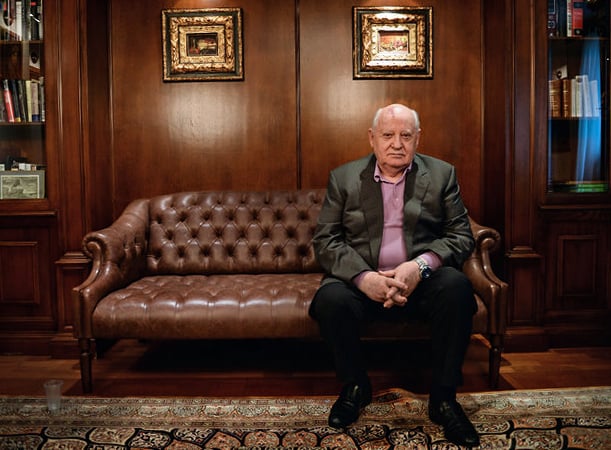
Russia and the U.S. are not condemned to confrontation


By Mikhail Sergeyevich Gorbachev

June 16, 2018

• Russia and the United States are not condemned to confrontation. We must now make up for lost time!

Mikhail Gorbachev’s Address to Participants in the Conference Marking the 30th Anniversary of Ronald Reagan’s Visit and the Moscow Summit.

Originally published at the homepage of the Gorbachev Foundation on June 4, 2018

I welcome all who have gathered to mark the thirtieth anniversary of President Ronald Reagan’s visit to Moscow and the US-Soviet summit. I think it was a truly historic event. It was a kind of summing up of the work we had done, starting in Geneva and then going through Reykjavik and Washington to Moscow.

It was not an easy path. Its first major milestone was the Joint US-Soviet Statement which declared that “a nuclear war cannot be won and must never be fought” and that “the two sides will not seek military superiority.”

This gave ground to the world media to speak of the spirit of Geneva.

But the spirit of Geneva was severely tested. The entry of US Navy ships in our territorial waters, spy scandals, propaganda campaigns in the in the media – all that and a lot more was done in order to push us off track. The negotiations could have turned into unproductive routine. It took Reykjavik to prevent a new deadlock and open up prospects.
I won’t describe all the ups and downs of the historic meeting in Reykjavik.

We came there with constructive proposals, which opened the way to agreements on INF and START, but stumbled on the US President’s commitment to the Strategic Defense Initiative and his attempt to obtain our consent to deployment of missile defenses. Nevertheless, the Reykjavik agreements were a breakthrough toward the first real arms reduction treaties.

Of equal importance was the fact that in Reykjavik Ronald Reagan showed himself to be a proponent of a world without nuclear weapons. That brought us closer together.

The summits in Washington and Moscow pointed to a new level of trust in our relations. It was not an accident that Ronald Reagan, standing next to me in the Kremlin, near the Tsar Cannon, answered the question whether he still considered the Soviet Union an evil empire by saying “No, it was another time, another era.”

Nobody put those words in his mouth. While this was not yet the final line drawn under the Cold War, the acute phase of the confrontation was over. I think this is a unique example of such a turnabout in relations between two major powers.

Why did in happen within such a historically short time? The short answer is: Because both sides had the political will. Without it, it would have been impossible to remove all the barriers and obstacles accumulated during the decades of the Cold War.

• •

I am recalling this not just to mark this meeting’s anniversary but also because I am convinced that the experience of those years is relevant today.

It suggests that even in the most difficult situations we must not panic or succumb to pessimism.

We must, however, be sober and realistic in assessing the current situation in the world and in relations between our countries. Over the past few years I’ve been following with great concern the developments in our relations. The most important gains of our past efforts – trust, the end of the arms race, cooperation and the prospect of partnership – are now in jeopardy.

I don’t want to strike a pose of accuser but let me repeat what I have said on many occasions. The major cause of the current severe problems lies in the incorrect assessment by the West and particularly by the United States of the historic event – the end of the Cold War.

It was our common victory, achieved through dialogue, negotiations and resolution of the most complex security, disarmament and regional issues and by putting bilateral relations back on track. Had it not been so, the Cold War and the arms race could have continued for decades, and who knows what it could have led to!

Instead of recognizing all that, the West declared victory in the Cold War. American leaders stated that it happened thanks to the policy of force. Therefore, they concluded, it is necessary to build up power, to impose their will, to build a unipolar world, an American empire.

We know the consequences – in the Middle East, in the Mediterranean, and in Europe: in Yugoslavia and now in Ukraine. This is happening in a continent where two world wars started! I believe that conflicts and the use of force in Europe are particularly unforgivable. It is the greatest failure of European and global politics.

A comprehensive system of security has not been built in Europe.

We proposed creating a Security Council for Europe, and the idea met with support from Mitterand, Genscher, Scowcroft; nevertheless, it was ignored. Instead, there was the enlargement of NATO, in spite of the position of Russia as well as warnings from many Western politicians and diplomats.

I will not list here all the examples of the United States’ unilateral action. In Russia, they were perceived unambiguously: Our interests are being ignored, and the aim is to push us out of the world arena. That is not the way to talk to Russia.

Those who expected Russia to agree to a secondary role in world affairs and not to defend its interests made a huge mistake, as did those who sought to isolate Russia.

• •

This is the real situation. What is needed now is realistic policy.

The main question today is what needs to be done to start exiting from the current deadlock and move our relations off the ground.

I have made my views known many times, through both Russian and international media, including TIME magazine.

We squandered 2017 and, already, almost a half of this year. We must now make up for lost time.

First of all, I urge that an end should be put to further escalation of sanctions, countermeasures and negative, hostile rhetoric.

A meeting between the President of Russia and the United States should be prepared. It is far from normal that they still have not had full-fledged negotiations.

It is important to define the summit’s agenda, starting with the main priorities. Today, they are the problems of curbing the arms race, strengthening strategic stability and reaffirming the arms reduction agreements – INF and START. A strong impetus from the president is required.

At the same time, dialogue should begin on the entire agenda, including regional and global problems and bilateral relations. The obstacles here are tremendous and it would take a big effort to get them out of the way. And yet, there is no alternative. This is something political leaders should understand, and we must insist on it.

I believe all of us – civil society organizations, experts, academics, businessmen and the media – must stimulate movement in this direction. We need to resume people-to people diplomacy and expand contacts, educational and student exchanges. This is essential, though it might be done in ways different from thirty years ago.

I hope we’ll have the strength and energy to accomplish the enormous work that lies ahead in order to break out of the vicious circle and start moving toward normal relations.

Indeed, we must look beyond that, toward the prospect of cooperation and partnership. We gave serious thought to that prospect, but today some are saying that it is a utopia and that Russia and the United States are condemned to confrontation. My answer is: No, they are not. And I hope that all of you here share that view.

I wish you fruitful deliberations and an interesting discussion that would help learn lessons from the past and formulate new, constructive proposals.

Mikhail Gorbachev



2 Responses

  1. Gorbachev still sounds like one of the greatest statesmen of our times. There has been a great deal of criticism of the Putin-Trump press conference after their summit. It had to be criticised but not for the reasons given by some pundits, such as their body language or who won and who lost. These two people could have achieved a great deal by looking for peaceful means for resolving the conflicts in Syria, Libya, Yemen and the disagreements over the Iran nuclear deal, or above all to cut their insane military expenditure and to reduce if not abolish nuclear weapons, but there was none of that. It seems that practically all politicians and pundits are happy to dwell on trivialities and ignore the bigger picture.

  2. Dear Farhang – couldn’t agree more. I think it was a show, a lost opportunity, a helter-skelter meeting with absolutely NO tangible result. And they held it on the 73rd anniversary of the birth of the nuclear bomb. And said only blah-blah about nuclear disarmament. I’ve already said it and will say it again…

Related Posts

Tony Robinson October 4, 2026 Violence is easy to recognise when someone is being beaten, shot or killed. It becomes more difficult when nobody is holding a weapon. Poverty, discrimination, exploitation and repression can restrict a human life just as effectively, although they do so in very different ways and with very different consequences. Simply adding more categories to an ever-growing list of forms of violence does not really solve the problem. The more interesting question is what all these different situations have in common and why it makes sense to describe them using the same word. Human beings do not simply react to what happens around them. They remember the past, imagine things that do not yet exist, make plans and undertake projects. Workers organise because they imagine different working conditions; people migrate because they imagine another life somewhere else; social movements emerge because people refuse to accept the...
It’s a matter of principles, courage, vision and pulling together – while the militarist world is falling apart… Peter Langille October 3, 2026 “Here, then, is the problem which we present to you, stark and dreadful and inescapable: Shall we put an end to the human race; or shall mankind renounce war?”The Bertrand Russell—Albert Einstein Manifesto, July 9, 1955 ⁕ The forecast for what’s ahead is worrisome. The sharp rise in armed conflicts over the past three years is adding to what was already the highest level in over seventy years. Genocides, which should be prevented are supported. A shared climate emergency that jeopardises survival is ignored. Diverse polls now suggest that people are war-weary, worried and interested in a more effective United Nations. And, there are viable policy options for a more secure world! Yet governments are doubling-down, betting on more war and investing heavily. If current trends persist,...
Johan Galtung 1930-2024October 2015 Published here on October 3, 2026 Let us focus on Civilization for conflict analysis and remedies. Major forms of disorder use violence; war is state organized violence. The most belligerent states are the United States of America and Israel, both with civilization roots. National Evangelism, the US Protestant Christian civilization– more national than evangelical–justifies US warfare as exceptionalism of a people chosen by God, with a manifest destiny to run the world. Orthodox Judaism justifies Israeli warfare to conquer and expand from Nile to Euphrates as a religious right and duty to the Eternal One. The third most belligerent country, the UK, no longer believes it is God-chosen but chosen by the USA; not quite the same but something. But the root cause of global disorder lies in the Occident–with Islam–seeing itself as the single, universal civilization valid for all at all times, all others being...

Recent Articles

Tony Robinson October 4, 2026 Violence is easy to recognise when someone is being beaten, shot or killed. It becomes more difficult when nobody is holding a weapon. Poverty, discrimination, exploitation and repression can restrict a human life just as effectively, although they do so in very different ways and with very different consequences. Simply adding more categories to an ever-growing list of forms of violence does not really solve the problem. The more interesting question is what all these different situations have in common and why it makes sense to describe them using the same word. Human beings do not simply react to what happens around them. They remember the past, imagine things that do not yet exist, make plans and undertake projects. Workers organise because they imagine different working conditions; people migrate because they imagine another life somewhere else; social movements emerge because people refuse to accept the...
It’s a matter of principles, courage, vision and pulling together – while the militarist world is falling apart… Peter Langille October 3, 2026 “Here, then, is the problem which we present to you, stark and dreadful and inescapable: Shall we put an end to the human race; or shall mankind renounce war?”The Bertrand Russell—Albert Einstein Manifesto, July 9, 1955 ⁕ The forecast for what’s ahead is worrisome. The sharp rise in armed conflicts over the past three years is adding to what was already the highest level in over seventy years. Genocides, which should be prevented are supported. A shared climate emergency that jeopardises survival is ignored. Diverse polls now suggest that people are war-weary, worried and interested in a more effective United Nations. And, there are viable policy options for a more secure world! Yet governments are doubling-down, betting on more war and investing heavily. If current trends persist,...
Johan Galtung 1930-2024October 2015 Published here on October 3, 2026 Let us focus on Civilization for conflict analysis and remedies. Major forms of disorder use violence; war is state organized violence. The most belligerent states are the United States of America and Israel, both with civilization roots. National Evangelism, the US Protestant Christian civilization– more national than evangelical–justifies US warfare as exceptionalism of a people chosen by God, with a manifest destiny to run the world. Orthodox Judaism justifies Israeli warfare to conquer and expand from Nile to Euphrates as a religious right and duty to the Eternal One. The third most belligerent country, the UK, no longer believes it is God-chosen but chosen by the USA; not quite the same but something. But the root cause of global disorder lies in the Occident–with Islam–seeing itself as the single, universal civilization valid for all at all times, all others being...

TFF on Substack

Discover and subscribe to more peace materials on TFF Substack

Most Popular

Tony Robinson October 4, 2026 Violence is easy to recognise when someone is being beaten, shot or killed. It becomes more difficult when nobody is holding a weapon. Poverty, discrimination, exploitation and repression can restrict a human life just as effectively, although they do so in very different ways and with very different consequences. Simply adding more categories to an ever-growing list of forms of violence does not really solve the problem. The more interesting question is what all these different situations have in common and why it makes sense to describe them using the same word. Human beings do not simply react to what happens around them. They remember the past, imagine things that do not yet exist, make plans and undertake projects. Workers organise because they imagine different working conditions; people migrate because they imagine another life somewhere else; social movements emerge because people refuse to accept the...
It’s a matter of principles, courage, vision and pulling together – while the militarist world is falling apart… Peter Langille October 3, 2026 “Here, then, is the problem which we present to you, stark and dreadful and inescapable: Shall we put an end to the human race; or shall mankind renounce war?”The Bertrand Russell—Albert Einstein Manifesto, July 9, 1955 ⁕ The forecast for what’s ahead is worrisome. The sharp rise in armed conflicts over the past three years is adding to what was already the highest level in over seventy years. Genocides, which should be prevented are supported. A shared climate emergency that jeopardises survival is ignored. Diverse polls now suggest that people are war-weary, worried and interested in a more effective United Nations. And, there are viable policy options for a more secure world! Yet governments are doubling-down, betting on more war and investing heavily. If current trends persist,...
Johan Galtung 1930-2024October 2015 Published here on October 3, 2026 Let us focus on Civilization for conflict analysis and remedies. Major forms of disorder use violence; war is state organized violence. The most belligerent states are the United States of America and Israel, both with civilization roots. National Evangelism, the US Protestant Christian civilization– more national than evangelical–justifies US warfare as exceptionalism of a people chosen by God, with a manifest destiny to run the world. Orthodox Judaism justifies Israeli warfare to conquer and expand from Nile to Euphrates as a religious right and duty to the Eternal One. The third most belligerent country, the UK, no longer believes it is God-chosen but chosen by the USA; not quite the same but something. But the root cause of global disorder lies in the Occident–with Islam–seeing itself as the single, universal civilization valid for all at all times, all others being...
Read More
Living-Peace-Sign-Budapest-copy
Tony Robinson October 4, 2026 Violence is easy to recognise when someone is being beaten, shot or killed. It becomes more difficult when nobody is holding a weapon. Poverty, discrimination, exploitation and repression can restrict a human life just as effectively, although they do so in very different ways and with very different consequences. Simply adding more categories to an ever-growing list of forms of violence does not really solve the problem. The more interesting question is what all these different situations have in common and why it makes sense to describe them using the same word. Human beings do not simply react to what happens around them. They remember the past, imagine things that do not yet exist, make plans and undertake projects. Workers organise because they imagine different working conditions; people migrate because they imagine another life somewhere else; social movements emerge because people refuse to accept the...
b54a1f10-8c65-4f0b-9dd5-4abc0a7d04cc_2659x2659
It’s a matter of principles, courage, vision and pulling together – while the militarist world is falling apart… Peter Langille October 3, 2026 “Here, then, is the problem which we present to you, stark and dreadful and inescapable: Shall we put an end to the human race; or shall mankind renounce war?”The Bertrand Russell—Albert Einstein Manifesto, July 9, 1955 ⁕ The forecast for what’s ahead is worrisome. The sharp rise in armed conflicts over the past three years is adding to what was already the highest level in over seventy years. Genocides, which should be prevented are supported. A shared climate emergency that jeopardises survival is ignored. Diverse polls now suggest that people are war-weary, worried and interested in a more effective United Nations. And, there are viable policy options for a more secure world! Yet governments are doubling-down, betting on more war and investing heavily. If current trends persist,...
010
Johan Galtung 1930-2024October 2015 Published here on October 3, 2026 Let us focus on Civilization for conflict analysis and remedies. Major forms of disorder use violence; war is state organized violence. The most belligerent states are the United States of America and Israel, both with civilization roots. National Evangelism, the US Protestant Christian civilization– more national than evangelical–justifies US warfare as exceptionalism of a people chosen by God, with a manifest destiny to run the world. Orthodox Judaism justifies Israeli warfare to conquer and expand from Nile to Euphrates as a religious right and duty to the Eternal One. The third most belligerent country, the UK, no longer believes it is God-chosen but chosen by the USA; not quite the same but something. But the root cause of global disorder lies in the Occident–with Islam–seeing itself as the single, universal civilization valid for all at all times, all others being...
Screenshot 2026-10-02 011738
Jan ObergPhD, director, The Transnational Foundation for Peace and Future Research, TFFLund, Sweden October 2, 2026 This is my full original manuscript. The Chinese Academy of Social Science, CASS, makes two publications out if it. 1. China’s Five-year plan emphasized the capabilities of basic research and original innovation. It is regarded as the goal of the future social development, which, as required, should be significantly enhanced. Can you comment on the importance of original innovation in research and academic study? I believe it is easier to define “original innovation” in the natural sciences than in social sciences. The breaking points of what constitutes something new, or innovative, are not quite as sharp in the latter. But in both fields it is about opening up something that was closed, unseen, unexplored before – making manifest what was earlier latent. Innovations come in many forms and shapes – naming something that was not...
arctic-circle-map
The agreement is catastrophic both because of what it says and what it doesn’t mention. It reduces further the major asset of security policies: Freedom of action. Jan Oberg TFF director September 25, 2026 A couple of hours before the agreement was signed on September 22, 2026, I published the following 13 hypotheses about what it would most likely contain on TFF Substack (in English). I was wrong on only the first point. Contrary to what Trump had written on his Truth Social platform, it does not appear to come into force immediately. In fact, it turned out to be worse than even I had anticipated. After these hypotheses now come a number of reflections in light of what the agreement actually contains, and does not contain, as well as the way in which it has generally been presented by major media outlets and by the public-service broadcaster DR. My...
girl-5894831_1280
Below are TFF-related media mentions, comments, videos and social media posts published elsewhere but not on this homepage. We happen to catch and list only a fraction. Regarding video comments and debates, we recommend that you go to the TFF Video Channel on Substack where many of them are reproduced. Jan Oberg is a contributor to China Daily – 52 million daily clicks – and Global Times, CGTN and CCTV (the national television), China Investment, Xinhua News Agency and several others. Articles and videos on these media very often multiply into countless Chinese (and Western media) that re-post them from these main media. Thanks to The China Academy, his analyses, interviews and comments are frequently posted on YouTube channels such as Thinkers Forum and Wave Media. These videos are often re-posted on Bilibili (China’s YouTube), the China Content Center on TikTok, and on the Chinese edition of TikTok, Douyin.com. This means reaching hundreds of millions of viewers worldwide over a year. While there are too many to catch on all these...




