
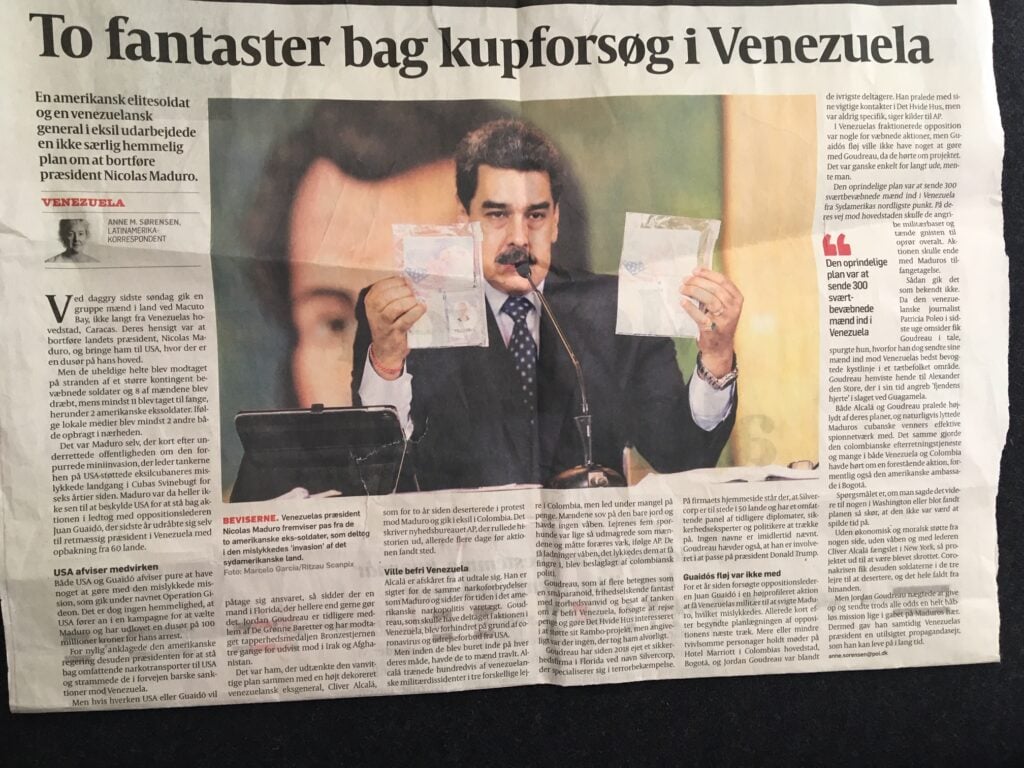
Politikens parodi på perspektivrig udlandsdækning

Artiklen i Politiken den 9. maj 2020.

Dette er en analyse af denne artikel fra Politiken den 9. maj 2020, som er skrevet af Latinamerika-korrespondent Anne M. Sørensen: ”To fantaster bag kupforsøg i Venezuela” (artiklen har en anden overskrift online end på papir):

Artiklen i Politiken handler om Venezuela, men min analyse tager udgangspunkt i en artikel om Venezuela blot for at illustrere, hvordan medierne dækker udlandsstof fra et land som Venezuela, vi ikke længere hører så meget om. Hvilke ord og betegnelser anvendes i dækningen? Formår et medie som Politiken at perspektivere nyheder om Venezuela, så de bliver væsentlige og sat i en dansk indenrigspolitiks kontekst?

Og formår artiklen at være kritisk overfor egne magthavere, som for et år siden var dybt interesseret og involveret i Venezuela?

Min analyse kan forhåbentlig bidrage til en større bevidsthed om, hvordan de danske medier dækker udlandsstoffet og ikke altid formår at levere objektiv, perspektivrig og kritisk journalistik.

For godt to år siden var, tro det eller ej, manges øjne internationalt rettet mod Venezuela. Præsident Nicolas Maduro genvandt den 20. maj 2018 retten til at fortsætte som Venezuelas præsident i en seksårig periode i et omdiskuteret demokratisk valg, som fik oppositionen i landet til at komme med anklager om valgfusk.

Samtidig var dele af befolkningen i Venezuela stærkt utilfredse med Maduro blandt andet på grund af landets fattigdom og dermed mangel på mad og medicin.

Derfor sad Maduro løst i sadlen, da en række lande i starten af 2019 for alvor satte spørgsmålstegn ved, om valget var foregået retmæssigt.

I spidsen for de 54-60 lande, der var modstandere af Maduro som præsident, var USA, og heriblandt var også Danmark og den tidligere regering med Anders Samuelsen som udenrigsminister.

Sammen med amerikanerne stillede vi krav om, at et nyvalg skulle finde sted og indtil da, erklærede vi oppositionslederen Juan Guaidó som Venezuelas retmæssige præsident. Danmarks officielle holdning var altså at støtte Juan Guaidó som Venezuelas præsident.

Selv har jeg ingen umiddelbar holdning til, om Maduro, Guaidó eller en tredje person bør være Venezuelas præsident. Men Venezuela bliver interessant, når den danske stat pludselig begynder at have en holdning til, hvem der retmæssigt skal lede et andet land.

Pludselig retter danske politikere opmærksomheden intenst på ét bestemt land og udtrykker omsorg og sympati for de civile – og dernæst følger medierne med.

På nærmest mirakuløs vis er det indtil videre lykkes Maduro at blive siddende som Venezuelas præsident, og faren så umiddelbart ud til at være drevet over sammen med de mange landes sympati for den civile befolkning i Venezuela.

USA har dog ikke opgivet at redde de civile fra Maduro og har, som over for så mange andre civile befolkninger i de lande, de vil hjælpe, indført hårde økonomiske sanktioner. Det har man fx set i Irak, og det ser man blandt andet lige nu i Iran.

Økonomiske sanktioner går altid hårdest udover de svageste og fattigste borgere, da de ikke længere har samme adgang til samme mængde mad og medicin. Det viser en rapport fra april 2019 forfattet af CEPR (Center for Economic and Policy Research), af co-director for CEPR Mark Weisbrot, og professor i økonomi, forfatter og direktør for Centret for Bæredygtig Udvikling ved Columbia University Jeffrey D. Sachs.

I rapporten definerer de sanktioner som “collective punishment of the civilian population” og beregner at sanktionerne mod Venezuela har kostet mere end 40.000 mennesker livet i landet fra 2017-2018.

Selvom det altså var de mennesker, som USA og Danmark ønskede at redde fra Maduro.

I den senere tid har USA igen intensiveret sit forsøg på at få Maduro afsat. Den 26. marts kunne man læse, at USA udlovede en dusør på Maduros hoved på 15 millioner dollars, fordi Trump mener, at han er ansvarlig for salg af narkotika i USA.

For at komme det til livs og for at redde Venezuelas befolkning, flyttede Trump den 1. april 2020 amerikanske hangarskibe til Venezuelas kyst.

Og så den 3. maj 2020 blev to mænd taget til fange udenfor Venezuelas kyst. Maduro hævder at have bevis for, at de to mænd var på en mission for at udføre et statskup med opbakning fra USA for at afsætte ham som præsident.

Historien om Venezuela har både i en global og dansk kontekst nogle væsentlige perspektiver, som danske medier og journalister kunne vælge at vise interesse for at undersøge.

Jeg vil nu illustrere med et eksempel i Politiken søndag den 10. maj 2020, som indeholdt mange grundige, perspektivrige artikler om kommissionen om Støjbergs instruks, ensomhed og ny forskning i Kina – hvorimod den ellers høje journalistiske standard ikke så ud til at gælde dækningen af Venezuela.

Fangede fantaster, mener Politiken

Historien om det angivelige kupforsøg af to tilfangetagne mænd i Venezuela breakede i udlandet den 3. maj og var at finde på dr.dk dagen efter, men det tog en hel uge, før den historie blev rapporteret af Latinamerika-korrespondent Anne M. Sørensen i Politiken.

Da jeg læste artiklen blev jeg overrasket over, at man i Politiken ikke evnede at perspektivere den historie bredere i forhold til etik og moral, Danmarks udenrigspolitiske holdning til Venezuela og en generel kritisk tilgang til, hvad Venezuela kunne handle om for USA. Jeg vil herunder analysere artiklen, og hvordan jeg mener, at Politiken i sin artikel kunne have gjort det anderledes.

Først er det vigtigt at slå fast, at det naturligvis er mediernes rolle at informere og oplyse om nyheder til borgerne, men det er også mediernes rolle at være kritiske og perspektivere nyheder. Artiklen handler som nævnt tidligere om, at to mænd er anholdt i Venezuela, og præsident Maduro mener, at de ville udføre et statskup støttet af USA.

Overskriften på artiklen lyder ”To fantaster bag kupforsøg i Venezuela”. De to som er anholdt bliver i overskriften præsenteret som nogle, vi umiddelbart som læsere ikke skal tillægge stor tillid. Ordet fantast er defineret i ordbogen som en ”Person hvis forestilling er i strid med virkeligheden”.

Hvilken virkelighed Politiken refererer til, og hvad der gør de to anholdte til fantaster står ikke helt klart i artiklen, men det medvirker til at vi som læsere miskrediterer de to mænds troværdighed. Det er jo ikke nogle mennesker, vi skal tag helt alvorligt, når de har forestillinger, som er i strid med virkeligheden.

Dusør på præsidents hoved er en ”kampagne”

En af de informationer, som kunne have været interessante at problematisere og perspektivere i artiklen er USA’s dusør på Maduros hoved. Politiken skriver: ”Det er dog ingen hemmelighed, at USA fører an i en kampagne for at vælte Maduro og har udlovet en dusør på 100 millioner kroner for hans arrest.”

Den dusør har at gøre med at USA anklager Maduro for narkohandel hvilket også står i artiklen, men det bliver ikke nævnt, at USA (mig bekendt) ikke har fremført nogen dokumentation for denne anklage.

Artiklen nævner heller intet om, hvorvidt det er helt normalt at udlove en dusør på et andet lands leders hoved, hvad der giver USA ret til dette, og hvilke spændinger det skaber?

Politikens manglende kritiske holdning til dusøren kommer især frem når journalisten anvender ordet ”kampagne”. Et ord som ofte bliver brugt indenfor kommunikation, reklame og branding. Men i dette her tilfælde er der ikke tale om at reklamere, men at USA ønsker Venezuelas præsident dræbt.

Så at kalde det en ”kampagne” i Politiken er måske ikke en dækkende formulering. Kunne man forestille sig, at Politiken ville kalde det for en ”kampagne” hvis nu USA havde en dusør på Mette Frederiksens hoved?

Politiken nævner i artiklen, at 60 lande inklusive Danmark bakkede op om Guaidó som præsident: ”…Juan Guaidó, der sidste år udråbte sig selv til retmæssig præsident i Venezuela med opbakning fra 60 lande…”

Det fremgår ikke, hvor korrespondenten har tallet fra, men ifølge Wikipedia støttede 54 lande og ikke 60 lande Guaidó. Artiklen glemmer desuden at nævne, at ifølge Wikipedia støttede 22 lande Maduro, 10 lande støttede Venezuelas nationalforsamling og 18 lande tilkendegav offentligt neutralitet.

Med andre ord var verdens lande splittet i spørgsmålet om Venezuela. Artiklen nævner desuden ikke hvor mange lande der støtter Guaidó som præsident i dag.

Danmarks støtte til Guaidó er glemt

Maduro har beskyldt USA og Guaidó for at stå bag kupforsøget. De to anholdte personer, som skulle være hjernerne bag kupforsøget er Jordan Goudreau, som er tidligere medlem af De Grønne Baretter (US Army Special Forces) og har været i Irak og Afghanistan for USA og den venezuelanske eksgeneral Clíver Alcalá, som deserterede i protest mod Maduro for to år siden.

Politiken skriver at: ”Gourdreau hævder også, at han er involveret i at passe på præsident Donald Trump.” Og videre ”Spørgsmålet er” som artiklen skriver til sidst, ”om man sagde det videre til nogen i Washington eller blot fandt planen så skør, at den ikke var værd at spilde tid på.”

Artiklen formulerer dermed sidst i artiklen det spørgsmål, som Politiken mener, er det mest relevante. Det spørgsmål kunne også have været, hvordan forholder Danmark sig til denne sag, hvis det viser sig, at Maduro har beviser for at Guaidó og USA støttede eller kendte til kupforsøget?

Men Politikens artikel nævner ikke, at Danmark støttede Guaidó eller at Danmark vel stadig støtter Guaidó eftersom andet ikke er meldt ud?

Hvorfor er man på Politiken ikke længere interesseret i den danske holdning? Er Politiken heller ikke længere bekymret for de civile i Venezuela?

Artiklen bliver afrundet på en måder, der er en smule besynderlig:

”Dermed gav han samtidig Venezuelas præsident en utilsigtet propagandasejr, som han kan leve på i lang tid.”

For mig at se overskrider journalisten sin rolle som objektiv formidler her og vælger i stedet at lægge sin egen holdning ned over sagen. Hvad ordet ”propagandasejr” dækker over ved heller ikke ordbogen, men ordet propaganda dækker over: ”Information, ofte usand eller ensidig, som udspredes for at påvirke andre til at tænke, mene, føle eller gøre noget bestemt”.

Så hvis Maduro har fået en ”propagandasejr”, kunne det være, at han har spredt usandheder eller ensidig information, som har fået befolkningen til at tænke noget bestemt. Det er bestemt muligt, men hvordan Politikens journalist kommer frem til den konklusion i sin bestræbelse på objektiv formidling fremgår ikke af artiklen.

Tværtimod virker det som om sagen ikke er mulig at konkludere noget om endnu, men hvorvidt Venezuelas præsident har anvendt det som propaganda – og han derpå har sejret – må stå for korrespondentens egen regning.

Uambitiøs dækning af udlandsstoffet  

Politiken er bestemt en hæderlig avis og havde i søndagsavisen den 10. maj 2020 et hav af gode artikler, men når det kommer til udenrigsstoffet klarer man – ligesom mange andre danske medier – ikke at holde samme niveau.

Den kritiske sans er væk, refleksion og principielle perspektiver bliver ikke tænkt ind, og man evner end ikke at perspektivere det til en dansk kontekst, og dermed være kritisk overfor magten i Danmark.

Medierne skal turde konfrontere magten og tag udenrigspolitik mere alvorligt, også selvom vores fælles opmærksomhed lige nu er rettet mod COVID19. Det kræver både uddannelse, hukommelse og en portion kritisk refleksion og bevidsthed om sin rolle.

Det har medierne i Danmark mindre af, når det drejer sig om udenrigspolitik. Jeg har tidligere skrevet om Dagbladet Informations lettere dovne dækning af Venezuela, fordi eksemplet Venezuela meget godt illustrerer at medierne ikke lever helt op til deres vigtige samfundsrolle i deres internationale dækning.

Som jeg skrev på Twitter efter at have læst artiklen i Politiken:

”En grund til at jeg er betænkelig ved at betale for en avis er denne lidt for simple dækning af internationalt stof, som man her at Politiken vælger.”

Alternativet for os som borgere er, at vi konstruktivt kritiserer medierne, så de måske gør sig mere umage næste gang.

Det har jeg – efter bedste evne – forsøgt her.

Du er velkommen til at sende dette indlæg til Politiken, hvis du synes, at de skriver en masse gode artikler, men på udenrigsstoffet bør stramme sig an.

Politikens kontaktoplysninger: Udland@pol.dk

Note
Denne analyse af Politikens artikel tager ikke stilling til situationen i Venezuela, andre landes holdning til Venezuela eller hvordan sagen har udviklet sig sidenhen. Analysen forsøger i stedet at udøve mediekritik og bidrage til en kritisk, saglig og konstruktiv offentlig debat om Danmarks udenrigspolitik og international politik generelt. Og dét med håbet om at det kan bidrage til en fredeligere verden.

Related Posts

Below are TFF-related media mentions, comments, videos and social media posts published elsewhere but not on this homepage. We happen to catch and list only a fraction. Regarding video comments and debates, we recommend that you go to the TFF Video Channel on Substack where many of them are reproduced. Jan Oberg is a contributor to China Daily – 52 million daily clicks – and Global Times, CGTN and CCTV (the national television), China Investment, Xinhua News Agency and several others. Articles and videos on these media very often multiply into countless Chinese (and Western media) that re-post them from these main media. Thanks to The China Academy, his analyses, interviews and comments are frequently posted on YouTube channels such as Thinkers Forum and Wave Media. These videos are often re-posted on Bilibili (China’s YouTube), the China Content Center on TikTok, and on the Chinese edition of TikTok, Douyin.com. This means reaching hundreds of millions of viewers worldwide over a year. While there are too many to catch on all these...
Jan Oberg TFF director October 13, 2026 According to Alfred Nobel’s will, the Nobel Peace Prize shall be awarded: ”to the person who has done the most or best to advance fellowship among nations, the abolition or reduction of standing armies, and the establishment and promotion of peace congresses.” Further down, he also expresses how the prize for the “champions of peace” shall be decided: “that for champions of peace by a committee of five persons to be selected by the Norwegian Storting. Alfred Nobel’s will is remarkably short and clear. But few seem to have read it. Nobel did not say that the committee itself should consist of members of parliament. He entrusted the Storting with appointing five persons. In principle, it could have selected diplomats, mediators, peace researchers, conflict-resolution specialists, or other individuals with recognised expertise in matters of peace from around the world. Instead, the Storting gradually...
The Quest for Humane Survival Richard Falk Professor emeritus, Princeton UniversityTFF Associate since 1986October 12, 2026 After decades of teaching and writing about international law in academic frameworks that were not institutionally situated within law school environments—at Princeton and the University of California, Santa Barbara—I found myself most receptive to the TWAIL outlook. It has been especially illuminating in clarifying the extent to which international law evolved as a dialogical critique of Europe’s efforts to legitimize its colonial undertakings. In particular, TWAIL has exposed how international law has functioned to legalize the subjugation of Third World peoples, securing conditions for exploitative investment and trade relations, the coercive enforcement of public debts, and an ideology of cultural superiority. TWAIL’s exposure of these economic legacies of colonialism has influenced my understanding of the history and development of international law, broadly conceived, as an ideological project of the Western sub-system of the world...

Recent Articles

Below are TFF-related media mentions, comments, videos and social media posts published elsewhere but not on this homepage. We happen to catch and list only a fraction. Regarding video comments and debates, we recommend that you go to the TFF Video Channel on Substack where many of them are reproduced. Jan Oberg is a contributor to China Daily – 52 million daily clicks – and Global Times, CGTN and CCTV (the national television), China Investment, Xinhua News Agency and several others. Articles and videos on these media very often multiply into countless Chinese (and Western media) that re-post them from these main media. Thanks to The China Academy, his analyses, interviews and comments are frequently posted on YouTube channels such as Thinkers Forum and Wave Media. These videos are often re-posted on Bilibili (China’s YouTube), the China Content Center on TikTok, and on the Chinese edition of TikTok, Douyin.com. This means reaching hundreds of millions of viewers worldwide over a year. While there are too many to catch on all these...
Jan Oberg TFF director October 13, 2026 According to Alfred Nobel’s will, the Nobel Peace Prize shall be awarded: ”to the person who has done the most or best to advance fellowship among nations, the abolition or reduction of standing armies, and the establishment and promotion of peace congresses.” Further down, he also expresses how the prize for the “champions of peace” shall be decided: “that for champions of peace by a committee of five persons to be selected by the Norwegian Storting. Alfred Nobel’s will is remarkably short and clear. But few seem to have read it. Nobel did not say that the committee itself should consist of members of parliament. He entrusted the Storting with appointing five persons. In principle, it could have selected diplomats, mediators, peace researchers, conflict-resolution specialists, or other individuals with recognised expertise in matters of peace from around the world. Instead, the Storting gradually...
The Quest for Humane Survival Richard Falk Professor emeritus, Princeton UniversityTFF Associate since 1986October 12, 2026 After decades of teaching and writing about international law in academic frameworks that were not institutionally situated within law school environments—at Princeton and the University of California, Santa Barbara—I found myself most receptive to the TWAIL outlook. It has been especially illuminating in clarifying the extent to which international law evolved as a dialogical critique of Europe’s efforts to legitimize its colonial undertakings. In particular, TWAIL has exposed how international law has functioned to legalize the subjugation of Third World peoples, securing conditions for exploitative investment and trade relations, the coercive enforcement of public debts, and an ideology of cultural superiority. TWAIL’s exposure of these economic legacies of colonialism has influenced my understanding of the history and development of international law, broadly conceived, as an ideological project of the Western sub-system of the world...

TFF on Substack

Discover and subscribe to more peace materials on TFF Substack

Most Popular

Below are TFF-related media mentions, comments, videos and social media posts published elsewhere but not on this homepage. We happen to catch and list only a fraction. Regarding video comments and debates, we recommend that you go to the TFF Video Channel on Substack where many of them are reproduced. Jan Oberg is a contributor to China Daily – 52 million daily clicks – and Global Times, CGTN and CCTV (the national television), China Investment, Xinhua News Agency and several others. Articles and videos on these media very often multiply into countless Chinese (and Western media) that re-post them from these main media. Thanks to The China Academy, his analyses, interviews and comments are frequently posted on YouTube channels such as Thinkers Forum and Wave Media. These videos are often re-posted on Bilibili (China’s YouTube), the China Content Center on TikTok, and on the Chinese edition of TikTok, Douyin.com. This means reaching hundreds of millions of viewers worldwide over a year. While there are too many to catch on all these...
Jan Oberg TFF director October 13, 2026 According to Alfred Nobel’s will, the Nobel Peace Prize shall be awarded: ”to the person who has done the most or best to advance fellowship among nations, the abolition or reduction of standing armies, and the establishment and promotion of peace congresses.” Further down, he also expresses how the prize for the “champions of peace” shall be decided: “that for champions of peace by a committee of five persons to be selected by the Norwegian Storting. Alfred Nobel’s will is remarkably short and clear. But few seem to have read it. Nobel did not say that the committee itself should consist of members of parliament. He entrusted the Storting with appointing five persons. In principle, it could have selected diplomats, mediators, peace researchers, conflict-resolution specialists, or other individuals with recognised expertise in matters of peace from around the world. Instead, the Storting gradually...
The Quest for Humane Survival Richard Falk Professor emeritus, Princeton UniversityTFF Associate since 1986October 12, 2026 After decades of teaching and writing about international law in academic frameworks that were not institutionally situated within law school environments—at Princeton and the University of California, Santa Barbara—I found myself most receptive to the TWAIL outlook. It has been especially illuminating in clarifying the extent to which international law evolved as a dialogical critique of Europe’s efforts to legitimize its colonial undertakings. In particular, TWAIL has exposed how international law has functioned to legalize the subjugation of Third World peoples, securing conditions for exploitative investment and trade relations, the coercive enforcement of public debts, and an ideology of cultural superiority. TWAIL’s exposure of these economic legacies of colonialism has influenced my understanding of the history and development of international law, broadly conceived, as an ideological project of the Western sub-system of the world...
Read More
girl-5894831_1280
Below are TFF-related media mentions, comments, videos and social media posts published elsewhere but not on this homepage. We happen to catch and list only a fraction. Regarding video comments and debates, we recommend that you go to the TFF Video Channel on Substack where many of them are reproduced. Jan Oberg is a contributor to China Daily – 52 million daily clicks – and Global Times, CGTN and CCTV (the national television), China Investment, Xinhua News Agency and several others. Articles and videos on these media very often multiply into countless Chinese (and Western media) that re-post them from these main media. Thanks to The China Academy, his analyses, interviews and comments are frequently posted on YouTube channels such as Thinkers Forum and Wave Media. These videos are often re-posted on Bilibili (China’s YouTube), the China Content Center on TikTok, and on the Chinese edition of TikTok, Douyin.com. This means reaching hundreds of millions of viewers worldwide over a year. While there are too many to catch on all these...
Nobel-Prize-Plaque
Jan Oberg TFF director October 13, 2026 According to Alfred Nobel’s will, the Nobel Peace Prize shall be awarded: ”to the person who has done the most or best to advance fellowship among nations, the abolition or reduction of standing armies, and the establishment and promotion of peace congresses.” Further down, he also expresses how the prize for the “champions of peace” shall be decided: “that for champions of peace by a committee of five persons to be selected by the Norwegian Storting. Alfred Nobel’s will is remarkably short and clear. But few seem to have read it. Nobel did not say that the committee itself should consist of members of parliament. He entrusted the Storting with appointing five persons. In principle, it could have selected diplomats, mediators, peace researchers, conflict-resolution specialists, or other individuals with recognised expertise in matters of peace from around the world. Instead, the Storting gradually...
law-419057_1280
The Quest for Humane Survival Richard Falk Professor emeritus, Princeton UniversityTFF Associate since 1986October 12, 2026 After decades of teaching and writing about international law in academic frameworks that were not institutionally situated within law school environments—at Princeton and the University of California, Santa Barbara—I found myself most receptive to the TWAIL outlook. It has been especially illuminating in clarifying the extent to which international law evolved as a dialogical critique of Europe’s efforts to legitimize its colonial undertakings. In particular, TWAIL has exposed how international law has functioned to legalize the subjugation of Third World peoples, securing conditions for exploitative investment and trade relations, the coercive enforcement of public debts, and an ideology of cultural superiority. TWAIL’s exposure of these economic legacies of colonialism has influenced my understanding of the history and development of international law, broadly conceived, as an ideological project of the Western sub-system of the world...
images-2
Advocates of nuclear disarmament are regularly dismissed by the champions of nuclear deterrence as naïve and unrealistic, utopian or even irresponsible. Yet this ‘doctrine’ of deterrence, regarded by France as the ‘cornerstone’ of its national security, is based on quasi-religious beliefs, a theory that cannot be proven, risky gambles and fragile assumptions. So much so that one might legitimately ask which side the ‘Care Bears’ are on. Marc FinaudVice-President of Initiatives for Nuclear Disarmament (IDN) October 9, 2026 This article was originally published on Pressenza When it comes to these things being treated as religious concepts, look here. Idealists and realists It was Hubert Védrine, François Mitterrand’s former Foreign Minister, who repeatedly coined the phrase: ‘Europeans are a sort of Care Bears who don’t realise they’re living in Jurassic Park’. He applies this reference to the cartoon for well-behaved children not only to what he regards as weakness or idealism...
8824b09f-33a5-43f9-9fd0-550f28cda24d_1536x1024
What the West Borrowed from Asia and What It Left Behind Jan Krikke October 8, 2026 The article was originally published here In the late 1960s, the musical Hair announced that the Age of Aquarius was dawning. Its opening anthem promised a transformation of human consciousness: an era of peace, harmony and understanding. Half a century later, a familiar echo of that promise is a meditation app offered by your employer. You can find it in the same list of benefits as the pension plan and the gym discount. How did a spiritual revolution become an employee benefit? The answer lies in the history of the movement known as New Age: where it came from, what it borrowed from Asia, and why the meaning of what it borrowed changed in the process. Two definitions will help. New Age is a loose label for a wide range of spiritual practices and...
Screenshot 2026-10-04 210142
Small and different + among the 10% most active + 9,000 texts + 150 Associates + 60 000 a day — and a stubborn belief that peace is smarter and must be secured by peaceful means. In 2026, the Transnational Foundation for Peace and Future Research (TFF) turns 40. On Monday, October 5, 2026, a new TFF homepage will go live — a new gateway to more than 9,000 articles, analyses, research papers and other contributions produced over four decades of independent peace research. But this is not simply a new website. For four decades, TFF has worked from a simple conviction: peace is smarter than militarism and can be brought about by peaceful means. This is not merely an aspiration. It is the principle expressed in the UN Charter and the Gandhian tradition that has guided our work from the beginning. TFF is a research-based, independent and people-financed foundation....




