
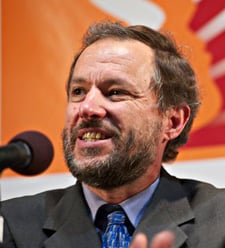
One of the world’s leading peace advocates threatened to punch me in the face

Gareth Evans, a former attorney-general and foreign minister in Australia, threatened me because I raised the issue of his support for the Suharto dictatorship in Indonesia.

I have rarely ever come face to face – only inches in fact – with such anger. Certainly not at an academic conference. And certainly not from such a prominent figure: chancellor of Australian National University, former attorney-general and foreign minister, former head of the International Crisis Group, and one of the world’s most prominent global thinkers.

Yet here I was with Gareth Evans, cursing at me, ripping my badge off, and threatening to punch me in the face.

What prompted his outburst was my raising the issue of his support for the Suharto dictatorship in Indonesia during its savage repression in the occupied island nation of East Timor. Since the March 17 conference at the University of Melbourne – at which I, like Evans, was a plenary speaker – was about the first anniversary of the Arab revolts, the organizers came to his defense by insisting that I had raised an issue that was off-topic. In reality, it was very relevant.

Gareth Evans is perhaps best known internationally as the world’s principal intellectual architect and proponent of the doctrine of the “Responsibility to Protect” (R2P), which calls for Western military intervention in crisis areas to prevent massacres of civilians. He was particularly outspoken in his support for what he referred to as “the overwhelming moral case” for the controversial NATO military intervention in Libya, which went well beyond the original mandate to protect civilians to effectively become the air force of the rebel coalition. Evans has insisted that his advocacy for the intervention was unrelated to oil or to Gaddafi’s traditional hostility to Western interest, but out of purely humanitarian concern.

At the time Evans began advocating for foreign intervention in Libya, less than 300 civilians had been killed by Gaddafi’s forces. However, as foreign minister, Evans supported close security cooperation with the Indonesian military during its brutal occupation of East Timor, in which over 200,000 civilians died. Furthermore, Evans denied, downplayed and covered up for a number of Indonesian atrocities and, during this time in office, was the only foreign minister in the world to formally recognize Indonesian sovereignty over that illegally occupied territory.

Evans’ blatant hypocrisy is now being used by opponents of R2P – including apologists for Gaddafi, Assad, and other tyrants – to back their contention that R2P is not an example of benign liberal internationalism, but simply an excuse for imperialist intervention.

The Incident

During the opening plenary of the conference when both Evans and I were in the audience, I thought it appropriate to ask an Egyptian speaker – who had expressed his disappointment at continued Western support for the military junta in Egypt – about perceptions in his country of Western double-standards. I prefaced my question by noting how the American and British governments were opposing the repressive regime in Syria while supporting the repressive regime in Bahrain, how Washington had called for greater democracy in Egypt while arming its autocratic military rulers, and how the principal advocate for Western intervention against the Libyan regime to stop repression under the doctrine of the “responsibility to protect” had, as foreign minister of Australia, supported far greater repression by the Indonesian regime against the East Timorese.

Before I could get to the actual question, Evans shouted out, “Are you referring to me?” I answered, “Yes, actually.” “That’s crap!” he yelled. I began to explain why I thought it was a valid statement when the conference organizer asked me to proceed with my actual question, which I did.

At the end of the session and as the group in the auditorium exited for a coffee break, Evans rushed over to me and launched into his expletive-filled tirade, demanded to know who I was, ripped off my conference badge, threatened to punch me in the face, and insisted that he had in fact never supported Indonesia’s repression.

In order to diffuse a situation in which I felt physically threatened, I said, “If I misrepresented you, I apologize,” and eventually he stormed off.

In an interview about the incident with the Sydney Morning Herald two days later, he blamed me entirely for the incident, and quoting Clive of India, said, “I stand astonished at my own moderation.”

Evans’ Record

Evans claimed my assertion was “as ignorant as it was offensive.” Similarly, he later told the Sydney Morning Herald that my allegation was ”disgustingly defamatory.”

However, the record shows otherwise.

In early 1991, despite reports by Amnesty International and other human rights groups documenting the contrary, Evans had stated that East Timor’s “human rights situation has, in our judgment, conspicuously improved, particularly under the current military arrangements.” When Indonesian forces massacred 430 civilians at a funeral in the capital of Dili nine months later, Evans falsely described the mass killings as simply “an aberration, not an act of state policy.” In the face of international outrage at an Indonesian “investigation” of the tragedy which blamed the massacres on the nonviolent protesters, Evans claimed there was “no case to be supremely critical” of the regime. He insisted that the Indonesian dictatorship had “responded in a reasonable and credible way” and argued that “essentially punitive responses from the international community are not appropriate” (a very different perspective than he would later take toward non-ally Libya).

Evans was also a strong advocate of close Australian security cooperation with the Indonesian dictatorship despite its widespread mass killings of civilians, even though Evans later admitted that “many of our earlier training efforts helped only to produce more professional human rights abusers.” During the period in which Evans was foreign minister, Australia engaged in more military exercises with Indonesia than with any other country.

Perhaps Evans’ most notorious role as foreign minister was in his signing of the Timor Gap Treaty with his Indonesian counterpart in 1989, which gave Australia access to oil and gas reserves in the territorial waters of occupied East Timor. This “historically unique” agreement, in Evans’ words, came despite provisions in international law forbidding the exploitation of natural resources in occupied territories which fail to benefit the country’s inhabitants. Rutgers University professor Roger Clark, one of the world’s foremost authorities on international law, referred to the agreement as “the same as acquiring stuff from a thief. The fact is that they have neither historical, nor legal, nor moral claim to East Timor and its resources.”

In order to sign the treaty, Australia became the only country in the world to formally recognize Indonesia’s illegal annexation of the territory, in direct contravention of basic international legal statutes forbidding the expansion of any country’s territory by force and the legal principle than non-self-governing territories be granted the right of self-determination.

Despite no less than three UN Security Council resolutions demanding East Timor’s right to independence and an eventually successful worldwide campaign to end the occupation, Evans insisted that the Indonesian conquest was “irreversible” and declared “the sovereignty issue as effectively closed.” A few years later, when his Labour Party was in opposition, he worked hard to weaken a proposed plank in the party platform supporting an end of the occupation and the right of the East Timorese for self-determination. When Indonesia eventually conceded to international pressure to live up to its international legal obligations and offer independence to East Timor in 1999, Evans referred to it as “a fit of pique.”

Since East Timor finally became independent, much has come to light regarding the extent of the regime’s genocidal campaign against the people of that island nation, which lost one-third of its population in the course of the Australian-backed occupation. Yet Evans insists to this day that “the notion that we had anything to answer for morally or otherwise over the way we handled the Indonesia-East Timor relationship, I absolutely reject.”

Aftermath

Rather than come to my defense following Evans’ public outburst and threats against me, the principal organizer of the conference, Professor Shahram Akbarzadeh, faulted me for provoking Evans, asking “what else could he do?” and prevented me from explaining to the assembly the factual basis of my allegations. Similarly, the brief article in the Sydney Morning Herald regarding the incident appeared to put most of the blame on me.

Australians, then, appear to be as much in denial of their political leaders’ complicity in war crimes as are my fellow Americans. (Indeed, the U.S. role in supporting Indonesia’s occupation is as sordid as that of Australia.) And they appear to be just as contemptuous of those of us who have the temerity to expose them.

The irony is that I deeply respect much of Evans’ work, particularly those addressing peace and disarmament issues. I was so impressed with his book on the United Nations, I assigned it as a required text in some of my courses in the 1990s. However, his failure to come to terms with his shameful role in East Timor will forever be an albatross around his neck.

Evans certainly is not alone regarding his moral culpability for the horror of the Indonesian occupation. Indeed, quite a number of other prominent Australian political leaders – as well as American political leaders, including Henry Kissinger and Richard Holbrooke – have much to answer for as well. However, none have won such widespread accolades, honors, awards, and recognition as a liberal internationalist and peace advocate as Gareth Evans. Perhaps it’s not surprising, then, he could get worked up into such a fit at someone publicly challenging such a positive image.

In many ways, Evans’ attack on me is but an extreme example of the contempt that Western governments and their supporters have for scholars, human rights activists, and others who raise critical questions regarding their support for occupying powers that engage in gross violations of international humanitarian law, be they Indonesia, Morocco or Israel. However, we must never succumb to such intimidation by those who seek to undermine the post-WWII international legal order and deny or justify the slaughter of innocents.

It was the tireless efforts of Australian human rights activists – along with their counterparts in the United States, Great Britain, Canada, and elsewhere – who eventually shamed their governments into ending their support for Indonesia’s occupation and helped set East Timor free. However, if we do not also hold our politicians accountable for their collusion in such tragedies, there will be little to stop them from doing so again.

Published by Alternet, April 5, 2012
Related Posts

Lena Petrova of “World Affairs In Context” with more than half a million subscribers on YouTube wanted to explore what a peace researcher like me has to say about, among other things, the First and the Second Cold War and why eethics has disappeared from politics. I am particularly happy about this conversation that also yielded an amazing number of very appreciative comments on YouTube. No doubt, people are longing for alternatives, including peace perspectives.
This is not another geopolitical commentary on the Arctic. It is a visionary peace proposal that can save the region from militarised rivalry and ecological ruin. A blueprint for shared security, sustainable development, and human dignity — benefitting Greenland, the Arctic, and the rest of us. Jan Oberg TFF director Lund, Sweden, February 17, 2026 I. Four Principles for a New Arctic Vision The Arctic is often framed as a cold arena of rivalry — a place where great powers test each other’s resolve. But this worldview is outdated, unimaginative, and ultimately self‑defeating. The Arctic is not a vacuum waiting to be militarised; it is a living region, a climate stabiliser, and a cultural homeland whose future will shape the future of humanity. If we begin from that understanding, a far more rational Arctic order becomes possible — one that is peaceful, cooperative, and centred on the people who actually live there. This vision rests...
Photos © TFF 2000 Read PressInfo 90 “Lift the Sanctions and Bring More Aid to Yugoslavia” See Pictures from Belgrade © TFF 2000 Please reprint, copy, archive, quote or re-post this item, but please retain the source.

Recent Articles

Tony Robinson October 4, 2026 Violence is easy to recognise when someone is being beaten, shot or killed. It becomes more difficult when nobody is holding a weapon. Poverty, discrimination, exploitation and repression can restrict a human life just as effectively, although they do so in very different ways and with very different consequences. Simply adding more categories to an ever-growing list of forms of violence does not really solve the problem. The more interesting question is what all these different situations have in common and why it makes sense to describe them using the same word. Human beings do not simply react to what happens around them. They remember the past, imagine things that do not yet exist, make plans and undertake projects. Workers organise because they imagine different working conditions; people migrate because they imagine another life somewhere else; social movements emerge because people refuse to accept the...
It’s a matter of principles, courage, vision and pulling together – while the militarist world is falling apart… Peter Langille October 3, 2026 “Here, then, is the problem which we present to you, stark and dreadful and inescapable: Shall we put an end to the human race; or shall mankind renounce war?”The Bertrand Russell—Albert Einstein Manifesto, July 9, 1955 ⁕ The forecast for what’s ahead is worrisome. The sharp rise in armed conflicts over the past three years is adding to what was already the highest level in over seventy years. Genocides, which should be prevented are supported. A shared climate emergency that jeopardises survival is ignored. Diverse polls now suggest that people are war-weary, worried and interested in a more effective United Nations. And, there are viable policy options for a more secure world! Yet governments are doubling-down, betting on more war and investing heavily. If current trends persist,...
Johan Galtung 1930-2024October 2015 Published here on October 3, 2026 Let us focus on Civilization for conflict analysis and remedies. Major forms of disorder use violence; war is state organized violence. The most belligerent states are the United States of America and Israel, both with civilization roots. National Evangelism, the US Protestant Christian civilization– more national than evangelical–justifies US warfare as exceptionalism of a people chosen by God, with a manifest destiny to run the world. Orthodox Judaism justifies Israeli warfare to conquer and expand from Nile to Euphrates as a religious right and duty to the Eternal One. The third most belligerent country, the UK, no longer believes it is God-chosen but chosen by the USA; not quite the same but something. But the root cause of global disorder lies in the Occident–with Islam–seeing itself as the single, universal civilization valid for all at all times, all others being...

TFF on Substack

Discover and subscribe to more peace materials on TFF Substack

Most Popular

Tony Robinson October 4, 2026 Violence is easy to recognise when someone is being beaten, shot or killed. It becomes more difficult when nobody is holding a weapon. Poverty, discrimination, exploitation and repression can restrict a human life just as effectively, although they do so in very different ways and with very different consequences. Simply adding more categories to an ever-growing list of forms of violence does not really solve the problem. The more interesting question is what all these different situations have in common and why it makes sense to describe them using the same word. Human beings do not simply react to what happens around them. They remember the past, imagine things that do not yet exist, make plans and undertake projects. Workers organise because they imagine different working conditions; people migrate because they imagine another life somewhere else; social movements emerge because people refuse to accept the...
It’s a matter of principles, courage, vision and pulling together – while the militarist world is falling apart… Peter Langille October 3, 2026 “Here, then, is the problem which we present to you, stark and dreadful and inescapable: Shall we put an end to the human race; or shall mankind renounce war?”The Bertrand Russell—Albert Einstein Manifesto, July 9, 1955 ⁕ The forecast for what’s ahead is worrisome. The sharp rise in armed conflicts over the past three years is adding to what was already the highest level in over seventy years. Genocides, which should be prevented are supported. A shared climate emergency that jeopardises survival is ignored. Diverse polls now suggest that people are war-weary, worried and interested in a more effective United Nations. And, there are viable policy options for a more secure world! Yet governments are doubling-down, betting on more war and investing heavily. If current trends persist,...
Johan Galtung 1930-2024October 2015 Published here on October 3, 2026 Let us focus on Civilization for conflict analysis and remedies. Major forms of disorder use violence; war is state organized violence. The most belligerent states are the United States of America and Israel, both with civilization roots. National Evangelism, the US Protestant Christian civilization– more national than evangelical–justifies US warfare as exceptionalism of a people chosen by God, with a manifest destiny to run the world. Orthodox Judaism justifies Israeli warfare to conquer and expand from Nile to Euphrates as a religious right and duty to the Eternal One. The third most belligerent country, the UK, no longer believes it is God-chosen but chosen by the USA; not quite the same but something. But the root cause of global disorder lies in the Occident–with Islam–seeing itself as the single, universal civilization valid for all at all times, all others being...
Read More
Living-Peace-Sign-Budapest-copy
Tony Robinson October 4, 2026 Violence is easy to recognise when someone is being beaten, shot or killed. It becomes more difficult when nobody is holding a weapon. Poverty, discrimination, exploitation and repression can restrict a human life just as effectively, although they do so in very different ways and with very different consequences. Simply adding more categories to an ever-growing list of forms of violence does not really solve the problem. The more interesting question is what all these different situations have in common and why it makes sense to describe them using the same word. Human beings do not simply react to what happens around them. They remember the past, imagine things that do not yet exist, make plans and undertake projects. Workers organise because they imagine different working conditions; people migrate because they imagine another life somewhere else; social movements emerge because people refuse to accept the...
b54a1f10-8c65-4f0b-9dd5-4abc0a7d04cc_2659x2659
It’s a matter of principles, courage, vision and pulling together – while the militarist world is falling apart… Peter Langille October 3, 2026 “Here, then, is the problem which we present to you, stark and dreadful and inescapable: Shall we put an end to the human race; or shall mankind renounce war?”The Bertrand Russell—Albert Einstein Manifesto, July 9, 1955 ⁕ The forecast for what’s ahead is worrisome. The sharp rise in armed conflicts over the past three years is adding to what was already the highest level in over seventy years. Genocides, which should be prevented are supported. A shared climate emergency that jeopardises survival is ignored. Diverse polls now suggest that people are war-weary, worried and interested in a more effective United Nations. And, there are viable policy options for a more secure world! Yet governments are doubling-down, betting on more war and investing heavily. If current trends persist,...
010
Johan Galtung 1930-2024October 2015 Published here on October 3, 2026 Let us focus on Civilization for conflict analysis and remedies. Major forms of disorder use violence; war is state organized violence. The most belligerent states are the United States of America and Israel, both with civilization roots. National Evangelism, the US Protestant Christian civilization– more national than evangelical–justifies US warfare as exceptionalism of a people chosen by God, with a manifest destiny to run the world. Orthodox Judaism justifies Israeli warfare to conquer and expand from Nile to Euphrates as a religious right and duty to the Eternal One. The third most belligerent country, the UK, no longer believes it is God-chosen but chosen by the USA; not quite the same but something. But the root cause of global disorder lies in the Occident–with Islam–seeing itself as the single, universal civilization valid for all at all times, all others being...
Screenshot 2026-10-02 011738
Jan ObergPhD, director, The Transnational Foundation for Peace and Future Research, TFFLund, Sweden October 2, 2026 This is my full original manuscript. The Chinese Academy of Social Science, CASS, makes two publications out if it. 1. China’s Five-year plan emphasized the capabilities of basic research and original innovation. It is regarded as the goal of the future social development, which, as required, should be significantly enhanced. Can you comment on the importance of original innovation in research and academic study? I believe it is easier to define “original innovation” in the natural sciences than in social sciences. The breaking points of what constitutes something new, or innovative, are not quite as sharp in the latter. But in both fields it is about opening up something that was closed, unseen, unexplored before – making manifest what was earlier latent. Innovations come in many forms and shapes – naming something that was not...
arctic-circle-map
The agreement is catastrophic both because of what it says and what it doesn’t mention. It reduces further the major asset of security policies: Freedom of action. Jan Oberg TFF director September 25, 2026 A couple of hours before the agreement was signed on September 22, 2026, I published the following 13 hypotheses about what it would most likely contain on TFF Substack (in English). I was wrong on only the first point. Contrary to what Trump had written on his Truth Social platform, it does not appear to come into force immediately. In fact, it turned out to be worse than even I had anticipated. After these hypotheses now come a number of reflections in light of what the agreement actually contains, and does not contain, as well as the way in which it has generally been presented by major media outlets and by the public-service broadcaster DR. My...
girl-5894831_1280
Below are TFF-related media mentions, comments, videos and social media posts published elsewhere but not on this homepage. We happen to catch and list only a fraction. Regarding video comments and debates, we recommend that you go to the TFF Video Channel on Substack where many of them are reproduced. Jan Oberg is a contributor to China Daily – 52 million daily clicks – and Global Times, CGTN and CCTV (the national television), China Investment, Xinhua News Agency and several others. Articles and videos on these media very often multiply into countless Chinese (and Western media) that re-post them from these main media. Thanks to The China Academy, his analyses, interviews and comments are frequently posted on YouTube channels such as Thinkers Forum and Wave Media. These videos are often re-posted on Bilibili (China’s YouTube), the China Content Center on TikTok, and on the Chinese edition of TikTok, Douyin.com. This means reaching hundreds of millions of viewers worldwide over a year. While there are too many to catch on all these...





