
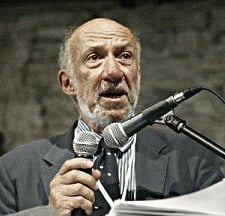
I took part last week in an illuminating conference on Syria sponsored by the new Center of Middle East Studies that is part of the Josef Korbel School of International Studies at the University of Denver. This Center has been recently established, and operates under the excellent leadership of Nader Hashemi and Danny Postel, who previously together edited the best collection of readings on the Green Revolution in Iran published under the title The People Reloaded.
The conference brought together a mixture of Syrian specialists, Syrian activists, and several of us with a more general concern about conflict in the region, as well as with human rights and as participants in the heated debates of recent years about the virtues and vices of ‘humanitarian intervention’, what is now being called ‘Responsibility to Protect’ of ‘R2P’ in UN circles and among liberals.
I came to the gathering with a rather strong disposition to present myself as a confirmed R2P skeptic, regarding it as a cynical geopolitical euphemism for what Noam Chomsky labeled as ‘military humanism’ in the context of the controversial NATO Kosovo War of 1999. Ever since the Vietnam War I have viewed all Western claims to use force in the post-colonial non-West with suspicion.
I support presumptions in favor of non-intervention and self-determination, both fundamental norms of international law. But I left the conference dissatisfied with my position that nothing more could or should be done at the international level to help end the violence in Syria or to assist the struggle of the Syrian people. I became convinced that human solidarity with the ordeal of the Syrian people was being deeply compromised by the advocacy of passivity in the face of the criminality of the Damascus government, although what to do that is genuinely helpful remains extremely difficult to discern.
In the immediate background of the debate on Syrian policy are the bad memories of stealth diplomacy used by the United States and several European partners in March 2011 to gain UN Security Council backing for the establishment of a No Fly Zone to protect the beleaguered and endangered population of the Libyan city of Benghazi. What ensued from the outset of the UN authorized mission in Libya was a blatant disregard of the limited mandate to protect the population of a city from a threatened massacre.
In its place, the NATO undertaking embarked on a concerted regime-changing NATO mission that ended with the unseemly execution of the Libyan dictator. What NATO purported to do was not only oblivious to Libya’s sovereignty, it was unmistakably a deliberate and dramatic extension of the authorized mission that understandably infuriated the autocrats in Moscow. A case could certainly have been made that in order to protect the Libyan people it was necessary to rid the country of the Qaddafi regime, but such an argument was never developed in the Security Council debate, and would never have been accepted.
Against such a background, the wide gap between what was approved by the UN Security Council vote and what was done in breach of the mandate was perceived as a betrayal of trust in the setting of the Security Council, particularly by those five governments opposed to issuing a broader writ for the intervention, governments that had been deceptively induced to abstain on the ground that the UN authorization of force was limited to a single one-off protective, emergency mission.
Global diplomacy being what it is and was, there should be no surprise, and certainly no condescending self-righteous lectures delivered by Western diplomats, in reaction to the rejectionist postures adopted by Russia and China throughout the Syrian crisis.
Of course, two wrongs hardly ever make a right, and do not here. NATO’s flagrant abuse of the UN mandate for Libya should certainly not be redressed at the expense of the Syrian people. In this respect, it is lamentable that those who shape policy in Moscow and Beijing are displaying indifference to the severity of massive crimes of humanity, principally perpetrated by the Assad government, as well as to the catastrophic national and regional effects of a continuing large-scale civil war in Syria.
The unfolding Syrian tragedy, already resulting in more than 60,000 confirmed deaths, one million refugees, as many as 3 million internally displaced, a raging famine and daily hardships and hazards for most of the population, and widespread urban devastation, seems almost certain to continue in coming months.
There exists even a distinct possibility of an intensification of violence as a deciding battle for control of Damascus gets underway in a major way. Minimally responsible behavior by every leading governments at the UN would under such circumstances entail at the very least a shared and credible willingness to forego geopolitical posturing, and exert all possible pressure to bring the violence to an end.
Some suggest that an effect of this geopolitical gridlock at the UN is causing many Syrians to sacrifice their lives and put the very existence of their country in jeopardy. This kind of ‘compensation’ for NATO’s ultra virus behavior in Libya is morally unacceptable and politically imprudent. At the same time it is hardly reasonable to assume that the UN could have ended the Syrian strife in an appropriate way if the Security Council had been able to speak with one voice. It both overestimates the capabilities of the UN and under appreciates the complexity of the Syrian struggle.
Under these circumstances it is also diversionary to offload the frustrations associated with not being able to do anything effective to help the rebel forces win quickly or to impose a ceasefire and political process on the stubborn insistence by Russia and China that a solution for Syria must not be based on throwing Assad under the bus.
The Syrian conflict seems best interpreted as a matter of life or death not only for the ruling regime, but for the entire Alawite community (estimated to be 12% of the Syrian population of about 23 million), along with their support among Syria’s other large minorities (Christian 10%, Druze 3%), and a sizable chunk of the urban business world that fears more what is likely to follow Assad than Assad himself.
Given these conditions there is little reason to assume that a unified posture among the permanent members of the Security Council would at any stage in the violent months have had any realistic prospect of bringing the Syrian parties to drop their weapons and agree to risk a compromise.
The origins of the crossover from militant anti-regime demonstrations to armed insurgency is most convincingly traced back to the use of live ammunition by the governing authorities and the armed forces against demonstrators in the city of Daraa from March 15, 2012 onwards, resulting in several deaths. Many in the streets of Daraa were arrested, with confirmed reports of torture and summary execution, and from this point forward there has been no credible turning away from violence by either side. Kofi Annan, who resigned as Special Envoy for the UN/Arab League indicated his displeasure with both external actors, criticizing Washington for its insistence that any political transition in Syria must be preceded by the removal of Bashar al-Assad from power, a precondition that seems predicated on an insurgent victory rather than working for a negotiated solution.
Without greater diplomatic pressure from both geopolitical proxies, the war in Syria is likely to go on and on with disastrous results. There has never been a serious willingness to solve the problems of Syria by an American-led attack in the style of Iraq 2003. For one thing, an effective intervention and occupation in a country the size of Syria, especially if both sides have significant levels of support as they continue to have, would be costly in lives and resources, uncertain in its overall effects on the internal balance of forces, and involve an international commitment that might last more than a decade.
Especially in light of Western experiences in Iraq and Afghanistan, neither Washington nor Europe, has the political will to undertake such an open ended mission, especially when the perceived strategic interests are ambiguous and the political outcome is in doubt. Besides, 9/11 has receded in relevance, although still insufficiently, and the Obama foreign policy, while being far too militaristic, is much less so than during the presidency of George W. Bush.
Another approach would be to press harder for an insurgent victory by tightening sanctions on Syria or combining a weapons embargo on the regime with the supply of weapons to the opposition. This also seems difficult to pull off, and highly unlikely to bring about a positive outcome even if feasible. It is difficult to manage such an orchestration of the conflict in a manner that is effective, especially when there are strong proxy supporters on each side.
Furthermore, despite much external political encouragement, especially by Turkey, the anti-Assad forces have been unable to generate any kind of leadership that is widely acknowledged either internally or externally, nor has the opposition been able to project a shared vision of a post-Assad Syria. The opposition is clearly split between secular and Islamist orientations, and this heightens the sense of not knowing what to expect what is being called ‘the day after.’ We have no reliable way of knowing whether escalating assistance to the rebels would be effective, and if so, what sort of governing process would emerge in Syria, and to what extent it would be abusive toward those who directly and indirectly sided with the government during the struggle.
Under such circumstances seeking a ceasefire and negotiations between the parties still seems like the most sensible alternative among an array of bad options. This kind of emphasis has guided the diplomatic efforts of the UN/Arab League Special Envoys, first Kofi Annan, and now Lakhdar Brahimi, but so far producing only disillusionment. Neither side seems ready to abandon the battlefield, partly because of enmity and distrust, and partly because it still is unwilling to settle for anything less than victory.
For diplomacy to have any chance of success would appear require both sides to entertain seriously the belief that a further continuation of the struggle is more threatening than ending it. Such a point has not been reached, and is not in sight.
Despite the logic behind these failed efforts, to continue to pin hopes on this passive diplomacy under UN auspices seems problematic. It grants the governing Assad regime time and space to continue to use means at its disposal to destroy its internal enemy, relying on high technology weaponry and indiscriminate tactics on a vast scale that are killing and terrifying far more civilians than combatants. Bombarding residential neighborhoods in Syrian cities with modern aircraft and artillery makes the survival of the regime appear far more significant for the rulers than is any commitment to the security and well-being of the Syrian people and even the survival of the country as a viable whole.
It is deeply delegitimizing, and is generating a growing chorus of demands for indicting the Assad leadership for international crimes even while the civil war rages on. This criminal behavior expresses such an acute collective alienation on the part of the Damascus leadership as to forfeit the normal rights enjoyed by a territorial sovereign. These normal rights include the option of using force in accord with international humanitarian law to suppress an internal uprising or insurgency, but such rights do not extend to the commission of genocidal crimes of the sort attributable to the Assad regime in recent months.
Although it must be admitted that the picture is complicated by the realization that not all of the criminal wrongdoing is on the regime side, yet the great preponderance is. The rebel forces, to be sure, are guilty of several disturbing atrocities. This is sad and unfortunate, as well as politically confusing so far as taking sides is concerned. Overall, it adds to the victimization of the people of Syria that is reaching catastrophic proportions because it makes more difficult the mobilization of international support for concerted action.
Essentially, the world shamelessly watches the Syrian debacle in stunned silence, but it is fair to ask what could be done that is not being done?
So far no credible pro-active international scenario has emerged. There are sensible suggestions for establishing local ceasefires in the considerable areas in the countryside under the control of rebel forces, for supplying food and medical supplies to the population by means of protected ‘humanitarian corridors,’ and for taking steps to improve the woeful lot of Syrian refugees currently facing inadequate accommodations and unacceptable hardships in Lebanon and Jordan. Such steps should be taken, but are unlikely to hasten or alter outcome of the conflict. Can more be done?
I would further recommend a broad policy of support for civil society activists within Syria and outside who are dedicated to a democratic inclusive governing process that affirms human rights for all, and promises constitutional arrangements that will privilege no one ethnic or religious identity and will give priority to the protection of minorities.
There are encouraging efforts underway by networks of Syrian activists, working mainly from Washington and Istanbul, to project such a vision as a program in the form of a Freedom Charter that aspires to establish a common platform for a future beneficial for all of Syria’s people.
The odds of success for this endeavor of politics from below seem remote at present for these activist undertakings, but they deserve our support and confidence. As often is the case when normal politics are paralyzed, the only solution for a tragic encounter appears to be utopian until it somehow materializes and becomes history. This dynamic was illustrated by the benign unraveling of South African apartheid in the early 1990s against all odds, and in opposition to a consensus among experts that expected emancipation of the victims of apartheid to come, if at all, only through success in a long and bloody war.
Another initiative that could be taken, with great positive potential, but against the grain of current of Western, especially American, geopolitics, would be to take the Iran war option off the table. Such a step would almost certainly have major tension-reducing effects in relation to regional diplomacy, and would be a desirable initiative to take quite independent of the Syrian conflict.
The best way to do this would be to join with other governments in the region, including Iran, to sponsor a comprehensive security framework for the Middle East that features a nuclear weapons free zone, with an insistence that Israel join in the process.
Of course, for the United States to advocate such moves would be to shake the foundations of its unconditional endorsement of whatever Israel favors and does, and yet it would seem over time even to be of greater benefit to Israeli security than an engagement in a permanent struggle to maintain Israeli military dominance in the region while denying the right of self-determination to the Palestinian people.
If American leaders could finally bring themselves to serve the national interest of the United States by acting as if the peace and security of Israel can only be achieved if the rights of the Palestinian people under international law are finally realized it would have many likely positive effects for the Middle East and beyond. As matters now stand, the dismal situation in the region is underscored by the degree to which such prudent proposals remain in the domain of the unthinkable, and are kept outside the disciplined boundaries of ‘responsible debate.’
If the imagination of the political is limited to the ‘art of the possible’ then constructive responses to the Syrian tragedy seem all but foreclosed. Only what appears to be currently implausible has any prospect of providing the Syrian people and their nation with a hopeful future, and we need the moral fortitude to engage with what we believe is right even if we cannot demonstrate that it will prevail in the end.






